
Key Takeaways
- Word of mouth brings in your first clients. It cannot scale. Social media is the system you build to generate leads when you need them, not just when your clients happen to mention you.
- Instagram tests every Reel on a small pool of non-followers first. Your existing gym clients are not the performance signal you are optimizing for. Strangers are.
- Resharing is the top signal Instagram uses when deciding how far to distribute a Reel. Before you film, ask: who would send this, and to whom?
- The CCN framework tells you which content speaks to strangers instead of your existing audience. Most trainers post for people who already know them and wonder why reach stalls.
- The credibility bank fills up before a prospect ever decides to book. Every post is either a deposit or a withdrawal.
- Trial Reels let you test reach-oriented content with non-followers before your existing clients see it. Low-risk experimentation, real data.
- The Your Algorithm update (June 2026) means topic categorization now affects who sees your content. Generic gym content may not reach fitness-interested non-followers at all.
Why the Referral Ceiling Is Real
Referrals are a good sign. They mean your clients get results and feel good telling people about it. That is genuinely hard to earn.
But here is the problem. Referrals are not on your schedule. They happen when your clients happen to mention you to someone who is currently looking. That overlap is random. You cannot turn it up when you need new clients. You cannot turn it off when you are full.
The referral model also caps out. Eventually you exhaust your current clients’ social circles. The loop closes.
Social media is not a replacement for referrals. It is a second pipeline that runs whether or not your clients are talking about you this week. When you build it right, it puts you in front of strangers who are already looking for what you offer. Those strangers become followers. Followers become warm leads. Warm leads book calls.
That process does not start with posting more often. It starts with understanding how content actually gets in front of new people.
How Does Instagram Decide Who Sees Your Content?
Instagram does not show a new Reel to your followers first. It shows it to a small predicted audience of non-followers it thinks might like it. If that audience engages, the Reel expands to a progressively larger pool. If it does not, distribution stops there.
This is the expanding distribution model Instagram describes for creators of all sizes. It is designed to give smaller accounts a fair shot at non-follower reach without needing a large existing audience to start.
What this means practically: the people who already follow you are not the performance signal you are optimizing for. They are not the test audience. Strangers are.
A Reel your current gym clients enjoy but that does not move non-followers will not expand. A Reel a stranger finds useful enough to send to someone they know will.
Most trainers post content their existing clients enjoy. Workout check-ins. Motivational posts. Progress updates. That content serves retention. It does nothing for acquisition.
The acquisition question is different: what does someone who has never heard of you need to see right now? That is the content the algorithm tests on non-followers, and that is the content that grows your audience.
What Signal Does Instagram Weight Most Heavily for Reels?
Reshares. Instagram’s own ranking page lists how likely a viewer is to reshare a Reel as the top prediction signal, ranked ahead of watching all the way through, ahead of likes, and ahead of visiting the audio page.
Read that again.
4.5 billion videos are shared daily across Instagram and Facebook. Reshares drive that scale. The algorithm knows it, and it rewards content that gets sent.
So the right question to ask before you film is not “will my audience like this?” It is: will someone send this to a specific person they know?
A tip that solves a specific enough problem makes someone think “I need to send this to my sister.” A generic tip about drinking more water does not. That is the freaking difference between content that stalls and content that expands.
Specificity is the whole move. The more precisely your content targets a real problem, the more likely it gets reshared. And reshares are what moves the algorithm.
How to Attract Clients as a Personal Trainer?
The most reliable way to attract personal training clients is to make content that non-followers find before they ever decide to follow you. That means optimizing for reshares, keeping your subject matter narrow enough for Instagram to categorize it correctly, and building enough trust with strangers that they reach out before you ever ask them to.
The CCN Framework
This is the move most trainers miss entirely. The name is a bit much, but the concept is the whole game.
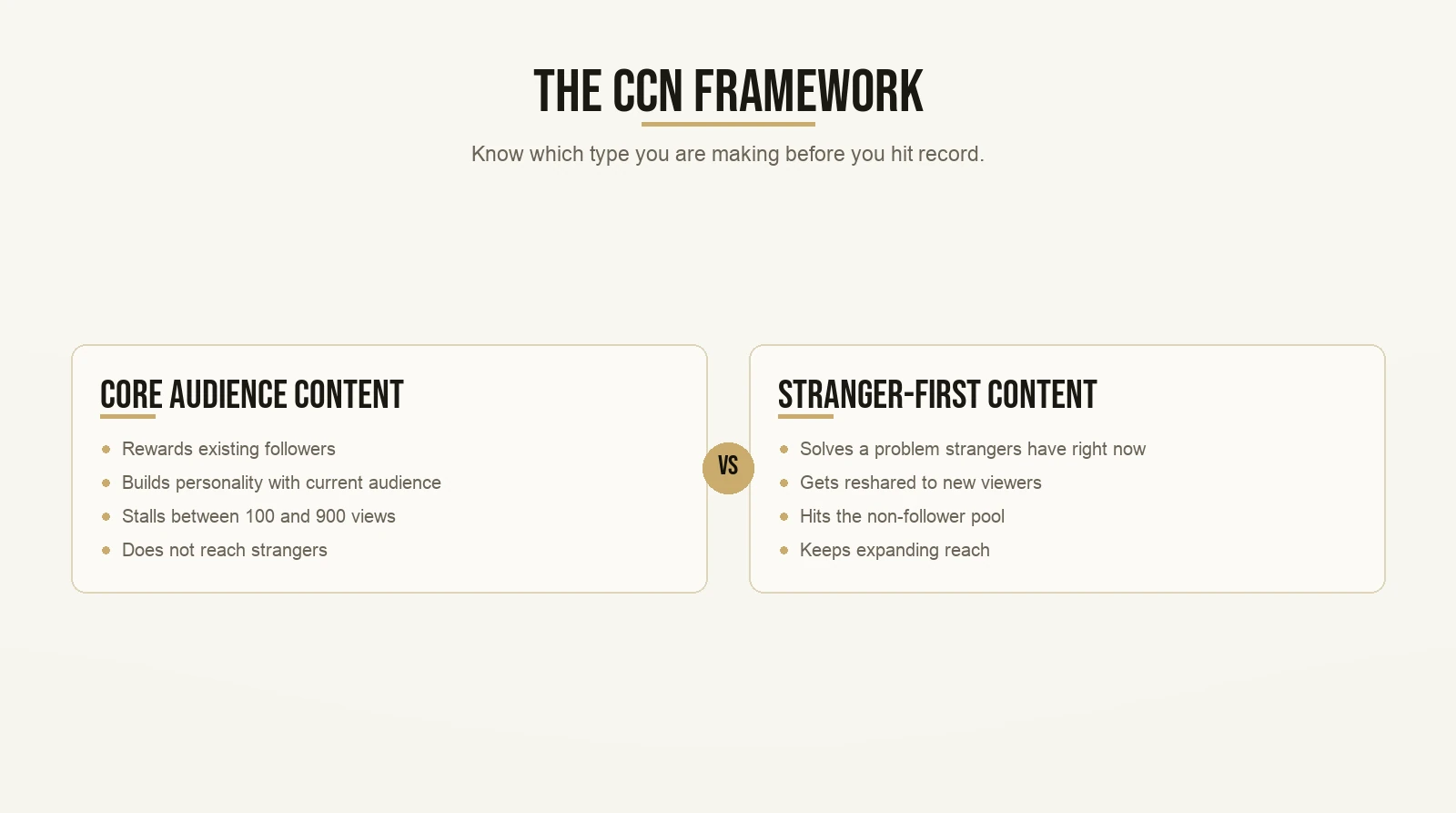
CCN is the framework that separates content made for your existing followers from content made for people who have never heard of you.
Here is how it works.
When you create content, you are implicitly choosing who it is for. Content about your morning routine rewards people who already follow you and find your lifestyle worth watching. It builds personality with an existing audience. It does nothing for a stranger who does not care about your mornings yet.
Content about why lower back pain happens during Romanian deadlifts and how to fix it in 30 seconds serves a stranger who has that exact problem right now. They are not searching for you. They are searching for a solution. Your content is the solution. They watch. They send it to the friend with the same problem.
The CCN shift is one question asked before you hit record: what does someone who has never heard of me need to hear right now?
Not “what does my audience want to see today.” That is the core audience question, and it is the wrong question for growth.
But wait. Isn’t content about my expertise and personality still valuable? People want to know who they are hiring.
Yes. Make that content too. Just know what it is for. Content that builds your personality builds credibility with people who already follow you. Content that builds your audience speaks to strangers first. You need both. You just need to know which one you are making before you hit record.
Videos that only interest your core audience stall between 100 and 900 views. Videos that serve a stranger’s real problem hit the non-follower pool with the right energy, generate reshares, and keep expanding.
For a deeper look at putting this into practice, this guide to finding clients on Instagram covers the approach in more detail.
Who Is Your Target Market?
Your target market is not “people who want to get fit.” That describes most of the adult population and tells you nothing useful about what to post or who you are making it for. A specific target market has a specific problem: women in their 40s managing muscle loss, men over 50 who have never trained consistently, new mothers rebuilding strength after postpartum recovery.
But hold on. Doesn’t getting that specific cut out most of my potential clients?
No. It cuts out the noise and keeps the signal.
Pew Research found that 50% of US adults are now on Instagram, up from 40% just a few years ago. The audience is there. The problem is not reach. The problem is relevance.
Getting 400 views from women in their 40s who are specifically looking for a trainer like you is worth more than 40,000 views from a general fitness crowd with no reason to book a session.
Specificity also helps Instagram categorize your content correctly. The Your Algorithm update means users now actively manage the topics shaping their recommendations. A trainer whose content is clearly filed under “weight loss” or “strength training” gets surfaced to users who have expressed interest in those topics. A trainer whose content is a mix of everything may not surface to any of them.
Where Should Personal Trainers Market Their Services?
Instagram is the strongest platform for in-person trainers right now because of how Reels get distributed to non-followers. But the platform only works if you treat it as an audience-building tool, not just a posting calendar you fill to stay consistent.
The Credibility Bank
Here is a framework worth building your whole content strategy around.
Every piece of content you post is either a deposit or a withdrawal.
A deposit is value. A tip that works. An explanation that saves someone a trip to Google. A genuine answer to a question your target client is already asking. Deposits build trust with strangers who do not know you yet.
A withdrawal is an ask. “Book a session.” “DM me for coaching.” “Check the link in my bio.” Those are fine in their place. But if you have not made enough deposits first, the ask feels premature. It feels like someone you just met asking for your credit card number.
Think about how a referral works offline. Your client does not walk up to a stranger and say “my trainer has openings.” They mention you after someone has complained about back pain or said they want to start training. The introduction comes after there is already a reason for it.
Social media is the same thing at scale. You are not asking strangers to book before they have any reason to trust you. You are making enough deposits that by the time they see your call to action, the ask feels like a logical next step.
The rule: for every one withdrawal post, make at least four deposits first. Get the balance high enough that a stranger can watch three or four of your videos and feel like they already know what you stand for.
That balance in the credibility bank is what turns reach into inquiries.
What Are Trial Reels and Should You Use Them?

Trial Reels let you send a Reel to non-followers before your existing audience sees it. You get performance data including plays, likes, comments, and shares in roughly 24 hours. If the numbers are strong, Instagram can auto-publish it to your followers based on the first 72-hour play count. Only you know the Reel is on trial.
Trial Reels launched in December 2024. Yes, use them.
Here is why this matters specifically for a trainer.
Your gym clients follow you for one set of reasons: accountability, updates, content that rewards the relationship they already have with you. Non-followers follow you for a completely different reason. You said something useful before they had any relationship with you at all.
Those are two different audiences with two different needs. With Trial Reels, you can test content aimed at strangers without risking it landing flat in front of the people who already trust you. If a reach-oriented Reel flops with non-followers, your existing clients never see it. If it performs well, you publish it everywhere.
Use Trial Reels whenever you are testing a new topic, a new angle, or a new format. It is low-risk experimentation with real data.
The “Your Algorithm” Change You Cannot Afford to Ignore

In June 2026, Instagram completed the rollout of “Your Algorithm” across Feed, Reels, and Explore. Users can now see an AI-generated summary of the topics shaping their recommendations and actively add, remove, or adjust those topics. Changes apply across all three surfaces at once.
Here is what that means for you.
Instagram is now actively categorizing your content and matching it to users who have told the platform what they are interested in. A post correctly filed under “fitness,” “weight loss,” or “personal training” reaches users who have actively opted in to seeing that type of content. A post that is too generic, too personal, or too mixed in topic may not reach any of them.
If your content calendar is a mix of workout clips, motivational quotes, personal updates, and the occasional tip, Instagram has a hard time deciding what category to file it under. Which means it may not surface your content to users who are literally asking to see fitness content.
The fix is straightforward. Stay consistent in topic. Make it clear what your content is about from the first frame. A fitness post should read as a fitness post, not a lifestyle post that happens to have a squat rack in the background.
This is not about gaming the algorithm. It is about making sure the algorithm can do its job of connecting your content to people who already want it.
Does Your Monthly Rate Feel Too High to Prospects?
Whether your rate feels like “a lot” depends entirely on how much trust a potential client has in you before they ask. Content-first marketing builds that trust before the price conversation starts.
When a prospect searches whether your rate is “a lot,” one of two things is happening. Either they are price-sensitive and actively comparing options. Or they have not yet seen enough of your content to feel confident that what you offer is worth the cost.
The second situation is the one marketing solves.
When a stranger finds you through a Reel that solved a real problem for them, they are not comparing your rate to a competitor’s rate. They are asking if you have availability. The credibility bank has already shifted the conversation from “is this worth it” to “can I get access.”
Trainers who compete primarily on price are often trainers who have not yet built a content presence strong enough to change that frame. Content-first marketing does not just bring in more leads. It brings in leads who are already sold on the value before they ask about the cost.
If you want to see what that trajectory looks like in practice, the results from coaches who have taken this path give a sense of what the credibility-first build looks like.
The Local Reach Problem
Here is a tension none of the generic personal trainer marketing guides address.
Instagram distributes globally. You train people locally. A Reel that reaches 50,000 people across the country does not fill your Tuesday 7am slot.
So what do you actually do when your client pool is within 20 miles?
Two things help.
First, add local context to your content where it fits naturally. Not a forced mention. Just geography in the caption or title when it is relevant. “Best weekend workout spots in [your city]” surfaces to local searches in a way that “best weekend workout spots” does not. You are still making content non-followers can discover. You are just narrowing the relevance funnel toward your geography.
Second, do not write off non-local reach entirely. A viewer in another state who watches three of your videos and trusts your read on a problem is a warm lead for an online offer, even if they can never train with you in person. The in-person pipeline and the broader organic reach are not competing. Many trainers run both at the same time.
If you are thinking about what an online layer would look like on top of your in-person practice, this guide on getting online fitness coaching clients covers the transition in detail.
What Makes a Reel Actually Get Shared?
Content that gets reshared is content that makes someone say “I need to send this to [specific person].” Not “this was interesting.” Specifically: “this was made for someone I know.” That requires specificity.
“Here are five tips to build muscle” does not get shared. “Here is why your chest is not growing even though you have been benching consistently for two years, and the one adjustment that fixes it” gets shared. Because someone watching immediately thought of their friend with that exact problem.
Before you film, ask yourself two questions. Who would send this? And who would they send it to? If you cannot answer both in under five seconds, the topic is probably too broad.
Two things on the technical side worth knowing.
First, Reels up to three minutes are now recommendation-eligible. The old 90-second cap no longer applies. If your topic needs more time to explain, take it. Clarity matters more than a runtime rule that is no longer in effect.
Second, Instagram will not recommend Reels to non-followers if they are low-resolution, watermarked, have borders, or are mostly text. This is spelled out directly in Instagram’s ranking documentation. Clean output, clear audio, no overlay cluttering the frame.
For templates that already hit the technical and structural requirements, the reel format guide for coaches is a good starting point.
Frequently Asked Questions
How to attract clients as a personal trainer without paid ads?
Post content that non-followers find valuable before they know who you are. Instagram tests every Reel on a non-follower pool first. Strong reshare rates expand that pool. You do not need paid ads if your content consistently answers a specific question strangers are already searching for and gives them a reason to send it to someone else.
How does Instagram decide who sees a personal trainer’s Reels?
Instagram tests each Reel on a small predicted audience of non-followers. If they engage, especially by resharing, the Reel expands to a larger audience. Follower count is not the primary factor. Reshare rate is what moves distribution forward.
What kind of content should a personal trainer post to attract new clients?
Content that solves a specific problem a non-follower is already searching for. Use the CCN framework: ask what a stranger who has never heard of you needs to hear right now, not what your current clients want to see today. Specificity drives reshares, and reshares drive reach.
How does a local personal trainer get clients from Instagram?
Add geographic context to content where it fits naturally. City or region references in the caption or title narrow the relevance funnel toward your local area. Non-local viewers who engage with your content are also warm leads for an online offer even if they cannot train with you in person.
What is the credibility bank for a personal trainer?
The credibility bank is the trust you build with strangers before they ever consider booking. Every value-first post is a deposit. Every call-to-action post is a withdrawal. Make enough deposits that by the time a prospect sees your call to action, they already trust your read on the problem and the ask feels natural.
Want the templates behind content that actually gets watched? Grab the templates here and start with the first one today.