
Key Takeaways
- DM appointment setting is the process of converting Instagram conversations into booked calls, without ads or a sales page.
- The content you post and the DMs you receive are one system. One feeds the other.
- Instagram treats sends per reach as the top signal for unconnected reach. Posts people share with friends are what surface your name to strangers.
- The CCN framework tells you which content topics pull in people who have never heard of you.
- The 7 building blocks framework includes a CTA step that starts the DM conversation directly.
- Most coaches run the inbox themselves at first. A setter is a scaling move, not a starting move.
What Is DM Appointment Setting?
DM appointment setting is when a stranger messages you on Instagram and you guide that conversation toward a booked call. The person reached out first. No cold outreach, no ads, no chasing. Your job is to move them from “curious” to “on a scheduled call” with you.
That one fact makes this different from almost every other sales approach most coaches have tried.
The word “setting” is short for setting an appointment. Booking a time. Getting a confirmation. That is the only goal of the DM conversation. Not closing the sale in text. Not explaining the entire offer in three paragraphs. Just booking the call where a real conversation can happen.
This is how coaches who do not run paid ads and do not have a big email list still fill their calendar every week. It is a pipeline built entirely on content and conversation, and the person who starts it is almost always the stranger, not you.
Why Do Coaches Use DMs Instead of a Sales Page?
A sales page gives information. A DM creates a conversation. In a conversation you can ask questions, understand the specific situation, and make the next step feel relevant to that person. For most high-ticket coaching offers, that personal connection is what closes the gap between interest and a booked call.
Most coaches who rely on word of mouth and referrals have never had to think about this before. A client mentioned their name to a friend. The friend called. Simple enough. But word of mouth has a ceiling. It tops out at how many conversations your existing clients are willing to have on your behalf.
If you have built most of your business through referrals so far, this breakdown of social media marketing for coaches who rely on referrals explains how the content-first approach works as the natural next step.
DM appointment setting removes that ceiling. When a post lands in front of ten thousand people who have never heard of you, some of them message you. You did not wait for a referral. You built the pipeline yourself.
That is a freaking massive difference.
And here is a bonus you do not get from a sales page: every DM conversation is market research. The exact words a lead uses to describe their problem become your next hook. Your content gets sharper. Your pipeline grows. The whole system improves itself over time.
How Does Your Content Feed the DM Pipeline?
A post earns views. Some viewers share it. Instagram counts those shares and uses them to decide whether to push your content to strangers. More strangers see it. Some of them DM you. The content and the DMs are one connected system, not two separate activities.
This is not a metaphor. Adam Mosseri, the head of Instagram, stated directly in January 2025 that sends per reach correlate more with overall reach than any other signal, because Instagram is designed to help people share content worth passing to a friend.
Read that again.
Sends per reach is the top signal for unconnected reach. Not likes. Not comments. Not watch time. Shares.
When someone shares your post to a friend because it describes that friend’s exact situation, two things happen. Instagram rewards the share by distributing the post to more strangers. And that friend, who has never heard of you, is now a warm lead.
One billion people message a business each week across WhatsApp, Messenger, and Instagram Direct combined, according to Meta’s own data. The behavior is already built into how people use these platforms. The question is whether your content earns its way into those conversations.
Content strategy and DM conversion are the same system. Getting the content right is what makes the DM side possible.
The CCN Framework: Which Topics Pull Strangers Into Your Inbox?

Most coaches post about what their existing audience already understands. That content earns likes from followers. It almost never reaches strangers, because strangers do not have the context to care about it yet.
The CCN framework fixes that. CCN stands for Core, Casual, and New audience. It is how you decide which topic to build each post around, based on who you want to reach.
Your core audience is your existing followers. They already know you and your methods. A core audience post goes deep into the mechanics of something you teach. Only people who follow you and understand your approach will find it relevant.
Your casual audience is broader. They have come across your content or followed you at some point. They understand the general category you work in, even if they do not know your specific frameworks.
Your new audience has never heard of you. They do not know your name. They do not know your approach. But they have a problem you solve. A post aimed at the new audience does not teach your method. It names a frustration those people already carry, whether or not they have ever heard of you.
Here is what that looks like in practice.
If you are a relationship coach, a core audience post might be something about a specific model you use in your sessions. Only your existing followers who already understand your approach care about that. It might earn a few hundred views from people who already follow you.
A new audience post from the same niche might be something like “Why you keep attracting the same wrong person.” That is a pattern interrupt. It describes a feeling anyone stuck in that cycle already has. You do not need to know anything about therapy or attachment models to feel that in your gut.
The second post reaches a much larger pool of people. And because it describes a pain that makes someone want to tag a friend in the same situation, it earns sends. Sends bring strangers. Strangers become DMs.
Hold up. Does that mean I should stop posting for my core audience entirely?
No. Your core audience is your existing buyer pool. You still post for them. But if every post is aimed at people who already follow you, your pool never grows. New audience posts are what expand the pond.
The CCN framework is pretty straightforward to apply. Before you write a topic, ask: who is this post for? Core, casual, or new? For a DM-driven pipeline, you want a healthy mix, but the new audience posts are what bring strangers into your inbox for the first time.
What Is a DM Setter Job, and Do You Need to Hire One?
A DM setter manages an inbox on behalf of a coach. They qualify leads, answer initial questions, and book calls. They do not run the session. You do not need one to start. Most coaches handle the inbox themselves until volume makes it genuinely impractical.
This is actually the right order to do things. Running the inbox yourself first is not a constraint. It is where you want to be. You learn the objections. You learn which questions your best leads ask. You learn what language converts and what language signals a bad fit.
You cannot hand off your inbox before you understand it. If you pass it to a setter before your qualifying process is clear, they will book calls with people who are not a fit. Those calls waste everyone’s time.
Get the process dialed in yourself first. Then scale it when the volume genuinely justifies it.
What Does a Remote Appointment Setter Actually Do?
A remote setter logs in, responds to DM leads, runs through the qualifying questions you have set, and books calls with the ones who pass. They work from wherever they are and often handle multiple clients at once. Your process must be documented before they can execute it.
They are not strategy people. They are process people. Give them a clear qualifying framework, a clear objection-handling path, and a clear offer statement, and they can execute. Leave those gaps unfilled and they cannot invent what is missing.
This is why the coach always has to own the DM flow first. This breakdown of DM scripts for booking discovery calls covers the conversation structure in detail, which is a good place to start before you think about scaling.
How Does Instagram Decide Who Sees Your Content?
Instagram scores content based on three signals: watch time, likes per reach, and sends per reach. For content shown to strangers who do not follow you yet, sends per reach outweigh the others. Posts that people share with friends get pushed to more strangers. That is the gate your content has to pass through.
Mosseri laid these signals out publicly in January 2025. For content shown to your followers, likes matter slightly more. For content shown to strangers, sends matter more. The distinction is super duper key if your goal is building a DM pipeline from people who have never met you.
And he reiterated it in a separate statement: more people engage in DMs than with feed posts. Instagram is building toward that behavior, not away from it.
One more thing worth knowing. As of April 2026, Instagram removed accounts that mostly repost other people’s content from recommendation eligibility. To reach strangers through recommendations, you need original content. If your strategy leans on reposting or remixing other people’s work, that pipeline closes.
Original posts. New audience topics. CTAs that trigger DMs. That is the formula.
The 7 Building Blocks: Where Does the DM Conversation Begin?

Every video has parts. Most people think of a video as one thing. But each part does a specific job, and one of those jobs is starting the DM conversation before the call ever happens.
The 7 building blocks framework breaks a viral video into its structural components. Each building block handles a different function in the viewer’s experience. For a DM-first strategy, the building block that matters most is the CTA.
The CTA building block has three possible goals. You pick one per video.
The first goal is building a following: “Follow me for more [topic].” This grows your audience. It does not fill your inbox with leads.
The second goal is building trust through a freebie: “Comment [keyword] and I’ll send it to you in the DMs.” This opens a thread. Someone comments, a DM goes out automatically or manually, and a conversation starts.
The third goal is starting a direct conversation about your paid offer: “Comment [keyword] to get the details” or to open a qualifying exchange about working together.
The second and third options are how the DM pipeline starts. Someone comments. A thread opens. You ask one question. They answer. You book the call.
Hold up. What if I do not have ManyChat or any automation set up yet?
Then start without it. Put the CTA in your video and tell people to DM you the keyword directly. Respond manually. Yes, it is slower. But you learn the flow, you hear the objections, and you close real calls. Add automation later once you have enough volume to make the setup worth it.
The 7 building blocks framework tells you where the CTA lives in the video structure and which goal it should serve. On a DM-first strategy, you are almost always using the freebie CTA or the paid-offer CTA, not the follow CTA. The follow CTA builds your pool. The other two fill your inbox.
What Does the Actual DM Conversation Look Like?
The first message is a question, not a pitch. Ask one thing about their situation before you say anything about your offer. Their answer tells you whether they are a fit, what language they use to describe their problem, and how ready they are for a call.
Someone saw your post. They felt something. They commented a keyword or they messaged you directly. Now what?
The answer is simpler than most coaches expect.
Ask one question. Keep it plain. Something like “What is going on for you right now with [topic]?” or “What made you reach out today?” That is it.
Their answer does most of the qualifying work for you. If they describe a real, specific problem you can solve and they are actively looking for help, you are talking to a buyer. If they seem vague or disengaged, you get that signal early and save the call time for someone who is ready.
Once you know they are a fit, the next move is getting them on a call. Not explaining the offer in three paragraphs. Not sending a list of features. Just: “This sounds like something worth actually talking through. Are you open to a quick call this week?”
That is the whole move. The DM sets the appointment. The call does everything else.
What kills most DM conversations is over-explaining. The coach gets excited, sends a wall of text about the offer, and the lead feels overwhelmed. They go quiet. The thread dies. One question at a time. One step at a time. These DM templates for replying to new followers give you a starting structure you can adapt to your niche and your offer.
How Do You Know If Your DM Pipeline Is Healthy?
Watch three numbers: DMs per week from strangers, calls booked from those DMs, and calls that convert. Each number points to a different part of the system. If strangers are not DMing, the problem is in your content. If DMs are dying before a call gets booked, the problem is the conversation itself.
A breakdown at the first number means your content is stuck in core audience territory. You are not reaching strangers. That is a CCN problem: you need more new audience topics.
A breakdown at the second number means conversations are starting but dying before a call gets booked. That is usually a pitch problem. You are over-explaining, or you are asking for the call before you have understood their situation.
A breakdown at the third number means calls are happening but not converting. That is a qualification problem. The DM conversation is not filtering out unfit leads. Add one or two better qualifying questions before you offer the call.
Each problem has a specific fix. But you can only see where the leak is if you are tracking all three numbers. Most coaches who say their DMs “are not working” have never looked at which of the three numbers is actually off.
What Does a Healthy Content-to-DM Flow Look Like in Practice?
You post a new audience topic. Strangers share it. Instagram surfaces it further. Someone comments a keyword from your CTA. A DM thread opens. You ask one question. They answer. You book a call. That entire chain is set in motion by picking the right topic for the post.
Let me make this concrete.
You post a Reel built around a frustration your ideal client already carries. It earns sends because the person watching wants to tag a friend who has the same problem. Instagram sees the sends and shows it to more strangers. Reels are reshared over 4.5 billion times per day across Meta platforms, which is exactly why the send signal carries this much weight in the ranking logic.
Strangers watch it. Some comment the keyword you put in the CTA. A DM thread opens. You ask them one question. They answer. You book a call.
That call is warm. They watched your video. They commented. They answered your question. They already trust you a little. This is not a cold pitch. It is a continuation of a conversation your content started.
This is why the pipeline is one system and not two. The content is not the “awareness stage” and the DM is not the “sales stage.” They are the same mechanism running end to end. The topic you choose for the post is what sets the temperature of every call that follows.
If you want to see what coaches who have made this shift say about it, their feedback is worth reading.
Frequently Asked Questions
Do I need a lot of followers before DM appointment setting works?
No. Follower count matters less than whether your content reaches the right people. A post that earns sends from a focused niche audience is more valuable than broad reach from people who will never buy coaching. The pipeline can start from a single well-targeted piece of content.
Do I need automation like ManyChat to get started?
No. Start with manual responses. Post a CTA telling people to DM you a keyword, then respond yourself. It is slower, but it teaches you the objections and the exact language your leads use. Add automation once volume makes manual responses impractical. This overview of Instagram DM automation tools for coaches covers what is worth knowing when you get there.
What should I say first when someone DMs me about my coaching?
Ask one question about their situation before you mention your offer. Something like “What is going on for you right now with [your topic]?” gives you qualification data and shows you the exact words they use to describe their problem. Those words will sharpen your next post.
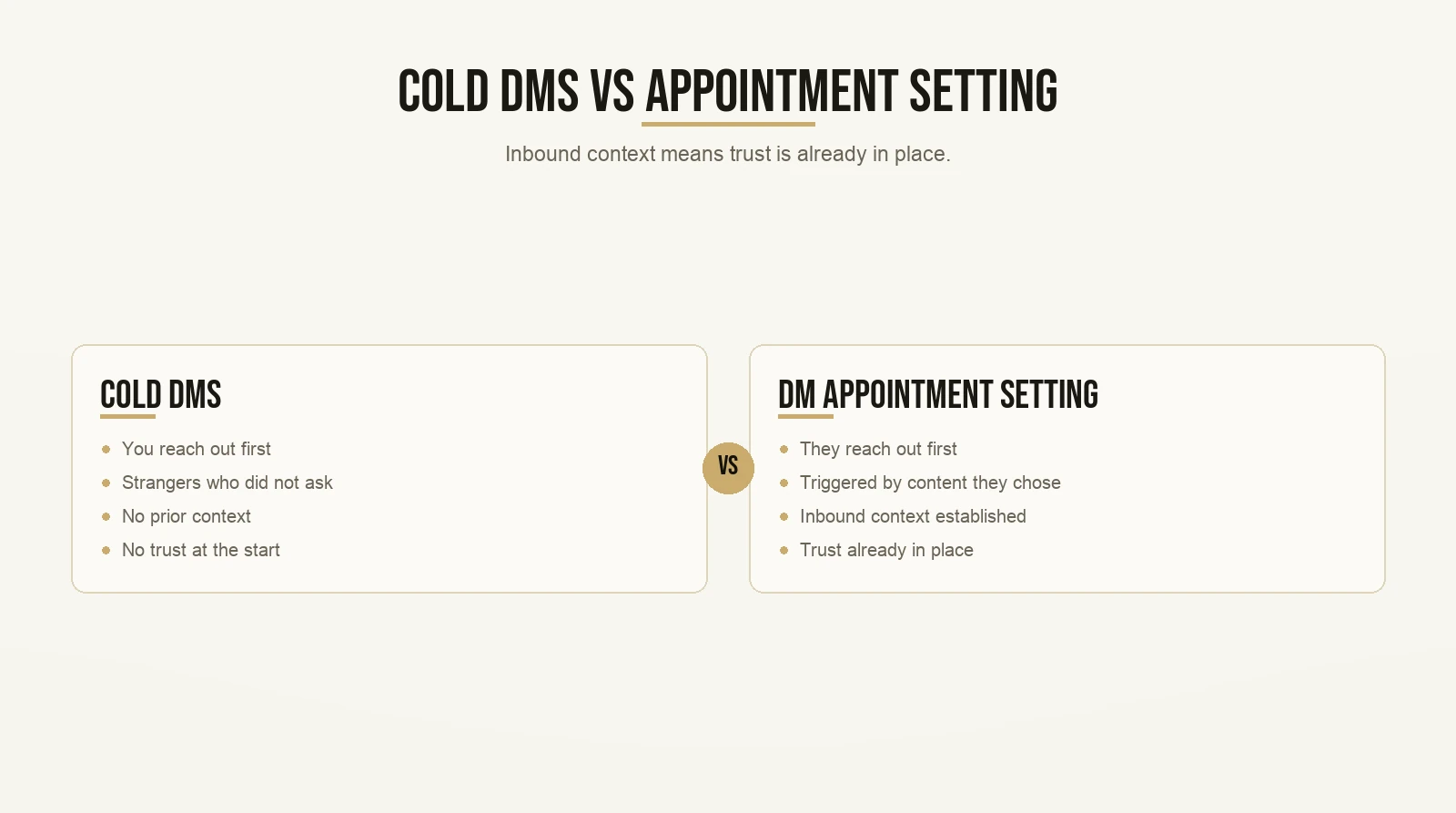
How is DM appointment setting different from cold DMs?
Cold DMs are outbound. You reach out to strangers who did not ask to hear from you. DM appointment setting is inbound. The stranger reaches out first, triggered by content they chose to engage with on their own. That inbound context means the conversation starts with a layer of trust already in place, which changes the entire dynamic of what follows.
Want the templates behind content that actually gets watched? Grab the templates here and start with the first one today.