
Key Takeaways
- A beta round tests your program before the full launch, but its real job is to generate the case studies and content that fuel every cohort after it.
- Charge for your beta. Even at a discount. Free betas attract people who are not committed and give you feedback you cannot trust.
- Recruit your first beta clients before you make any public announcement. Instagram’s Close Friends Stories let you do this with a private, hand-picked shortlist.
- Pick one offer type, one recruitment channel, and one feedback mechanism. Maximize one before adding another.
- Your beta client results are the first deposits in your credibility bank. Without them, your next launch has nothing to point to.
What Is a Beta Coaching Program?
A beta coaching program is a small, test version of your offer that you run with a limited group before your full launch. Beta clients go through the program and give you detailed feedback. In exchange, they pay a reduced rate. You use what you learn to refine the experience before opening enrollment to a wider audience.
That is the standard definition. Here is what most people miss.
A beta round is not a closed experiment. It is the starting point of a system. The transformation your beta clients get becomes the proof that drives every client after them. If you run the beta but fail to capture that proof, you have left most of its value on the table.
We will come back to exactly how to capture it.
Why Would You Run a Beta Round at All?
Because launching cold is hard and it is unnecessary. You do not know which parts of your program land and which confuse people until someone goes through it. You have no social proof yet. A beta round gives you both: a tested delivery and real results to point to, before you stake your reputation on a full public launch.
If you have never delivered this particular program before, a beta is how you find out where clients stall. Which modules need more explanation. Which parts they race through and which parts they reread three times. You will not know any of that until real clients tell you, and a beta is the fastest way to get that signal with low stakes.
You also have no case studies yet. No before-and-after. No testimonials a new prospect can read and think “that is me.” The beta is how you build that proof quickly, with a small group who are invested enough to give you honest feedback.
Think of it this way. You are the Sherpa, not the guarantor. You know the route. You carry the heavy load. You point out the pitfalls. But you need to have made the climb with at least a few people before you can say that with confidence. The beta is that first climb.
Should You Charge for Your Beta Round?
Yes. Every time. Even a discounted rate. A free beta attracts people who are curious but not committed. Their feedback reflects that. The client who paid, even at a reduced price, shows up differently and gives you data you can actually use.
Hold up. If the program is still being tested, why would anyone pay for something unfinished?
Because they are not paying for a finished product. They are paying for your time, your direct access, and the outcome your program is designed to produce. The fact that it is a first run does not make it worthless. For the right client, it makes it an early-access opportunity with a price that reflects the test format.
There is a principle in marketing: those who pay, pay attention. The more someone invests, the more seriously they engage. A paid beta client attends sessions, does the assigned work, and gives you specific feedback because they have something at stake. A free beta client treats it like a webinar they can drop out of.
Free betas also attract the wrong people. You fill your cohort with clients who are optimizing for free, not for transformation. Their results will not reflect what a real buyer at full price will experience. Their feedback tells you what people who would never actually be your client think of your program. That is not a useful signal. It is noise.
Contrarian Ideology: Why the Standard Beta Advice Is Wrong

Contrarian ideology is a framework for spotting where popular advice breaks down. The mechanism is simple: find the belief that most people in your niche hold without questioning, then ask whether the opposite is true or at least more useful. When you find an inversion that holds up, that is your content angle and your positioning edge.
Most coaches online say: offer a free or deeply discounted beta to get early adopters and feedback. That advice is consistent across articles, communities, and courses. It sounds reasonable. Lower the barrier, fill the cohort, collect feedback, then charge properly.
But wait, isn’t that the safe move? I just want to test whether the program works before I commit to a price.
Flip it. What does offering a free beta actually signal to your market? It signals that you are not confident the program is worth paying for. It filters for people who value free things over people who value transformation. It also breaks your feedback loop, because clients who paid nothing tend to engage less, skip homework, and give you vague feedback that does not reflect the real experience your paying clients will have.
The contrarian version: charge for your beta, be transparent that this is a test round, and recruit people who genuinely have the problem your program solves. Those clients show up. They complete the work. Their results are real, and their feedback is specific.
Contrarian ideology is not about being difficult. It is about checking whether the popular answer is actually optimal, or just repeated. In this case, the free beta advice is repeated constantly and wrong consistently.
How Do You Find Beta Clients?
Start with people who already know you. Not a cold audience. Past clients, people who engage with your content regularly, network contacts, referrals from people in your professional circle. They already have some baseline trust in you, which means a beta invitation is a small next step for them, not a leap.
If you currently get most clients through word of mouth and referrals, your beta pool is right there. You do not need a large social following to run a first beta round. If you are thinking about how to grow beyond that starting pool once your program is proven, the guide on marketing for coaches who rely on referrals covers how to build that outreach on Instagram.
Here is a practical order of operations:
- Make a list of 15 to 30 people you already know who fit your client profile. This includes past clients who might want to go deeper, people who comment on your posts and ask the kinds of questions your program answers, and contacts in your network who have the problem you solve.
- Reach out personally, one at a time. Not a mass DM. A specific message that references something real about them.
- Tell them you are running a small test round of a new program. Tell them the specific outcome it is designed to produce. Tell them the price and what the full price will be at launch.
- Ask if they are interested or know someone who might be a good fit.
No sales page required at this stage. No public announcement. Just one real conversation at a time.
How to Use Instagram to Recruit Beta Clients Without Going Public
You do not have to announce your beta to your whole audience. For a first beta round, it is usually better if you do not.
Instagram’s Close Friends feature lets you set up a private list of hand-picked followers and share Stories, Reels, and Notes only with them. No one outside that list can see the content, and no one can request to be added. You update the list whenever you want.
This is exactly right for a quiet beta recruitment. Add your shortlist of qualified followers to Close Friends, then post a Story that explains what you are testing and what the beta price is. The rest of your audience sees nothing. You get direct replies from the people most likely to say yes.
Once you have your cohort, Instagram Broadcast Channels give you a lightweight way to deliver content to them. Broadcast Channels launched globally in June 2023 and work as one-to-many tools where only the creator sends messages. Followers can react and vote in polls. You can also restrict a channel to paid subscribers, which keeps your beta content gated without needing a separate platform.
If your audience is already on Instagram, meeting them there removes friction. It also keeps your delivery and your community in one place while you are still figuring out what the full version looks like.
How Many Beta Clients Do You Need?
Eight to twelve is the right range for most programs. Fewer than five gives you too little variation to identify real patterns in the feedback. More than fifteen makes it hard to give each person the attention that makes a beta valuable, both for them and for your data.
For high-ticket one-on-one programs, five to eight clients is enough. For a group format, ten to twelve gives the group dynamic enough material to actually develop. The mechanics of the group structure, how to design sessions, set up delivery, and structure the cohort experience, are covered in the full guide on how to launch a group coaching program.
What Should the Beta Actually Include?
A beta round needs four things: a defined outcome, a defined timeline, regular contact with your clients, and a structured way to capture results before and after. Without all four, you cannot refine the program or build the proof that makes your next launch viable.
Here is what each one looks like in practice:
- Defined outcome. What will clients be able to do or have achieved by the time the program ends?
- Defined timeline. Six to eight weeks is the workable range for most programs. Short enough that engagement stays high.
- Regular contact. Weekly calls, check-ins, or a combination. This is where you hear confusion in real time and get the detail that forms do not surface.
- Feedback mechanism. A short form, a debrief call at the end, or both. Ask specifically: what worked, what confused you, what would you have wanted more of?
- Results capture at intake. Ask clients to document their starting point before the program begins. You need something concrete to compare against when it ends.
One more thing: pick one format and run it fully. Do not split your cohort into some paid spots and some free, or run two different program structures at once. If you test multiple variables at the same time, the feedback tells you nothing about which variable actually mattered. Choose one format, execute it all the way through, then adjust for round two.
The Credibility Bank: How Beta Results Fuel Every Launch After This One

Here is the thing nobody on the internet connects when they talk about beta rounds.
A beta is not just a test. It is the first loop of a repeatable system, and that loop runs on something called the credibility bank.
The credibility bank is a framework for building social proof over time. Every client result is a deposit. Every transformation story you capture and post adds to the balance. The more specific the deposit, the more it is worth when a new prospect is deciding whether to work with you.
Most coaches finish their beta, collect a few vague testimonials, and move on. Their posts are general: “So grateful for my amazing beta clients.” That content does not convert. It does not answer the question a new prospect is actually asking, which is: does this work for someone like me?
Hold on. Isn’t any testimonial better than nothing?
Not if it is vague. The deposit that converts is specific. It names the starting point. It names the result. It describes the thing that shifted. Before: a coach with a real offer but no clients finding them on social. After: a system that generates consistent, qualified inquiries from people who have never heard of them before. The specific starting point and the specific change. That is a real deposit. “Great experience, highly recommend” is not.
According to DataReportal’s Digital 2026 Global Overview Report, 62.3% of Instagram’s active adult users use the platform to research brands and products, higher than any other social platform. That is not passive scrolling. It is active evaluation. The transformation story you post from your first beta client lands in front of people who are actively deciding whether to work with someone in your niche.
Read that again.
More than six in ten active Instagram users are in research mode. Your beta results content reaches them at the exact moment they are looking for proof. That is the loop: beta clients get results, you post those results, new prospects find them and reach out, they become the next cohort. Each launch builds on the one before.
Without the credibility bank, every launch starts from zero. With it, the proof compounds. If you want to see what a fully funded credibility bank looks like in practice, the results page here is a good example of what the system produces over time.
What Is a Beta Course?
A beta course is a beta round applied to a self-paced or recorded product rather than a live coaching program. You release a draft version to a small group, they go through the material, and you collect feedback before finalizing the content.
The same rules apply: charge something, recruit people who genuinely have the problem your program solves, and capture their starting point at intake so you have something to compare against at the end.
The key difference is feedback collection. In a live program, you hear confusion on calls in real time. In a self-paced course, confusion tends to go unspoken unless you build in a way to surface it. A community channel, regular check-in messages, or a debrief call at the end all work. Build one of those in before you start, not after.
How Do You Price a Beta Round?
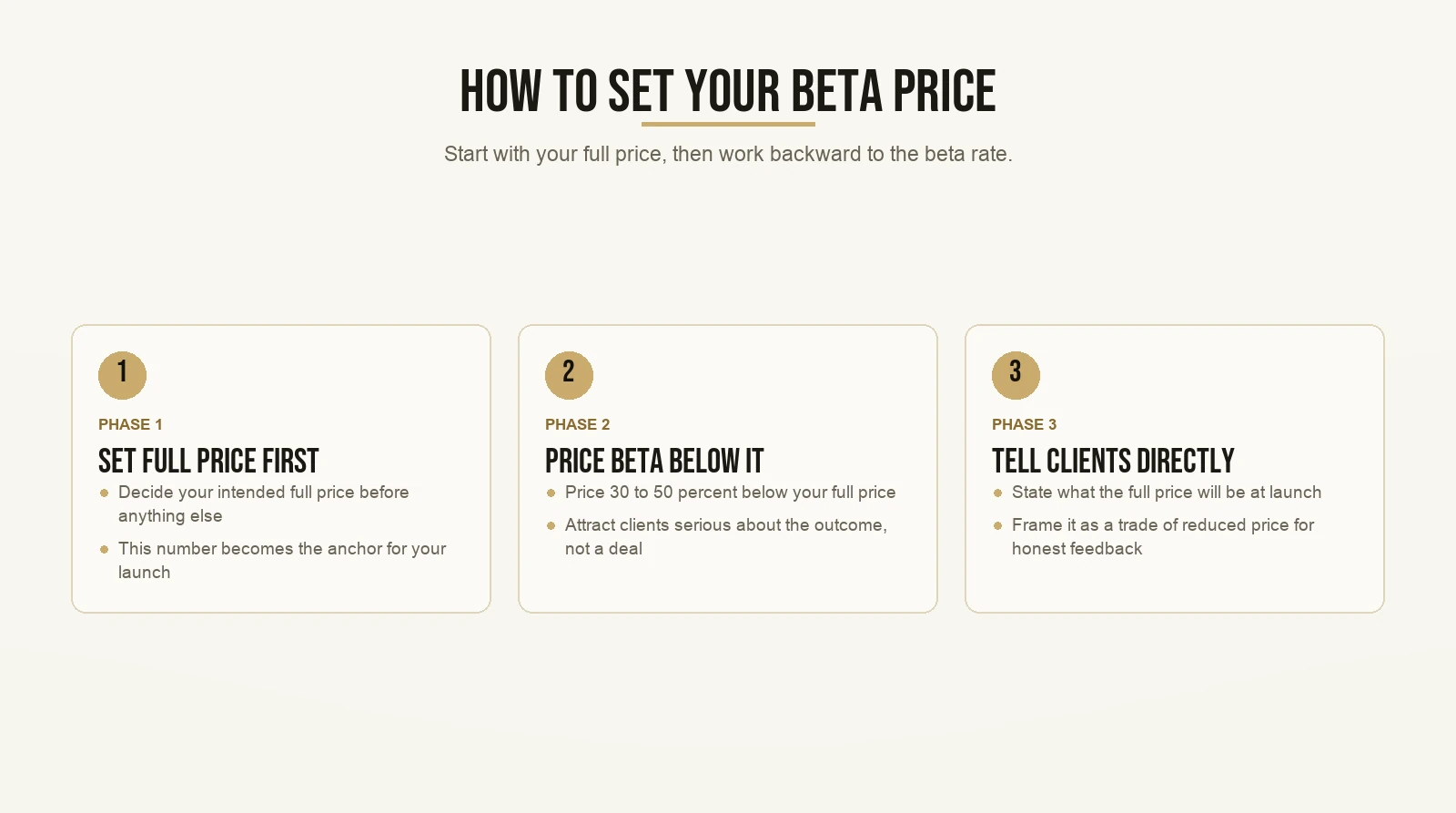
Price your beta at 30% to 50% below your intended full price, and tell clients explicitly what the full price will be at launch. That creates the right expectation and makes the discount feel like what it is: a genuine trade of reduced price for their time and honest feedback, not a signal that the offer is uncertain.
Here is why this is a positioning decision and not just a math problem.
The price you set for your beta creates an anchor. Price too low and you attract clients who are hunting for a deal, not a result. When you move to full price at launch, the gap feels arbitrary to anyone who heard about the beta rate. You can also inadvertently train your audience to wait for a discount.
Set your intended full price first. Price the beta as a percentage below that. And tell your beta clients directly: “This will be full price when it officially launches. You are getting access now at the beta rate because I want real feedback from people who are serious about the outcome.”
The high-ticket path and the low-ticket path also call for different beta structures. A high-ticket beta should run close to your full delivery format: more direct access, more check-ins, more one-on-one attention. A low-ticket product beta can run with a slightly larger group and is testing the content more than the relationship. Decide which lane you are in before you set the price. For more on how each path plays out on Instagram, the guide on how to sell a course on Instagram covers the mechanics for both.
How Do You Know When the Beta Is Done?
Two conditions. Both need to be true before you move on.
First: you can name at least three specific things you would change about the program. Not general impressions. Specific things: “Module two needs a worked example before the exercise,” “the onboarding check-in should happen in week one, not week two,” “clients need a one-page reference for the core framework.” If you cannot name three, either the feedback was too vague or the program ran too short.
Second: at least two clients have a specific, describable result and have given you permission to share it. Two is the minimum. More is always better. But two concrete case studies is the threshold that makes your next launch viable. You need something a new prospect can read and see themselves in.
Both conditions met? You are done with the beta. Move to your full launch with a refined program and a credibility bank that is funded and ready.
What Comes After the Beta?
Your full launch. By this point you have a refined program, real client results, and case study content you can post and point to. You have tested the delivery, found the weak spots, and fixed them. You are not launching on hope. You are launching on proof.
If you are running a high-ticket offer, your full launch happens through sales conversations. You post content that draws in qualified people, they reach out, you have a call, and you close. If you are building that system from the ground up, the guide on how to start a life coaching business covers the foundational steps for coaches who are still putting the pieces in place.
If you are running a lower-ticket course or group program, your full launch can happen through a landing page and a well-timed Story or email sequence. Either way, the beta made it possible.
DataReportal’s Digital 2026 data shows that 50% of adult social media users now visit platforms specifically to learn about brands, up from 47.7% in 2022. Android Instagram users average 1 hour 13 minutes per day in the app. Your next cohort is on Instagram every single day. The case studies you built during your beta are the content they are looking for. Give them something to find.
Want the templates behind content that actually gets watched? Grab the templates here and start with the first one today.