
Key Takeaways
- 62% of U.S. adults identify as Christian, and that share has been stable since 2019. The audience is large and not shrinking.
- Instagram weights reshares above all other signals for Reels. Content that teaches a specific, arguable idea gets sent to a friend. Content that merely inspires gets liked and forgotten.
- Reposting devotional graphics from other accounts, one of the most common habits in Christian coaching, can disqualify your entire account from recommendations entirely.
- Two frameworks solve most of the problem: contrarian ideology (how you stand out) and the credibility bank (how you convert profile visitors into paying clients).
- Reels up to three minutes are now eligible for the Reels tab and Explore. Longer teaching content has reach potential it never had before.
- Trial Reels let you test a hook with non-followers first. If it performs with strangers, then push it to your existing audience.
Why Most Christian Coaches Stay Stuck on Instagram
Here is what I see constantly.
A coach with a genuine gift builds an Instagram profile. They post scripture graphics. They share quotes from faith leaders. They clip a message from church and add subtitles. Their existing followers like the posts. Comments say “this blessed me” and “so needed this today.” Then nothing.
No new followers. No DMs from strangers. No booked calls.
The problem is not the message. The problem is the format. And the format is working against the algorithm in three separate ways at the same time.
Instagram’s ranking system for Reels lists reshare likelihood as its first prediction. Not likes. Not comments. Reshares. The question Instagram is asking, before it decides how far to push your content, is this: will someone send this to a friend?
Inspirational content gets liked. It does not get sent.
The second problem: Instagram has specifically flagged content with mostly-text visuals, watermarks, reposted images, and borders as lower-ranked. The classic Christian coach format – a Canva quote card from someone else’s page, reposted to your feed – hits every one of those signals at once.
The third problem is the one most coaches do not know about. Instagram removes from recommendations any account that reposts ten or more pieces of content from other accounts in a thirty-day period. If sharing devotionals from other pages has been your main strategy, you may have already crossed that line without realizing it.
None of this means faith does not belong on Instagram. It means the format most Christian coaches default to is algorithmically invisible. The fix is structural, not spiritual.
Is Instagram the Right Platform for a Christian Coaching Business?
Yes, and the numbers back this up plainly.
50% of U.S. adults now use Instagram, up from 40% in 2021. That puts it alongside YouTube and Facebook as one of only three platforms used by at least half the country. 62% of U.S. adults identify as Christian. The overlap between those two groups is enormous. Your potential audience is already on the platform and actively using it.
Here is what most coaches miss. Instagram’s ranking system does not favor large accounts. The algorithm gives smaller accounts the same Explore and Reels recommendation access as established ones. Follower count is used to spread opportunity, not concentrate it. A coach with 400 followers can reach cold audiences – people who have never seen their content before – the same week they post.
The unlock is content that earns reshares. That single metric drives discovery more than follower count, hashtags, or posting frequency. Reshares come from content that is specific, arguable, and useful enough that someone thinks: “I need to send this to [name].”
That is the entire game. Everything below is how to play it.
What Is Contrarian Ideology and How Does It Fix the Sermon Problem?

Contrarian ideology is probably the most immediately useful framework for any Christian coaching business.
Most coaching content in a faith-based niche sounds identical. Everyone posts some version of “God designed you for more” or “your calling is your business” or “success and faith go together.” None of that is wrong. All of it is indistinguishable. A cold audience scrolling the Reels tab has no reason to stop, follow, or send it.
Contrarian ideology is the structural opposite of that.
The framework works like this. You identify the common belief most people in your niche hold. You make clear, without hedging, that your approach differs. Then you present your specific method – the thing that makes your coaching different from the conventional advice – and you back it with results.
But wait. If I push back on the common beliefs in my niche, won’t I alienate potential Christian clients who hold those beliefs?
Not if you do it right. The goal is not to be edgy. The goal is to be specific.
“Pray and trust the process” is a belief. It feels encouraging. It travels nowhere on Instagram.
“Here is the specific pattern I see in the clients who actually build a thriving practice – and why most advice in this niche skips the hardest step” is a contrarian position. It is arguable. People will forward it to a friend who needs to hear it. That is the mechanism.
Here is the practical structure for this as a Reel.
Clip one: name one or two common beliefs in your niche that most people follow. Be specific. Not “most people think X” but “most Christian coaches I talk to believe that if you post consistently and stay authentic, clients will come.” The more precisely you name the belief, the more your audience nods and keeps watching.
Clip two: present your contrarian position. Show that your approach goes a different direction. Direct, not aggressive. “I believe that without a specific reshare-worthy hook, consistent posting is just noise that exhausts you and grows nothing.”
Clip three: show your actual method. Not your coaching program. Not your pricing. The mechanism itself. The two or three principles that make your approach work differently. Keep it concrete. Keep it teachable. “My approach focuses on three things: naming the problem specifically, teaching the mechanism clearly, and showing what the result looks like in a real client’s life.”
Clip four: client results. A written testimonial, a before-and-after narrative, or a short clip from someone who applied your method and got the outcome your audience wants.
The faith element does not disappear inside this structure. It gets sharper. Instead of “God has a plan for your business,” you get: “Most Christian coaches I work with are told to pray more and post consistently – here is what I actually teach, and why the second half of that advice is missing the most important step.” The specific version travels. The general version does not.
This is what creates the reshares Instagram rewards more than anything else.
How Do You Build a Credibility Bank on a New or Small Account?

Hold up. I’m just starting out. I don’t have a big track record yet. How do I build credibility without it feeling like self-promotion?
Here is the thing. The credibility bank is not about how much you have done. It is about making what you have done legible to a cold audience – someone who landed on your profile from a Reel and has about fifteen seconds to decide whether you are worth following.
Most coaches leave this completely empty. They have a clean bio but nothing else that answers the question: “Has this person actually helped anyone?”
The credibility bank is the structure that answers that question.
Max teaches this through the Instagram highlight section. Three highlights, minimum: Who Am I, What I Do, and Results.
Who Am I is your hero story. Not a resume. The arc: where you started, what the problem was, what changed, and why you now help others through the same transition. A Christian life coach who once carried the weight of burnout and found a specific path out has a story there. A relationship coach who rebuilt their own marriage has a story there. That story, told directly to camera, is what makes a cold audience trust your method before they have ever seen you deliver it.
What I Do is where your contrarian ideology lives. Not your coaching program. Not your pricing or tier structure. The method itself. The two or three principles that make your approach distinct from every other coach in your space. What does a client learn from working with you that they would not get anywhere else?
Results speaks for itself. Written testimonials. Short transformation narratives. Screenshots with personal details removed if needed. Even two or three solid results are enough. You are not competing with an account that has hundreds of them. You are competing with the blank profile a cold visitor sees on most accounts.
Here is the part that surprises most people. Instagram’s ranking factors include your history with the poster. Highlights are the only persistent content structure on Instagram that builds that history before someone follows you. A cold visitor who watches your Who Am I highlight for two minutes is no longer fully cold the next time they see your Reel in the Reels tab. They already know who you are. That prior contact shapes how they engage.
Build these three highlights before you post your first Reel. That is super duper key. Not after you have 1,000 followers. Before Reel number one goes live.
How Do You Actually Begin a Christian Coaching Business on Instagram?
If you are starting from zero, the fundamentals of setting up a life coaching business apply whether or not your niche has a faith component. The Instagram mechanics sit on top of that foundation.
Here is the starting sequence that works.
Step one: define your contrarian belief. What does most coaching in your niche get wrong? What would a peer in your space push back on if you said it in a Reel? Write it down. That single position is your content center. Every Reel you make should connect back to it.
Step two: build your three highlights before you post anything. A cold visitor who finds great content and lands on a blank profile leaves immediately. The highlights catch them.
Step three: post a contrarian Reel using Trial Reels. Instagram introduced Trial Reels in 2025 specifically to let creators test content with non-followers before their existing audience sees it. If the Reel earns strong watch time, reshares, and profile visits from strangers, push it to your followers. If it underperforms, you have learned something without damaging your existing engagement rate. Test the hook before you commit it.
Step four: when you get a DM that says “how do I work with you” or “can you help me with this,” have one clear next step ready. Usually a short call. Not another piece of content. The content creates the relationship. The call converts it.
The coaches who consistently get clients through social media rather than waiting on referrals are not posting more than everyone else. They are posting with a more specific mechanism. Every piece of content is built around an idea someone would argue with – or send to a friend who needs to hear it.
What Content Format Actually Works for Christian Coaches in 2025?
The format that outperforms everything else for a Christian coaching business is the speaking-to-camera Reel that teaches one specific idea.
Here is why that format works when the alternatives do not.
First, reach. Instagram expanded the Reels cap from 90 seconds to three minutes in 2025. Reels up to three minutes are eligible for the Reels tab and Explore recommendations. A Reel where you walk through your contrarian belief, name your method, and point to a client result takes more than 90 seconds when done properly. That format is now fully viable for reaching cold audiences.
Second, carousels and photos can appear in the Reels tab if audio is added. If you have been creating text-based educational carousels, adding even a short spoken intro opens them to non-follower discovery. You do not need a filmed Reel for every piece of content.
Third, hashtags are now capped at five per post. Caption keywords do the work hashtags used to do. Write captions that name your topic clearly and describe the transformation the content delivers.
What does not work, and I want to be freaking direct about this:
Reposted scripture graphics from aggregator accounts. Sermon clips with heavy text overlays. Quote cards shared from other profiles. These formats hit multiple low-rank signals at once. Post them frequently enough and your entire account can become ineligible for recommendations.
The underlying reason is pretty straightforward. Instagram ranks content that people watch fully, send to others, and find genuinely surprising or useful. A devotional that confirms what someone already believes feels good. It does not earn a send. Your faith perspective is not the liability. The format is.
How Do You Convert Instagram Followers Into Paying Clients?
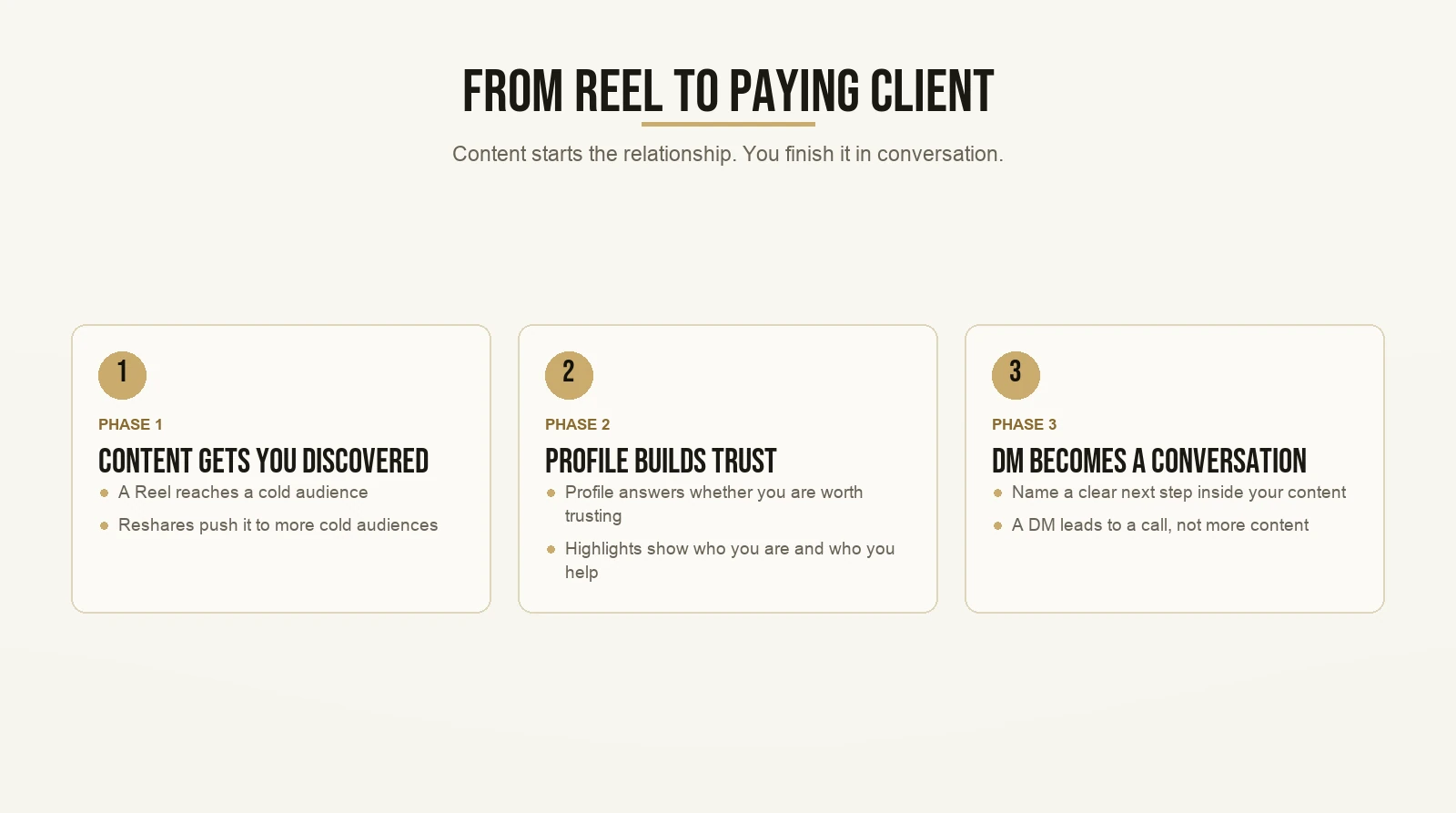
Content gets you discovered. The conversion path is a separate mechanism, and most coaches confuse the two.
A Reel introduces you to a cold audience. If it earns reshares, more cold audiences find it. If your profile answers the question – “is this person worth trusting?” – they follow. If your highlights show them who you are, what you teach, and who you have helped, they DM you or click a link in your bio.
The next step after a DM is a conversation, not more content.
Read that again.
The next step after a DM is a conversation, not more content.
Most Christian coaches post consistently, grow slowly, and wait for someone to buy. The coaches who consistently book clients from Instagram have a single clear next step ready – a short call, a direct DM invitation, or a lead magnet that qualifies intent – and they name it inside the content or in the caption.
If you have been building your practice through referrals and word of mouth, the Instagram version of your business is not a reinvention of what you do. It is the same conversation, at a different scale and with a larger pool of people you have never met. The content starts the relationship. You finish it.
Coaches who are in that transition – moving from referral-dependent to content-driven – will find concrete mechanics in this guide to marketing for coaches who rely on referrals.
If you are still sorting out the foundation of becoming a life coach at the same time, that can run in parallel with building your Instagram presence. The platform does not check your training hours. It checks whether someone sent your content to a friend.
The coaches who have figured this out build trust through documented results and a specific method – not through volume of faith content. You can see how that plays out across different niches by looking at real coaching client results. The mechanism is consistent regardless of the niche.
Boom.
Want the templates behind content that actually gets watched? Grab the templates here and start with the first one today.