
Key Takeaways
- Influencer coaching splits into two types: growth coaching and monetization coaching. They serve different stages. Mixing them up is where most people waste time and money.
- Follower count does not qualify you for coaching. A creator with 2,000 followers in a tight niche can benefit more than someone with 50,000 followers chasing broad views.
- High-ticket coaching cannot be sold from a landing page alone. The investment level requires a real conversation first.
- Niche specificity matters more than audience size. Getting 5,000 views in a tight niche can be worth more commercially than 500,000 views in a broad one.
- Paid coaching works differently from a free course because the investment changes how seriously you show up.
- Coaching does not create clarity. You need to bring it. A coach helps you execute faster once you know what problem you solve and for whom.
What Is Influencer Coaching, Exactly?
Influencer coaching is one-on-one or small-group guidance from someone who has already built a social media audience and turned it into clients. The coach hands you frameworks they tested themselves, so you spend less time figuring things out and more time executing on what actually works.
But calling everything “influencer coaching” is part of the problem. It is at least two very different services aimed at two very different stages of a creator’s business. Let’s crack into it.
What Does Influencer Coaching Actually Cover?
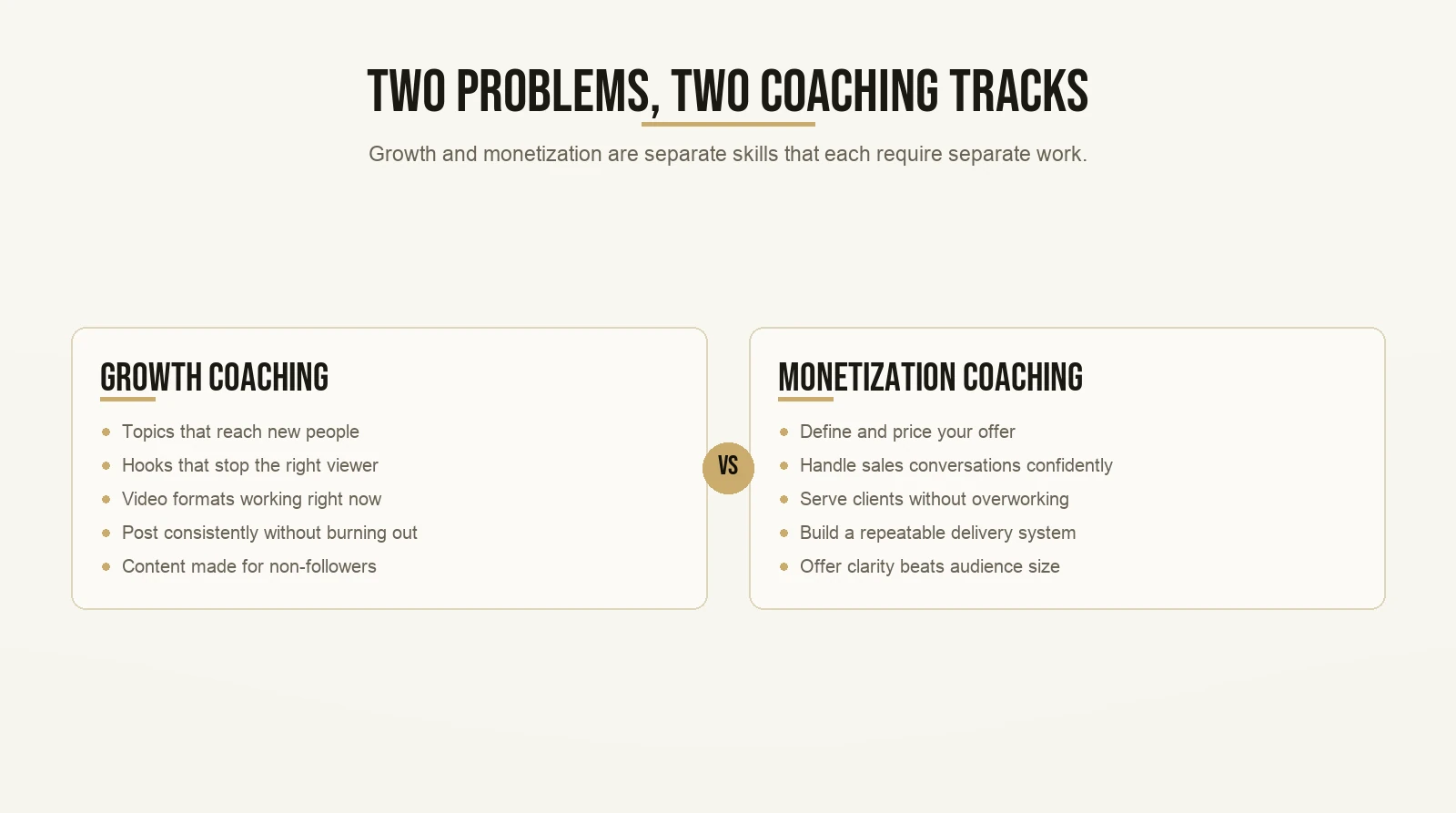
Influencer coaching covers two separate problems. Growth coaching is about getting the right views from the right people. Monetization coaching is about turning those people into paying clients. Both are valuable. Neither one fixes the other on its own.
Growth coaching deals with content strategy, platform mechanics, and audience building.
This is where you learn how to choose topics that reach people who have never heard of you, how to write hooks that stop the right person from scrolling, which video formats are working right now, and how to post consistently without burning out.
There is a freaking important concept at the core of growth coaching. Most creators post content that only their existing followers care about. Views are decent. But the account does not grow because nobody new is finding it. The fix is making at least some of your content specifically for people who do not know you yet. That is a very different kind of video than what you make for your existing fans. Growth coaching teaches you to tell the difference and balance both.
Monetization coaching is a different problem entirely.
This is where you work on your offer, your pricing, your sales process, and your delivery system. You learn what you actually sell, how to price it for your current stage, how to handle a sales conversation without freezing, and how to serve clients without working around the clock.
Here is what surprises most people. A creator with sharp monetization coaching and a small audience can outperform a creator with a large following and no business structure. The audience size is often not the constraint. The offer clarity is.
Who Is Influencer Coaching Actually For?
Influencer coaching is for people who already have a business or an existing social presence and want to grow faster, reach more people, or convert their audience into actual revenue. It is not for complete beginners with no niche, no offer, and no direction.
Coaching tends to deliver the clearest results in three specific situations.
Situation one: You have an audience but no revenue system.
You have been posting consistently. People follow you and engage. But nobody is buying, and you are not sure why. That is a monetization problem, not a content problem. Coaching helps you build the offer structure and sales process that turns attention into clients.
Situation two: You have an offer but no audience.
You know exactly what you sell and who you sell it to. But your content is not reaching new people. Views are low. The account is stuck. That is a growth problem. Coaching helps you fix your content strategy, your hook approach, your format choices, and your platform mechanics.
Situation three: You have some of both but you want to scale.
You have made it work at a small level. Now you want to move faster and more intentionally. You need someone who can look at exactly what you are doing and tell you what to cut, what to double down on, and what is still holding you back.
If you are a business owner who already has clients and wants social media to bring in more, coaching almost always makes sense. You already know your offer. You already know your audience. You just need to learn how to translate that into content that works.
Who Is NOT Ready for Influencer Coaching?
Good coaching is honest about who should wait. Not everyone is ready to invest right now, and investing too early is its own kind of setback.
The clearest sign you are not yet ready: you cannot clearly answer “who do I help and with what specific problem?” If you cannot answer that, a coach cannot fix it for you. Coaching accelerates execution. It does not build the foundation. You bring the clarity; the coach helps you move faster with it.
Another sign: you know your niche but you are not willing to commit to a real content schedule. Coaching gives you a better strategy. You still have to post.
Okay, Max. So what do I do if I am not ready yet?
Get clear on your niche first. Figuring out how to niche down as a coach without feeling too narrow is a good place to start. Do that work. Then revisit coaching once you have something worth accelerating.
Growth Coaching vs. Monetization Coaching: What Is the Difference?

Growth coaching fixes your content so the right people find you. Monetization coaching fixes your offer and sales process so those people actually buy. One does not automatically lead to the other, and conflating them is one of the most common and expensive mistakes creators make.
Let me make the distinction concrete.
Imagine two creators. Creator A has 50,000 followers in the general fitness space. They make broad content about workouts and nutrition. Their audience is large and diverse. People watch. But most of them will never buy anything.
Creator B has 2,000 followers. Their niche is hyper-specific: they coach photographers on shooting equine portraits. Every person who follows Creator B has the same specific problem. When Creator B launches a coaching program, they already know exactly who they are talking to.
Creator B will almost always convert at a higher rate. The niche does the heavy lifting. You get the gist.
Getting 5,000 views in a very specific niche can have more commercial value than 500,000 views in a broad one. The reason is context. Views from your exact target client are worth more than views from people who would never buy what you sell.
This applies directly to coaching decisions. Growth coaching only helps you if you are already clear on who you are trying to reach. If you are chasing broad views, you will get broad views. They just will not convert.
Why Follower Count Does Not Qualify You for Coaching
This one feels counterintuitive. But it is super duper key.
The question is not “do I have enough followers to hire a coach?” The right question is “do I have enough clarity to make coaching work?”
A creator with 2,000 followers who knows exactly what they sell, who they sell it to, and what problem they solve is a much better coaching client than someone with 20,000 followers still figuring all of that out.
Coaching accelerates what you already have. It does not create the foundation.
There is another thing follower count does not tell you. It does not tell you whether your content is reaching new people or just recycling your existing audience. An account stuck at 10,000 followers could be getting 80% of its views from people who already follow it. That is a growth problem. And you can have that exact problem at 10,000 followers or at 100,000 followers.
According to DataReportal’s 2026 Global Overview, there are now 5.79 billion social media user identities worldwide. That is more than two-thirds of the world’s population. Platform-level opportunity is not the constraint. Your content mechanics are.
Does Coaching Work If You’re Selling a High-Ticket Offer?
Yes. In fact, coaching tends to deliver the sharpest results for creators with high-ticket offers. High-ticket sales depend heavily on trust built before the call, and your content is where that trust gets built.
Here is why this matters. A high-ticket offer cannot close from a landing page alone. The investment level requires a conversation. People need to feel like they know you, trust your thinking, and believe your approach actually works before they will ever book a call. Your content builds that trust before you ever meet them.
Max teaches a framework called the CIA method: Content Into Appointments. Every piece of content should do one of three jobs. It attracts new people who have never heard of you. It builds credibility with your existing audience. Or it moves warm leads closer to a conversation.
Building the credibility layer of that system is something most creators underinvest in. If you want to understand how to do it, read about building a credibility bank from your experience. It is one of the highest-leverage things you can develop, and coaching helps you deploy it inside your content on purpose rather than by accident.
The sales call itself is also a learnable skill. Coaching addresses that too. There are frameworks and scripts. Zero prior sales experience is not a disqualifier. But you should not try to figure it out live on your first real call with a prospect.
Boom. Moving on.
What Is Happening in the Creator Economy Right Now?
The platform landscape in 2026 looks genuinely different from three years ago, and those differences matter when you are deciding what kind of coaching you actually need.
Meta’s creator payouts grew 35% year-over-year in 2025, reaching their highest annual total. They also launched Creator Fast Track in March 2026, a program that pays established creators a monthly rate and boosts their reach on Facebook Reels for three months. To qualify, you need 100,000 or more followers on at least one platform, whether that is Instagram, TikTok, or YouTube.
The cross-platform requirement is the detail worth noticing. Meta is designing its creator incentive programs around multi-platform portfolios. A creator optimizing only for one platform is already behind how the platform owners themselves are thinking about creator monetization.
Instagram’s worldwide advertising reach is now 1.99 billion users, the fourth-largest of any social platform globally. Research also shows that Instagram users are distinctively more likely to publish their own content compared to users on TikTok or Reddit. Instagram is built for creators, not just consumers.
Instagram Subscriptions now support up to five pricing tiers, from under one dollar per month to just under one hundred. Subscriber-exclusive access covers Reels, Stories, Lives, and Broadcast Channels. That is structured recurring revenue. Any coaching that does not address subscription strategy or multi-platform thinking is coaching you for a version of this industry that no longer exists.
Why Does Paid Coaching Work Differently From a Free Course?
Paid coaching works differently from a free course because accountability and specificity change your behavior. When you invest at a meaningful level, you show up to sessions differently, implement faster, and treat the frameworks as tools rather than information to collect and forget.
But Max, I can find free content on everything you teach. Why does paying actually matter?
Excellent question. And it is a fair one.
There is a saying in marketing: “those who pay, pay attention.”
Think about your own behavior. Have you ever bought something for a small amount, watched the first few videos, and then let it collect digital dust? Now think about the last time you invested at a level that felt real to you. How did you show up differently?
Paid coaching changes your behavior because the investment raises the stakes. You are accountable. There is a session on the calendar. Someone is going to ask what you did this week. You have to come with an answer.
That is not just psychology. It is structure. And structure changes outcomes.
Pew Research found that 21% of U.S. adults regularly get news from social media influencers, rising to 37% among adults aged 18 to 29. Creators are no longer entertainment. They are part of how people make sense of the world. That raises the bar for what good content actually looks like, and coaching helps you clear that bar faster than going it alone.
How Do You Know When Coaching Is Worth It?
Coaching is worth it when you have clear direction but you are moving too slowly. It compresses the timeline. It is not for figuring out what you want to do. It is for doing it faster once you know.
Three signs you are probably ready.
Sign one: Your offer is clear but your content is not generating leads.
If you know what you sell and who you sell it to, but your content is not bringing those people in, that is a mechanics problem. A coach who understands platform strategy can diagnose it fast.
Sign two: You are getting leads but they are not converting.
People are expressing interest. DMs are coming in. But they never book a call or close into a client. That is a sales process problem. It is very learnable, and there are specific frameworks for it. If you want to start developing that skill right now, how to qualify a lead in DMs before you mention price is one of the highest-leverage things you can work on.
Sign three: You are growing but you cannot explain why.
You are getting results but you have no idea how. That means you cannot repeat it on purpose. Coaching helps you identify what is actually working so you can double down, and stop spending time on everything else.
What Coaching Cannot Do for You
Let me be direct.
Coaching does not create discipline. It does not make you post when you do not want to. It does not invent your niche if you refuse to pick one. It does not fix an offer that nobody wants.
If you show up to every session and do nothing between them, nothing changes.
The creators who get the most from coaching treat it like a job. They do the assigned work. They test what they are told to test. They come to every call with a specific question, not a vague frustration. Not “I am not growing” but “here is what I tried, here is what happened, and here is what I am still not sure about.”
The contrarian ideology framework Max teaches is a good illustration. A coach can help you identify what your contrarian beliefs are and how to frame them inside content. But the beliefs themselves have to come from you. Nobody can tell you how you see your niche differently. That is yours. The coach helps you express it clearly and deploy it in a way that reaches new people.
The same is true for the full content-to-client pipeline. Building content that converts viewers into high-ticket clients is a real and teachable skill. The frameworks are solid. The execution is still yours to do.
If you want to see how this plays out for real people, Max’s reviews page gives you a direct look at what the process actually looks like.
Want the templates behind content that actually gets watched? Grab the templates here and start with the first one today.