
Key Takeaways
- The DM conversation is a five-move sequence. Get the moves out of order and the conversation dies.
- Your profile sets up credibility before anyone messages you. If it does not, the opener has to do twice the work.
- The biggest mistake is pitching before qualifying. Qualifying is not interrogating. It is two or three genuine questions.
- Instagram’s Messaging API enforces a 24-hour engagement window. Going dark after a strong opener is a platform-enforced dead end.
- As of May 8, 2026, Instagram removed end-to-end encryption from all DMs. Treat every message like the professional exchange you want associated with your name.
Why Are So Many Coaches Losing Sales in Their Own Inbox?
If you are trying to figure out how to sell coaching in Instagram DMs, the problem is almost never the opener. It is the sequence. Most coaches pitch too early, qualify too late, or skip the step that earns the right to ask. The result: warm conversations that go cold inside three messages.
Pew Research Center published survey data in November 2025 showing that half of all U.S. adults now use Instagram, including 80 percent of adults between 18 and 29. The audience is not the problem. What you do when they land in your inbox is the problem.
Most coaches treat the DM like a second bio. They write a four-paragraph pitch in the first reply and wonder why nobody books. Boom. Conversation over.
The platform is not the issue. The sequence is.
Every first-page article on this topic describes what not to do: don’t pitch right away, don’t be salesy, lead with genuine curiosity. That advice is correct. But it stops exactly where you need it to start. It never shows you the actual moves.
There are five moves, in order. Each one earns the right to the next. Skip one and the conversation goes cold. Do them in order and booking a call feels like the obvious next step to both of you.
Let’s crack into it.
What Should Your Profile Do Before Anyone Messages You?

Your profile is the credibility engine that runs before the DM even starts. A cold follower scans your bio, pinned content, and highlight section in about three seconds and decides if you are worth a message. If those elements do not answer who you help, how you help them, and that it works, you lose them before the inbox opens.
This is super duper key. The highlight section is doing more work than most coaches realize, and most coaches have it wrong.
Think about it from the follower’s side. They just watched a Reel of yours. They liked it. They click over to your profile. Now what?
If your highlight section has three clear buckets: who you are, what you do, and proof that it works, that person arrives at your DM already warm. They know your track record. They understand your method. They are not starting from zero when they type the first message.
If your highlight section is a random collection of stories from last summer, they arrive cold. You have to earn trust from scratch inside the DM itself, which makes every single move harder.
The other thing most coaches skip: pinned posts. Pin one or two posts that speak directly to the problem your ideal client is already feeling. If a cold follower reads those before they DM you, the qualifying step becomes much easier. They arrive already knowing they relate to the problem you solve.
Before you worry about what to say in the DM, ask yourself: does my profile tell a cold stranger what I do, how I do it, and that it works? If the answer is no, fix that first.
For the full method on building those signals before anyone opens your inbox, turning your experience into proof that sells covers the credibility bank framework in detail.
What Are the Five Moves That Take a Reply to a Booked Call?
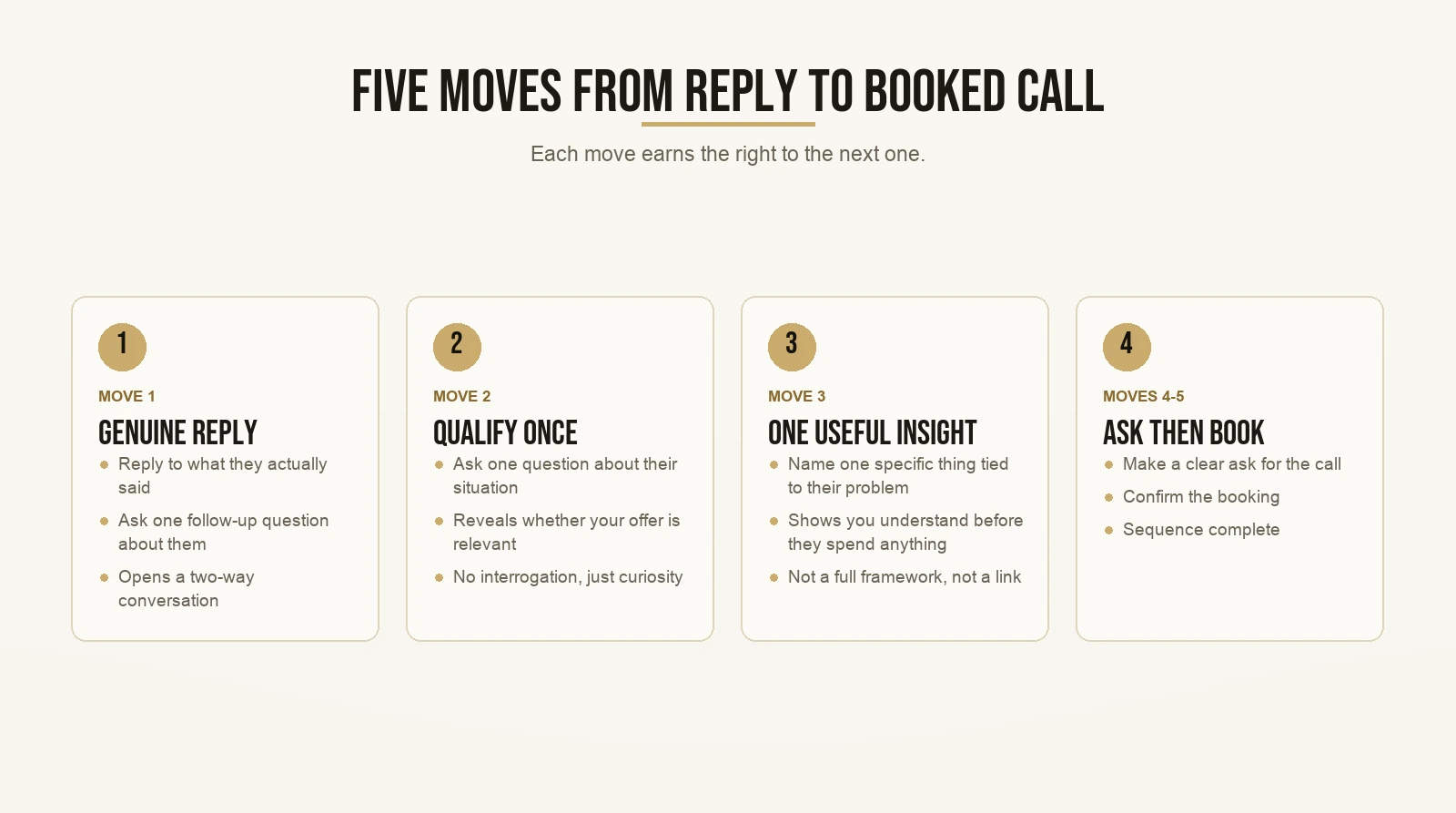
The DM conversation is a five-move sequence. It starts with a genuine reply to something the person already said, runs through a qualifying question, a useful insight, and a clear ask, and ends with a confirmed booking. Do the moves in order. Each one earns the right to the next.
Move One: Start With a Genuine Reply, Not a Pitch
Someone comments on your post. Someone replies to your story. That is your door.
Here is what most coaches do. They get a comment and immediately fire back: “Hey, thanks for watching! I help coaches build their audience. Want to chat?”
That is a pitch disguised as a reply. The person can smell it. The conversation dies.
Here is what you do instead. Reply to the actual thing they said. If they commented “this was so helpful,” ask one follow-up question about them. Something like: “What part hit closest to home for you? The hook angle or the audience targeting?”
One genuine question. That is it.
The person replies because you asked about them, not because you sold at them. And now you are in a two-way conversation. That is the only environment where coaching gets sold.
Move Two: Ask One Qualifying Question
Qualifying is not interrogating. You do not hand them a list of questions. You ask one question that reveals whether this person has the problem you solve.
Here is a concrete example. Say you help coaches build an audience from scratch. Your qualifying question might be: “Are you posting consistently right now, or is that the part you’re stuck on?”
That one question does three things. It shows you are curious about their situation. It tells you where they are in the journey. And it tells you whether your offer is even relevant before you mention it.
For a deeper breakdown of how to run this step without it feeling like an interview, see how to qualify a lead in DMs before you ever mention price.
Move Three: Give One Useful Insight
This is the move that separates coaches who book calls from coaches who just have nice conversations.
When the person names their problem, you give one specific, useful insight tied to that problem. Not a full curriculum. Not a link to your course. One useful thing.
This does two things. It shows you understand their situation. And it makes talking to you feel valuable before they spend anything. That is freaking important.
But Max, how much is too much to give away in a DM?
The mistake is giving either too much or too little. Too much: you dump an entire framework into the thread and they have everything they need. They never book the call. Too little: you say “I can help with that!” and immediately ask for the call. They feel like the insight was just bait.
Find the middle. One insight that names why the problem exists and hints at how to fix it, without mapping out every step.
Then you transition. Something like: “There are a few ways to approach this depending on where you are. Would it be worth mapping that out on a quick call?”
That is your bridge into move four.
Move Four: Make the Ask Once, Clearly
This is the move most coaches dread. And because they dread it, they either never make it or hedge so hard that the ask disappears into politeness.
But Max, what if they say no?
They might. That is fine. A clear no is better than a maybe that fades into silence over three weeks.
Here is the thing. If you have done moves one through three correctly, the ask is not a pitch. It is a natural next step. The person has named their problem. You have shown you understand it. You have given them something useful. Now you are suggesting a short conversation to figure out the right path forward.
The ask should be one sentence. Something like: “Would it make sense to jump on a 20-minute call this week to map out the right approach for your situation?”
No price. No program name. no promises. Just an invitation to a specific, time-limited conversation.
Make the ask once. If they say yes, great. If they say not right now, say: “No problem at all. Let me know if anything changes.” Then let it go.
Do not send five follow-ups. Do not re-explain yourself. One ask, one clear response, and you let the ball stay in their court.
If you want to see how the content itself sets up this entire sequence before anyone DMs, getting clients from Instagram without paid ads maps the full content-to-conversation path.
Move Five: Confirm and Protect the Booking
You got a yes. The person said they would love to chat.
Now your only job is to make the booking easy and protect it.
Send the calendar link in the very next message. Not tomorrow. Not after a summary of what you discussed. The next message.
Once the booking lands, confirm it: “Just saw you booked for Thursday. Looking forward to it.”
That confirmation does two things. It makes the booking feel real and deliberate. And it opens the door for them to ask any final questions before the call.
Stay present in the thread until the call happens. If something comes up on their end, you want to know about it before the call, not two minutes after it was supposed to start.
What Are the Mistakes That Kill a Warm DM Thread?
Five specific mistakes turn warm conversations cold. Each one hits the thread at a different point in the sequence: pitching before qualifying, over-explaining the offer, delayed follow-ups, ignoring the platform’s timing window, and asking for the call before the person has named their problem.
Here is each one in more detail.
Pitching before qualifying. You skip moves two and three and go straight to “Want to hop on a call?” The person has no reason to say yes. The conversation ends before it starts.
Over-explaining the offer. You write a four-paragraph breakdown of your method and who it is for. The DM looks like a landing page. People do not buy from landing pages in their inbox. Keep it human.
The follow-up delay. You have a genuinely good first exchange. Then life gets busy and you wait three days to reply. The energy is gone. The thread restarts cold. The person feels like they are not a priority, because they are not.
Ignoring the platform timing window. Instagram’s Messaging API enforces a 24-hour engagement window. After 24 hours with no interaction from the other person, the automated response window closes. For human conversations, the same dynamic applies. Go quiet and the thread goes cold. Stay responsive and the conversation keeps moving.
Asking for the call before the revelation. The person has not named their specific problem yet and you are already asking for 30 minutes. They say no or they ghost. Wait for the moment when they name it. Then ask.
All five of these are sequence errors. They happen because coaches skip ahead. The fix is not a better script. It is respecting the order of the moves.
Does Profile Size Matter When You Are Selling in DMs?
Profile size matters less than most coaches think. A small account with a clear highlight section, a sharp bio, and content that demonstrates competence will outperform a large account where none of those things are in place. What closes the deal is whether the person believes you can solve their problem, not how many followers they see under your name.
A lot of coaches use “I only have a few hundred followers” as the reason they are not selling in DMs. I get it. But that reason does not hold up.
The follower count is not what closes the deal. What closes the deal is whether the person who just started a conversation with you believes you can solve their specific problem.
That belief comes from your credibility signals. Your highlight section. Your pinned content. The Reels and carousels that tell a cold audience whether you know what you are talking about before they ever send the first message.
Pew Research Center’s November 2025 data puts Instagram at 50 percent of all U.S. adults. A 400-follower account that clearly demonstrates it solves one specific problem well will convert better in DMs than a 40,000-follower account that is trying to speak to everyone.
You can see what that credibility looks like in practice by reading what clients actually say about working with Max.
Build the trust before they DM. Your profile is a credibility engine, not a follow-back machine.
How Does the Platform Reality Change Your DM Strategy in 2026?
Three platform shifts since 2023 have changed how DMs work. End-to-end encryption is gone, Meta AI is now inside the inbox, and Broadcast Channels now support two-way replies. Each change makes human responsiveness more valuable, not less. Advice from before May 2026 may be stale on some of these points.
End-to-end encryption is gone. Instagram removed E2E encryption from all DMs on May 8, 2026. Every message is now a standard Instagram message, visible to Meta, the same way Messenger works. Meta redirected users who wanted private messaging to WhatsApp. For coaches, this changes nothing about the strategy itself. It does mean every message you send should reflect the professional standard you want associated with your name.
Meta AI is inside the inbox. Followers now see two contact lists: real people and AI agents. Your inbox is noisier than it was a year ago. The coaches who get replies are the ones who respond fast and write like a human, not like marketing copy.
Broadcast Channels now support replies. Instagram launched Broadcast Channels in February 2023 as a one-to-many creator tool. By late 2024, replies were enabled. Coaches who use broadcast channels to warm up their audience before DM-ing now have a platform-endorsed, two-way path. A subscriber who has been in your broadcast channel for two weeks has a very different DM conversation than a cold follower who just found you through Reels.
None of these changes break the five-move sequence. They reinforce it. Human, responsive, specific conversations are what the platform is struggling to produce at scale. Being a human who responds promptly and writes like a person is a genuine competitive advantage right now.
What Does a Full DM Sequence Actually Look Like?
Five moves in practice look like this: a genuine reply opens the thread, one qualifying question reveals the problem, a short insight demonstrates competence, a single clear ask invites the call, and a confirmed booking closes the sequence. The whole exchange can happen in under ten messages.
Let me put the moves together in one example so you can see how they connect.
You post a Reel about why posting more often is not the reason accounts stop growing. Someone comments: “This is literally what happened to me. I doubled my posting and got fewer views.”
Move one. You reply: “That’s such a common thing to hit. When the drop happened, were you posting to a general audience or had you defined a specific niche?”
They say: “General, honestly. I was trying to reach as many people as possible.”
Move two. You ask the qualifying question: “Got it. Do you have a coaching offer you’re trying to fill, or are you still in the audience-building stage?”
They say: “I have an offer, but I’m not getting many inquiries.”
Move three. You give one insight: “That’s usually where the drop comes from. When the audience is too broad, the algorithm doesn’t know who to push the content to. It defaults to your existing followers instead of finding new people. Tightening the audience definition tends to fix reach faster than any posting frequency change.”
They say: “That makes total sense. I had no idea those two things were connected.”
Move four. You make the ask: “Happy to dig into your specific setup if you want. Would a quick 20-minute call this week be worth it to map out the right approach?”
They say yes.
Move five. You send the link. You confirm the booking when it lands. You stay present.
That is the whole sequence. No pitch. No pressure. No awkward energy.
I digress for one second: notice what you never said in that thread. You never mentioned a price. You never named a program. You never described what working together looks like. All of that is for the call. The DM’s only job is to get you to the call.
What Happens in the DM Thread After the Call?
The DM thread does not end when the call is booked. It is where you follow up, confirm, and build the relationship that makes the next conversation easier. One message the day after a call that did not close is plenty. Three messages looks like pressure.
If the call was good and they did not book on it: send one follow-up in the thread the next day. Something like: “Good talking through your setup yesterday. Let me know if anything we covered sparked more questions.”
That is it. One message. Not three.
If they booked on the call: send a confirmation in the thread and any prep materials they need before the next step. Keep it warm and professional.
The DM is not just where you close. It is where the relationship lives after the close. And that relationship is the business. A warm audience converts better than any cold ad spend because they already know you. The DM is where that knowing becomes trust, and trust becomes a booking.
Keep the thread professional. Keep it human. Keep responding. That is pretty straightforward, and it is what most coaches fail to do consistently.
Want the templates behind content that actually gets watched? Grab the templates here and start with the first one today.