
Key Takeaways
- Every reply you leave has two audiences: the person who commented and every silent reader in that thread.
- Comments are not a top signal for reaching new people. Watch time, sends per reach, and likes per reach drive distribution to strangers. Comments build relationship history, and that history determines who sees your future posts and Stories first.
- The CCN framework applies to replies, not just videos. Your reply is micro-content visible to your Core audience, your Casual audience, and any New viewer who found the post.
- The comment keyword CTA (“comment GUIDE to get my free resource”) is a setup, not a close. What you do after the automated DM fires is where the relationship actually starts.
- Every reply is either a deposit or a withdrawal from your credibility bank. Lazy replies spend trust you built with your content.
Why do most creators treat the comment section wrong?
Most creators treat how to respond to comments on Instagram as a courtesy task. Be polite. Say thanks. Ignore spam. That is the floor, not the ceiling.
The comment section is a public sales floor. Every reply you leave is visible to every silent reader in that thread, not just the person you are answering. Someone who found your post through Explore or a share reads that reply and forms their first impression of you based on it.
Your reply is not just a message to one person. It is a piece of content with a live audience.
Most creators optimize hard for the content in the post and give up at the caption. But the comment section is where the content keeps working after you walk away. A sharp, specific reply to one question can be more persuasive to a cold reader than the Reel that brought them there.
Treat the comment section like a stage. The audience is always bigger than the one person who asked.
What does the algorithm actually do with your replies?

Comments are not a primary signal for reaching strangers. What they do instead: they build interaction history between you and a specific follower, and that history trains the algorithm to show your future posts and Stories to the people most likely to convert.
Here is the honest version that most articles still get wrong.
Mosseri confirmed in January 2025 that the top signals for reaching people who do not follow you are watch time, likes per reach, and sends per reach. Comments did not make that list. So the advice “reply to get more reach” is working from pre-2025 assumptions.
But here is what comments do that matters far more for creators who are serious about turning followers into clients.
Instagram’s own ranking explainer describes how the feed algorithm works: it tracks your interaction history with a specific account. The more consistently you and a follower exchange comments, the stronger that relationship signal becomes. And the stronger that signal, the more likely your future posts appear at the top of their feed.
For Stories, the same explainer explains that Stories ranking uses “closeness,” meaning your overall relationship with an account, including comment history. A follower who regularly comments and gets real replies from you will see your Stories first.
Read that again.
If your business runs on Instagram, the people most likely to buy from you are the ones who need to see you most consistently. Consistent comment replies train the algorithm to put you in front of exactly those people.
Mosseri’s 2021 explainer adds one important detail: the system looks at recent interaction history. Old comment exchanges decay. You have to keep showing up in the comment section consistently for the relationship signal to hold.
Comment replies do not make your posts go viral. They make your most valuable followers see you first. That distinction is super duper key.
Which two audiences are reading every reply you post?
Two audiences read every reply: the person who commented and every silent reader in that thread. Add the CCN lens and it is actually three tiers. Your reply is micro-content with a live, mixed audience, and most creators optimize for only one of them.
This is where the CCN framework changes how you think about the comment section.
CCN stands for Core, Casual, and New. It describes the three tiers of audience your content reaches. Your Core audience already knows you, follows closely, and trusts you. Your Casual audience has seen your content a couple of times but has not committed yet. Your New audience found this specific post through Explore, a share, or a recommendation, and has no prior context about you at all.
The principle Max teaches is that content should be built to reach Casual and New audiences, not just Core. Your Core audience converts into clients. Your Casual and New audiences grow you.
The same logic applies directly to your replies.
When you leave a reply, your Core audience sees it and it confirms what they already think. Fine. But your Casual audience is watching to decide whether you are consistent. And your New audience, people in that thread who found this post for the first time, sees that reply as their primary data point on who you are.
A reply that says “Thanks!” keeps your Core audience satisfied and leaves your Casual and New audience with nothing.
A reply that teaches something specific, shows a clear opinion, or sparks a follow-up comment works for all three tiers. It deepens trust with the person who commented. It builds a visible track record for every lurker. And it generates notification activity that keeps the thread alive and visible.
Think of each reply as a micro-post. It has a live audience. Give it the same intentionality you would give a caption.
What makes a reply worth writing?
A good reply does at least one of three things: teaches something specific, invites a follow-up that keeps the conversation visible, or demonstrates your actual opinions. If a stranger read only that reply and nothing else about you, would they want to follow you? That is the test.
It teaches. If someone asks a question, give the actual answer publicly. Do not tease or redirect to DM. Answering publicly benefits every reader in that thread, not just the person who asked. A reply that says “great question, DM me for more” looks evasive to every lurker watching. And it spends the trust your post just built.
It invites a follow-up. “Does that help? Curious what you have tried so far” costs you nothing and often turns a single comment into a two or three exchange thread. Instagram’s comment threading, which has been in place since 2017, groups replies visibly under the original comment. A three-exchange thread is three pieces of visible engagement under your post, and the original commenter gets a notification at each step.
It demonstrates who you are. Your voice, your specific take, your real opinion. This is the part most creators skip because it feels risky. But a reply that shows genuine conviction is more persuasive to a cold reader than a dozen polite acknowledgments.
But Max, what about when I disagree with what someone said in a comment?
Great. Say so. Politely and directly. Strong agreement drives shares. Strong disagreement also drives shares. A confident response to a dissenter shows your Casual and New audience that you have actual beliefs and stand behind them. That builds trust faster than any amount of cordiality.
How does the comment keyword mechanic actually work?
You post a video or caption inviting people to comment a keyword like GUIDE. An automated tool sends the resource via DM. The mechanic captures leads well. Where most creators lose the thread is what happens after the DM fires. That is the step that actually matters.
The comment CTA is one of the most direct applications of how comments can drive client acquisition. If you want to see the full range of approaches that generate real replies, this breakdown of Instagram call-to-action examples covers the full spectrum.
The mechanic itself works well. But most creators treat the automated DM as the finish line. It is the starting line.
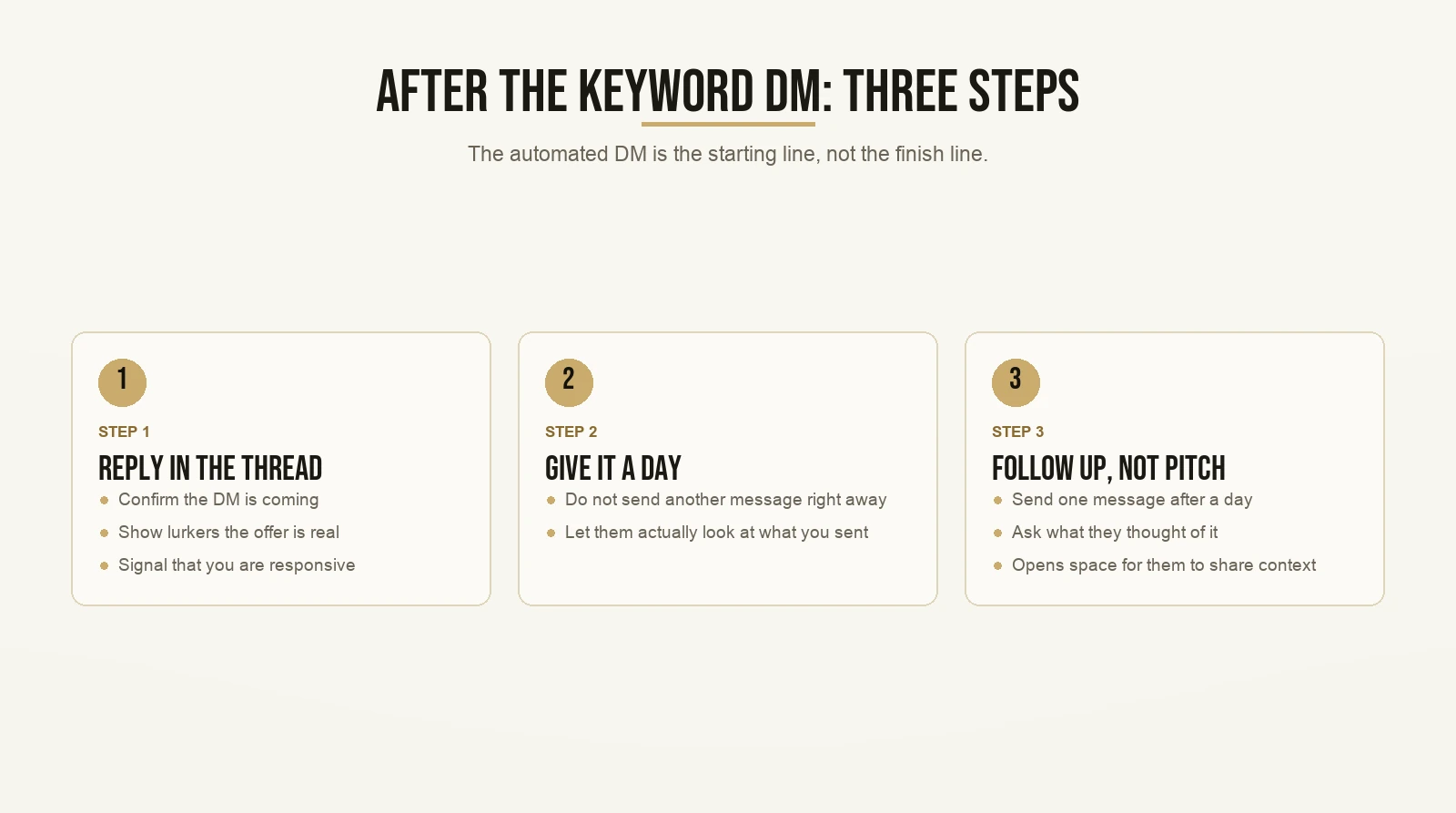
Here is the three-step flow for what to do next.
Step 1: Reply publicly, briefly. When someone comments the keyword, reply to that comment in the thread. Something like: “Sent. Let me know what you think once you check it out.” This confirms to the commenter that the DM is coming. More importantly, it shows every lurker watching that people are requesting this, you are responsive, and the offer is real. That social signal matters.
Step 2: Give it room. The automated DM delivers the resource. Do not immediately pile on with another message. Give the person a day to actually look at what you sent.
Step 3: Follow up with a question, not a pitch. After a day, send one message: “Did you get a chance to look at it? Curious what you thought.” That is a conversation opener. It creates space for them to respond with context, which is what you need to figure out if there is a genuine fit.
The shift from public comment to private DM is one of the most important moves in the client acquisition flow. For a full breakdown of what to say once you are in the conversation, this guide on selling coaching in Instagram DMs covers the sequence without the awkward pitch energy.
Should you reply to negative comments?
Genuine disagreement is worth engaging directly. A confident reply to a dissenter builds more trust with your Casual and New audience than any amount of fan engagement. Spam and personal attacks get deleted, not engaged.
Hold on, Max. What about the people who are just trying to start something?
There are four types of comments worth distinguishing. Each one gets a different response.
Genuine disagreement. Someone thinks your take is wrong and says so in good faith. This is the most valuable type. Engage it. State your position clearly and without hedging. You do not need to convince them. You need to show every reader watching that you can hold your ground. A confident, reasoned reply to a dissenter builds more trust than ten replies to fans.
A real question. Answer it publicly, even if it seems obvious. The most basic questions are the most common ones. Everyone else in that thread who had the same question but did not ask it is reading your reply right now. If your goal is to build a real community and not just a following, this post on community building on Instagram explains how public replies fit into the longer arc.
Spam or bot comments. Delete and move on. No reply.
Personal attacks or bad faith. Delete. Do not engage. Feeding it costs more than ignoring it.
The rule is simple. If the comment moves the conversation forward, engage publicly. If it does not, remove it and spend that energy on a reply that does.
The credibility bank: why lazy replies cost you more than you think

The credibility bank is built on one mechanic: every interaction is either a deposit or a withdrawal. You build trust through consistent, specific, useful behavior over time. You spend it through vague, dismissive, or low-effort responses.
Most people think of the credibility bank in terms of content. Your posts, your Reels, your Stories. But the comment section runs on the same logic, and a lot of creators are making silent withdrawals every day without realizing it.
For a deeper look at how the credibility bank works across your full content strategy, this post on turning your experience into proof that sells breaks the framework down end to end.
In the comment section specifically, here is what deposits and withdrawals look like.
A deposit: “If you are posting Reels under 90 seconds and your watch time is dropping off at the 20-second mark, put a pattern interrupt there. A direct question to camera, a visual cut, or one sentence that reframes what the video is actually about. That break resets the viewer’s attention.”
Neutral: “Thanks!” or a short acknowledgment. Polite. Does not move the needle.
A withdrawal: “Great question, DM me.” This looks evasive to every lurker watching. You just made the room smaller and spent trust you built with the post.
The credibility bank compounds. Creators who consistently leave specific, useful replies in their comment sections build a visible track record that lives in public. Every new person who reads through a thread on your posts and sees you answering questions directly and in detail, that is a deposit with a reader you have never met.
You do not need a large audience for this to work. You need consistent deposits. A creator with 500 followers who leaves genuinely useful replies converts cold readers into followers at a higher rate than someone with 50,000 followers who defaults to emoji responses.
You can see what this kind of consistency looks like in practice on Max’s results page, where creators who apply this methodology document their progress publicly.
How many comments do you actually need to reply to?
Reply to every comment in the first hour after posting. That early engagement velocity matters most to the algorithm. After that, prioritize questions and genuine statements over generic compliments. For posts with high volume, focus on the 10 to 15 most substantive comments.
But Max, I do not have time to reply to every comment. I have a business to run.
Fair. Here is the practical version.
The first hour after you post carries the most weight. Instagram’s ranking explainer describes how quickly a post generates interaction as a factor in how widely it gets distributed. Early replies generate notifications. Notifications bring people back to the thread. That re-engagement adds velocity in the window when the algorithm is paying the most attention.
After the first hour, focus on questions, genuine disagreements, and comments from people who look like your ideal client based on their profile and bio.
For high-volume posts, above 100 comments, pick the 10 to 15 most substantive ones and give those your attention. You are not trying to reply to everyone. You are trying to keep the conversation alive and demonstrate publicly that you actually engage with your audience.
One system that works: check comments at 30 minutes, 2 hours, and 24 hours after posting. That cadence covers the high-value windows without turning the comment section into a full-time job.
When do you take the conversation to DMs?
Move to DMs when the answer requires personal context you cannot give publicly, or when the conversation has become genuinely private. Keep it public when the answer benefits every reader watching. Never deflect to DMs just to avoid answering a question you could answer in two sentences.
Move it when the answer requires context you do not have. If someone asks “Can you help me with my account?” that is too vague to answer usefully in a comment. Reply publicly: “There is a lot that depends on your niche and what you are already posting. Send me a DM and I will take a look.” Honest and pressure-free.
Move it when the conversation is personal. If someone shares something specific about their situation or struggle, acknowledge it briefly in public, then invite them to continue in DM. “That is a real situation. Send me a message and we can talk through it properly.”
Do not move it just to avoid answering. If you have the answer, give it publicly. Deflecting to DMs for questions you could answer in two sentences reads as evasive to every other reader watching that thread. That is a credibility bank withdrawal disguised as helpfulness.
The decision rule is simple: keep it public when the answer benefits the room. Move it private when the value is specific to that one person.
One native surface most creators never use
Instagram’s Visual Replies feature lets you respond to any comment by recording a Reel. The original comment appears as a sticker in the video. This has been available since late 2021. It is freaking underused.
If the same question appears repeatedly in your comment section, record a 30-second Reel answering it and reply to one instance of it with that video. That single reply turns one commenter’s question into content your entire audience sees.
It is not right for every reply. But for recurring questions, for questions from a clearly engaged follower, or for any comment where your answer is long enough to deserve a video, Visual Reply turns a private exchange into a public teaching moment.
That is the CCN principle applied at the micro level. One person asks. Your Core audience, your Casual audience, and any New viewer who watches that Reel all get the answer.
The short version
Here is how to respond to comments on Instagram without overthinking it.
Reply early. Reply specifically. Answer publicly when the answer helps the room. Move to DMs when the conversation needs to be personal. Use comment CTAs to bring people into your DM funnel, then follow up like a human instead of a pitch sequence.
Your comment section is not a feedback form. It is a live, public window into how you think and how you treat people. Every reply is either a deposit or a withdrawal from your credibility bank. Most creators do not realize the account is running.
Boom. Now you do.
Want the templates behind content that actually gets watched? Grab the templates here and start with the first one today.