
Key Takeaways
- Instagram Reels are built to reach people who don’t follow you yet. That is the only surface on the platform designed for discovery.
- 5,000 niche-specific views outperform 500,000 generic fitness views. The right viewer converts. The casual one doesn’t.
- The real buyer objection isn’t “why should I pay for workouts?” It’s “why should I pay for your attention specifically?” Answer that in your content, and inquiries follow.
- The fitness niche is one of the most crowded on social media. You need a Contrarian Ideology to stand out. Generic content is invisible.
- The Credibility Bank is built post by post through mechanism-based content. It’s what turns a cold viewer into a warm inquiry.
- You don’t need a large following. You need the right viewers and a clear path from content to conversation.
Why are so many fitness coaches posting on Instagram and getting nothing?
Because the content isn’t doing a job. Posting workout tips and transformation photos talks to people who already believe in fitness. It doesn’t give a specific person a specific reason to reach out. Volume without a clear point of view is invisible.
The platform is full of excellent trainers. They post workout videos. They share before-and-afters. They put up motivational quotes. And they wait.
Most of them wait a long time.
The problem isn’t effort. Posting more of what everyone else posts is not a strategy for getting online fitness coaching clients. It is a strategy for blending into the background.
Getting clients from Instagram requires a different frame. You are not just a fitness creator. You are someone with a specific point of view that makes a specific type of person think: I need to talk to this person.
This post is going to show you exactly how to build that.
Who is actually on Instagram, and why does it matter for fitness coaches?
According to Pew Research Center, 50% of U.S. adults use Instagram. Among adults ages 18 to 29, that number rises to 80%. That is the highest adoption rate of any platform in that age bracket. Those same adults are also on YouTube, which 84% of U.S. adults use.
Your potential client is almost certainly using both platforms. But they are using them differently.
YouTube is where they go for free workouts. Instagram is where they discover people.
That distinction matters more than any other platform statistic. If you try to compete with YouTube-style content on Instagram, you lose. You can’t out-free-workout the people who built their audiences there.
But you can be the coach who has a specific take on why the standard advice is wrong. And for the right person, that’s exactly what they were looking for.
What does “how to get online fitness coaching clients” actually mean?
It means finding the right viewer, not the most viewers, building their trust through mechanism-based content, and creating a clear path from watching your Reel to booking a call. Follower count is a byproduct, not the goal.
Most coaches read that question and think: how do I get more eyeballs?
Wrong frame.
More eyeballs from the wrong audience doesn’t convert. 5,000 views from people who are your exact ideal client outperforms 500,000 views from the general fitness audience. Every time.
Instagram’s own ranking documentation makes this clear. Reels are built for discovery. The majority of Reels impressions go to people who don’t follow you yet. The niche framing of your content determines who the algorithm sends it to.
A Reel about “why busy dads should stop doing morning cardio” reaches a fundamentally different audience than “five beginner fitness tips.” Same platform, same effort, radically different viewers.
The objection you have to answer before anything else
This is the question I’ve never seen another fitness coaching blog tackle directly.
Your prospect can watch free workout videos on YouTube for the rest of their life. Every major trainer has a channel. Every exercise has ten free tutorials. The information is not scarce.
So why would they pay you?
That is the real objection. If your content doesn’t answer it, your Reels will get views and generate zero messages.
The answer is not “because I’m better than YouTube.” The answer is: because YouTube gives them workouts. You give them you.
Your direct attention. A specific plan built for their body and situation. Accountability on the days they want to quit. A real person who sees their specific problem and has a specific framework for solving it.
That is a completely different product from free video content. The person who invests in coaching is not paying for exercise demonstrations. They are paying for access to one human who is entirely focused on them.
Your content needs to signal that from the first three seconds of every Reel. Not “here are some fitness tips,” but “here is why the standard advice is failing people like you, and here is what I do instead.”
What is Contrarian Ideology, and why does every fitness coach need one?

Contrarian Ideology is the framework for standing out in a crowded niche by being specific about what you actually believe, not just what is generally accepted. It splits into two parts: your contrarian beliefs and your contrarian visuals. For fitness coaches, it is not optional.
If you are one more coach talking about calorie deficits and consistent cardio, you are invisible. Not because the advice is wrong. Because it’s indistinguishable from a hundred posts the algorithm could show instead of yours.
Part one: Contrarian Beliefs. These are the common positions in your niche that you genuinely disagree with, and your specific reasoning for disagreeing.
Here’s how to build them. Write down the three or four most repeated pieces of advice in fitness coaching. Then write down, honestly, what you actually believe instead.
For a coach working with desk workers over 40:
What the fitness industry says: “Cardio is the best fat-loss tool.”
What you believe: “Three heavy compound lifts per week will do more for body composition in this population than five cardio sessions, because it preserves muscle as metabolism slows.”
What the industry says: “Track every calorie from day one.”
What you believe: “Most people who start tracking obsessively are managing anxiety about food, not building habits. I don’t put new clients on tracking until they have consistent protein habits first.”
Those contrasts stop the scroll. Not because you’re being edgy. Because you’re saying something specific that someone has long suspected was true but never heard a coach say directly.
Hold up, Max. Does being contrarian mean I have to disagree with everything? What if I actually agree with a lot of standard advice?
It means being specific about your real beliefs, not manufacturing controversy. You have trained people. You’ve seen what actually works in practice. Most widely shared fitness advice is too broad to help anyone in particular. Your specific take, grounded in your actual experience, is the contrarian position.
Part two: Contrarian Visuals. How your content looks should reinforce the same differentiation. If every coach in your niche films in a gym with upbeat music and white text overlays, that’s the baseline. What you do consistently that differs from that baseline is your visual identity. It doesn’t need to be radical. It needs to be consistent and recognizable.
The platform structure supports this directly. Instagram’s April 2024 update explicitly moved to reward original content from smaller creators. According to Instagram’s head Adam Mosseri: “If you create something from scratch, you should get more credit than if you are resharing something that you found from someone else.”
A generic calorie-deficit post is not original content, even if you filmed it yourself. A specific take on why calorie-deficit advice fails desk workers over 40 is original content. The algorithm treats them differently.
More importantly: the top ranking signal for Reels is reshare. Contrarian content is what people send to each other. Nobody texts their friend a standard form-tip video. They text them the post that made them think: wait, I’ve been approaching this wrong.
What is the Credibility Bank, and how do you build it as a fitness coach?

The Credibility Bank is the accumulation of trust you build post by post through content that explains how your method works, not just that it worked. When a viewer has consumed four or five posts that each teach a specific piece of your thinking, they arrive in your DMs already pre-sold on your approach.
Most fitness coaches want to show proof. Their first instinct is transformation photos.
Those are fine. But they don’t build the Credibility Bank.
What builds it is mechanism-based content. Every time you post something that explains WHY your approach works, you make a deposit. Those deposits compound.
Here’s the difference in practice.
A results post: “My client dropped two clothing sizes in ten weeks.”
A mechanism post: “I don’t give new clients a training program in the first week. I spend the first seven days on one habit: eating protein at every meal. Here’s why that consistently outperforms the program-first approach.”
The mechanism post does two things the results post doesn’t.
First, it filters for the right buyer. Someone who reads your thinking and thinks “that makes sense, that’s exactly what I’ve suspected” is already aligned with your method. They come into the DMs without standard objections. They’ve self-selected.
Second, it answers the YouTube objection. Free workout content shows people what to do. It never explains the thinking underneath. When you explain the thinking, you’re delivering something the free content can’t.
The Credibility Bank compounds over time. A viewer who finds your account and watches five posts that each teach a specific piece of your method is not a cold lead. They know how you think. They understand why they want your specific approach.
You can read more about the teaching philosophy behind this framework in Max’s own words.
How do you actually turn Instagram views into fitness coaching clients?
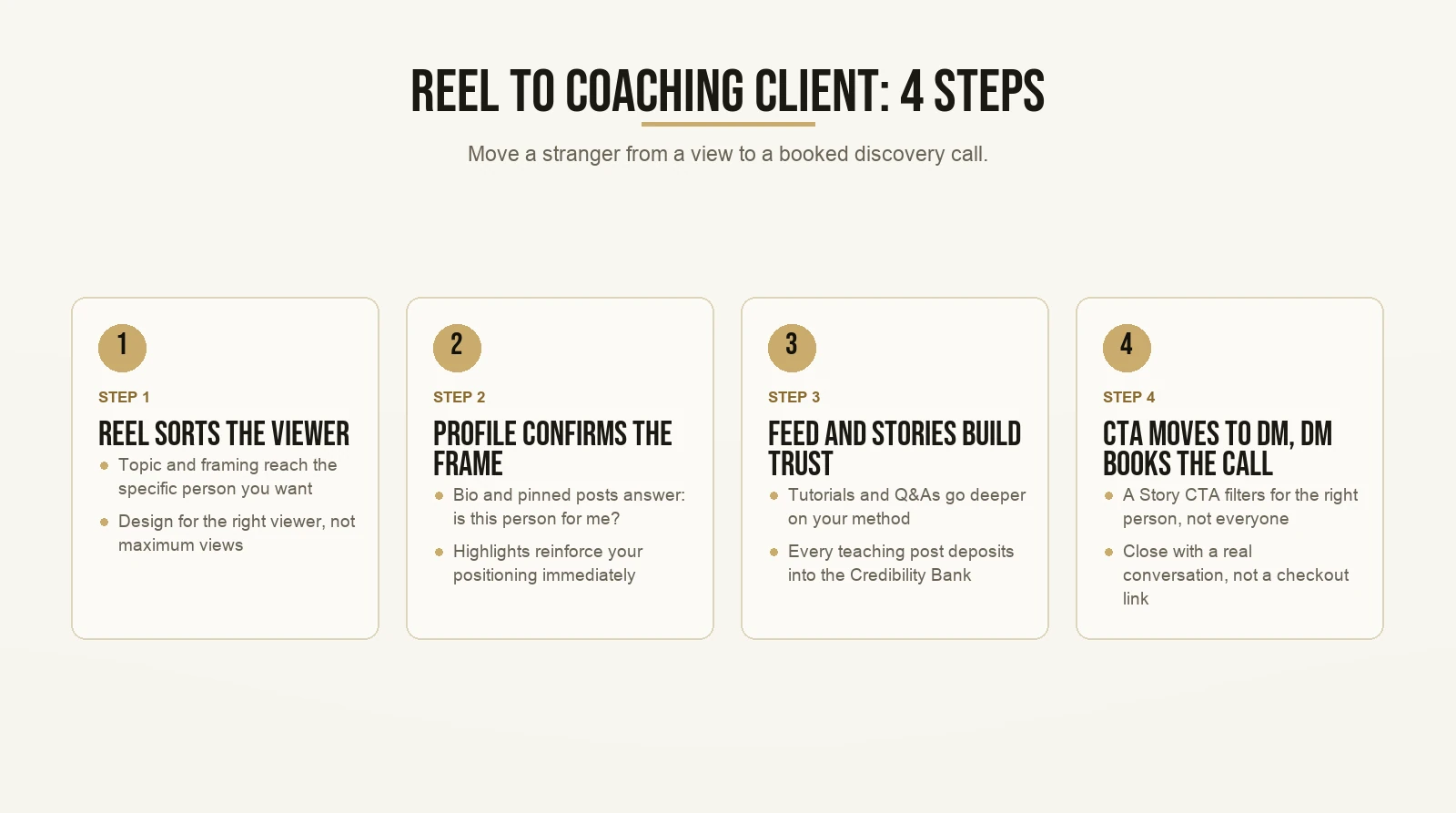
Post a well-framed Reel that reaches the right niche viewer, confirm your positioning on your profile so they follow, build trust with mechanism content in feed and Stories, invite the right person into a DM with a specific CTA, and convert that conversation into a discovery call.
Let me break each step down.
Step one: The right Reel sends the right viewer to your profile. The topic and framing do the sorting. “Strength training for shift nurses” reaches a completely different person than “how to get lean.” Design your Reel for the specific person you want in your DMs, not for maximum views.
Step two: Your profile confirms the frame. Someone who clicks your profile from a Reel is asking one question: is this person for me? Your bio, your pinned posts, and your highlights need to answer that immediately and specifically.
Step three: Feed and Stories build the Credibility Bank. Once someone follows, they see your regular content. This is where you go deeper on your method. Tutorials, Q&As, process content. Every post that teaches your thinking makes a deposit.
Step four: A CTA moves a follower into the DMs. You don’t need a hard pitch. A Story like “if you’re a desk worker over 40 who has tried three programs and nothing stuck, DM me the word STUCK and I’ll send you something useful” is a filter, not a sales pitch. It gets responses only from the right people.
Step five: The DM qualifies and converts. For a one-on-one offer, a conversation is how you close. Not a checkout link. A real conversation where you understand their specific situation and show how your approach addresses it.
For the mechanics of moving someone from a DM to a booked call, the post on finding clients on Instagram covers the conversation structure in detail.
Does follower count matter for getting personal training clients on Instagram?
No. Reels are distributed primarily to non-followers, so a well-framed Reel from a 300-follower account can reach thousands of exactly the right people. What matters is whether the viewer is the right person for your offer, not how many total followers you have.
Hold up. If follower count doesn’t matter, why do bigger accounts seem to get more clients?
Bigger accounts have more Credibility Bank deposits. More content. More proof of method. More people who have been watching for months and are already warm. That compounds trust. But you build that bank by posting consistently, not by waiting to grow first.
DataReportal’s January 2025 data puts Instagram’s advertising reach at 1.74 billion users globally. The audience is enormous. The constraint isn’t reach. It’s relevance. A small account with a sharp contrarian position in a specific niche will consistently outperform a large account posting generic content.
Why is 1:1 coaching the right starting model for most fitness coaches?
One-on-one coaching gives you direct feedback, faster learning about your ideal buyer, and a business model that doesn’t require a massive audience. You need a small number of the right clients, not thousands of followers.
This changes how you think about your content.
You are not broadcasting to the masses and hoping some percentage converts. You are specifically calling in the right person. Every Reel should feel like it was made for one specific type of person and no one else. That’s not limiting. That’s precise.
A client who is genuinely invested in the outcome is also more coachable. They show up. They do the work. They get results. Those results become genuine proof, the kind that goes into your next piece of content without exaggeration.
There is a saying worth keeping here: those who pay, pay attention. A client who made a real investment takes the process seriously. That is not a sales claim. That is how human psychology works. And it means your results as a coach are better when clients have real skin in the game.
What should a fitness coach’s Instagram Reel actually look like?
A well-converting fitness Reel has four parts: the common belief in your niche that you disagree with, your contrarian take, your specific method, and optional social proof. The mechanism matters more than the transformation photo.
Here is the full structure.
Part one: The common belief. Name two or three things standard advice says. Be specific. Not “most coaches get this wrong” but “most fitness coaches tell desk workers to add morning cardio. I disagree, and here’s why.”
Part two: Your contrarian belief. State your take directly. “I think desk workers over 40 get more body-composition change from two heavy lifting sessions per week than from daily cardio. Here is the mechanism.”
Part three: Your method. Explain your specific process. Not your program, your method. “My approach with this type of client focuses on three things: compound lifts, a daily protein target, and two anchor habits that hold up when the schedule falls apart.”
Part four (optional): Social proof. Testimonials or client results. This is the least important part of the Reel. The mechanism is the hook. The proof supports it.
This structure does something most fitness Reels don’t. It doesn’t just show that you’re a coach. It demonstrates how you think. And how you think is the product people are actually buying access to.
For the technical side of filming this on your phone without expensive equipment, the post on how to film Reels on your phone that sell your coaching offer walks through it step by step.
What happens after the Reel? How does a view become a discovery call?
A view becomes a discovery call when the Reel creates a “this person gets my specific problem” moment, the profile confirms it, follow-up content deepens it, and a direct CTA turns that trust into a DM. Each stage has one job and hands off to the next.
The Reel’s job: create the “this person sees my specific situation” feeling. Not “good general tip.” If your Reel could be posted by any fitness coach, it is not doing its job.
The profile’s job: confirm the frame. The viewer is asking “is this person for me?” Answer it in the first two lines of your bio.
The DM’s job: qualify. Not every viewer is a good client. A simple CTA-word filter gets responses only from people ready to engage.
The discovery call’s job: close. For a one-on-one offer, a conversation is the right close. Show you understand their specific situation. Show how your specific method addresses it.
If you want a word-for-word framework for that call, the coaching discovery call script builds it out in full.
Key mistakes fitness coaches make when trying to get clients on Instagram
These are the patterns that keep good coaches invisible.
Posting for existing followers instead of cold viewers. If your content assumes the viewer already trusts you, it’s Feed content, not Reel content. Reels go to strangers. Write them that way.
Leading with results instead of mechanism. A transformation photo proves something worked. It doesn’t explain why. The mechanism is what creates the “I need to talk to this person specifically” response.
Being too broad. “Fitness tips for everyone” competes with every fitness account on the platform. “Strength training for postpartum moms returning to lifting” competes with almost nobody. The narrow frame is not a limitation. It’s a filter.
Waiting to post until the account is bigger. Reels reach non-followers. Your follower count does not cap your reach on that surface.
No clear CTA. A Reel that ends without a direction leaves the viewer with nowhere to go. Give them one specific action. Make it feel like it was written for their exact situation.
Getting online fitness coaching clients from Instagram is a system. It runs on a clear contrarian position, content that deposits into the Credibility Bank, and a path from view to conversation to call. None of those pieces are complicated. But they have to work together.
Once someone is in your DMs and ready to move forward, the next step is the close. The post on how to close high-ticket clients covers the full process.
Want the templates behind content that actually gets watched? Grab the templates here and start with the first one today.