

Key Takeaways
- DM setters are paid three main ways: commission-only, hybrid (base plus commission), or per-call (a flat fee for each qualified lead who shows up).
- High-ticket offers close on calls. Low-ticket offers close on pages. That fork should drive how you structure setter incentives.
- Meta’s 24-hour messaging window resets each time a lead replies but closes permanently if they go quiet. Response speed is a platform constraint, not a preference.
- Commission-only pay does not automatically make a setter a 1099 contractor. The IRS three-factor test weighs behavioral control, financial control, and type of relationship together.
- Your setter’s conversion rate depends on two things you control before any DM gets sent: the credibility bank you have built through content, and whether your CCN is pulling in the right leads.
What Does a DM Appointment Setter Actually Do?
A DM setter monitors your Instagram inbox, responds to warm leads, qualifies them, and books calls onto your calendar. They do not create content, manage ads, or close sales. Their entire job is the gap between a stranger noticing your content and a sales call appearing on your calendar.
The word “warm” is doing a lot of work in that sentence. Meta’s messaging architecture only opens a conversation window after a user acts first – a comment, a story reply, an organic DM. There is no compliant path for a setter to blast outreach to a scraped list of usernames through the API. Every lead in the inbox arrived because they engaged with something you posted.
That fact separates the coaching DM setter entirely from the cold-outreach SDR model used in B2B sales. A cold-outreach setter creates leads. A DM setter converts leads that content already created. The scope is narrower, the conversations are warmer, and the performance metrics are completely different.
If you are still working out what DM appointment setting actually looks like as a system, the full guide to DM appointment setting covers the end-to-end architecture.
What Are the Responsibilities of a DM Appointment Setter?
Day to day, a setter opens new conversations, runs a qualifying script, handles basic objections, and drives toward a booked call. They track show rates, flag no-shows for follow-up, and report volume and conversion numbers back to the coach.
Notice what is not on that list. A setter does not write captions. They do not handle email. They do not manage the coach’s content calendar. Their scope is the DM inbox, full stop. That narrow scope is what makes performance measurable in a way most marketing activities are not. You can see exactly how many conversations they opened, how many calls booked, how many people showed up. That measurability is what makes commission-based pay viable for this role in the first place.
What Are the Three Main Models for Paying a Setter?
The three models are commission-only, hybrid, and per-call. Commission-only means the setter earns a percentage when a client signs and pays. Hybrid adds a modest base on top of that commission. Per-call pays a flat fee for each qualified lead who actually shows up on the call, regardless of whether they buy.
Each one puts the performance risk in a different place.
- Commission-only: the setter carries all the risk. They earn nothing unless a lead converts to a paying client.
- Hybrid: you carry a fixed base cost; the setter shares in the outcome through commission.
- Per-call: the setter is accountable for filling your calendar with qualified, confirmed people – not for closing them.
How Does a Commission-Only Arrangement Work?
In commission-only, the setter earns nothing until a lead becomes a paying client. No base, no hourly rate, no payment for effort or time spent. If calls book but nobody signs, the setter earned nothing that cycle.
The case for it: you pay nothing until results arrive. For a coach who has never hired a setter before and is still figuring out lead volume, commission-only keeps the financial risk low. You are paying for outcomes, not activity.
Hold on. What percentage should I actually offer?
There is no universal benchmark, and anyone who gives you a confident number without knowing your offer price and conversion rate is guessing. What is reliable: higher-priced offers typically carry a lower commission percentage but a larger absolute amount per sale. A small percentage of a high-ticket program can be meaningful setter pay. A large percentage of a low-priced offer may not be worth the setter’s time.
For general context, PayScale’s salary data from 76 U.S. profiles shows commission as an add-on component above a base in traditional W-2 sales floor roles. That data reflects employees in sales floors, not independent DM setters working with solo coaches – use it as floor-level context, not a direct target.
One more thing to know about commission-only: it does not automatically mean the setter is a 1099 contractor. More on that below.
What Is the Hybrid Pay Model for a DM Setter?
Hybrid pairs a modest base with a per-close or per-show commission. The setter has a floor. You have a predictable fixed cost. The upside is still tied to results.
This model tends to attract more experienced setters. They accept a lower commission percentage than in a pure commission deal because they are not carrying all the downside risk. In return, you get someone who shows up consistently even in a slow week, not just when there is easy money on the table.
The tradeoff is obvious. The base goes out whether the week was good or bad. If your content hits a dry spell and DM volume drops, the fixed cost stays fixed. For coaches with consistent inbound – meaning content is running and leads are coming in regularly – the hybrid usually makes more sense than commission-only. You are paying for reliability, and the volume is there to justify it.
What Is Per-Call or Per-Show Pay?
Per-call means a flat fee for each qualified lead who actually shows up to a call. Booked but no-showed does not count. The setter has to qualify the lead, confirm them, and get them to show up. Getting a yes on Monday and having an empty meeting on Thursday is a zero.
This aligns the setter’s incentive exactly with what you actually need: a warm, confirmed person in the seat. It works well for coaches who close their own calls. They are not asking the setter to help with closing – just to fill the calendar with the right people.
Per-call pay can be attractive for experienced setters because the math is predictable. They know roughly how many conversations they can handle per day and what their confirmation rate tends to be. They can calculate earning potential without waiting for a sale to close weeks later.
Does Your Offer Type Change Which Pay Model Makes Sense?
Yes. And this is super duper key.
High-ticket offers close on calls. A prospect is not going to commit a significant amount to a coach they have never spoken to, no matter how good the landing page is. The setter’s job in this model is to move a qualified, interested person onto a phone or video call. The coach closes from there. The setter is a gatekeeper to a call that produces revenue.
Low-ticket offers can close directly from a page. A well-built landing page handles the conversion without a call. The setter role in this model is different – if it exists at all. They might answer a quick question, pre-qualify for a group program, or direct someone to a link. It is lighter work.
But Max, does that mean I don’t even need a setter for low-ticket?
Not necessarily – but the role is different, and so is the right pay structure. If your sales flow does not require a conversation to close, a commission tied to completed sales does not match the scope of work. Per-action pay or a modest base for inbox management fits better. For high-ticket coaching, the setter is genuinely essential to the revenue chain. Pay them like it.
What Is Meta’s 24-Hour Messaging Window and Why Does It Matter?
Meta opens a 24-hour conversation window every time a user sends a message. The window resets each time the lead replies. But if the lead goes quiet, the window closes. The setter cannot reach back out through the standard API until the lead takes another action.
Read that again.
A setter who batches their replies every day and a half is not just slow. They are sometimes locked out of conversations by the platform itself. The window closed while they were waiting.
This has a direct impact on pay structure. If you measure a setter on booked calls and results are disappointing, check response times before you change the pay model or replace the person. You may be losing leads to timing, not to effort or skill.
Meta also allows a Human Agent tag that extends the window to 7 days for support purposes. But Meta’s policy explicitly prohibits using it for promotional content – no deals, offers, or discounts. A setter using that extended window for sales follow-up is outside Meta’s policy. That risk sits with you, not the setter, so your pay structure should not accidentally encourage it.
On Instagram specifically, one-time notification tokens and sponsored messages are only available on Facebook, not Instagram. On Instagram, the standard 24-hour window and the Human Agent tag are the two operating modes. Nothing else.
Build response-time standards into your working arrangement. A commission model tied to booked calls without a response-time requirement is missing a key lever.
Does Commission-Only Pay Make a Setter a 1099 Contractor?
No. Not automatically. Paying someone commission-only does not settle their worker classification. The IRS uses a three-factor test that weighs behavioral control, financial control, and type of relationship together. No single factor is decisive.
Here is what that means in practice.
If you hand a setter a required script, tell them which CRM to use, specify the hours they need to be online, and require daily reporting – that is behavioral control. If the setter works exclusively for you and the work is integral to your revenue – the type of relationship starts to look like employment.
Paying them commission and issuing a 1099 does not override those facts. The IRS does not look at payment structure in isolation. They look at how much control the hiring party exercises over how the work gets done.
A simple way to think about it: the more you direct how someone does their work, the more it looks like employment. The more you specify only the outcome – book X qualified calls per week, however you like – the more it looks like a contractor arrangement.
If the classification is genuinely unclear, either you or the setter can file IRS Form SS-8 for an official IRS determination. If you are scaling to multiple setters, get clarity now rather than after the fact.
How Does the Credibility Bank Affect Your Setter’s Success Rate?

The credibility bank is the accumulated proof of expertise a coach builds through consistent content. Every video is a deposit. Over time, the bank holds the coach’s frameworks, their specific take on the reader’s problem, and demonstrated knowledge of the niche.
When a lead lands in the DMs after watching several videos, they are not meeting a stranger. They have already seen how the coach thinks. They know the coach’s name, face, and angle. The setter is not introducing the coach – they are moving someone who already believes in the coach toward a next step. That is a completely different job than starting from scratch.
Here is a worked example. A parenting coach posts three videos per week for two months. By the time someone slides into their DMs, that person has likely seen eight or ten clips. They know the coach’s specific take on child behavior. The setter opens the conversation and the lead’s first question is about how to get started – not about who the coach even is. The credibility bank did the convincing before the DM window ever opened.
Now flip it. A coach with three total posts has an empty bank. Every DM the setter handles is a cold introduction. Longer conversations, lower show rates, worse conversion. The setter is not failing. The content did not do its job first.
This matters for pay model sustainability. Higher conversion rates mean more output per setter hour. A commission model works when the bank is full because enough leads convert to make the percentage meaningful. When the bank is thin, commission-only can feel punishing for the setter and expensive on a per-booking basis for the coach.
The same principle applies to coaches building a client pipeline after years of relying on referrals – the content system and the setter system run on the same fuel.
What Is CCN and How Does It Affect the Quality of Leads in Your Inbox?
CCN is the targeting mechanism inside your content. It determines whether your videos attract the specific kind of person who would ever buy your offer – or just a broad audience that watches and moves on.
Get CCN wrong and you end up with high inbox volume and low-quality leads. A lot of conversations, very few calls worth having. The setter is not failing. They are working a stream of leads that content attracted for the wrong reason.
Get CCN right and the inbox fills with people who are pre-qualified by the content itself. They have the exact problem your offer solves. When the setter opens a conversation, the lead already understands roughly what this is about. Qualification is shorter. Show rates go up.
Here is a worked example. A relationship coach posts content about “how to communicate better in a relationship” and attracts a broad, curious audience. Then they shift – using CCN – to content about reconnecting with a partner after years of emotional distance. The angle is narrower and speaks directly to someone already in pain and actively looking for a solution. The DM inbox changes almost immediately. The setter books more calls from fewer conversations because the leads coming in are already the right people.
CCN is not about getting more views. It is about getting the right views. Understanding how the Instagram algorithm actually distributes content explains why changing the targeting angle changes who ends up in the inbox – and who the setter is talking to.
How Do You Choose the Right Pay Model?
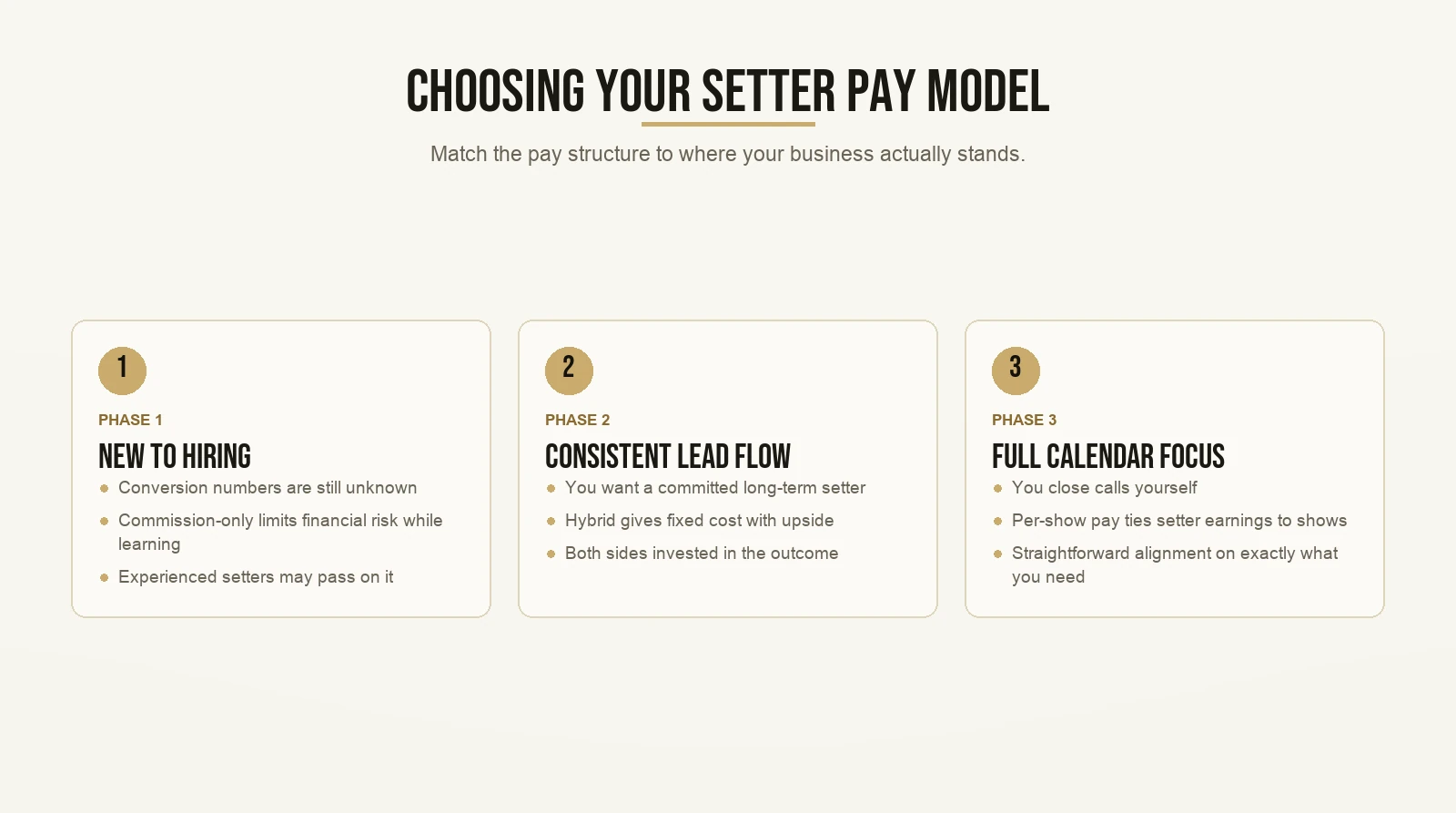
No single model fits every coach. Here is how to think through it.
If you are hiring your first setter and are not sure what conversion looks like yet: commission-only limits financial risk while you learn what the numbers look like. The tradeoff is that experienced setters may pass on it.
If you have consistent lead flow and want a committed setter over the long run: hybrid is usually the move. You carry a fixed cost; they earn upside tied to results. Both sides are invested in the outcome.
If you close your own calls and just need a full, qualified calendar: per-show pay ties the setter’s pay to exactly the thing you need. Pretty straightforward.
Whatever model you choose, build response-time standards into the arrangement. Meta’s 24-hour window means a slow setter loses leads to timing, not lack of effort. If that standard is not part of the working agreement, you will measure the wrong variable when results disappoint.
And before you hire at all, check your credibility bank and your CCN. A setter is a conversion layer. They convert the leads your content creates. If the bank is thin and the targeting is off, the bottleneck is upstream of the setter’s role. Fix that first, then hire to convert what is already coming in.
You can read what coaches who have built this kind of system say about it at the reviews page. The ones who see strong results from DM setters are the ones whose content was already doing the warm-up work.
For the practical side of opening DM conversations correctly, Instagram DM templates for replying to new followers gives a starting framework for how these conversations begin on the right foot.
Want the templates behind content that actually gets watched? Grab the templates here and start with the first one today.