
Key Takeaways
- Your saved posts are market research you already ran. The audience voted with their bookmark.
- A save signals replay intent: the reader wanted to come back and use the information. That is the exact mindset of a course buyer.
- The CCN framework (Core, Casual, New audience) shows you how to take a niche, save-heavy post and build a course title that pulls in buyers far outside your core following.
- Every post you publish is a deposit into your credibility bank. A course launch is a withdrawal. The deposits need to be there first.
- Your course outline is already sitting in your analytics. You do not need to start from scratch.
What does a save actually tell you?
A save is not a like. A like says “I enjoyed this.” A save says “I need to come back to this and use it.” Those are two different signals, and only one of them points toward a course sale. Instagram’s own explanation of how it ranks content, published in May 2023, lists saves as a top-weighted signal for both Feed and Explore because the platform treats a save as durable interest, not a one-time reaction.
Think about what that means for course creation.
The person who saves your Reel about how to write a hook is already telling you they want more of that teaching. They bookmarked it. They plan to return to it. They want to apply it. That is the same mindset as someone who buys a course on writing hooks. The gap between save and purchase is usually just packaging and depth.
When I look at which posts to expand into course content, saves are the first number I check. Not likes. Not follower growth. Saves. That single metric filters out inspiration content and points straight to the mechanism content your buyers are looking for.
Why are your best-performing posts already a course outline?
Your analytics are market research you did not have to commission. Posts with the most saves show which topics your audience wants to apply, not just watch. Group those posts by theme and you have a draft curriculum. The order and depth are the only things left to figure out.
DataReportal’s Digital 2026 Global Overview shows 5.66 billion people now use social media, which is 68.7% of the global population. Instagram users alone average 1 hour 13 minutes on the platform daily. Your audience is already there. They are already telling you what they want. The signal is flowing. You just have to read it.
Open your Instagram analytics. Sort your posts by saves. Look at the top ten. Those posts are the skeleton of your course.
Every one of them answers a real question your audience has. Every one of them proved it could hold attention. Every one of them got bookmarked because someone thought “I will need this later.” That is your curriculum. Your audience built it for you.
How do you know which posts are actually course-worthy?
Not every saved post belongs in a course. Apply three filters. Does the post teach a mechanism, not just inspire? Does it have a longer version hiding inside the short format? And does it connect to other saved posts on the same theme? A yes on all three means this post belongs in your course.
Here is what each filter looks like in practice.
Mechanism versus inspiration. A post about “why most creators give up” is inspiration. A post about “the three places your hook fails and how to fix each one” is mechanism. Course buyers want mechanism. They want to know how something works, not just that they should care about it.
The longer answer. If you answered a question in 30 seconds, is there a 15-minute version hiding behind it? If yes, you have a module. If the Reel already said everything there was to say, it works better as a quick-reference bonus than a full lesson.
The cluster. Look for groups of saved posts that circle the same topic. Three posts about hooks. Four about structuring a lesson. Two about selling without feeling pushy. That cluster is a course section. Each post is a module inside it.
What is the CCN framework and why does it change how you position your course?

This is the part that separates courses that sell from courses that sit. CCN stands for Core, Casual, and New audience. Most creators write for one of these three groups without realizing it, and they almost always write for their Core audience. The problem is that Core content, with its insider language, does not convert new buyers. The CCN filter fixes that.
Here is how each level breaks down.
Your Core audience already follows you. They know your terminology. They save your most technical posts because they are working through the same problems. A Core post uses insider language: “why your hook-to-CTA ratio is off” or “how the CCN levels affect your distribution.”
Your Casual audience is interested in the topic but not committed yet. They understand the pain but not your specific system. A Casual post on the same topic sounds like: “why most people’s hooks don’t work and the fix is simpler than you think.”
Your New audience has never heard of you. They do not even know they have the problem yet. A New audience post attacks a widely held belief to stop the scroll: “You are not getting clients because your content is too good.” Pattern interrupt. Now anyone on the platform can engage, not just people already in your world.
Your best-saved posts are almost always Core level. Deep, specific, niche. That is exactly why they got saved. Your core audience loves them. But your course needs to sell to all three groups, not just the people who are already deep in your ecosystem.
Here is the move. Take your validated Core topic and run it through the CCN filter to find the right title and marketing angle.
Say your save-heavy post is about how to structure a sales conversation in your DMs. That is a Core topic. Your core audience gets it immediately.
At the Casual level, that becomes: “Why most people feel awkward selling in DMs and what to do instead.” Broader pain. Understandable for anyone who has ever tried to sell something and felt weird about it.
At the New audience level: “You are losing clients in your DMs and you do not even know it.” Pattern interrupt. Now even people who have never thought about DM scripts will stop scrolling.
Your course title and your launch content should live at the Casual or New level. Your course content can stay at Core level, because by the time someone buys, they are already converted.
As Max teaches it: “Put it through the CCN filter first and turn it into a topic that is resonatable for a new audience.” That is the move. Validate the content at Core level. Market it at New audience level.
This is very very key. The saves come from Core content. The sales come from CCN positioning. You need both.
What is the credibility bank and why does it matter for course sales?

Every post you publish is a deposit. Every save, reshare, and applied-result comment adds to the balance. When you launch a course, you make a withdrawal. The size of that withdrawal needs to match the size of your deposits. A creator with 80 posts of genuine mechanism teaching has a very different account balance than one who has been posting for three weeks.
A creator who has published ten posts and wants to launch a course is trying to draw from an almost-empty account. The trust is not there yet. The audience barely knows them.
A creator with consistent saves and comments showing that people are actually using the content has a real balance. The course sale makes sense. The audience has already decided they trust this person to teach them.
Hold up. Does that mean I need to post for a year before I can sell anything?
No. It means you build the account first, then draw from it. And if you are reading your analytics correctly, you build that account faster. You post what your audience already saves. You skip the guesswork. You double down on what earns deposits.
The creators who build a credibility bank fast are not guessing at topics. They are watching their saves, noticing which posts make their audience stop and bookmark, and repeating the pattern. That is the whole game.
You can read more about tracking those signals in our guide on reading your Instagram analytics.
How do you actually turn a saved post into a course module?
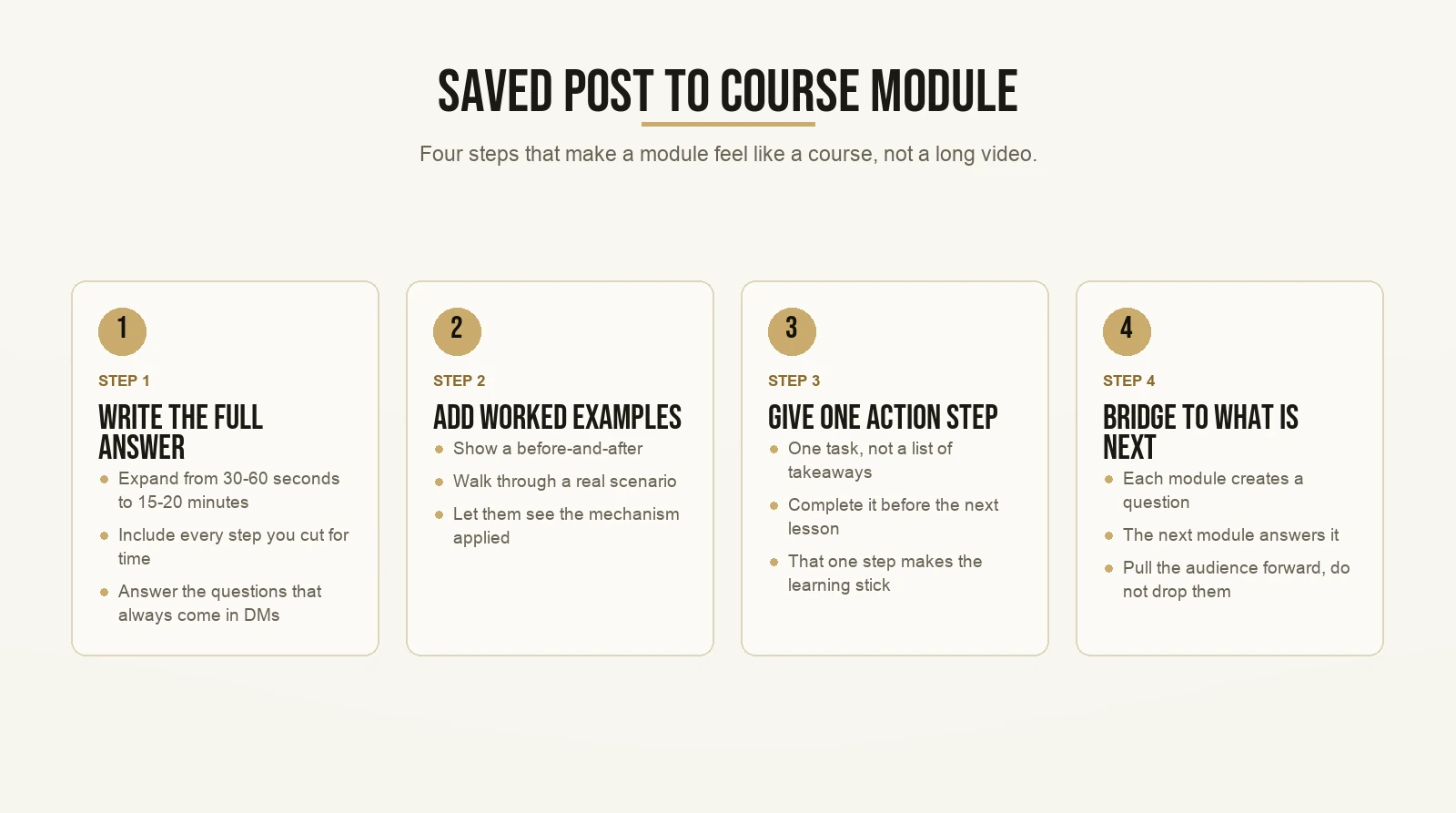
Four steps: expand the full answer beyond the Reel format, add worked examples the original post had no room for, give the viewer one action step before the next lesson, and bridge to what comes next. That structure is what makes a course a course instead of a long YouTube video.
Here is what each step looks like in practice.
- Write out the full answer. Your Reel gave the audience 30 to 60 seconds. Now give them 15 to 20 minutes. Expand every step. What did you cut for time? What questions does this topic always generate in your DMs? All of it belongs here.
- Add worked examples. The post gave them the concept. The module gives them the execution. Show a before-and-after. Walk through a real scenario. Let them see the mechanism applied, not just explained.
- Give them one action step. Not a list of takeaways. One thing to do before moving to the next lesson. “Write three hook options using this format before you continue.” That one step is what makes the learning stick.
- Bridge to the next module. Your course is a sequence, not a pile of posts. Each module should create a question that the next one answers. The audience should feel pulled forward, not dropped.
What order should your modules go in?
Start where your buyer is right now, with the problem, not where you are as an expert. Your New audience content shows the starting line. Your Core content shows the finish. The module sequence is the path between those two points, one clear step at a time.
Most creators default to the order that feels logical to them as an expert. That is usually the wrong order for someone who just bought the course.
Think about where your buyer is when they purchase. They have the problem. They do not yet have the solution. Start there. Show them why they have it. Then introduce the mechanism. Then show how to apply it. Then give them the advanced version.
Your New audience posts already map the starting point. Your Core posts already map the destination. The CCN filter shows you the full arc. Build the modules to match it and your students will move through the course instead of abandoning it halfway.
How do you title your course so new people want it?
Run your working title through the CCN filter. A Core title uses your framework name. A Casual title names the pain. A New audience title attacks a belief. For external marketing, use the Casual or New version. Save the insider language for inside the course itself, where buyers are already committed and ready to learn the terminology.
Most creators name their course after the mechanism. “The Content Sequencing Method.” “The DM Sales System.” These names mean everything to your core audience and nothing to anyone else.
Instead of “The DM Sales System,” try “How to Sign Clients From Instagram Without Feeling Pushy.” Same content. Completely different pool of buyers.
The course content can use all the framework names it wants. By the time someone is inside a paid course, they are ready for the terminology. The title just has to get them there first.
If you want to see how this philosophy shapes Max’s full approach to positioning and content, it is explained clearly for new readers on his reviews page.
What if my posts are too short to fill a whole course?
But wait. My best posts are 30-second Reels. How does that fill an entire course?
The Reel is not the course. It is proof the topic works. Short format is not a limitation. It is a test. A Reel that holds nearly all of its viewers all the way through is a validated topic. The course is the full lesson the short format did not have time to deliver.
Instagram’s own ranking guidance makes clear that Reels are ranked in part on how likely viewers are to watch them all the way through and reshare them. Passing that test means the topic works. The course is what comes after.
And this mechanic is getting more important over time, not less. In October 2025, Meta announced new tools to make Reels easier to find and share on Facebook, including personalized discovery feeds and new sharing features. More reach means more saves. More saves means better data on what your course should cover. The platform is investing in the share graph. You should be reading that graph too.
How do you find your highest-saved posts right now?
Open Instagram Insights, go to Content You’ve Shared, filter by posts, and sort by saves. Your top ten posts are the starting point. Group them by theme and each cluster is a potential course section. If you are on a newer account with limited save data, sort by reshares instead. It is an equally strong signal for buyer intent.
Once you have your list, write a theme name for each cluster. You are looking for three or four topics that keep appearing across different posts. Those repeated topics are your course sections. The individual posts inside each cluster are your modules.
Pretty straightforward. The hard part is not finding the data. It is trusting what the data tells you instead of building what you think your audience wants.
How do you test your course idea before you build the whole thing?
Post two or three new pieces of content that go one layer deeper on your top-saved topic, then watch the saves. If they hold steady, the demand is confirmed. Build after you confirm, not before. You are not guessing. You are responding to a signal your audience already sent.
Take your most-saved cluster. Find the follow-up question it always generates in your DMs. Create two new posts that answer that question. Check whether your audience saves those too.
If they do, you have confirmation. Not a gut feeling. Real behavior from real people who are already in your audience. You get the gist.
What makes someone buy a course instead of just watching your free content?
Free content teaches the what and the why. A course teaches the how at full depth. The gap has to be visible. If your free posts already walk through complete execution, there is no gap left to fill. Design free content that opens a door. The course is the room behind it.
Your free post shows the concept and proves it works. Your course walks buyers through full execution with worked examples for their specific situation and action steps that hold them accountable. That is a different product. The audience knows the difference.
The posts that bridge free content to your paid offer show the concept clearly and stop just before the how-to. Not as a tease. As a real sample of what the depth looks like.
Check out how to create and sell a digital product from Instagram for the full breakdown on positioning that offer once your course is built.
Do I need to post about the course topic before I launch it?
Yes. Freaking yes. Build the save data first, then build the course. Your analytics are real behavior from people who already follow you. A post with above-average saves on your intended course topic is proof the demand exists right now. A survey asking “would you buy this?” is not.
This is super duper key and it is the thing most course creation advice misses entirely.
Other guides tell you to do keyword research or send a poll to your audience. That is not wrong. But it is slower and less accurate than what your own analytics already show.
A bookmarked post is not hypothetical. Someone stopped scrolling, hit save, and decided this was worth returning to. That is a much stronger signal than “I think I might buy this if it existed.”
If you do not have save data on your intended topic yet, build it first. Post consistently on the topic. Track what performs. You can also check out how to repurpose long-form content for Instagram for ideas on how to build that library faster without burning out.
The short version
Here is the whole process in one place.
- Open your analytics and sort your posts by saves.
- Find the clusters. Each cluster is a potential course section.
- Run each post through the three filters: mechanism, longer answer, and connection to other saved posts on the same theme.
- Use the CCN framework to title and market the course at the Casual or New audience level.
- Expand each post into a full module: complete answer, worked examples, one action step, and a bridge to the next lesson.
- Post two or three deeper pieces on your top-saved topic before you launch. Watch the saves. Confirm the demand.
- Draw from your credibility bank. Make sure the deposits are there before you ask for the withdrawal.
Boom. You do not need a new idea. You do not need to start from scratch. Your audience already told you exactly what to build. You just have to read what they said.
Want the templates behind content that actually gets watched? Grab the templates here and start with the first one today.