
Key Takeaways
- The name field is the highest-leverage keyword placement on your profile. The handle is not.
- Instagram’s own guidance is explicit: keywords in captions get posts found. Keywords in comments do not count.
- Alt text was built for accessibility. Since July 2025, Google indexes it. Write it for Google, not Instagram search.
- Instagram capped hashtags at 5 per post in December 2025. Keyword-rich captions are now the primary discovery lever.
- Consistency compounds. The more posts you publish on the same topic with the same keywords, the stronger your search signal becomes.
- The 7 building blocks and the credibility bank are the frameworks that connect viral reach to long-term search authority.
What Is Instagram SEO, and Why Should You Care?
Instagram SEO is how strangers find you through search on the platform. Instagram matches what someone types in the search bar to text across your profile and posts. If your keywords are in the right spots, you show up. If they are not, you do not – no matter how good your content is.
This matters more right now than it ever has. As of July 2025, public professional accounts are indexed by Google and Bing by default. Every caption you write is a dual-purpose document. It either works in Instagram search and Google search, or it works in neither.
Most creators are still treating Instagram SEO like it is optional. It is not. It is the difference between posting into a void and posting to an audience that was already looking for you.
How Does Instagram Search Actually Work?
Instagram search is a text-matching problem first, and an engagement-ranking problem second. When someone types a phrase into search, Instagram scans usernames, bios, captions, and hashtags for that text. It surfaces the best text matches, then ranks them by engagement and account authority. If your text does not match, you are not in the candidate pool – full stop.
Adam Mosseri confirmed in 2021 that “the text you enter in the search bar is by far the most important signal.” Instagram scans your username, bio, captions, and hashtags to match against what a user searched. It is a writing problem before it is an engagement problem.
Here is what most creators miss. Search ranking is completely separate from Feed ranking, Reels ranking, and Explore ranking. Instagram’s own ranking explainer confirms that each surface uses different signals. Going viral on Reels does not automatically make your account findable in search. You build search visibility separately, with text, on purpose.
That means two accounts can have identical follower counts and identical engagement rates, and one will dominate search while the other is invisible – purely because of how they write their captions and set up their profiles.
Does the Name Field Matter More Than the Handle?
Yes. Your name field is your searchable storefront sign. It appears in search results next to your profile photo, and it is the text Instagram uses first when matching a search query to accounts. Your handle is just your address – it lets people tag you and find you when they already know who you are.
Max teaches this using a real client example. The client’s handle was literally just his last name. Nothing keyword-stuffed. Nothing fancy. But his name field said “guitar coach for beginners.” When someone searched that phrase on Instagram, he appeared in results. The keyword in the name field did the job. The handle was just there to let people tag him correctly.
Instagram’s own guidance says to “use a fitting handle and profile name” and to “include relevant keywords and locations in your bio.” The name field is the most visible text element in search results. It is where you put your one primary phrase.
The name field is always step one in any profile audit – it is free to change and it immediately affects how you appear in search. Here is a deeper guide to structuring your full bio for coaches and service providers.
Hold up, Max. Does that mean I need to stuff every keyword I can think of into my name field?
No. You have limited space. Pick the one phrase your ideal client is actually searching for. If you coach women on nutrition, your name field should say something like “Nutrition Coach for Women 40+” rather than listing six keywords nobody searches together. One targeted phrase beats keyword soup every time. Your bio gives you four more lines to expand.
Why Do Captions Beat Comments Every Single Time?
Because Instagram only scans captions when deciding whether a post matches a search query. A post whose caption lacks your keywords will not appear in search for those keywords, even if the comments are full of them. The comment section is invisible to Instagram search.
Instagram says it directly: “For a post to be found in Search, put keywords and hashtags in the caption, not the comments.”
Read that again.
A huge number of creators drop their keywords and hashtags in the first comment to keep captions clean. That habit is actively working against them. Instagram does not pull keywords from comments. It reads captions. Pretty straightforward, but almost nobody acts on it.
Your primary keyword goes in the first line of the caption. That is the line that shows before the “more” cutoff in the feed. It is also the first text Instagram’s crawler reads for relevance. Get the keyword there.
But Max, what if I like writing short captions? Do I have to write a wall of text to rank in search?
No. Three keyword-rich sentences beat three paragraphs of keyword-free storytelling. The goal is clarity about your topic, stated upfront, not length. If you naturally write longer captions because they deliver real value, great – you have more room to include keyword variations. If you write short captions, just make sure the primary keyword is in the first sentence and a related phrase is somewhere in the body. Boom. That is the floor.
How to write captions that engage your audience and rank in search at the same time is covered here.
What Are the 7 Building Blocks and How Do They Connect to Instagram SEO?

The 7 building blocks are Max’s framework for what makes a video spread to new audiences instead of staying trapped inside your existing follower base. Every element in the framework plays a role in both viral reach and search discoverability – and the two are more connected than most people realize.
The first building block is the hook. Here is what most creators miss when they think about Instagram SEO: the hook is also your headline.
The words that open your caption are doing two jobs at once. They stop the scroll for someone already on the platform, and they tell Instagram’s search index what the content is about. If your hook is “I tried three things to fix my morning routine and here is what worked,” that is not a search-optimized hook. Nobody types “things to fix my morning routine” into search.
But if your hook is “How to build a morning routine when you have ADHD,” you have a scroll-stopper and a search match in the same sentence. The phrase “morning routine ADHD” is exactly what that audience types. One sentence does both jobs.
The second building block is the topic. This is where Instagram SEO and content strategy stop being separate jobs – they are the same job. The topic has to be specific enough to rank in search. “Content tips” is not specific. “How to write a Reel hook that stops the scroll in the first second” is specific. “Instagram growth” is too broad. “How to grow an Instagram account without paid ads” is searchable. The specificity that makes a video shareable is the same specificity that makes it findable.
Max’s approach to finding these topics is methodical. Sort your own content and competitor content by most-viewed. Save the hooks that perform. Find the pattern. The pattern is almost always a topic the core audience deeply cares about, phrased so that a stranger who has never seen your account can immediately understand the value. That phrasing is your search keyword.
The other building blocks – format, pacing, social proof, call to action, and completion – feed into watch time and completion rate. Those signals build your overall account authority, which in turn affects how prominently you appear in search results. So the 7 building blocks are not just a viral video system. They are your long-game search authority strategy, built one video at a time.
Does Alt Text Actually Help Your Instagram SEO?
On Instagram itself, probably not in the way most guides claim. Custom alt text is not a confirmed Instagram search ranking signal – and the distinction matters.
Alt text was introduced in November 2018 for accessibility, specifically to help screen readers describe images to visually impaired users. Instagram uses object recognition to auto-generate descriptions. You can override them with custom text. The 2018 announcement does not mention search ranking – not once.
But wait, Max – every article I’ve read says custom alt text boosts your Instagram SEO. Are they all wrong?
They are repeating a claim Instagram never actually made. The confusion is understandable because the advice spread widely, but there is no official statement connecting alt text to Instagram’s internal search ranking. The reason to write custom alt text is real – it is just a different reason than what most people think.
Since July 2025, Google indexes public professional accounts. Google reads alt text when it crawls your posts. That means custom alt text now affects Google image search and Google text search. An alt text like “coach explaining how to structure a discovery call on a whiteboard” tells Google exactly what the image shows and adds a keyword signal to the page. Instagram’s internal search may or may not read it. Google definitely does.
Write custom alt text for every post on a professional account. Keep it descriptive, natural, and keyword-relevant. It takes 15 seconds and it is doing real work on the Google side of your discoverability, even if it is uncertain on the Instagram side.
What Did the July 2025 Google Indexing Update Change?
Starting July 10, 2025, every caption you write on a public professional account is potentially indexed by Google and Bing. A caption is not just for your current followers anymore. It is not just for Instagram search. It is now a piece of web content that Google can surface to someone who has never opened Instagram in their life.
That changes how to think about caption writing from day one. A caption that says “this week’s vibe” is indexed for nothing useful. A caption that says “here is how I structure my content calendar for the week, starting with one anchor topic and batching from there” is indexed for “content calendar,” “content batching,” “anchor topic strategy,” and more.
This is not a different writing style from what already works for engagement. Clear, specific, and front-loaded. The same caption that hooks a human reader is the same caption that tells a search crawler what the post is about. Writing well for your audience and writing for search are the same discipline.
Personal accounts and private accounts are excluded from Google indexing. If you are on a personal profile, switch to a professional account (business or creator) before the indexing benefit applies. The opt-out is in Instagram’s privacy settings under “Searchability” if you want to turn it off – but there is almost no reason to if you are trying to grow.
The Credibility Bank: Why Consistency Is an Instagram SEO Strategy

Max teaches a framework called the credibility bank. The idea is that every piece of content you publish is a deposit. Over time, those deposits build a balance. That balance is what makes someone trust you enough to follow, engage, reach out, or buy.
In the context of Instagram SEO, the credibility bank is also a literal algorithm signal.
Instagram’s search ranking looks at your account’s overall relevance to a topic – not just one post. The more consistently your posts, bio, and name field all point to the same topic, the stronger your relevance signal becomes. An account with 50 videos about productivity systems will outrank an account with one great productivity video surrounded by 49 videos on random topics. Same follower count. Totally different search visibility.
Every keyword-rich caption you publish in your niche is a deposit into your credibility bank with Instagram’s algorithm. Every off-topic post is a smaller deposit – or potentially a signal that your account is not consistently about one thing.
This is why beginners should not expect to rank for competitive search terms on day one. You will not. But if you make consistent deposits – same topic, same keywords, same core message – the balance compounds. Accounts that have been making consistent deposits for six months rank above accounts with larger followings that post sporadically across multiple topics.
You can see how this plays out across different niches in results from creators who have applied this system. The pattern is the same every time: consistency in topic and language beats occasional spikes.
More on building and using this kind of compounding authority is here.
What About Hashtags After the December 2025 Cap?
Instagram hard-capped hashtags at 5 per post as of December 2025, down from a previous soft ceiling of around 30. The cap was confirmed via the official @Creators account. Instagram’s stated reasoning: “using fewer, more targeted hashtags can improve both your content’s performance and people’s experience on Instagram.”
Before that, in late 2024, Instagram removed the ability to follow hashtags. Hashtags no longer distribute your content to followers of a tag. They are categorization signals now – they tell the algorithm what your post is about, but they do not push it to a new audience the way they once did.
What does this mean practically?
Use 3 to 5 specific hashtags that describe exactly what the post is about. Skip broad ones like #motivation or #contentcreator with hundreds of millions of posts – you will be invisible in those pools. Use medium-specificity tags where your post has a realistic shot of being seen.
More importantly: stop treating hashtags as your primary discovery strategy. They never were the most powerful signal for search. Now that hashtag volume is capped and hashtag following is gone, keyword-rich captions are essentially the only remaining lever for in-app search discovery. You get the gist.
This simplifies the job. Write a clear caption about your specific topic. Put your keyword in the first sentence. Add 3 to 5 tight hashtags. That is the whole formula.
What Is the Full Instagram SEO Placement Map?
Here is every placement ranked by how much it affects your search visibility, from highest to lowest leverage:
- Name field. Highest leverage. This is what appears in search results next to your profile photo. Use your one primary search phrase here.
- Bio. High leverage. Reinforce the name field keyword on one line. Add a location or secondary keyword if relevant to your business.
- Caption. High leverage and Google-indexed since July 2025. Primary keyword in the first sentence. Related keywords naturally in the body.
- Hashtags. Medium leverage, categorization only. 3 to 5 specific tags per post.
- Alt text. Low leverage for Instagram’s internal search. High leverage for Google indexing. Write it for Google.
- Handle. Very low leverage for search. Keep it clean and memorable. Do not optimize this at the expense of having a professional handle.
If you are rebuilding your account from scratch, start with the name field. It is the single change with the most immediate impact on search visibility, and it costs nothing to update.
Who Is Actually Using Instagram Search?
Pew Research reported in 2025 that 80% of U.S. adults ages 18 to 29 use Instagram – the highest penetration of any platform in that age group other than YouTube. DataReportal’s 2026 global overview put Instagram at third globally in monthly use, with 55.1% of online adults reporting use in the past 30 days.
Those are not trivia numbers. They are a signal about where your potential clients already are and what they are already doing. People search Instagram for coaches, for creators in their niche, for specific answers to specific problems. When someone is ready to invest in working with someone, they often go to Instagram search first – because that is where they spend their time.
Instagram SEO is not a technical project. It is a writing habit. Put the right words in the right places every time you post. Build the credibility bank deposit by deposit. Over time, an account that does this consistently will outrank accounts that do not – regardless of who has more followers.
The opportunity is wide open right now because most creators still do not know that the name field matters more than the handle, that keywords in comments do nothing, or that captions are now indexed by Google. Get this right while your competition is still guessing.
If you are not showing up in search right now and want to understand what else might be holding your account back, here is a full breakdown of the most common reasons Instagram accounts stop growing.
Frequently Asked Questions
Does Instagram SEO work for small accounts?
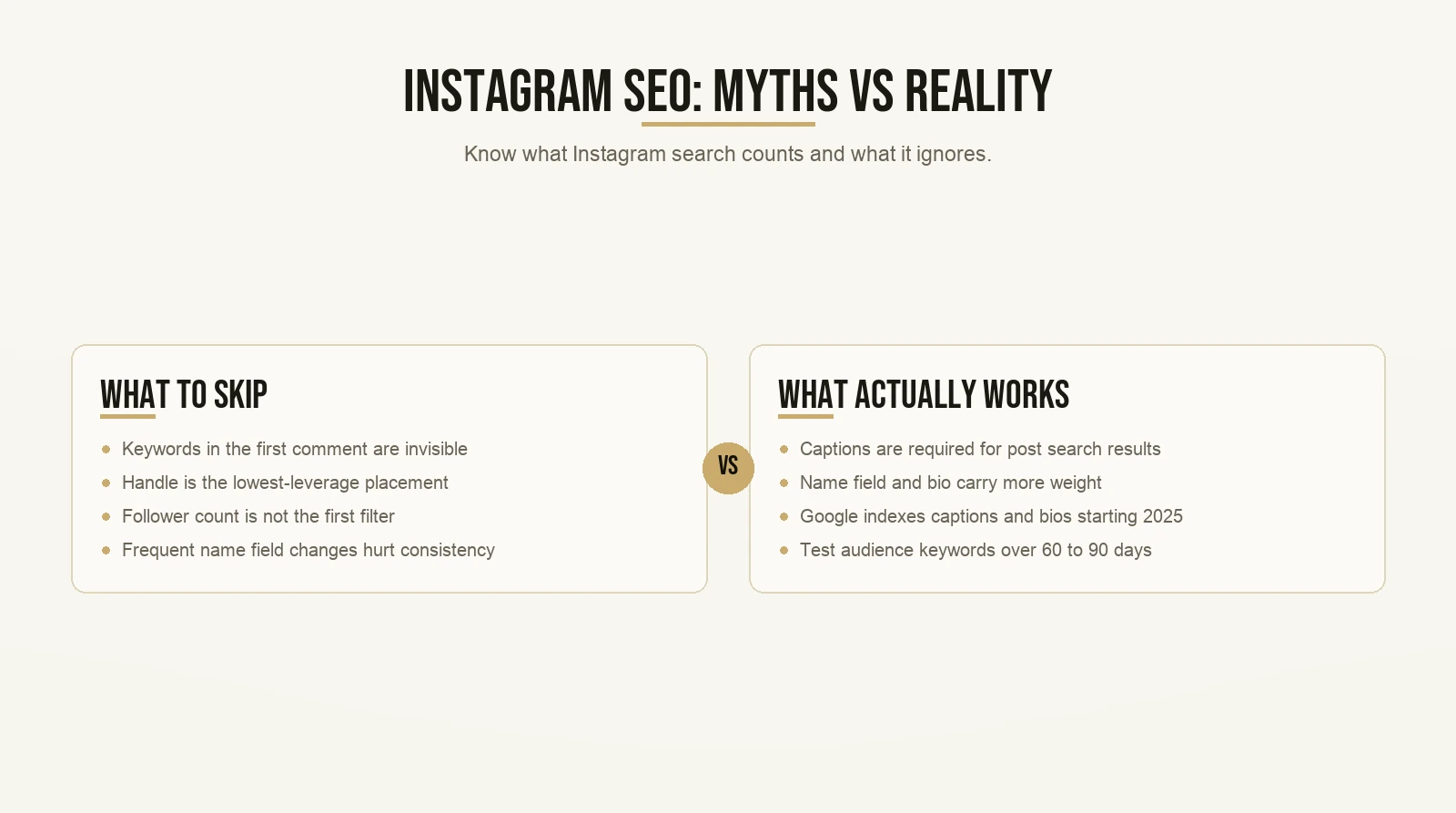
Yes. Instagram search matches text to intent, not follower count. An account with 500 followers and a keyword-optimized name field and caption will appear in results ahead of larger accounts that skip keyword placement. Follower count breaks ties in ranking, but text matching is the first filter you either pass or fail.
Can I put keywords in the first comment instead of the caption?
No – the comment does not count. Instagram’s own guidance states that for a post to be found in search, keywords must be in the caption. A keyword in the first comment is invisible to Instagram search. Put everything that matters in the caption, before anyone has commented.
Do I need to change my handle to rank in Instagram search?
No. The handle is the lowest-leverage placement for search. The name field, bio, and captions carry far more weight. Keep your handle simple and professional. Save your keyword effort for the name field and every caption you write going forward.
Does Google really index Instagram posts now?
Yes, starting July 10, 2025, for public professional accounts. Captions, alt text, usernames, and bios are all considered for relevance in Google search. Personal and private accounts are excluded. You can opt out in Instagram privacy settings under “Searchability,” but most creators who want to grow have no reason to.
How often should I update my name field?
Update it when your primary offer or niche focus changes. If you are testing a new audience keyword, run it for 60 to 90 days before judging. Frequent changes disrupt the consistency signal the algorithm builds over time. Change with intention, not experimentation.
Want the templates behind content that actually gets watched? Grab the templates here and start with the first one today.