
Key Takeaways
- Parenting coaching is unregulated in every U.S. state. No license is required. Certification is a credibility signal, not a legal prerequisite.
- Two programs worth knowing: PCI (one year, 100+ coaching hours required) and Jai Institute (seven months, includes a ready-to-use client curriculum). Neither is currently ICF-accredited.
- ICF credentials (ACC, PCC, MCC) require an ICF-accredited program. Use the ICF Education Search Service to verify any program before you enroll. No parenting-specific program currently appears on that list.
- A certificate is not your offer. The specific result you promise parents is your offer. Most coaches stop short of that step.
- “Parenting coach” is too broad to build content around. A specific sub-niche makes your content reach the right parents and makes your profile make sense at a glance.
- 62% of U.S. adults ages 30-49 use Instagram. That is your buyer. Content is how they find you before they know you exist.
If you are looking into parenting coach certification, you have already read three articles comparing programs. This post is not one of them. This post covers what certification actually gets you, which programs are worth knowing about, and the real reason most certified coaches never fill their calendar.
What Is Parenting Coach Certification?
Parenting coach certification is a credential from a training program that teaches coaching skills, child development frameworks, and how to structure sessions with parents. It is not a government-issued license. No state requires you to hold one before you can call yourself a parenting coach and charge for your time.
The field is unregulated. You can start coaching parents today.
That does not mean structured programs have no value. A good program accelerates your learning. You get real frameworks, practice hours with actual clients, feedback from more experienced coaches, and a community working on the same problems you are. That is genuinely useful, especially when you are building from scratch.
What certification does not do: get you clients. That is a different skill set entirely, and most programs skip it.
There are two main credential paths worth understanding.
The first is a parenting-specific certificate from a program focused entirely on this niche. These go deep on the subject matter. They are not ICF-accredited.
The second is a credential from the International Coaching Federation (ICF). ICF credentials are recognized across all coaching fields. They require an ICF-accredited program and a specific number of logged coaching hours. Currently, no parenting-specific training program sits on the ICF-accredited list. If you want both, you are looking at two separate programs.
Most coaches pick one path based on what their specific clients are likely to ask about. Both paths are legitimate. Neither one fills your calendar by itself.
Do You Need a Parenting Coach Certification to Start Coaching?
No. Parenting coaching is unregulated in the United States. You can legally work with paying clients today without any certificate. What certification does is give a parent who has never heard of you a reason to trust that you know what you are doing.
Think of it as credibility in your bio, not a barrier to entry.
Hold on. If I can start without a certificate, why would I spend thousands of dollars on a program?
Here is the honest answer.
If you already understand how to help parents and you have a clear offer, you may not need a formal program right now. What you probably need is a way to find new clients outside your existing network.
If you are new and want real training in the frameworks parenting coaches use, a structured program is worth it. The coaching hours you log during training also give you real stories and real results to draw on when you start creating content.
What a certificate does not give you: a client acquisition strategy. That is what the rest of this post covers.
Which Parenting Coach Certification Programs Are Worth Knowing?
Two programs have real structure, transparent curriculum, and clear costs. Here is what each actually includes, based on what is published on their own websites.
PCI – Parenting Coaching Institute
PCI’s certification program runs one year, fully online, across four courses. Cohort discussions happen roughly twice a month on Zoom, 90 minutes each. Completing certification requires 100 or more coaching practice hours. Payment can be made in full or split into installments. Graduates are listed in a searchable “Find a PCI Coach” directory.
PCI does not claim accreditation from a named external body. The “Parent Coach Certification” name is their registered trademark.
Jai Institute for Parenting
The Jai Institute program runs seven months, online, at roughly five to seven hours a week. It moves through three phases: personal transformation in weeks one through twelve, coaching skills in weeks thirteen through twenty-four, and a business and practice launch phase in weeks twenty-five through twenty-eight. Graduates receive a ready-to-use client curriculum they can take directly into sessions. Full payment and payment plan options are both available; the installment total is higher than the single-payment price. Jai Institute does not claim ICF accreditation for its own program.
The ICF Path
If you want an internationally recognized credential, the ICF runs three levels: Associate Certified Coach (ACC), Professional Certified Coach (PCC), and Master Certified Coach (MCC). Each level has specific training hour and coaching hour requirements. Full requirements are listed here.
ICF credentials only count hours from ICF-accredited programs. Use the ICF Education Search Service to verify whether any program you are considering is currently accredited. That search tool is the only source of truth. Program pages can describe themselves as designed for future ICF accreditation without actually holding it yet.
If your clients are educated professionals who will Google your credentials, the ICF path carries more third-party weight. If your clients are parents who want proof you can actually help their kid, the depth of the specific program content matters more than the letters after your name.
The Certificate Is Credibility. Your Offer Is What Gets You Clients.

Here is where most parenting coaches stall.
They finish a program. They update their bio. They add a credential after their name. Then they wait. The clients do not come.
The problem is not the certificate. The problem is that “certified parenting coach” is a job title, not an offer. Parents do not hire job titles. They hire someone who can fix the specific problem they are dealing with right now.
This is where two frameworks change everything: contrarian ideology and CCN.
What Is Contrarian Ideology, and How Does a Parenting Coach Use It?

Contrarian ideology is a framework for standing out in a crowded niche by publishing what you actually believe instead of repeating what everyone else in your space already says.
It has two parts: contrarian beliefs and contrarian visuals.
Your contrarian beliefs are the positions you take that contradict the conventional wisdom your audience keeps hearing. Your contrarian visuals are the way your account looks and feels compared to every other account in your niche.
Hol’ up. How contrarian do I actually need to be?
It depends on how crowded your niche is. Parenting coaching is crowded. There are a lot of coaches posting “connection before correction” and “big feelings need big love.” If you post the same content in the same tone with the same visual style, you disappear. You need a real point of view.
Here is how to find your contrarian beliefs. Make a simple table. On the left: the things your audience is constantly being told. On the right: what you believe is actually more accurate or more useful.
What the market says: you need to be calm before your child will be calm.
What you believe is better: calmness follows structure. Parents who lose it every morning are not insufficiently zen. They have no system for the 6:45 a.m. window. Build the system and the calm follows.
That second version is specific. It names a real moment. It implies you have a method. That is what contrarian ideology does for your content. It tells the reader: this coach actually thinks. That is the only reason to keep watching.
Here is another example.
What the market says: you just need to spend more quality time with your kids.
What you believe is better: kids do not need more time. They need you to be fully present for ten minutes instead of half-present for three hours. Most parents already have the ten minutes. They just do not know what to do with them.
See how the second version cuts? It does not contradict everything. It just reframes the diagnosis. That is contrarian ideology done right. It does not need to be divisive. It needs to be specific enough that a parent in the middle of a hard week thinks: finally, someone who gets it.
Contrarian visuals work the same way. If every parenting coach in your corner of Instagram uses soft pastels and motivational overlay text, showing up with a bolder, more direct look stops the scroll. Same niche, different signal. The algorithm notices when people stop. Your contrarian visual style is what earns that pause before they hear your first word.
What Is CCN, and Why “Parenting Coach” Is Too Broad to Build Content Around?
CCN stands for Core Content Niche. It is the framework for getting precise about who you make content for, what specific problem you address, and what distinguishes your angle from everyone else in the space.
Most coaches start with the broadest version of their niche. “I help parents.” That is the problem. “Parents” is not an audience. It is a category. A parent of a two-year-old and a parent of a sixteen-year-old have almost nothing in common as buyers. Content aimed at both converts neither.
Your CCN is the intersection of three things: the specific parent, the specific problem, and the specific result.
Here is what that progression looks like in practice:
- Generic: parenting coach
- Better: behavior coach for kids ages 6-10
- Specific CCN: behavior coach for parents of defiant kids ages 6-10 who want mornings without a battle before school
Want more examples of what a real CCN looks like in this niche?
- Sleep coach for parents of toddlers ages one to four who are still up twice a night
- Parenting coach for single dads navigating co-parenting conflict
- Teen communication coach for parents who feel completely shut out by their 13-to-17-year-old
- Behavior coach for parents raising kids with big emotions who want tools that do not rely on punishment
Notice what every one of those does. It names a parent, a child’s age or stage, and a specific situation that parent is living. Any parent in that situation who sees a post from that coach immediately thinks: this is for me.
Hold on. Won’t going that specific shrink my audience to nothing?
This is the most common objection. The answer is the opposite of what most people expect.
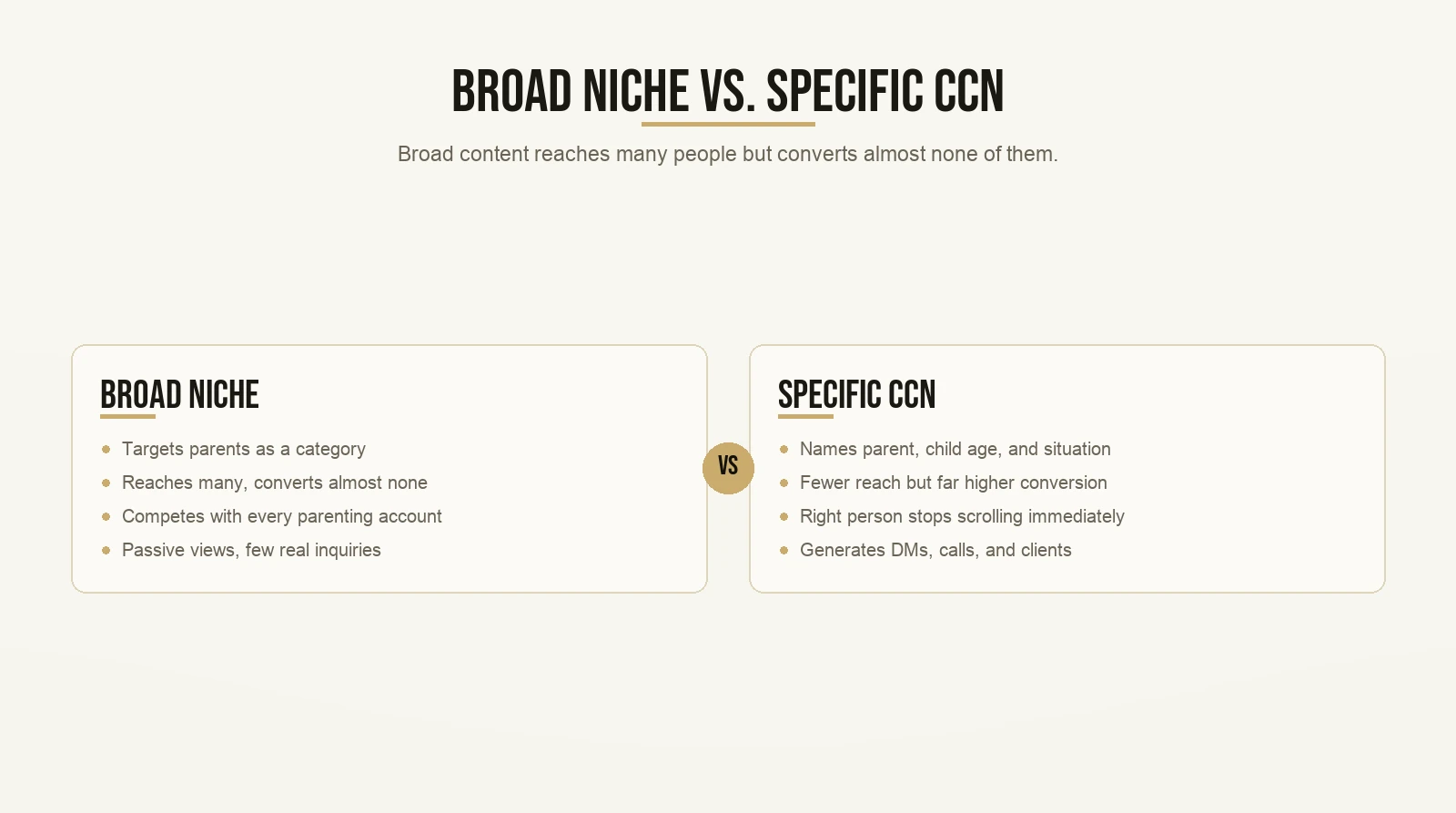
Broad content reaches a lot of people and converts almost none of them. Specific content reaches fewer people on the surface, but the people it reaches see themselves in it immediately. When a reel is titled “why your seven-year-old won’t listen in the morning and what actually works,” the parent of a defiant seven-year-old stops scrolling. That is your client. A thousand people who vaguely relate to general parenting tips are not.
Content that targets your CCN will sometimes pull modest early view counts. That is not failure. Those are the people who DM you, book a call, and become clients. One real inquiry from the right person outperforms five hundred passive views every single time.
Your CCN also shapes your Instagram profile. The algorithm surfaces accounts based on keywords in the name field, not just the handle. If your name says “Parenting Coach,” you are competing with every other account using those two words. If your name says “Behavior Coach for Defiant Kids” or “Parenting Coach for Divorced Moms,” you show up for the parent who typed those exact words into search. That is the parent you want. For a deeper look at building a profile that works as a lead generator, see the Instagram profile template for coaches. The keyword logic there applies directly to what you put in your name field.
That combination, a specific CCN driving a specific profile driving specific content, is what coaches who have built their practices through organic Instagram describe as the thing that changed everything. You can read what that looked like for them and see the pattern clearly.
What Should You Post on Instagram as a Parenting Coach?
Once you have your CCN and your contrarian beliefs, each post is a variation on the same structure: here is the thing you are probably doing that is not working, here is why, here is what works instead.
That three-part structure applies to reels, carousels, and story content. The hook names the specific parent and the specific moment. The body gives the reframe. The close shows what is possible when the reframe is applied.
Content that works well for parenting coaches specifically:
- The daily moment post: name a specific window your client dreads. Bedtime. Dinner. The 20 minutes after school. The morning rush. Name the moment and the thing that usually goes wrong in it.
- The myth bust: one thing the parenting internet told your reader that is actively making things harder for them.
- The one-sentence reframe: a belief swap with no setup, no explanation. Just the before and the after.
- The “what I tell my clients” format: this positions you as the guide with real experience, not just another educator sharing general tips.
For coaches who are new to short-form content, the Instagram Reel ideas for coaches page has formats you can slot your CCN directly into without starting from a blank script.
One thing worth knowing before you start: this is a long-term momentum play, not a launch event. Some posts will not perform. That is the nature of the game. But when you stay consistent, create content for your specific CCN, and keep refining what lands, the content that does perform becomes the foundation you build on. Have fun with it. Coaches who enjoy their content stay consistent. Coaches who treat every post like a test they might fail quit before the momentum kicks in.
What About the Legal Line Between Coaching and Therapy?
Parenting coaching and parenting therapy are not the same thing, and the line matters more now than it did a few years ago.
Coaching works on skills, habits, communication patterns, and behavior change. Therapy treats mental health conditions and requires a state license. You can help a parent stop the yelling cycle at bedtime. You cannot diagnose why a child is acting out, and you cannot treat clinical attachment disorders or trauma responses.
In 2025, Utah passed SB48, legislation that gives regulators tools to investigate coaches who cross into unlicensed mental health practice. It is the first state-level enforcement mechanism of this kind in the U.S. Other states are paying attention.
This is not a reason to avoid parenting coaching. It is a reason to build a clear offer with a defined scope from the start.
Build your work around observable behavior change. Communication scripts. Routine systems. Practical strategies for specific daily moments. Stay in that lane. A parenting coach with a crisp, behavior-focused offer does not have this problem. The coaches who run into trouble are the ones who let sessions drift into processing childhood trauma without the license to do it.
How Do You Move from Certified to Booked?
The fastest path from certification to clients is not better marketing. It is a clearer offer.
A clear parenting coaching offer has four parts: the specific parent you help, the specific daily problem they have, your method, and the observable result they can expect. When someone reads your bio or watches your content, they should immediately know whether you are for them. If they have to think about it, the offer is not specific enough yet.
Once you have that clarity, your Instagram profile is easy to write. Your content has a clear direction. Your first message to a warm lead has a natural agenda. The coaching discovery call script walks through how to structure that first conversation so it converts without feeling like a pitch.
The coaches who stay stuck after certification are the ones who try to be for every parent who might possibly need help. The coaches who grow are the ones who pick a specific parent, name their problem precisely, and show up for that person every day.
The certificate gives them a reason to trust you once they land on your profile. Content is how they find you in the first place. For more on building that full flow from content to conversation to client, the guide to finding clients on Instagram covers the complete sequence.
Want the templates behind content that actually gets watched? Grab the templates here and start with the first one today.