
Key Takeaways
- “I have nothing to say” is a process problem, not a creativity problem. The research step is what most creators skip.
- Outlier research finds video ideas the algorithm already approves of before you spend a minute filming.
- The 7 building blocks break any viral video into parts you can extract, store, and adapt to your own niche.
- The CIA framework (Clarity, Interest, Action) filters ideas down to the ones that are actually ready to film.
- Batching separates research, ideation, scripting, filming, and editing into their own sessions, which builds momentum instead of breaking it.
- A single 30-minute research session can fill a viral library with enough material for several weeks of content.
The Real Reason You’re Running Out of Video Ideas
Blank page. Cursor blinking. You need to post but nothing is coming.
Most creators treat this as a creativity problem. They search for inspiration lists. They scroll for twenty minutes hoping something clicks. They wait for a good idea to arrive.
That is the wrong diagnosis.
The blank page is not a sign you are not creative enough. It is a sign you skipped the research step. You sat down to create without a bank of pre-validated ideas to pull from. You never built the library that makes the blank page impossible.
The fix is not more inspiration. The fix is a research habit that runs ahead of your content schedule. When the research happens in advance, you never sit down to nothing. You sit down to a list of ideas already tested against real audience behavior.
Let’s build that habit from the ground up.
What Makes a Video Idea Worth Making?
A video idea is worth making when the algorithm and your audience have already voted on something close to it. You find that vote through outlier research: identifying accounts in your niche or adjacent niches, applying the 5x rule to find which videos performed far above average, and studying what made those videos spread.
Instagram’s own ranking documentation names resharing as the top predicted action for Reels – above likes, above comments, above follows. That single signal tells you exactly what to optimize for: clarity and portability. The takeaway needs to be something a viewer can pass on to a friend in one sentence.
Outlier research puts you on the right side of that signal before you spend a minute creating.
The 5x rule is your filter. If an account has 10,000 followers and a video has 50,000 views or more, that is an outlier. If an account averages 2,000 views per video and one video has 10,000 or more, that is an outlier. Do not overthink the math. You are looking for the videos that traveled much farther than the account usually goes. Those are the ones worth studying.
What Are the 7 Building Blocks of a Viral Video?

The 7 building blocks are the distinct components inside every video that gets widely shared: the hook, the format, the intro, the body, the payoff, the ending, and the call to action. When you study an outlier video, you extract each building block separately. Those extracted pieces go into your viral library and become the raw material for future content.
The building block most worth logging first is the hook – because the hook actually has three parts, and each part does a different job.
Verbal hook: what is spoken in the first one to three seconds. This is the line the viewer hears before they decide to keep watching.
Written hook: what text appears on screen in the opening frame. This often adds a second layer of attention on top of the audio. Strong written hooks work even on mute.
Visual hook: what the viewer sees in the very first frame. A freaking great visual hook stops the scroll before the audio even registers. The viewer’s thumb pauses based on what they see, then the audio confirms or loses them.
Here is the part most people miss. You do not need to find outlier videos inside your own niche to use this system. A fitness creator’s hook about “the three mistakes people make when they first start lifting” can become a relationship coach’s video about “the three mistakes people make when they start dating again after a divorce.” Same structure. Your topic. Completely original to your audience.
The topic is theirs. The structure is yours to borrow.
The other building blocks matter too. The format is the way the video is filmed or shown on screen – talking head, text overlay, split screen, tutorial, reaction, side-by-side comparison, and so on. The body is where you make the case. The ending is where most creators lose viewers unnecessarily.
There are really only three acceptable endings. The abrupt ending: the video simply stops when the last point is made, giving the viewer no time to scroll away before they have absorbed the takeaway. The loop: the last second of the video matches the first second, pulling the viewer back to the beginning. And the callback: you return to a line or image from the opening and resolve it. Long, drawn-out sign-offs hurt watch rate. Boom – that is the ending section of the 7 building blocks. Short, and that is the point.
When you find an outlier video, log all seven building blocks. Not just the hook. The format, body structure, and ending type are all reusable in their own right.
How Do You Build a Viral Library?

A viral library is a categorized document where you store extracted building blocks from outlier videos. Every hook triplet, format, body structure, and ending type you find goes in it. The library turns one research session into weeks of ready-to-use material.
Here is what each entry should include:
- The verbal hook (the spoken line)
- The written hook (what appeared on screen)
- The visual hook (what was shown in the first frame)
- The format (how the video was filmed or structured)
- Any note on why it worked
You do not need a tool or a subscription to do this. A spreadsheet or a simple notes document works fine. The discipline is logging entries in the moment – not relying on memory later.
Pro tip: when you are scrolling and a video stops you completely, that is the signal. The feeling of being stopped means the hook worked on you. If it worked on you, there is a version of it that will work on your audience. Log it immediately.
Pro pro tip: search by keyword, not hashtag. Instagram removed hashtag follows entirely. Posts are now capped at five hashtags and those hashtags carry almost none of the search function they used to. Caption keywords are now how Instagram indexes content for search. Searching keywords in the app is the primary way to do competitive content analysis in-platform right now.
After four consistent weeks of research sessions – 20 to 30 minutes each – your viral library has enough material that you will not run out of ideas for months. The blank page problem does not come back.
Max, why can’t I just use one of those “100 video ideas” lists I find online?
You can, but here is the problem. Those lists are not validated for your audience. They are not validated for any audience. They are guesses dressed up as strategy. One validated building block from a 5x outlier is worth more than one hundred random prompts from a blog post, because it comes with real evidence that a real audience responded to it.
What Is the CIA Framework and Why Does It Discipline Your Ideas?
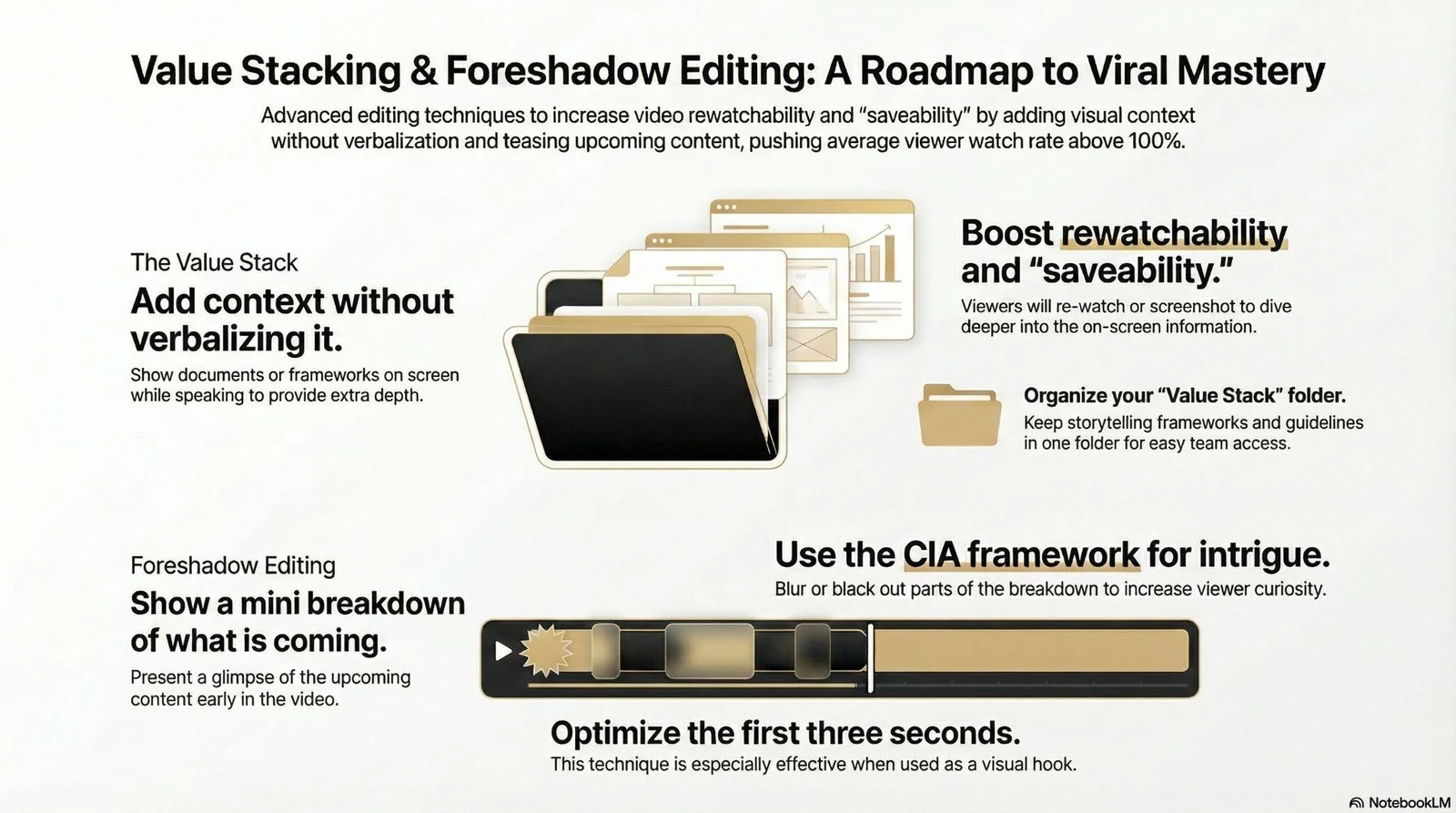
The CIA framework stands for Clarity, Interest, and Action. It is a filter you run on every idea before you write a script. A strong idea passes all three tests: the viewer knows immediately what the video is about (Clarity), the hook is specific enough to stop the right person mid-scroll (Interest), and the video ends with one clear thing the viewer can think or do differently (Action).
The most important letter is the C.
Clarity means one idea per video. Not one main idea plus a supporting idea. One. Single. Idea.
Hold up. Why is that rule so strict?
Because of what happens when the video is ambiguous. Instagram runs separate ranking systems for Feed, Stories, Explore, and Reels. For Reels specifically, the system surveys users on whether the content was worth their time. A video that wanders between two ideas leaves the viewer uncertain about what they learned. They cannot answer that survey in your favor. They do not share it. They do not save it. The algorithm reads the silence and stops pushing the video.
Videos that stall between 100 and 900 views almost always have this problem. Too many points, no single clear takeaway. The viewer closes the video feeling like they watched something but cannot say what it was about. When people can’t summarize it, they don’t share it.
Read that again. When people can’t summarize it, they don’t share it. Resharing is the single most weighted signal Instagram uses to decide whether to keep recommending a Reel. Clarity is not a creative preference. It is a distribution strategy.
Here is the practical test. After you write an idea down, ask: if a viewer finished this video and I handed them a microphone, what would they say they learned? If the answer is “a couple things,” cut the idea in half. Take the more specific half and film that first.
Here is a worked example of the CIA filter in action.
Idea: “How to grow on Instagram” – fails Clarity. Too broad. No single takeaway possible.
Idea: “The three things hurting your Reels reach right now” – passes Clarity (one topic, three specific sub-points all serving it), passes Interest (specific to a problem the viewer already has), passes Action (viewer can check their own Reels against the three things). That is a filmable idea.
Run every idea through the CIA filter before you script it. It takes thirty seconds and it saves you hours of filming content that will not travel.
What Kind of Content Can I Create for YouTube?
Create content that answers one specific question for one specific type of person. The CIA framework applies here exactly as it does for Reels: one idea, one clear takeaway, specific enough that the right viewer immediately knows the video is for them and no one else.
The platform is different from Instagram, but the selection logic is identical. Outlier research, the 5x rule, building block extraction – all of it works on YouTube. If you are a coach building on Instagram and want to see what this looks like applied to Reels specifically, these Reel ideas for coaches walk through the format in that context.
The mistake most beginners make on YouTube is picking topics that are interesting to them rather than topics that already have proven audience demand. Outlier research solves that. Find a channel in your niche, identify the videos that performed 5x above average, extract the building blocks, and then ask: what version of this hook and format works for my specific audience?
What Are Some Good Channel Ideas for 2026?
The best channel idea for 2026 sits at the intersection of something you know deeply and something a defined audience is actively searching for. “Business coach helping women negotiate their first senior role” will outperform “business tips” every time – not because it reaches fewer people, but because it stops the exact right person.
Hold up. Doesn’t that level of specificity limit how many people I can reach?
No. Here is why.
According to DataReportal’s 2026 Digital Overview, approximately 95% of online adults watched online video in the past 30 days. Instagram users average about 1 hour and 13 minutes in the app per day. The audience is enormous. Standing out in a feed packed with content is the constraint, not audience size.
A specific hook on a video about “how parenting coaches get their first paying client without a big following” will stop exactly the right person cold. A broad hook about “growing your coaching business” stops almost nobody, because it sounds like it is for everyone – and content that sounds like it is for everyone is noticed by no one.
Narrower is almost always better. Specific hooks reach smaller audiences with much higher intent. High intent means saves. Saves mean the algorithm keeps showing the video to new people. You get the gist.
If you are a coach or consultant building a presence from scratch and want to see how organic Instagram growth actually compounds over time, this breakdown of organic Instagram growth covers the mechanics in detail.
How to Generate Video Ideas Fast: Batch the Work
This is the step most creators skip, and it is the main reason they feel stuck every week.
The brain works in modes. Ideation mode and scripting mode are different modes. Filming mode and editing mode are different modes. When you sit down to “make a video” and try to do all four at once, you switch modes constantly and never build momentum in any of them. That switching is the stuck feeling. It is not a creativity shortage. It is a task-switching problem.
The fix is batch creating.
Here is what batch creating looks like in practice:
Research session (20 to 30 minutes). Open Instagram or YouTube. Search keywords relevant to your niche. Scroll through results and save every outlier you find. Log each one in your viral library: verbal hook, written hook, visual hook, format, notes. Do not write anything yet. Just collect.
Ideation session. Pull from your viral library. For each hook or format you logged, ask: what version of this fits my niche and my specific audience? Write 10 to 20 rough ideas. Do not judge them yet. Just generate. The goal is quantity, not quality. Quality comes in the next step.
Scripting session. Take the 3 to 5 strongest ideas from your ideation session and write full scripts for each one. Keep each script to the minimum words that carry the maximum meaning. Run the CIA filter: one idea per script, one clear takeaway, nothing extra. Say as little as possible while meaning as much as possible.
Filming session. Film all scripts in one block. You are warmed up after the first one. The second takes less effort. The third takes less than the second. Fifteen minutes in, you are in a groove and knocking out videos one after another. That is the momentum the batch system is designed to create.
Editing session. Edit everything in one block.
Five separate sessions. Each one builds momentum within itself. None of them interrupt the others.
Here is the math that makes this worth caring about. In one 30-minute research session, you can log 8 to 12 outlier videos. Each entry contains multiple building blocks. From that library, a focused ideation session can generate 15 to 20 rough ideas. From those, a scripting session produces 5 to 8 scripts. A focused filming session turns those scripts into 5 to 8 finished videos. That is one to two weeks of daily posting, or five to six weeks of posting three times a week.
One research session. Five to six weeks of content.
The blank page is not your enemy. Skipping the research session is.
But what if my research sessions don’t turn up anything useful in my niche?
That is almost always a sign you are searching too close to home. The best hooks often come from adjacent niches. A parenting coach can pull hooks from fitness content. A relationship coach can pull structure from business videos. A nutrition coach can pull formats from personal finance creators.
You are looking for structure, not subject matter. Once you train yourself to see structure instead of topic, every scroll session becomes a research session. The niche does not matter. The building block is what you take.
How to Create a Creative Video When You Think You’re Not Creative Enough
Creativity in content is recombination, not invention from scratch. You find building blocks that already work, adapt them to your niche and voice, and produce something new from proven parts.
That is not cheating. That is how every serious creator operates.
The 7 building blocks framework makes this explicit. When you extract a hook from an outlier, you are not copying the video. You are noting that a specific structure worked with a specific audience. Then you apply that structure to your own expertise. The content is yours. The framework came from research.
Most of your credibility in the body of any video will come from one of two places: your experience or verifiable facts. That is it. If you are talking about something you have done, your experience is the authority. If you are making a factual claim, the fact is the authority. You do not need income claims. You do not need follower counts. Specific, accurate information is what makes viewers trust you and come back.
If you’re a coach who currently gets all of your clients through word of mouth, the content system above can feel like a lot at first. A useful way to understand the broader framework Max teaches – and why this system is built the way it is – is to read more about the approach here.
How Do You Know If an Idea Will Actually Perform Before You Film It?
Test your hooks on non-followers before you commit to promoting the video. Trial Reels, a feature launched in December 2024 with scheduling added in February 2026, lets you post a Reel to non-followers only for a 24 to 72 hour window. It does not appear on your profile grid or in your followers’ feeds during that period. You see how cold audiences respond before the video ever reaches people who already know you.
This is super duper key for testing hooks specifically. If a video stalls in the trial window, the hook likely needs work. If it travels, push it to your full audience and move on to filming the next batch.
One thing to keep in mind: Instagram extended its original content policy to photos and carousels in April 2026. It previously applied only to Reels. Accounts that primarily repost others’ content stop receiving recommendations to non-followers. Everything you adapt from your viral library needs to be in your voice, in your niche, using your words. The building block is the structure. The content is yours.
Also worth noting: Instagram does not use a single algorithm. Feed, Stories, Explore, and Reels each run separate ranking systems, and Reels specifically deprioritizes videos that are low-resolution, watermarked, bordered, or contain mostly text. Those are easy technical wins. Make sure you are not leaving reach on the table because of a simple format issue.
When the Library Runs Dry: Three Fast Fixes
Sometimes the habit slips and the viral library empties out. Three fast ways to refill it without a full dedicated session:
Go one niche over. Pick an adjacent niche and search a keyword related to it. Find a 5x outlier. Extract one hook structure. Adapt it to your niche. That is your next video idea, found in under ten minutes.
Mine your own best performer. Find the one video of yours that got significantly more views than usual. Extract its building blocks: what was the verbal hook, the format, the single takeaway? Then ask: what related angle have I not covered? The audience that responded to that video will respond to the adjacent content.
Run the CIA filter on ideas you already have. You probably have a notes document somewhere with rough ideas you never filmed. Apply the test: one topic, one clear takeaway the viewer could state afterward, specific enough to stop the right person. The ideas that pass are ready to script today. Some ideas that felt half-formed before will suddenly look complete once you run them through the filter.
The Whole System in Plain Terms
You do not have a creativity problem. You have a process problem. Pretty straightforward.
The process:
- Run a weekly research session. Find outlier videos using the 5x rule. Log every building block.
- Apply the 7 building blocks framework to extract hooks (verbal, written, visual), formats, body structures, and endings.
- Run every idea through the CIA framework: one topic, one clear takeaway, specific enough to be interesting to the right person.
- Batch the work. Research in one session. Ideate in another. Script in another. Film in another. Edit in another.
- Test new videos with Trial Reels before pushing to your full audience.
Run this once a week for four weeks. The blank page disappears. Video ideas stop feeling like a mystery you are hoping to solve and start feeling like output from a system you built on purpose.
Want the templates behind content that actually gets watched? Grab the templates here and start with the first one today.