
Key Takeaways
- A 5-day challenge works because it delivers a visible result in a short time. That result is your proof of competence.
- Each day needs one clear lesson and one action the participant can finish the same day.
- Batch-film all five days before Day 1 goes live. Do not create as you go.
- Use the 7 building blocks framework for every promotional Reel: verbal hook, written hook, and visual hook must all work at once.
- Day 5 should complete the promise and name the gap it cannot close. That gap opens the door to your webinar.
- Instagram Broadcast Channels replace the Facebook Group for challenge delivery. The switch is not optional; it is already the default.
- Contrarian ideology applies here: the challenge is not a sales pitch. It is proof you can teach. Let the teaching do the converting.
What makes a 5-day challenge work for a coach?
A 5-day challenge works because it has a hard end date. People commit to five days when they would bail on 90. By Day 5, if participants have done the work, they have a result. That result builds trust faster than any sales page.
The mistake most coaches make is treating the challenge like a free sample. Five days of partial information designed to make the participant feel like they are missing something. Participants feel it. They leave.
The challenge that converts actually delivers. Give them something real. Let Day 5 be a moment where they look back at Day 1 and can see the distance they have traveled. That is the moment they consider working with you properly.
Here is a useful check. If a participant got nothing else from you and completed only your challenge, would they walk away with something they can use? If the answer is no, the challenge is broken.
What are the best 5-day challenge ideas for coaches?
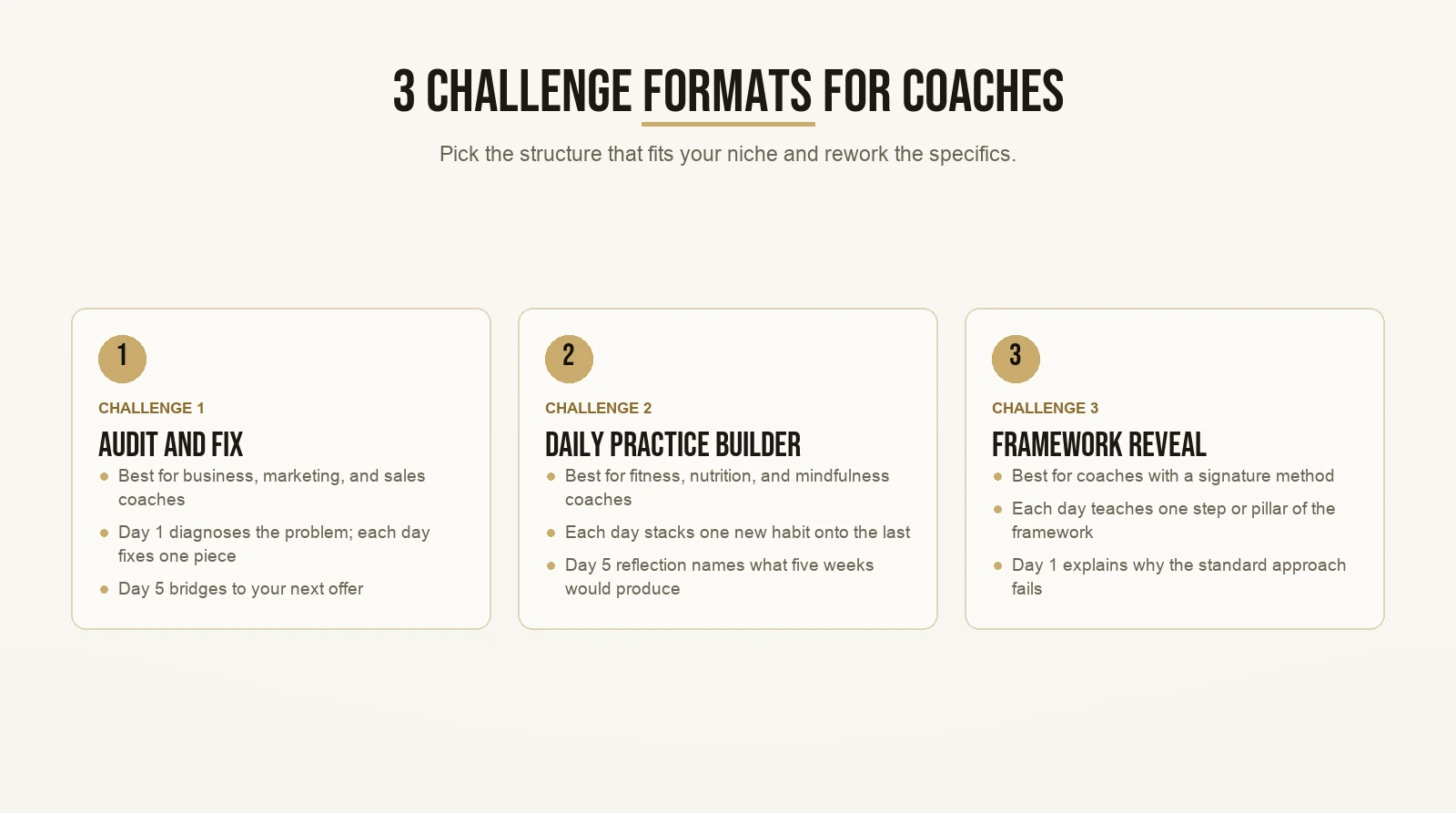
The eight ideas below cover every major coaching niche. Each one comes with a full five-day map: the lesson topic and the one action you assign per day. Pick the structure that fits your niche and rework the specifics.
Challenge 1: The Audit and Fix
Best for business coaches, marketing coaches, and sales coaches. This format works when your ideal client has a system that is not performing. You spend Day 1 diagnosing the problem. Each day after that, you fix one piece.
- Day 1 (Audit): Walk participants through a self-audit checklist. They identify where the current system is leaking. Action: complete the audit and name the one thing they found.
- Day 2 (Foundation): Fix the first and most fundamental problem. This is usually the piece everything else depends on. Action: implement the Day 2 fix.
- Day 3 (Middle layer): Address the second problem, which often reveals itself after Day 2 is fixed. Action: apply the Day 3 adjustment.
- Day 4 (Refinement): Tighten what they built on Days 2 and 3. Remove the friction. Action: run one test of the updated system.
- Day 5 (Integration): Put all four days together. Name the one thing the five days could not cover. That is the bridge to your next offer. Action: run the full system and report the result.
Challenge 2: The Daily Practice Builder
Best for fitness coaches, nutrition coaches, and mindfulness coaches. This format is about compounding. Each day adds one habit. By Day 5 the participant has a five-part routine they did not have on Day 1.
- Day 1: One morning action, five minutes maximum. Make it simple enough that nobody can fail. Action: do it and post a check-in to the channel.
- Day 2: Add a second action, timed differently in the day. Action: do both and notice how they feel stacked.
- Day 3: Add the third action. Teach why the sequence matters, not just the individual habits. Action: full three-habit sequence.
- Day 4: Add the fourth and address the most common reason people drop off. This is where you inject real teaching. Action: do all four.
- Day 5: The full sequence plus a reflection. They write down what changed in five days. Name what five weeks of this would produce. Name what gets in the way. That is the gap your offer closes. Action: full sequence plus written reflection.
Challenge 3: The Framework Reveal
Best for any coach with a signature method or proprietary process. Each day is one step or one pillar of the method.
- Day 1: Introduce the framework by name. Explain why the standard approach fails. Teach Step 1. Action: apply Step 1 to their specific situation.
- Day 2: Teach Step 2. Show how it fits on top of Day 1 with a worked example. Action: complete Step 2.
- Day 3: Teach Step 3. This is usually the most counterintuitive step. Voice the objection they are having and answer it immediately.
- Day 4: Teach Step 4. Show what the result looks like when all four steps are working together. Action: run Steps 1-4 as a sequence.
- Day 5: Full run-through, plus the honest limitation of the framework. Every framework has one. Name it. That limitation is the bridge to deeper work. Action: complete the full sequence on a real situation and share the outcome.
Challenge 4: The Identity Shift
Best for relationship coaches, life coaches, dating coaches, and parenting coaches. This format works when the transformation is internal, not skill-based.
- Day 1: Name the belief that is holding them back. Make it concrete. Action: write it down in their own words.
- Day 2: Introduce the replacement belief. Show the evidence for it. Action: find one example from their own life that supports the replacement belief.
- Day 3: Teach the behavioral pattern that comes from the old belief and show what it costs. Action: track one instance of that pattern today.
- Day 4: Replace one behavior. Give them a specific response to use in place of the old one. Action: use it once and write down what happened.
- Day 5: Reflect on the distance between Day 1 and Day 5. Name the deeper work the five days could not reach. Action: write the version of themselves they are working toward.
Challenge 5: The Quick Win Sprint
Best for any coach whose clients are overwhelmed or stuck.
- Day 1: One action that takes under ten minutes and produces a visible output. Action: share a photo or screenshot.
- Day 2: A second action that builds on Day 1, still small. Action: show the combined result.
- Day 3: A slightly harder step. Teach why this step feels harder than the first two. Action: do the step and report back.
- Day 4: Consolidation. Fix the one thing that is off. Action: submit the revised version.
- Day 5: Present the complete output and name what comes next. Action: share the finished product with the group.
Challenge 6: The Skill Stack
Best for business coaches, content coaches, and sales coaches. Each day is one skill. The skills compound.
- Day 1: The foundational skill. Everything else rests on this. Action: practice it in a low-stakes context.
- Day 2: The second skill. Show how it fits on top of Day 1. Action: use both skills together once.
- Day 3: The third skill. This one is usually the most visible. Action: post or share the output publicly.
- Day 4: The fourth skill. Address the most common mistake at this stage. Action: apply the correction.
- Day 5: Use all four skills together in one execution. Action: produce a complete output using the full stack.
Challenge 7: The 5-Day Clarity Sprint
Best for coaches who work with clients experiencing decision paralysis or unclear direction.
- Day 1: Diagnosis. Most people think clarity is missing information. Usually it is conflicting values. Action: write out the two things that are in conflict.
- Day 2: Values audit. Get clear on what actually matters most. Action: rank the top five values and explain why each one is there.
- Day 3: Map the options. Evaluate each path against the values from Day 2. Action: complete the values-options matrix.
- Day 4: Name the fear behind the hesitation. Action: write out the worst-case scenario and the actual probability of it.
- Day 5: Make the decision and take one action within 24 hours. Name the support structure they need to stay on course.
Challenge 8: The Relationship Repair Sprint
Best for relationship coaches, parenting coaches, and couples coaches.
- Day 1: Name the pattern. Most relationship problems are patterns, not incidents. Action: identify one recurring pattern and describe it without blame language.
- Day 2: Trace the pattern back to its source. Action: write one sentence about where this pattern likely started.
- Day 3: Introduce one new behavior in a low-stakes moment. Action: use it once and note the other person’s response.
- Day 4: Teach the repair move. When the pattern repeats, how do you interrupt it? Action: practice the repair move.
- Day 5: Reflect on the week. Name what shifted. Name what remains. The thing that remains is the gap your deeper work closes.
How do you film all five days without burning out?
Batch-create all five days in a single session before the challenge starts. Record Day 1, then Day 2 right after while you are already in teaching mode. By Day 3 you are warmed up. Trying to film each day live leads to drop-off and inconsistent quality.
Most coaches make a costly mistake when they run challenges. They film each day’s video the morning of. Day 1 is great. Day 3 is fine. Day 5 is recorded in a bathroom while the kids are asleep.
Here is what works instead. Set aside one focused session before the challenge starts. Record Day 1, then Day 2 right after while you are warmed up. By Day 3 you are in the groove. Days 4 and 5 feel easy because the thinking is already flowing.
This is the same reason writing three scripts in a row is easier than writing one. The first one costs you. The second one costs you less. By the third, you are just knocking them out. Momentum-based tasks work that way.
Batch all five days before Day 1. Schedule them. Then run the challenge without scrambling.
How do you use Reels to fill your challenge?
Create one fifteen-to-thirty-second Reel per day that teases that day’s lesson. Post it the day before or the morning of. Use Trial Reels to test which hook pulls non-followers first. The ones that get traction become your promotion clips.
This is where the 7 building blocks framework comes in. Every Reel you make for the challenge needs three hooks working at once.
The verbal hook is what you say in the first two seconds. “Most coaches run Day 3 of their challenge completely wrong.” That is a verbal hook.
The written hook is the text on screen. It does not have to repeat the verbal hook. It can add a second layer. “Day 3 mistake that kills every challenge.”
The visual hook is what is shown. A talking head with a plain background is the weakest option. Show a screen recording of a tool. Show a checklist with one item circled. Show before-and-after. The visual hook is often the one that stops the scroll.
The other building blocks matter too: format, script, video angle, and body. But if the hook trio is weak, none of the rest matters. The video does not get watched.
“Hold up. Do I really need a different hook for every single day’s Reel?”
Yes. The Day 1 Reel teases a different lesson than the Day 4 Reel. Reusing the same hook format is fine. Reusing the same hook is not.
After creators started using Trial Reels, 80% of those who saw increased reach gained it from non-followers. The feature sends your Reel to non-followers first before deciding whether to show it to your current audience. This removes the risk of testing a new hook with the people who already follow you.
75% of Instagram content recommendations in the US now come from original posts. Meta increased the preference for original content by 10 percentage points in late 2025. Challenge promo content you create from scratch gets algorithmic lift. Old repurposed clips do not carry the same weight.
Why do challenges convert better than free content?
Because challenges create commitment. When someone watches a Reel, they consume and scroll on. When someone joins your challenge, they opt in. That opt-in changes the relationship. By Day 5, they have made a small decision in your direction every single day.
That stack of decisions is why Day 5 converts better than any cold pitch. The participant has five days of evidence that you can teach. You have not claimed to be good. You have shown it. That is a very different conversation.
What is a 30-day challenge, and why do they work?
A 30-day challenge is a commitment device built on habit formation. The psychology works: repeated daily action over several weeks creates new default behaviors. For the participants who finish, the transformation is deeper than a five-day format can produce.
The problem is drop-off. Completion rates crater around Day 10 for most public challenges. People get busy. The initial energy fades.
A 5-day challenge is a proof-of-concept. Short enough that almost anyone will finish it. The transformation is smaller, but the completion rate is much higher. And completion is what converts.
For coaches, the 5-day format is the better starting point. Run it successfully once. Measure the conversion from Day 5 to booked calls or webinar registrations. Then decide whether a longer format fits your audience.
What happens after Day 5?
Day 5 should complete the transformation the challenge promised. Then it should name the gap it could not close. That gap is the invitation to the next step. For most coaches, that next step is a webinar, and the challenge is what fills the room.
Day 5 does two things. First, it delivers. The participant finishes and feels they got something real, not a teaser.
Second, it names the honest limitation. Not in a manipulative way. In a straightforward way.
Here is what that sounds like. “We covered the five core steps this week. You have the foundation. What we could not cover in five days is the part that determines whether this sticks long-term. That is what the next step is for.”
The challenge is the top of the funnel. The webinar is where you make the case for your program and take the conversion. If you want to understand how the webinar fits into the full structure, the post on how to build a webinar funnel maps the whole path from challenge sign-up to paying client.
Where do you actually deliver the challenge?
Not in a Facebook Group. That recommendation appears on most challenge guides because it was accurate a few years ago. It is stale now. Instagram Broadcast Channels are the modern alternative for any coach already building on Instagram.
Creators and followers exchange over 1.5 billion messages on Instagram Broadcast Channels every month. Since late 2024, channels support replies (followers can respond to each other), custom prompts for daily check-in threads, and creator insights including total interactions and poll votes.
Instagram Broadcast Channels support text, photos, videos, voice notes, and polls. Up to one million people can join. You post the daily content. They respond, react, and vote. You can run a full accountability loop inside your channel without asking anyone to join a third platform.
“But Max, what if I already have an active Facebook Group?”
Keep it. But build the channel alongside it. Your Instagram audience should not have to leave Instagram to participate in your challenge. The smaller the friction, the higher the completion rate.
If you want the full setup guide for the signup flow and delivery mechanics, the post on setting up a challenge on Instagram covers the infrastructure in detail.
What are some challenge ideas for self-improvement?
These six work across any coaching niche. Adapt the topic and specific exercises to your protocols. The structure is the frame. Your expertise fills the content inside it.
- 5-Day Morning Ritual: One new morning habit per day, five days, five habits compounding.
- 5-Day Inbox Zero Sprint: One communication system adjustment each day. Works well for business and productivity coaches.
- 5-Day Clarity Sprint: From Challenge 7 above. Diagnose, audit, map, identify, decide.
- 5-Day Content Sprint: Write and post one piece of content each day. For coaches who also teach content creation, the video ideas guide keeps topic selection fast when you are batch-filming.
- 5-Day Body Reset: One sustainable behavior per day: sleep, movement, hydration, food timing, and stress. Not a diet.
- 5-Day Relationship Reset: Five days of one intentional action with one important relationship. Works for relationship coaches, parenting coaches, and couples coaches.
Any of these can be made niche-specific. A fitness coach runs the Body Reset with their exact protocols. A parenting coach runs the Relationship Reset for parent-child dynamics. You get the gist.
How does contrarian ideology fit into a 5-day challenge?

Most coaches run challenges as teasers. Five days of partial information designed to make the participant feel like they need the full paid program. Contrarian ideology flips this: give away the full mechanism, not a preview.
Contrarian ideology is the principle that the best marketing does not look like marketing. It looks like teaching. The challenge that gives everything converts better than the challenge that withholds. Here is why.
“But if I give away everything, why would they buy?”
Because knowing and doing are different. Your participant can know exactly what to do and still need your help to do it. The challenge proves you know how to teach. Your program proves you know how to coach. Those are different offers. The challenge earns the right to make the second one.
This approach also surfaces the most committed buyers you will ever find. They are the participants who tried the challenge, did the work, and hit a wall anyway. They are not buying a fantasy. They are buying the solution to a problem they just experienced firsthand.
The same principle applies well beyond challenges. If you are a coach who still relies mainly on word-of-mouth, the post on marketing for coaches who rely on referrals covers how the same thinking shifts your approach to building a social presence. You can also read more about how Max approaches teaching and social growth if you want the full context behind these frameworks.
What format should each day’s challenge video use?
Not a static talking head. That format worked in 2021. It does not hold attention the same way now. Use screen recordings, checklists, before-and-after frames, or over-the-shoulder shots. These format choices make the teaching easier to follow and the video easier to watch.
This matters for the challenge promo Reels too, not just the lesson content. Format is one of the 7 building blocks for a reason. Two videos with identical hooks will perform differently if one uses a static frame and the other shows something happening on screen.
Bonus: format variety is easy to plan in a batch session. You are already set up to film. Spend three minutes adjusting the shot before each Day and you have five different-looking videos even though you filmed them back to back.
Pew Research found that 50% of U.S. adults now use Instagram, up from 40% in 2021. That is a bigger potential audience than any previous year. The infrastructure for running a challenge, from Broadcast Channels to Trial Reels, is better than it has ever been. The only thing left is building it.
Want the templates behind content that actually gets watched? Grab the templates here and start with the first one today.