
Key Takeaways
- A client transformation post is a Hero Story, one of the four HEEP topic types. It works best when it proves your method, not your product.
- Aim it at the casual audience in the CCN framework: people who know nothing about you yet.
- Get written consent first. Keep the right to withdraw consent in the agreement.
- Meta’s ad policy for weight-loss content is for paid ads. It was updated in July 2026, so check the current wording before you run one.
- Put a belief in the caption. Fitness is a crowded niche, and a generic caption blends in.
- Save every finished post to a Client results highlight so it keeps working after the feed moves on.
What Is a Client Transformation Post?
A client transformation post shows where a client started, what they did, and where they ended up, using photos, video or both. It gives a stranger a quick reason to believe your method works.
Most coaches know they should post these. The advice online is nearly always the same: get consent, use matching photos, write a story, post a carousel.
All of that is fine. It is also incomplete.
Few guides say who the post is for, what it should teach, or where it should live after the first 48 hours.
If you are paid by the hour or by the session, and your clients come from word of mouth, this is your gap. Your work is good. People who know you already believe it. The strangers scrolling past you do not.
A transformation post is one of the fastest ways to close that gap. It only works if you build it on purpose.
This post is a spoke of a bigger guide. If you want the full picture of how a fitness coach turns Instagram into a client pipeline, start with the main guide to getting online fitness coaching clients. Then come back here for the details on this one post type.
Who Is a Client Transformation Post Really For?
It is for the casual audience, not your existing fans. These are people who know nothing about you when they first see the post. They have no reason to trust you yet. The post gives them one in a few seconds.
The idea comes from a framework I teach called CCN: core audience, casual audience and new audience.
- Core audience: the people who already care deeply about your exact topic. They follow you, or they would.
- Casual audience: people who are interested in the general subject but know nothing about you.
- New audience: people who have never thought about the topic at all.
Why does this matter for a transformation post? Most coaches write it for their core audience. They use insider words. They assume the viewer already trusts them.
Content that only interests your core audience tends to stall somewhere between 100 and 900 views. That audience is small, and they have already seen you.
Content aimed at the casual audience can travel much further. That is the audience you want for this post.
Hold up, Max. Isn’t a transformation post proof for people who already follow me?
Partly, yes. Your followers like seeing it. But the bigger use is on cold viewers. A cold viewer has no idea who you are. A real result next to a clear method answers their silent question: “Does this person actually know what they are doing?”
So write it for someone who has never heard your name. If a stranger can follow it, your followers can too.
Why Is a Transformation Post a Hero Story?
A transformation post is a Hero Story because it follows one person’s journey from a problem to a result. In my HEEP framework, that is one of four topic types. Knowing the type tells you what the post should do and what to leave out.
HEEP is a simple way to sort every piece of content you make:
- H is for Hero Story. A journey or transformation, yours or a client’s.
- E is for Educational. Teaching, tips, advice and tutorials.
- E is for Entertaining. Anything funny or relatable.
- P is for Promotional. Promoting a freebie or a paid product or service.
Almost every post you will ever make fits one of those four.
The mistake I see is mixing them. A coach posts a client’s photo, then explains the full offer, then asks for a sale, all in one caption. That is a Hero Story and a Promotional post crammed together. It confuses the viewer and it feels pushy.
Keep the transformation post a Hero Story with one job: show the viewer the person, the problem and the method.
If you want a promotional post, make a separate one on another day. A good mix keeps your feed useful. Your followers should get a hero story, a lesson, something that makes them smile and, now and then, an offer.
How Do You Get Consent for a Transformation Post?
Get written consent before you post anything. The agreement should name the exact photos, say where they will be shown, and say the client can ask you to take them down. A verbal yes in a gym is not enough when a real person’s body is on your page.
Your consent form should cover:
- Which photos or videos you will use
- Where you will post them (your feed, Stories, highlights, other places)
- Whether you may use their first name, or no name at all
- Whether the post may be edited or cropped
- That they can withdraw consent and ask you to remove it
- A date and a signature
Why the withdrawal line? Meta’s own rules treat photos of people seriously. Under its Privacy Violations policy, a reported photo of an adult can be removed if that adult reports it from outside the US. If your client changes their mind, they can report it. You would rather hear about it from them first.
Hold up, Max. What if my client is thrilled today and annoyed in a year?
Then you take it down, kindly and fast. That is the whole point of the withdrawal line. A client who feels respected tells their friends about you. A client who feels used does the opposite.
If you gave the client something in exchange, like a free month, be careful. Gifted products and services can count as branded content on Instagram and may need a disclosure label. Check Instagram’s current branded content rules and the advertising rules where you live before you post.
What About Minors and Identifiable Details?
Skip minors unless a parent or guardian agrees in writing, and even then think twice. Meta says a child under 13 can be reported by the child or a parent or guardian. A teen aged 13 to 18 can report their own photo. The risk is not worth it for most coaches.
Then look at what else is in the frame. A face is not the only thing that can identify a person. Check for:
- Tattoos or distinctive birthmarks
- A gym name or street sign in the background
- A name tag, a license plate or a work badge
- A location tag you added without thinking
Ask your client what they are comfortable showing. Some people are happy to show their face. Others want a cropped shot or a faceless one. Both can work. A client in a plain outfit with a blurred background still tells the story.
Never pressure anyone. A person who feels safe will often share more, not less.
What Should the Photos Actually Show?
The photos should be matched and honest. Use the same lighting, the same angle, the same distance and similar clothing in both shots. Do not edit the body. If the only difference is a trick of light or posture, viewers can tell, and trust drops.
A few simple rules:
- Match the setup. Same spot, same camera height, same time of day if you can.
- Show more than the body. A short clip of the client doing a lift, or a note in their own words, adds a human touch.
- Show the timeframe. Say how long it took, in plain words. “Twelve weeks” is clear. “Fast” is not.
- Avoid shame. Do not pick shots that make the starting point look like a failure. The “before” is a person, not a punchline.
This matters beyond good taste. Meta’s health and wellness ad policy bans close-ups of pinching body fat in weight-loss ads. It also bans “statements of inferiority about physical appearance.” That policy is for paid ads. Still, it shows where the line sits for a company that sees billions of posts. Staying well clear of it is a smart habit for organic posts too.
Do Meta’s Rules Change What You Can Post?
Meta’s health and wellness policy applies to paid ads, not your regular feed posts. It was updated in July 2026. Because rules like this change, read the current wording on Meta’s page before you run any ad that uses transformation images.
I want to be careful here, because this is where many articles get it wrong.
The policy page says general cosmetic products, procedures or surgeries can show “before and after” images, but only when the ad targets people 18 and older. It also says general wellbeing products, “like fitness services and health clubs,” are exempt from the 18+ targeting rule. Weight loss or gain products and supplements must target 18+. All of this is on Meta’s health and wellness ad standards.
The same page warns against clickbait, meaning exaggerated claims or timeframe promises without disclaimers.
The page lists a change entry dated July 23, 2026. Some blogs say that update loosened the rules on side-by-side images. I could not confirm that from Meta’s page, so I will not pass it along as fact. Older articles may still describe stricter rules. Check the live page.
Hold up, Max. So can I run a transformation post as an ad?
You can, if you follow the current policy. But I would not build your growth on ads. Organic posts that earn trust cost nothing to test. If a transformation post does well on its own, you can then decide whether to put money behind it. Let the post prove itself first.
How Do You Write the Caption?
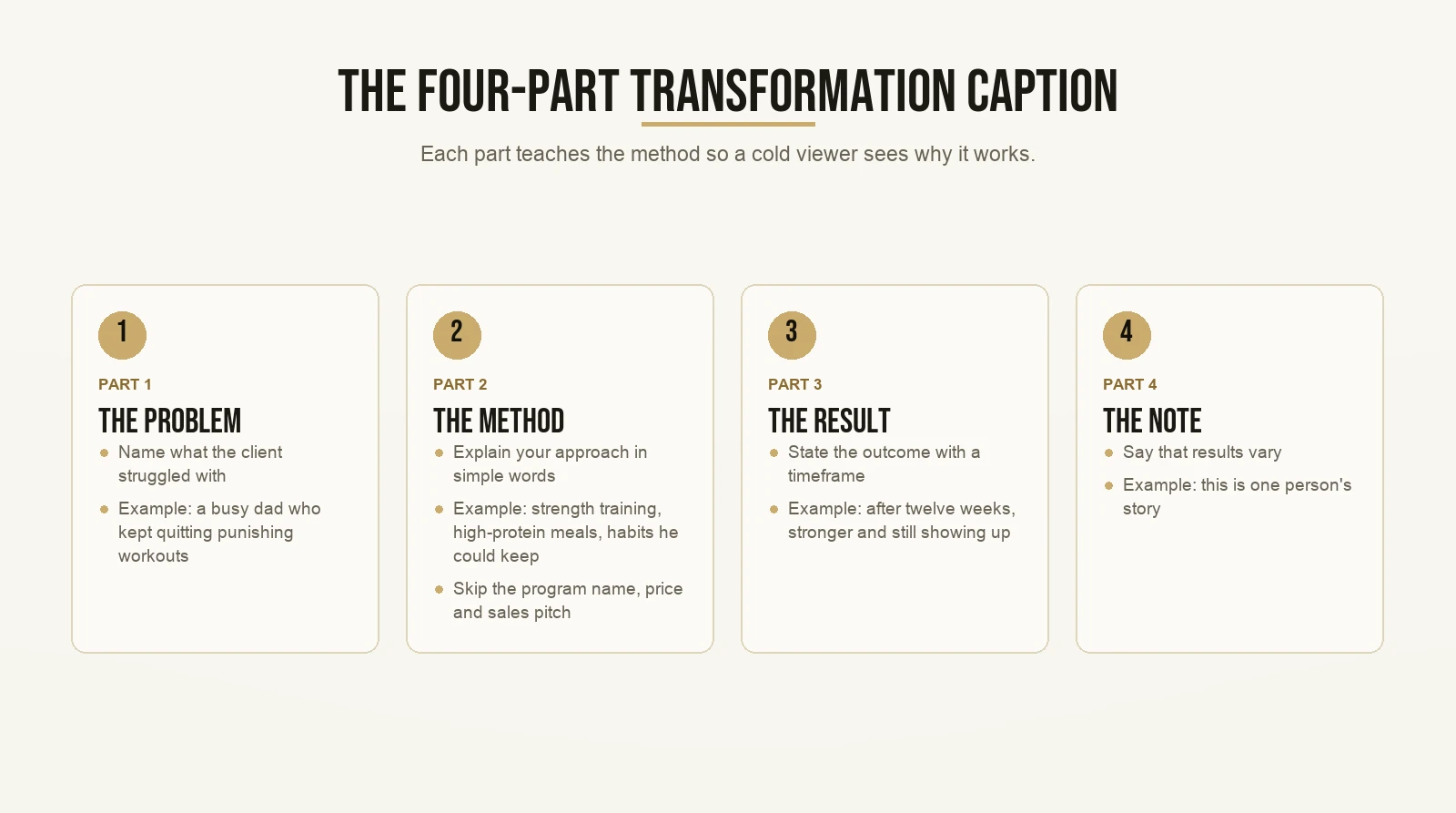
Write the caption in four short parts: the client’s problem, your method in simple words, the result with a timeframe, and a short note that results vary. Do not explain your product. Do not promise an outcome. The caption teaches the method so a stranger sees why it works.
This is where most coaches lose the viewer. They write “Another win! So proud of Sam! DM me to start.” That tells a cold viewer nothing.
A better shape:
- The problem. “Sam was a busy dad who kept quitting punishing workouts.”
- The method. “We focused on three things: strength training, high-protein meals and habits he could keep.”
- The result. “After twelve weeks, he is stronger and still showing up.”
- The note. “Results vary. This is one person’s story.”
Notice what is missing: a program name, a price, a sales pitch. The caption sticks to the method. That is the rule I use: do not explain your product, explain your method.
Why does the method matter more? It is what makes you different. Anyone can sell a plan. Few people can explain, in plain words, why theirs works.
Put a belief in the caption
Fitness is a crowded niche. If your caption sounds like every other coach’s, it disappears.
That is why I teach contrarian ideology. It has two parts: contrarian beliefs and contrarian visuals. The belief part is easy to start. Write down what your audience is usually told. Then write what you believe is better.
For a fitness coach, it might look like this:
| What your audience is told | What you believe is better |
|---|---|
| Punish yourself to get results | Strength training and sustainable habits beat punishment workouts |
| Cut everything you love | High-protein meals you can keep eating |
| Miss a day and you failed | Consistency over a long stretch beats a perfect week |
Hold up, Max. How contrarian should I be?
It depends on how crowded your niche is. If you are one of the first people in a small niche, you do not need much. If you are in fitness, you cannot be the gazillionth coach talking about calorie deficits. You need a clear point of view.
Put one belief in each transformation caption. The photos show the result. The belief shows the thinking behind it.
Should You Use a Carousel, a Reel or a Single Photo?
A carousel is the best default. It lets you tell the story in order: the problem, the method, the result, then the note. A Reel works well when your client can speak on camera. A single photo is fine for a quick update, but it carries less of the story.
How I would choose:
- Carousel: best for a full story with photos, a short quote and a clear method.
- Reel: best when you have motion, like a lift, a walk or a client talking about the change.
- Single image: best for a short check-in, not for your main proof post.
If you are not sure how to build a multi-photo post, this walkthrough on posting several photos at once on Instagram covers the steps.
A simple carousel layout:
- Slide one: a clear hook. “How a busy dad got stronger without punishment workouts.”
- Slide two: the matched before and after photos.
- Slide three: the three parts of the method.
- Slide four: a short line from the client in their own words.
- Slide five: the note that results vary, and a line about what to do next.
Each slide should stand alone. Someone might see only one.
How Does Instagram Decide Who Sees the Post?
Instagram has said there is no single algorithm. Feed, Stories and Reels each have their own ranking system. For Feed, your own activity matters, including likes, shares, saves and comments. So a post people want to save or send to a friend has a better shot at spreading.
This comes from Instagram’s own explanation of how ranking works. It was posted in May 2023, so treat it as a starting point.
What does that mean for your transformation post? Think about why someone would save or share it.
- A post that teaches the method gets saved. “I want to try those three habits later.”
- A post with a relatable story gets shared. “This is you, send it to your sister.”
- A post that only says “look at this result” gets a quick like at best.
Hold up, Max. How do I know if the post worked because of the hook or the topic?
Change one thing at a time. If you post two transformation stories with the same kind of hook and one does better, the story or the client may be the reason. If you keep the story type the same and change only the first line, you are testing the hook. One variable per test keeps the answer clear.
If you are not sure how often to post, read how often you should post on Instagram. In short, post at a pace you can keep up for the long haul. A transformation post every week is not required. One strong one a month beats four rushed ones.
Where Does the Post Live After It Goes Up?
It lives in your highlights. A feed post fades from view in a few days. A highlight stays on your profile until you remove it, so every new visitor can find it. Save each finished transformation post to a highlight called Client results.
This is the step most guides skip, and it matters a lot.
Think about what a cold viewer does. They see one post, get curious and tap your profile. What do they see? Your highlights, right under your bio. That is your chance to prove you are real.
I suggest three core highlights:
- Who am I. This is your hero story: how you went from not having the result your clients want to having it.
- What I do. This is your method and your beliefs. It is not your product.
- Client results. This is where your transformation posts live. Screenshots, photos and proof that your method works.
Now your profile does the selling while you sleep.
How do you add a post? Per Instagram’s own guide to Stories, you open an active story, tap the three-dot menu, tap Highlight, then add it to an existing or new highlight. You can also add from your Archive through the profile menu.
Share your transformation post to your Story first. Then add it to the Client results highlight. If you want a deeper walkthrough, see how to make highlights on Instagram.
When you share a client’s post that tags you, put it in Stories rather than reposting it on your feed. Instagram tends to favor original content, so a Story is a cleaner fit.
How Does a Transformation Post Fit Into a Bigger Plan?
It is one piece of a steady system. A single post will not fill your calendar. A set of posts, each with a clear job, will. Mix hero stories with lessons, light moments and the odd offer, and keep every post pointed at the casual audience.
Here is a simple weekly rhythm for a coach with a small team of one:
- One educational post that teaches a single idea from your method.
- One hero story such as a transformation post, or a post about your own journey.
- One entertaining post that is light and relatable.
- One promotional post now and then, with a clear and honest offer.
You do not need to post every day. In my teaching I say creators should post at a pace they can stick to for years. Missing a day is fine.
For ideas on how personal trainers can build a steady content habit, see marketing for personal trainers.
What Mistakes Should You Avoid?
Avoid posting without consent, using mismatched photos, writing a generic caption, promising results, and leaving the post to die in the feed. Each one costs you trust. Trust is the whole point of the post.
The big ones:
- No written consent. A hard stop. Fix this first.
- Misleading photos. Different lighting, angle or posture to fake a bigger change.
- Only the best results. If you only ever post the best outcomes, viewers may assume it is typical. Add a plain note that results vary, and share honest, ordinary wins too.
- A product pitch in the caption. Keep it a Hero Story.
- Promises and timelines you cannot back up. Say what happened for this person. Do not say it will happen for everyone.
- Using shame. Never mock the “before.”
- Forgetting the highlight. The post should keep working after the week ends.
Do not fake a story. If you do not yet have a client you can show, tell your own hero story first, or share a lesson from your method. Honest beats flashy.
Step-by-Step: Your Client Transformation Post Checklist
Use this checklist each time. It keeps the post safe, clear and useful. Work through the steps in order, and do not skip the consent step.
- Pick the client and ask. Choose someone who is proud of their progress and is happy to share.
- Get written consent. Name the photos, the places, the caption and the right to withdraw.
- Check for identifying details. Tattoos, signs, tags, locations, minors.
- Match the photos. Same light, angle, distance and clothing.
- Name the type. This is a Hero Story in HEEP. Keep it that way.
- Aim it at the casual audience. Use plain words a stranger can follow.
- Write the caption. Problem, method, result with timeframe, then the note that results vary.
- Add one belief. One line from your contrarian ideology.
- Build the carousel. Hook, photos, method, client quote, note.
- Post it. Then share it to your Story.
- Save it to Client results. Add it to your highlight so it stays on your profile.
- Review in a week. Look at saves, shares and profile visits, then change one thing next time.
Frequently Asked Questions
Can I post transformation photos if my client is happy but did not sign anything?
I would not. A written agreement protects both of you. It also gives your client a clear way to change their mind later. Take five minutes to put it on paper.
Does a transformation post have to show a body?
No. A transformation can be strength, energy, sleep, confidence or habits. A client lifting something they could not lift before is a strong post. So is a short quote about how they feel. Pick whatever your client is comfortable sharing.
How many transformation posts should I have in my highlight?
There is no magic number. Start with three to five good ones. Add more as you get new clients and permission. Keep the best and clearest at the front so a new visitor sees them first.
Can I use one client’s result to make a broad promise?
No. One person’s result is one person’s result. Say what happened for them, describe the method, and note that results vary. That is honest, and it still persuades.
If you want the wider picture, including how this post connects to the rest of your Instagram plan, read how to find clients on Instagram. You can also read more about Max and how he teaches if you want the thinking behind these frameworks.
What Is the Simplest Way to Start Today?
Pick one client, ask for permission in writing, and build one carousel using the checklist above. Keep it a Hero Story. Aim it at someone who has never heard of you. Then save it to your Client results highlight.
No fancy tools. No pressure to post daily.
The goal is a stranger landing on your page, seeing a real person with a real result, and understanding your method in under a minute. That is what turns a quiet profile into one that brings in messages.
Want the templates behind content that actually gets watched? Grab the templates here and start with the first one today.