
Key Takeaways
- Instagram’s official ranking documentation does not list hashtags as a signal for Reels, Explore, or Feed distribution to non-followers. Hashtags appear only in the Search surface documentation.
- The algorithm reads the actual audio and visuals in your video using pixel-level video understanding. It does not need your caption tags to know what your content is about.
- Discovery to new audiences is driven by collaborative filtering: behavioral overlap between users who engage with similar accounts. Hashtags play no documented role in that process.
- Hashtags still work for one narrow use case: search navigation. Someone types a hashtag in the search bar and sees a feed. That is not the same as algorithmic reach.
- The four signals that move Reels to new people, in priority order: reshare likelihood, watch-through rate, likes, and audio page visits.
- Spend your energy on topic selection, hook quality, and watch-through rate. That is where your reach actually lives.
Do Instagram hashtags still work in 2026?
No – not for algorithmic distribution to non-followers. Instagram’s official ranking documentation does not list hashtags as a signal for Reels, Explore, or Feed distribution to people who do not already follow you. Not once. If you are counting on hashtags to push your content to new audiences, you are optimizing a variable the algorithm is not reading.
That is the short answer. Here is the longer one.
Hashtags still work for one thing: search navigation. A user opens Instagram, taps the search bar, and types #streetfoodlondon. They see posts tagged that way. That is real. It is also narrow and intent-driven. The user is already looking. They are not being pushed anything by the algorithm. That is a completely different mechanism from organic reach.
The creators who went from a few hundred views per Reel to tens of thousands did not get there by cracking the hashtag code. They got there by making content the algorithm wanted to push. Those are two entirely different problems.
Let’s crack into it.
What does Instagram actually say about hashtags?
The short answer: Nothing – and that silence is the data point. Instagram’s official ranking explainer describes four signals for Reels distribution. Hashtags are not one of them. The four signals are: your activity as a viewer, your history with the poster, information about the Reel itself (audio, visuals, and popularity), and the poster’s follower count and engagement level.
I want to be precise about what that absence means.
This is not Instagram saying “hashtags are less important now.” They are not mentioned at all for Reels, Explore, or Feed distribution. When Adam Mosseri published the official ranking explainer, he laid out the signals for each surface separately: Feed, Stories, Explore, Reels, Search. Hashtags appear in the Search section because they function as navigation when a user types something in the search bar. They do not appear in the Reels section, the Explore section, or the Feed section.
Absent from a ranking document means not a ranking signal. That is not an interpretation. That is the text.
The algorithm can categorize your content much better than any hashtag can. Once you understand what it is actually reading, this becomes obvious. Here is the mechanism.
What does the algorithm actually read instead of hashtags?

The short answer: The video itself. Instagram uses pixel-level video understanding to classify your content from the audio and visual stream directly. It derives your topic, your audience category, and your content type from what is in your Reel – not from the text tags you attach to the caption.
Think about what that means in practice. Instagram watches your video. It listens to the audio. It reads the visuals frame by frame. By the time it finishes processing your Reel, it already knows what the video is about. You could write #fitness #wellness #health in your caption, or you could write nothing at all, and the platform would still route your content the same way.
Instagram’s 2021 ranking post named this explicitly as “video understanding based on pixels.” The algorithm is not relying on creator-supplied labels. It is reading the source material directly.
Here is the part that surprises most people. Reels that are “majority text” are actually deprioritized from recommendations. Read that again. If your video is mostly words on a screen, Instagram pushes it to fewer people. The platform is built to read visuals and audio. Hashtags in a caption are even further from what the algorithm cares about than text overlays are.
But Max, if the algorithm reads the video, how does it know who to send it to?
Good question. That is where collaborative filtering comes in.
Instagram looks at who has already engaged with your content. Then it asks: what other accounts are those people interested in? It maps behavioral overlap between users. If 200 people watch your video all the way through and also follow three other accounts in your niche, Instagram uses that overlap to find more people like them and push your content their way.
The official documentation puts it this way: “We look at who else likes [a creator’s posts], and then what other accounts those people are interested in.” Discovery routes through viewer behavior, not creator-applied tags.
This is a freaking important distinction. Your hashtags tell the algorithm what you think your content is about. Collaborative filtering tells the algorithm who is actually watching it. The algorithm trusts the second signal a lot more than the first.
What actually drives Reels to new audiences?
The short answer: Four signals, in priority order: reshare likelihood, watch-through rate, likes, and audio page visits. These are all behavioral – things the content earns from real viewers. All four appear in Instagram’s official ranking documentation. Hashtags are not on this list.
Let’s walk through each one.
Reshare likelihood is the top signal. When someone sends your video to a friend, Instagram reads that as a strong endorsement. The person sharing it put their own credibility on the line. That is a hard signal to fake, and the algorithm weights it accordingly. A video that gets reshared inside a close-knit group can suddenly reach an entirely new audience segment that algorithmic targeting alone would not have found.
Watch-through rate comes next. If people are watching your Reel all the way to the end – or watching it more than once – that tells Instagram the content is holding attention. If people drop off in the first two seconds, the algorithm stops distributing. This is why the hook matters so much. It is not just aesthetics. It is the variable that controls whether Instagram keeps pushing or pulls back. For specific hook patterns that keep people watching, this breakdown of Reel hook ideas is worth reading before your next post.
Likes are a signal, but not the dominant one. A video with strong reshares and high watch-through but modest likes still distributes well. A video with lots of likes but low watch-through underperforms. Likes are a trailing indicator, not a leading one.
Audio page visits act as a proxy for remix intent. When someone taps the audio track to check what it is, that often means they are thinking about using it in their own Reel. Instagram reads that as high-intent engagement and uses it as a positive distribution signal.
Notice what all four of these have in common. They are all earned through viewer behavior. None of them are applied to the content before posting. That tells you everything about where your energy belongs.
But Max, my reach dropped and I thought more hashtags might fix it.
I hear this constantly. And I understand the logic. When reach drops, you look for any variable you can control. Hashtags feel controllable. So people test 10 instead of 5, then 30, then whatever their favorite creator seems to use.
Here is the problem. Hashtags are not why reach drops, and they are not how reach comes back.
Ask yourself which of two situations applies to you.
Situation one: your videos reach your core audience and then stall. They get a few hundred views, decent engagement from people who already follow you, but no real spread beyond that. That is a topic problem. The content was built for insiders, not for strangers. The algorithm pushed it to your followers, they engaged, and then there was no behavioral overlap to pull in people who had never heard of you. Topic and angle problem. Not a hashtag problem.
Situation two: your content is not reaching anyone at all, including your own followers. That is almost always a watch-through issue. The first two seconds are not holding attention, so the algorithm stops distributing. Again, not a hashtag problem.
Both patterns have fixes, and both fixes live inside the content itself. I walk through them in detail in why your Instagram is not growing.
Why do so many articles still tell you to use hashtags?
Because most of the articles ranking for this topic are written by companies that sell scheduling software, analytics dashboards, and social media management tools. They have a soft incentive to keep the hashtag debate open. A definitive “no” shrinks their feature set.
Their argument is almost always a compromise: use 3 to 5 niche hashtags, not 30. They cite proprietary dashboard data to show a small positive correlation. But that data conflates two separate things. It measures whether posts with hashtags get more views overall. It does not measure whether the hashtags caused those views. And it almost never separates algorithmic reach from the narrow traffic that comes from hashtag search navigation.
I digress. The only authoritative source here is Instagram itself. And Instagram’s official documentation does not list hashtags as a ranking signal for any distribution surface except search. That is the ground truth, and so on and so forth.
Accept it and the strategy gets simpler. One fewer variable to obsess over. One more reason to put that energy into what actually moves reach.
Is there any case where adding a hashtag is still worth it?
The short answer: One case, and it is narrow. If your ideal viewer actively searches a specific hashtag in Instagram’s search bar, one targeted tag puts you in front of people who are already looking. This is not a volume play. It is deliberate placement for intent-driven search – not a shortcut to algorithmic reach.
Here is what that looks like in practice.
Say you coach runners. You know that serious runners type #marathontraining into Instagram’s search bar looking for training tips. Adding that specific tag might get you in front of people who are actively looking for what you teach. That is a real and limited use case.
But notice the conditions. The user is searching. The tag matches an actively searched term. You are not relying on it to push your Reels to strangers through the distribution algorithm. You are making yourself findable to people who go looking. Entirely different mechanism.
That is nothing like adding 20 hashtags hoping to “help the algorithm.” Instagram reaches 1.74 billion users via ads globally as of January 2025, and 55.1% of global online adults used the platform in the past month as of Q2 2025. That scale of reach comes from the algorithm. Not from creator-applied tags.
What should you actually optimize instead?
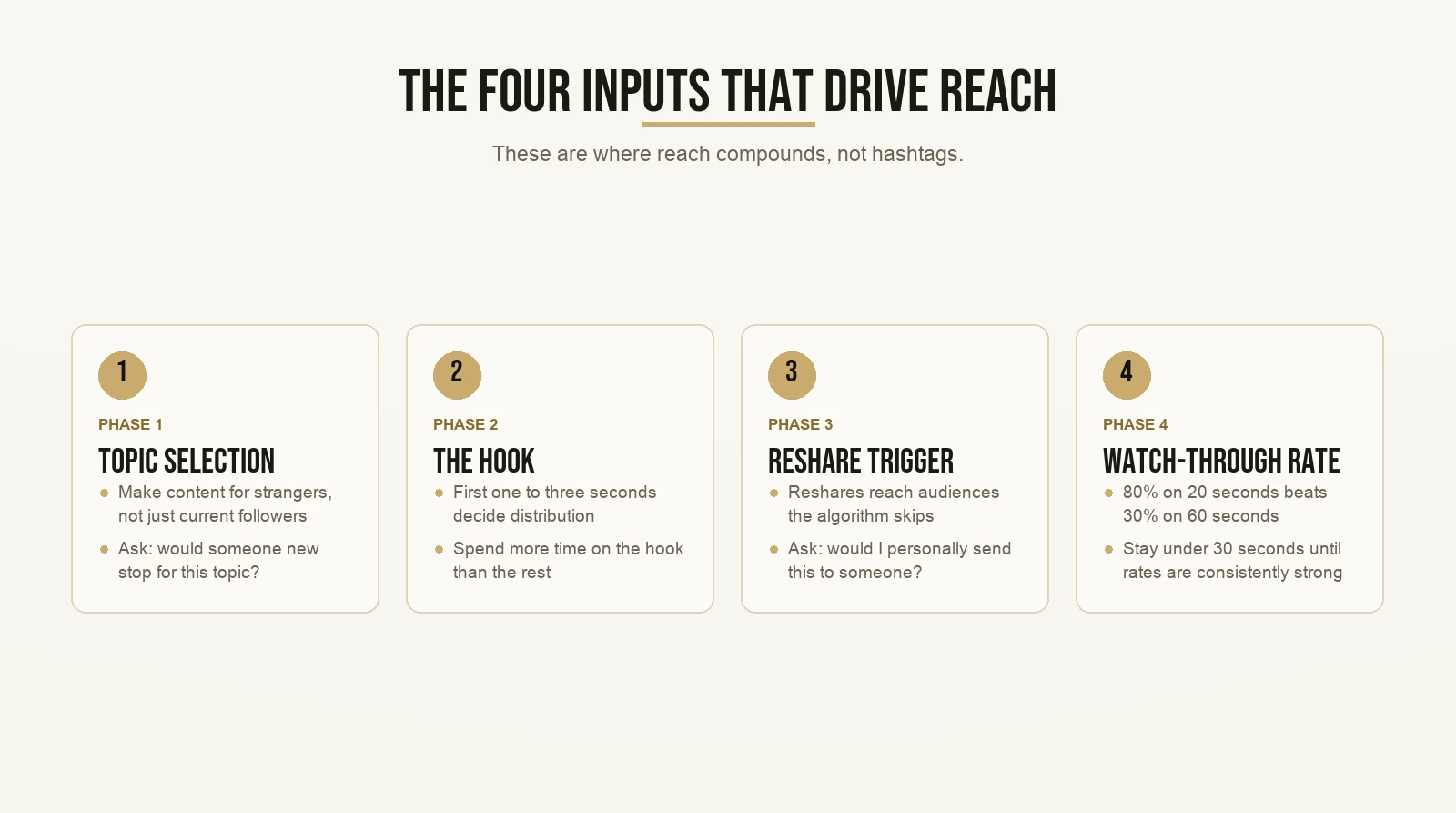
The short answer: Your topic, your hook, and your watch-through rate. Those are the inputs that drive the four signals Instagram actually measures. Spend the mental energy you were spending on hashtag strategy here instead. This is where reach compounds.
Topic selection is the foundation. The most common mistake I see is creators making content for the people who already follow them. That content does not travel.
Hold on, Max. My niche is specific. Of course my content is for people who already follow me.
No. Your niche can be specific and your topic can still be for strangers. “How I plan my week as a fitness coach” is for insiders. “The one scheduling mistake that makes you feel drained every Sunday” is for anyone who coaches, manages clients, or runs their own business. Same niche. The second one can reach people who have never heard of you. That is the difference.
Before you write a script, ask: would someone who has never heard of me stop for this topic? If the honest answer is no, rewrite the angle before you touch the rest.
The hook is the distribution lever. The hook is the first one to three seconds of your video. If people drop off there, Instagram stops distributing. If people stay, Instagram pushes harder. Spend more time on the first three seconds than on the last thirty. A weak hook on a solid video kills the whole thing.
Reshares break through ceilings. A video that gets reshared goes to audiences the algorithm would not have pushed it to on its own. It reaches the contacts of your existing viewers, who may have a completely different profile from your current followers. The question to ask when finishing a script is simple: would I personally send this to someone I know? If yes, you have a potential reshare trigger. If no, figure out what is missing before you post.
Watch-through beats length every time. A 20-second video with 80% watch-through beats a 60-second video with 30% watch-through. Shorter videos are easier to get right because you have less time to lose people. If you are building this skill, stay under 30 seconds until you are consistently getting strong watch-through rates, then extend if the content earns it.
The practical checklist: what to do before every post
Here is the process. Pretty straightforward.
- Topic test. Would someone who has never heard of me stop for this? If it only makes sense to people who already follow me, rewrite the angle.
- Hook test. Does the first line or the first frame create enough tension or curiosity to keep a stranger watching? If it opens with context-setting or introduction, cut to the conflict.
- Watch-through check. Is the video under 30 seconds? If not, does every sentence earn its place? Cut anything a viewer could skip without losing the point.
- Reshare test. Would I send this to a specific person I know? If yes, good signal. If no, ask what would make it worth sending before you post.
- One targeted hashtag, maybe. If there is a specific term my ideal viewer actively searches in Instagram’s search bar, I add it. One. Not twenty. I do not add hashtags to help the algorithm. It does not need that kind of help.
That is the whole checklist. You get the gist. It is short because the game is simple – even if it is not easy.
If you want to see how this plays out with real creators and business owners, you can read through some of those results here.
The bigger picture: what this tells you about content strategy
The hashtag question is a symptom of a larger pattern. Most creators look for levers they can pull without improving the content itself. Hashtags feel like a lever. Posting times feel like a lever. Caption length feels like a lever.
Some of those things matter at the margin. None of them matter as much as whether the content is compelling enough for a stranger to watch all the way through and pass it on.
The algorithm measures viewer behavior because viewer behavior is the ground truth. It is not measuring what you claim about your content in a caption. It is measuring whether real people – with no obligation to you – find your video worth finishing and worth sharing.
When you internalize that, the strategy gets simple. Make content that holds strangers. Pick topics that matter to people who do not know you yet. Open strong. Stay short until your watch-through rates are consistently high. Then go longer if the content earns it.
That is how you actually increase your Instagram reach – and none of it runs through metadata. The hashtag question is settled. The content question never is. That is where your energy belongs.
Want the templates behind content that actually gets watched? Grab the templates here and start with the first one today.