
Key Takeaways
- A hook is a filter, not just a view magnet. The right hook pulls in people who need your help. The wrong one inflates your numbers and quietly kills your conversion rate.
- Every reel has two hooks: a verbal hook (what you say out loud) and a headline hook (text on screen). Both must work together.
- The CCN framework – core audience, casual audience, new audience – shapes which hook you write for each video.
- Research beats creativity. Find outlier hooks that already perform at three to five times a creator’s baseline, then adapt the structure to your content.
- Low average watch time is almost always a hook problem. Your retention graph shows exactly where you lost people.
- Trial Reels let you test meaningfully different hook versions before they go live to your full audience.
Why Most Instagram Reel Hooks Are Solving the Wrong Problem
Every article about Instagram reel hooks gives you the same advice: stop the scroll, grab attention, keep the text under ten words.
That advice is not wrong. But it is incomplete.
Because views are not your goal. Clients are.
A hook that gets 10,000 passive viewers to pause is not automatically better than a hook that makes 200 people recognize their exact problem in the first two seconds. Those 200 people lean in. They watch the whole video. They follow. They send you a DM.
This guide is built on one reframe: treat your hook like a filter, not a gateway.
The right hook lets in the right people. The wrong hook inflates your numbers and quietly kills your conversion rate. Both feel like growth when you are watching the view counter. Only one of them is.
According to DataReportal, 62.3% of Instagram’s active adult users say they use it to research brands and products – the highest share of any major social platform. The buyers are already there. Your hook decides whether they find you.
Let’s crack into it.
What Is an Instagram Reel Hook, Exactly?

A hook is the first two to three seconds of your reel. It can be a spoken line, a text overlay on screen, or both running at the same time. Its job is to stop a specific viewer mid-scroll and give them a reason to keep watching. A good hook is not just attention-grabbing. It is attention-qualifying.
Here is why that distinction matters.
If you open with “Three tips to go viral,” you get everyone mildly curious about viral content. Some of those people are teenagers. Some are hobbyists. Most of them will never buy what you offer.
If you open with “If your reels are stuck between 200 and 900 views, here is the one thing I changed,” you get a smaller group. But that group is sitting exactly where you once sat. They know what 200 views feels like. They are already looking for a way out.
That second hook gets fewer views. It gets far better outcomes.
The hook also sets the contract for the whole video. Whatever you promise in the first two seconds, the viewer expects you to deliver. Break that contract and they leave. Keep it and they stay, they replay, they share.
What Are the Two Types of Reel Hooks – and Why Do Both Matter?
Every reel has two hooks, not one. The verbal hook is what you say out loud in the first few seconds. The headline hook is the text that appears on screen. They do different jobs and must work together. Most creators treat them as one thing and miss the opportunity entirely.
Here is how they work together: the headline hook stops the scroll before the audio even registers. Someone sees text on screen and their thumb slows down. Then the verbal hook either confirms that this video is worth their time or loses them before the three-second mark.
This is super duper key to understand: the headline and the verbal hook do not have to say the same thing. A headline that restates the verbal hook word for word is a missed opportunity. Use the headline to add a layer. The verbal hook can then expand on it, or hit a related angle that makes both lines more compelling together.
For example:
- Headline: “The reel I almost deleted before posting”
- Verbal: “It got three times my average views that week. Let me walk you through what made it different.”
Neither line is complete on its own. Together they answer two different questions: What happened? and Why should I care?
Hold up. What about viewers watching with the sound off?
Good question, because there are a lot of them. Instagram reaches 1.74 billion monthly ad-reachable users, and a large portion of them are scrolling in public with audio off. According to Pew Research, 78% of U.S. adults between 18 and 29 use Instagram. A headline that depends on the voiceover to make sense will lose all of those viewers. Write the headline so it stands completely on its own.
How Does Your Target Audience Change the Hook You Write?
The hook you write depends on who you are trying to reach. The CCN framework – core audience, casual audience, new audience – divides your potential viewers into three tiers. Each tier needs a different hook approach. Writing for the wrong tier is one of the main reasons content stalls between 100 and 900 views.
Your core audience already follows you. They know your frameworks, your style, your story. A hook built for them assumes context that a stranger does not have.
Your casual audience has seen you before but is not committed. They follow but might scroll past anyway.
Your new audience has never heard of you. This is the audience that drives growth. Here is what most creators miss: hooks written for your core audience stall early because the algorithm tests your content with non-followers first. If the hook assumes insider knowledge, strangers will not stop, and the video dies before it reaches anyone new.
But Max, does that mean I should always write for strangers?
Not always. Most of your content should aim at the casual and new audiences. That is what drives reach. But some content is built specifically for your core audience, and that is fine. Those videos deepen trust and pull in replies and DMs from people already in your ecosystem. The key is knowing which job a video is doing before you write the hook.
A hook written for strangers uses the problem, not the solution. “If your reels keep dying after 200 views” speaks to a pain that anyone in the space recognizes without knowing you. A hook written for your core audience might reference a framework they already know: “Remember the CIA method from last week? Here is where most people get it wrong.”
Know who you are writing for before you write the first word. This breakdown of why Instagram stops reaching new people explains the algorithm mechanics behind this in detail.
Why Does Research Beat Creativity When Writing Reel Hooks?
Research-first hook writing means finding videos that already outperform a creator’s baseline by three to five times, then studying how those hooks are structured. That pattern becomes your building block. You are not copying content; you are adopting a proven architecture and filling it with your own material.
Here is one of the most freaking important mindset shifts you will make as a creator: stop trying to invent original hooks.
I know that sounds wrong. The whole internet tells you to be creative, to stand out, to find your unique voice.
But Max, you are telling me to copy other people?
No. I am telling you to study what already works. Then recombine the pieces.
Here is the process. Find videos from creators in your niche that are outliers. An outlier is any video that gets at least three to five times the views of that creator’s average. Write down how the hook is structured. Is it a challenge? A confession? A specific number? A counterintuitive claim? Write the pattern down, not the words.
Now bring your own topic, your own mechanism, your own audience to that pattern. You are not stealing a hook. You are borrowing a proven structure and building something new on top of it.
Let me make that concrete. Say you teach coaches how to write captions. You find a video with 45,000 views from a creator whose average is 8,000. That is a 5x outlier. You open the video. The headline hook reads: “The caption I wrote in 11 minutes and forgot about.” You write down the pattern: specific time + dismissive framing + implied surprise result. Now you adapt it: “The hook I almost cut from this script.” Different content, same proven structure, your own angle.
That is the whole method. Research beats creativity every single time.
This approach is at the heart of how the framework was developed and why it produces repeatable results instead of occasional luck.
What Does a Hook Failure Actually Look Like in Your Metrics?

The clearest sign is a steep drop in the first two to three seconds on your retention graph. If viewers are leaving before the hook finishes, the hook failed – not the topic, not the edit, not the audio. Low average watch time confirms it. Fix the hook first.
A lot of creators see a video underperform and assume the topic was wrong. Or the trending audio choice. Or the edit.
Often it was the hook.
Here is how to diagnose it. Open Instagram’s native Insights or the Edits app. Pull up the retention graph for the underperforming video. A steep drop in the first two to three seconds means viewers left before the hook even finished. That is a hook problem, not a content problem.
Hold up. Does that mean I should ignore everything else and just obsess over the hook?
No. But the hook is where to start. Fix the hook first. Everything downstream of a bad hook is irrelevant, because nobody is watching it.
Instagram now measures total seconds watched, including replays. A fifteen-second reel watched three times outranks a sixty-second reel watched once. That replay behavior almost always starts with a hook strong enough that the viewer wants to go back immediately.
Sends per reach is the other signal worth watching. When someone sends your reel to a friend, it tells the algorithm the content is worth showing to a cold audience. Hooks that pull in buyers rather than passive viewers tend to get shared because they hit a specific nerve. “I literally just sent this to someone who needs to hear this” is the reaction you are aiming for.
For a full walkthrough of what each metric is telling you and how to act on it, this guide to Instagram Insights covers every number in plain language.
How Do You Test Instagram Reel Hooks Without Risking Your Whole Audience?
Trial Reels, launched by Instagram in December 2024, show your test content only to non-followers. After about 24 hours, you can see how it performed and decide whether to post it to your full audience. This gives you a low-stakes way to test different hook executions before committing to any one version.
Instagram launched Trial Reels specifically so creators could experiment with new ideas without putting their existing audience metrics at risk. That is a freaking powerful testing loop when you use it right.
But here is where most people mess it up. They take their normal video, post it as a Trial, get 200 views, and declare the feature useless.
The second mistake is slightly smarter but still wrong. Some creators film the same video, change one word in the headline hook, and post several nearly identical versions at once. Meta’s algorithm now detects duplicate and near-duplicate content. That approach gets flagged and suppressed. It used to work. It does not anymore.
The right way to use Trial Reels is to test versions that are genuinely different from each other. Not the same script with a different font color. Real differences: a question hook versus a confession hook, a problem-framing opener versus a result-framing opener, text-only versus verbal plus text.
Here is what a good test set looks like:
- Version A: Verbal hook that opens with a specific problem. Headline matches and adds one layer of detail.
- Version B: Headline hook that leads with a surprising result. Verbal hook expands on why it happened.
- Version C: Headline only. No verbal hook at all. Forces the viewer to keep watching to get the context.
Run these as Trial Reels. After 24 hours, look at watch time and sends – not just view count. Post the winner to your feed. Take the learning into the next batch.
Boom. A guess becomes a feedback loop.
What Makes a Hook Actually Qualify Buyers?
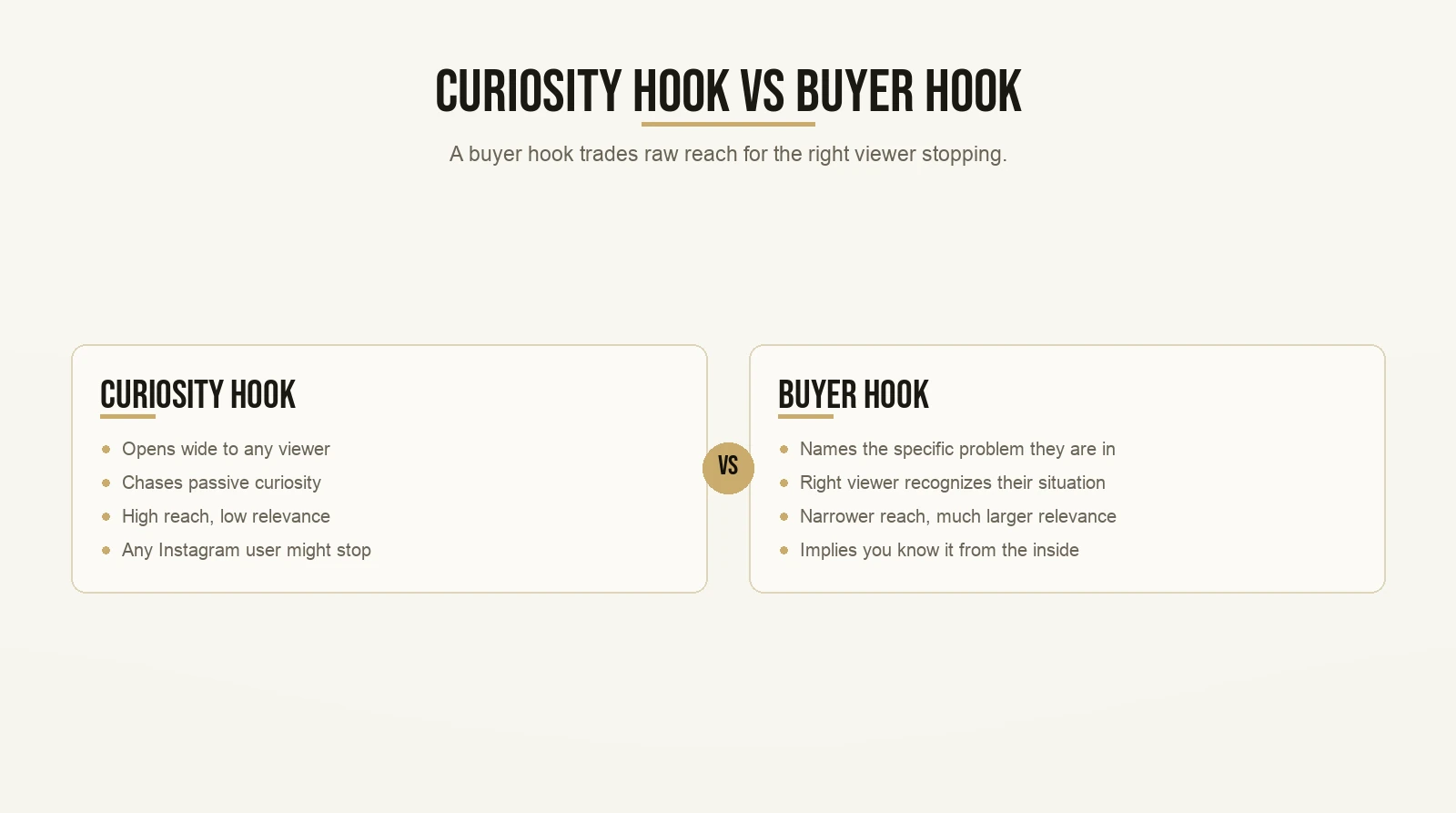
A buyer-qualifying hook names the specific problem your ideal client is sitting in right now. It does not chase maximum passive curiosity. It makes the right viewer stop because they recognize their own situation in the first two seconds. That recognition is worth more than a high view count from the wrong people.
Here is the difference in practice. Both of these are hooks for a coach who teaches content strategy:
- “Three things I wish I knew about Instagram sooner” – curiosity hook, opens wide, any Instagram user might stop
- “If you have been posting for six months and are still not getting DMs, here is what is actually happening” – buyer hook, much narrower, but the person who stops is already the person you want
That second hook is smaller by reach. It is much larger by relevance.
A buyer-qualifying hook does three things in two seconds. First, it names a real problem in specific terms. “You’re posting every day and nothing is growing” is more specific than “want more followers.” Second, it implies you have been there. Describing the problem with precision and without judgment tells the viewer you know it from the inside. Third, it makes a credible implied promise. “Here is what was actually happening” implies an answer exists and you are going to give it. Not a promise. A direction.
Hold up. Does that mean I should never use curiosity hooks?
No. Curiosity hooks work fine. But they work better when the curiosity is anchored to something your target buyer already cares about. “Would you believe this hook pulled in twelve DMs from coaches in one week?” is curiosity bait for coaches who want DMs. Same structure as a generic curiosity hook. Very different filter.
This is also why the two-track hook system matters. Your verbal hook can anchor the emotion. Your headline hook can anchor the specificity. Used together, they narrow the audience to exactly the right people.
If you want to see how this connects to converting viewers into actual client conversations, this guide to booking discovery calls from your content walks through the full sequence from hook to DM.
A Simple Hook Writing Process That Removes the Guesswork
This is pretty straightforward. Here is the exact process.
Step one: Write down the specific problem this video solves. One sentence. Make it as specific as you can.
Step two: Write down who has that problem right now. Not a demographic. A moment in their journey. “A coach who has been posting for three months and is stuck at 300 followers” is a moment. “Business owners” is not.
Step three: Find three to five outlier videos in your niche that share a topic or format with the one you are making. Study how each hook is structured. Write the pattern down, not the words.
Step four: Write three hook drafts using those patterns, with your specific problem and your specific audience built in. Do not recycle the exact wording. Take the architecture and fill it with your content.
Step five: Pick the draft that most clearly names the problem your target viewer is in right now. Post it as a Trial Reel if you are testing. Post it to your feed if you are confident in it.
You get the gist: research, match, adapt, test. No guessing. No waiting for inspiration.
The hook is one building block. The body of the video, the call to action, and the delivery all connect to it. But you cannot build on a foundation that is not there. Get the hook right first, and everything else becomes worth optimizing.
If you want to go deeper on what happens after the hook and how to build content that grows your reach over time, this guide to increasing your Instagram reach picks up where this one ends.
Want the templates behind content that actually gets watched? Grab the templates here and start with the first one today.