
Key Takeaways
- Closing high-ticket clients starts before the call. Your content and DMs do most of the convincing.
- Contrarian ideology flips the assumption: the call is confirmation, not conversion. Do the convincing in your content first.
- The 7 building blocks, specifically the CTA building block, create a chain of small prior commitments that wire a prospect toward a larger yes.
- Loss aversion is real. Prospects act faster when they feel the cost of staying stuck than when they imagine the gain of solving it.
- Research shows aggressive closing tactics erode the trust a high-ticket sale cannot function without.
- A structured 24-hour follow-up saves more “I need to think about it” situations than any on-call pressure ever will.
Why Most Coaches Struggle to Close High-Ticket Clients
Most people think learning how to close high-ticket clients comes down to a better script. It does not.
The close happens before the call starts. By the time a prospect shows up to talk to you, they have already done most of their evaluation. They watched your Reels. They read your captions. They scrolled your profile and made a judgment. The call is where they confirm what they already believe.
That is a freaking important shift. If you go into every call trying to convince cold strangers, you are playing on the hardest difficulty setting possible. And your close rate will show it.
The coaches who close high-ticket clients consistently are not better closers. They are better at building trust before the call.
Here is what that looks like. And here is the science behind why it works.
What Is Contrarian Ideology and How Does It Apply to Sales Calls?

Most coaches go into a sales call trying to sell. Contrarian ideology says: do the selling before you ever get on the call.
Contrarian ideology is a framework that says: look at what everyone else in your niche is doing, find the flaw in it, and do the opposite. Not to be different for the sake of it. To exploit a gap everyone else is missing.
The common approach to sales calls: show up, pitch your offer, handle objections, close with urgency. The flaw: you are trying to build trust in 45 minutes. Trust you could have been building for weeks through your content.
The contrarian approach is different. Your content does the positioning. Your DMs do the qualifying. Your freebie does the educating. By the time the prospect books a call, they already believe you understand their problem and have a way to help them solve it.
Hold up. That sounds great, Max. But what if someone books a call before seeing much of my content?
It happens. And it is harder. You are trying to build three weeks of trust in one conversation. That is possible. But your close rate will not be as strong.
When you apply contrarian ideology to your sales process, close through content and confirm on the call, every part of the process gets easier. Discovery flows because the prospect already trusts you. The close is simpler because they have already mostly decided.
The call’s job is to make the prospect feel safe making the decision. Not to convince them. To confirm.
That shift changes how you prepare. You spend less energy on your pitch and more energy building the content and DM sequence that does the work before the call begins. If you want to see how a full warm-up sequence comes together, here is a framework for warming up your Instagram audience before a push.
How Does Loss Aversion Actually Work in a Sales Conversation?
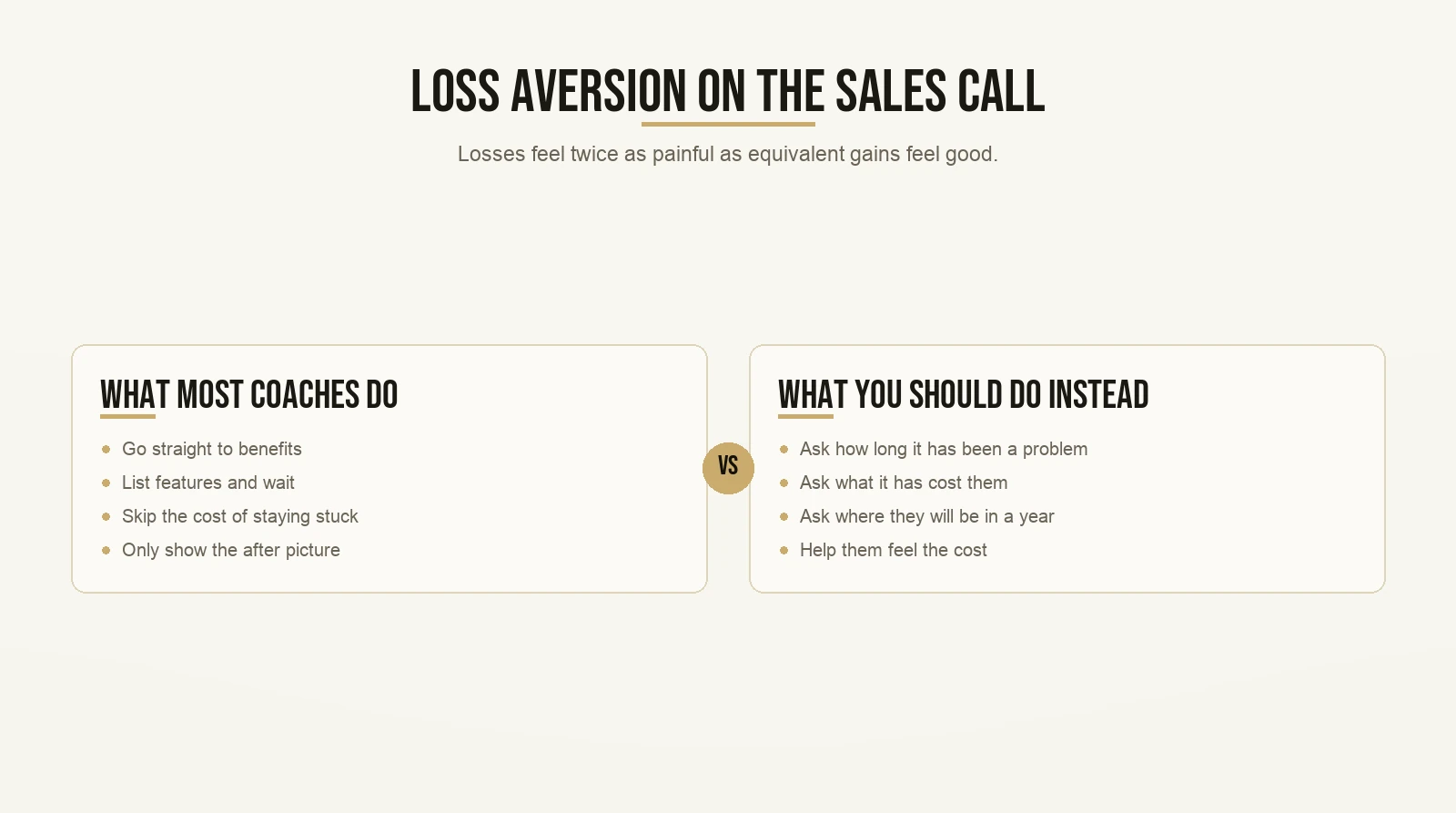
Prospects are more motivated by the cost of staying stuck than by the gain of solving their problem. Your call structure should reflect that.
A 2020 study by Ruggeri et al. replicated Kahneman and Tversky’s foundational work on loss aversion across more than 4,000 participants in 19 countries. The finding: losses feel roughly twice as painful as equivalent gains feel good. That 2:1 ratio held even for participants who knew about the bias and actively tried to correct for it.
Read that again.
Losses hit twice as hard as gains feel good. Your prospect is running that math on every high-ticket purchase they consider.
What this means for your sales call: do not only paint the picture of what life looks like after they solve their problem. Also help them feel the cost of leaving it unsolved.
Here is how you do that in discovery. Ask them how long this has been a problem. Ask what it has cost them to leave it sitting there. Ask where they will be a year from now if nothing changes.
When the prospect does that math themselves, out loud, in their own words, you do not need to pressure them. The decision becomes obvious to them. You are not pushing. You are helping them see what they already know but have been avoiding.
Most coaches skip this completely. They go straight to benefits. They list features and wait for enthusiasm. But the prospect’s brain is running a different calculation the entire time. Honor that calculation. Help them run it clearly and the close gets a lot easier.
What Are the 7 Building Blocks and Why Do They Matter Before a Sales Call?

The 7 building blocks is a framework for structuring a viral video. Building block three is the CTA, and it is super duper key for how you close high-ticket clients. That building block is where the pre-call commitment chain starts.
There are three CTA options in the 7 building blocks:
- Follow for more. Grows your audience.
- Comment a keyword to get the freebie in the DMs. Builds trust and captures warm leads.
- Comment a keyword to get the link to the paid product or to start a conversation. Drives sales directly.
The second and third options do something most people miss. They create a small commitment.
Research on commitment and consistency shows that a small prior commitment dramatically increases follow-through on a larger ask. In one study, homeowners who agreed to display a small sign in their window were 400% more likely to later agree to put a large billboard on their lawn. The first yes made the second yes much easier.
Your content CTA is that small first yes.
When someone comments a keyword on your post, they make a small decision in your direction. They get your freebie in their DMs. They read it. They reply. They book a call. By the time you say hello on that call, they have made four small decisions toward you. You are not a stranger. You are someone they have already chosen, four times over, in smaller ways.
That is the 7 building blocks doing exactly what they are designed to do.
There is another layer here worth knowing about. Research from the Cialdini Institute shows that specific social proof has a measurable effect on behavior. In one study, showing hotel guests that most other guests reused their towels raised compliance 26 percentage points above a generic environmental message. The comments on your posts, the visible replies in your DMs, the engagement from real people on your content, these are doing persuasion work for the next prospect before they ever show up to a call.
Build the CTA-to-DM sequence right and the call becomes the easy part. If you want to set up the DM side of this properly, here is an Instagram DM script that books discovery calls.
How Do You Run Discovery Without Killing the Deal?
Discovery is diagnosis, not rapport-building. Your job is to understand the prospect’s problem in their exact words before you say anything about your offer.
Most coaches treat discovery as a warmup. Ask a few friendly questions, then pivot to the pitch. That is a mistake.
The real danger is the problem-alignment gap. You describe the problem one way. The prospect describes it a completely different way. Same underlying issue, completely different language. When you pitch using your framing, the prospect hears a solution to a problem they did not say they had.
Here is how you fix it. Ask: “In your own words, what is the main thing you are trying to solve right now?” Then listen. Write down their exact words. Use those words when you explain what you do.
This is not a technique. It is basic communication. It is also one of the highest-leverage things you can do on a call. And most coaches skip it and then wonder why prospects do not feel understood.
Discovery questions that actually work:
- How long has this been a problem for you?
- What have you already tried?
- What would solving it change for you, day to day?
- Where do you see yourself in a year if this stays the same?
That last question does two things at once. It gets the prospect to name their goal out loud. And it invites them to feel the cost of inaction, which connects directly to loss aversion. You are not applying pressure. You are helping them see what is already true.
Does Aggressive Closing Actually Work for High-Ticket Clients?
No. Aggressive tactics damage the one thing a high-ticket sale cannot function without. That thing is trust in you as a person.
A 2025 study published in the Journal of Business and Industrial Marketing, cross-validated between Norway and Spain, found that trust in the individual salesperson has a stronger effect on buyer commitment than trust in the vendor organization itself. It also found that aggressive or coercive closing tactics erode that trust, which in turn reduces commitment. That is the direct opposite of what a long-cycle, high-ticket sale needs.
Let that land. Pressure closes do not just fail to work. They make the outcome worse than if you had said nothing at all.
High-ticket clients are not just evaluating your offer. They are evaluating you. Can I trust this person? Are they being straight with me right now, on this call?
Your behavior during the close is evidence. If you push hard, manufacture urgency, or make someone feel cornered, you might get a yes. But you have poisoned the working relationship before it starts. The client who felt pressured is the one who asks for a refund in week two.
Be direct. Be confident. Ask for the decision clearly. Do not beg for it and do not force it. There is a version of this that reads as both safe and decisive at the same time. That version is what you are going for.
You can see how Max has built the trust side of this with clients at his client results page.
How Do You Actually Close High-Ticket Clients on the Call?
The close is three moves: summarize what you heard, connect it to your offer, ask a direct question. Then stop talking.
Here is what it sounds like in practice.
Summarize: “So what I’m hearing is that you have been posting consistently, but the content isn’t converting to calls. You’ve been at this for several months and the bookings haven’t come in.”
Connect: “What we do is build the content system first, then set up the DM sequence so calls start coming inbound. That is exactly the problem you described.”
Ask: “Does that sound like what you need?”
Then stop. Do not add anything. Wait.
Hold up, Max. What if they just say nothing? Do I keep waiting in silence?
Yes. That is exactly what you do. Let the silence work. The next person who speaks loses momentum. Make it them.
Most coaches are afraid of the silence here. They fill it with more selling. That is the worst move. The question is hanging. Let it land.
If they say yes: move to next steps calmly. Do not celebrate and start pitching again. Just move forward.
If they hesitate: ask “What would you need to feel confident about this?” That surfaces the real objection. Nine times out of ten it is timing, fear, or a second decision-maker. Each one has a different response.
What Do You Do When the Prospect Says “I Need to Think About It”?
Ask one question: what specifically do you need more clarity on? No apologizing, no listing more benefits, no discounts.
Just ask: “What specifically do you need more clarity on?”
If the answer is specific, they want to understand how the first few weeks work or what happens if they travel, answer it directly. That is a real information need. Satisfy it clearly and concisely.
If the answer is vague, “I just need to think about the timing” or “I want to run it by my partner,” the real block is not information. It is fear. They do not need more details. They need to feel safe making the decision.
You can acknowledge that without backing down. “That makes sense. Is there anything about how this works that you want me to walk through before we close the call?”
Then follow up within 24 hours. Not a generic check-in. A direct response to what they told you. If they said they wanted to talk to their partner, your message speaks to exactly that. If they said they needed to think about timing, your message addresses it specifically.
The guide on following up in Instagram DMs without being pushy has a step-by-step structure for those conversations.
What About When Someone Else Has to Approve the Decision?
For business-side high-ticket buyers, a second decision-maker is common. Name it early and offer to loop them in directly rather than leaving the prospect to sell your offer on their own.
If a partner or spouse is part of the decision, do not wait for the prospect to go home and try to explain your offer to someone who was not on the call.
Ask directly: “It sounds like your partner is part of this decision. Would it make sense to set up a brief call with both of you so they can ask questions directly?”
That is not pushy. It is practical. A prospect who has to go sell your program to their partner after the call is fighting a battle without you in the room. A prospect whose partner heard it directly is in a much easier position.
If a second call is not possible, offer to send something they can share. A short voice note. A clear written summary of what you discussed. Give their partner the core information in plain language so it does not get garbled in translation.
Hold up, Max. Doesn’t that just drag the whole process out?
Yes. Sometimes. And that is fine. A deal that closes in two weeks and holds is better than a one-call yes that falls apart before week two.
What Happens Right After the Call?
Follow up within 24 hours of every call. Yes, every call. The 24 hours after the conversation is where deals are saved or lost for good.
Most coaches focus entirely on getting the yes and then go quiet. That is a mistake.
For the yes group: confirm next steps clearly and quickly. Momentum is real. The longer the gap between a verbal yes and the first concrete action, the more doubt creeps in and the more fragile the yes becomes.
For the “thinking about it” group: send a specific response to their specific concern. Not “just following up.” A real message that picks up exactly where you left off on the call.
For the no group: thank them, stay warm, and leave the door open. A prospect who says no today sometimes comes back in three months. They also know people who are the right fit.
Closing high-ticket clients is a process, not a single moment. The call is one step. How you handle the 24 hours after is part of how you close high-ticket clients and keep them. You get the gist.
For a full look at how the discovery call fits into a broader client acquisition system from the first DM to the signed client, this coaching discovery call script breaks it down start to finish.
Want the templates behind content that actually gets watched? Grab the templates here and start with the first one today.