
Key Takeaways
- Learning how to follow up in Instagram DMs without being pushy starts with understanding two things: what the platform actually allows and what kind of trust you built before the conversation began.
- Adam Mosseri confirmed that sends per reach is one of the top three ranking signals on Instagram. A message worth forwarding matters more than one that closes a sale.
- Automated follow-up sequences hit a 24-hour wall. A lead who went quiet last week cannot be reached by automation. Only a real person writing a real message can get there.
- CCN, which stands for Core, Casual, New, is the framework that changes who shows up in your DMs to begin with. Get your topics right and the leads are warmer before you ever send a word.
- The 7 building blocks CTA gets prospects to message you first. That one shift removes most of the awkwardness from follow-up entirely.
- Two messages with no response means you stop.
Why does following up in Instagram DMs feel pushy?
It is not the number of messages. It is the gap between what you gave and what you are asking for. When someone has gotten real value from your content and trusts you, a follow-up message feels like a continued conversation. When they have not, it feels like pressure no matter how politely you phrase it. That gap is the whole problem.
Most creators try to close that gap by writing better scripts. The real fix happens upstream, before anyone lands in your DMs.
Think about the last time a follow-up message felt gross to receive. The sender probably went from “hey” to “are you still interested in working together?” with nothing in between. No rapport. No value. Just one ask stacked on top of the previous ask.
That is the pattern. Understanding where it starts tells you exactly where to fix it.
Does Instagram actually limit how you can follow up in DMs?
Yes, and the limits are more specific than most people realize. If someone does not follow you, your message lands in their request inbox. They cannot see images, video, or voice notes until they accept your request. You can only send one text-only message before the conversation locks. One shot, full stop.
Even inside an accepted conversation, time matters. Automated sequences are capped by the Messenger API’s 24-hour window. If the conversation has been quiet for more than a day, automation cannot reach them. A lead who went quiet last week is outside that window entirely. Only a manual message from you can get there.
Instagram added nudges in 2022 reminding people to be respectful in DMs when sending a message request to a creator. The platform treats pushy outreach as a problem worth suppressing. They built friction into the system on purpose.
Before you write any follow-up, two questions determine what is possible. Is this an accepted conversation or a message request? Has it been more than 24 hours since the last interaction? Those two facts change everything.
What did Mosseri say about DMs and ranking?
On January 22, 2025, Mosseri confirmed that the top three ranking signals are watch time, likes, and sends. Sends are slightly more important than likes for content reaching people who do not follow you yet. By December 2025, he described private DM sharing as the primary way people use the platform. The DM inbox is no longer a secondary channel. It is the main one.
Read that again.
People forwarding your content to someone else in a DM carries more ranking weight than a like when it comes to reaching strangers. That is freaking significant for how you think about everything you send in a DM conversation.
This context reshapes how follow-up works. The DM inbox is the most personal space on the platform. When you treat it like a mass outreach channel, running timed sequences and automated check-ins, you bring the wrong energy to the wrong space. And that energy is exactly what the person on the other end feels as pressure.
The two-message sequence
Pretty straightforward. Here is how it works.
Message one: add value, no demand attached.
Your first follow-up is not a check-in. It is a deposit. You send something useful and specific to what the person actually mentioned. A relevant piece of content. A direct answer to a question they raised. An observation that shows you were paying attention.
“Hey, you mentioned [their specific topic] last week. I just put something out that speaks to that directly. Want me to send it over?”
That is the message. You are not asking if they are ready to move forward. You are not reminding them that your offer is still open. You are offering something useful and letting them decide whether they want it.
Message two: release the pressure.
If message one gets no response after a few days, send one more. Keep it short. Acknowledge the silence without making it strange.
“No pressure at all if the timing is off. Whenever you want to circle back, I am here.”
That is the full sequence. Two messages. Both short. Neither demands an answer.
Hold on. Two messages and that is actually it?
Yes. That is the sequence.
But here is what most people miss. The two-message sequence only works well if the person was already warm. If they were cold going in, two careful messages will not change that. The real work is upstream, before anyone lands in your DMs. That is where CCN comes in.
How does CCN change who lands in your DMs?
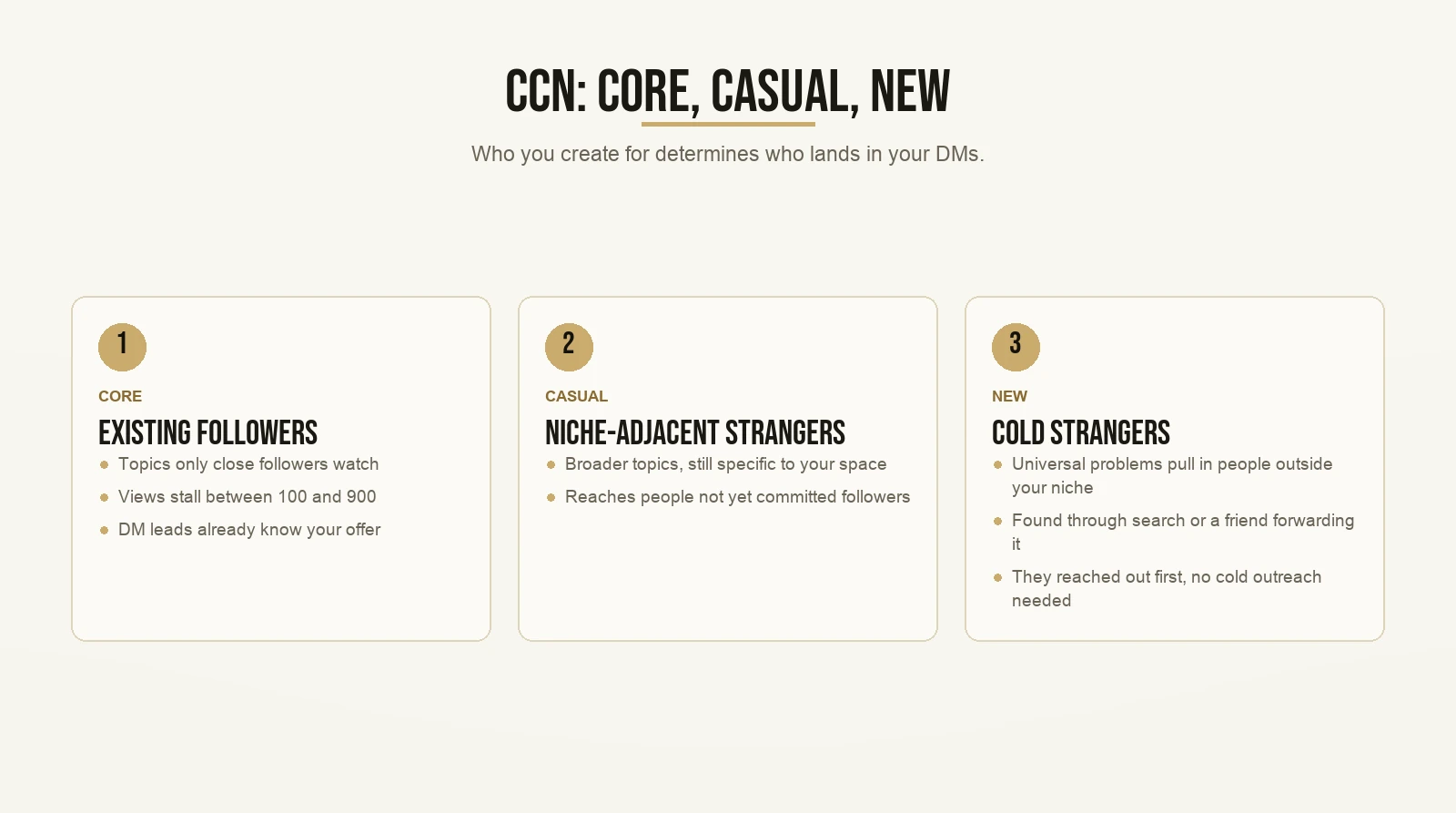
CCN stands for Core, Casual, New. It is a topic-selection framework that determines who your content reaches and who, as a result, ends up reaching out to you. Get this wrong and you will be chasing cold leads forever. Get it right and the people in your DMs are already invested before the first message is sent.
Core audience topics talk to people who already follow you closely. “How to warm up your DM leads using my three-step voice note framework” is a core audience topic. Only people who already know you sell through DMs will care. These videos tend to stall between 100 and 900 views because the platform can only show them to your existing followers. No new reach. The people who slide into your DMs afterward already know your offer. Following up with them is a different kind of conversation, and usually not the hard kind.
Casual audience topics are broader. “Why your Instagram DMs aren’t converting” reaches people who are niche-adjacent but not yet committed followers. Still specific, just wider.
New audience topics are the ones that pull in strangers. “Why you’re posting every day and still not growing” is a universal frustration. Even people completely outside your specific niche recognize that feeling. Emotions first, mechanics second. That is the principle behind a new audience topic. You are not leading with your method. You are leading with the problem.
Most creators post mostly for their core audience. The result is a feed full of videos that only their existing followers watch. The people who reach out are longtime followers who already know the offer. There is less tension, but there is also less room for growth.
When you shift toward new audience topics using CCN, everything changes. Strangers find your content through search or through a friend forwarding it to them. Some of them reach out. Those leads came to you. They were not cold-outreached. They watched something that resonated and decided to start a conversation. That energy carries into every follow-up you send.
If you want help writing the kind of content that brings people in rather than requiring you to chase them, how to write an offer post on Instagram that gets coaching DMs walks through what to say once they arrive.
How does the 7 building blocks CTA flip the follow-up dynamic?

Building block three is the CTA. When you ask viewers to comment a keyword to receive a freebie or a link, they are raising their hand. Your first DM to them is a response to their request, not an outreach. That one structural shift changes every follow-up that follows.
CCN tells you which topics to pick. The 7 building blocks tell you how to build each video. And the CTA block, building block three, is where the follow-up problem gets solved before it starts.
The CTA gives the viewer something to do. Three options depending on your goal.
If you want to build a following: “Follow for more [topic].”
If you want to send people to a freebie to build trust: ask them to comment a keyword and deliver it in their DMs automatically.
If you want to drive people toward a paid product: same structure. Comment a keyword, get the link.
Here is what that mechanism does. When someone comments the keyword, they raised their hand. They are not a cold lead you reached out to. They asked to be contacted. Your first message to them is a reply to their action, not an unsolicited outreach.
That is not a follow-up. That is a reply. Completely different energy.
The situations where you actually need the two-message sequence are the ones where the conversation was moving and then went quiet. They asked a question, you answered, they disappeared. They said “let me think about it” and then nothing for a week. That is when two messages do their work.
For a complete script that handles the conversation from first message to booked call, see the Instagram DM script to book discovery calls.
What should you actually say in a follow-up message?
Keep it short. Reference something real. Offer something useful without asking for anything back. Three things make a follow-up feel natural: specificity, utility, and brevity. Use something from the actual conversation, not a generic opener. Offer something relevant without asking for a decision. Keep the message under four lines.
The wrong opener: “Just wanted to follow up and see if you had any more questions about working together.”
That puts the topic back on your offer. The person now has to decide whether they want to step back into a sales conversation. That is friction. That is the push they feel.
The right opener: “Hey, you mentioned you were struggling with [specific thing they said]. I put something out recently that speaks directly to that.”
Now you are following up on their problem. No agenda visible. No decision required. You are just a person who was paying attention.
Long messages signal effort. Effort signals pressure. Short messages feel casual. They give the other person room to respond without feeling like they owe you something in return.
Why does automation fail for follow-ups with quiet leads?
Automation works well for exactly one job: the first response. When someone comments a keyword and triggers a sequence, the first message gets delivered accurately every time. You get the gist. Set it up once, it runs.
But the Messenger API caps automated sequences at 24 hours from the last interaction. Once that window closes, automation cannot send. A lead who commented on your post five days ago and then went quiet is completely outside that window. No sequence can reach them. You have to write a personal message yourself.
Instagram’s ranking documentation focuses on feed, Reels, and Stories signals. But Mosseri’s sends-per-reach confirmation makes the underlying point clearly enough. Messages that feel personal get forwarded. Messages that feel automated do not. Distribution comes from the human touch.
Automation handles volume at step one. Human judgment handles relationship at step two. Mixing them up is exactly where the pushy feeling comes from.
Should you use Broadcast Channels for follow-up?
For sharing useful content with a large group at once, yes. They appear directly in followers’ DM inboxes without going through algorithmic filtering, which is much higher-attention than a feed post or a story. For re-engaging individual leads who went quiet, no. Followers can only react to Broadcast Channel messages, not reply directly.
Instagram introduced Broadcast Channels in February 2023 as a one-to-many messaging tool inside DMs. Only the creator can send messages. Followers can react and vote in polls but cannot reply.
If you have a piece of content that is genuinely useful to a large group of people who previously expressed interest, a broadcast is a clean way to resurface it without sending hundreds of individual messages. It shows up in the DM inbox, which is prime real estate.
But for restarting an individual conversation with someone who went quiet, you still need to write them a personal message. Broadcast Channels are not a substitute for that.
What is the credibility bank and why does it matter here?

The credibility bank is the total trust your content has accumulated with anyone watching you. Every useful post is a deposit. Every framework you explain for free, every question you answer in the comments, every insight you give away when you could have hidden it behind a paywall: deposits. You are building a balance with everyone who has ever watched you.
When that balance is high, a follow-up feels like a natural next step. The person on the other end has already received real value from you. You are not a stranger asking for something. You are someone they trust, continuing a conversation they already wanted to have.
When the balance is low, every message feels like a cold pitch no matter how carefully you word it. People can sense the difference between someone who has been giving and someone who has been waiting to take.
Most creators put too much energy into perfecting the follow-up message and not enough into the content that fills the bank. The message is maybe ten percent of the result. The content is ninety percent.
You can read more about how Max thinks about this on the about page for Max Tornow.
How do you know when to stop following up?
Two messages, no response, stop. There are no exceptions to this. After two messages without a reply, the person has made a choice. Instagram shows you when messages are read. They saw your messages and decided not to respond. Sending a third message does not change their calculation. It signals desperation and damages the future relationship more than the silence does.
The instinct to keep going comes from anxiety. You are worried about losing the lead, so you try one more time. I understand it. But it is not strategy. It is noise. And they can feel the difference.
The creators who close consistently through DMs are not the ones sending five follow-ups. They are the ones posting content so consistently useful that leads self-qualify and come back on their own timeline. Some people re-engage three weeks later with “hey, I think I am ready.” That only happens if you did not push them away in the meantime.
For what to do when the conversation restarts and price comes up, see how to handle price objections in Instagram DMs.
What is the biggest mistake coaches make with Instagram DM follow-up?
Following up on the offer instead of the person’s problem. Most coaches re-open the sales topic when they follow up. The other person then has to decide whether to step back into a buying conversation. That is the exact friction that makes follow-up feel pushy. Follow up on their situation instead, and the whole dynamic changes.
“Just wanted to see if you had any more questions about working together” puts your agenda at the front. The person has to think about your offer to respond.
“You mentioned you were posting every day and still not growing, and I found something that speaks directly to that” puts their situation at the front. They do not have to think about your offer at all. They just have to think about whether they want the thing you found.
The follow-up that works is always about their problem, not your solution.
That skill starts with how well you listen in the first conversation. If you collected the details, the follow-up writes itself. If you moved too fast and skipped the qualifying questions, you have nothing real to reference later. A lot of what feels like a follow-up problem is actually a first-conversation problem.
What does the DM shift mean for how you approach follow-up?
The DM inbox is the primary channel on the platform now, and every message you send is a signal of how you operate. Follow-up messages that are patient and specific earn trust. Follow-up messages that repeat the ask erode it. The platform has designed itself around restraint, and the creators who treat DMs like real conversations are the ones who win.
Mosseri’s year-end memo at the end of 2025 made it explicit: private sharing has overtaken public feed sharing as the primary way people use Instagram. The conversation has moved inside. That means the follow-up you send into someone’s DM inbox is landing in the most personal space on the platform.
The framework for navigating that is not complicated. CCN gets the right people into your inbox in the first place. The 7 building blocks CTA gets them to reach out first. The credibility bank makes the follow-up feel natural when you do need to send one. And the two-message sequence handles the silence without making it weird.
None of it is complicated. All of it requires consistency.
Anywho. If you want to see how all of this fits into a complete content and DM strategy, start with how to turn Instagram story views into discovery calls. That piece picks up where this one leaves off.
Want the templates behind content that actually gets watched? Grab the templates here and start with the first one today.