
Key Takeaways
- A paid community is not just a product. It is a qualification layer. Every member has paid, which means they already trust you more than a free follower does, and that trust is the foundation for everything that comes next.
- The Rule of One says: maximize one offer before you add a second. A paid community built before your primary offer is proven is the shiny-object trap, not the strategy.
- Building Block 3 of the 7 Building Blocks is the CTA mechanic that moves viewers from your Reels directly into your community via an automated DM. It runs every day without ad spend.
- Contrarian ideology is what makes your content reach people who have never heard of you. Without it, your community fills with existing fans but never brings in new members.
- Meta is actively investing in tools that shorten the path from viewer to subscriber. Meta One, launched September 2026, now auto-sends follow invitations to people who engage with creator content. The platform direction is in your favor.
What Is a Paid Community, and What Makes One Actually Work?
A paid community is a space where members pay a recurring fee for access to you, your content, and each other. What makes it work is not the platform or the price. It is the quality of the people inside and the system that keeps bringing new ones in, long after the launch excitement is gone.
Most guides about paid communities start with platform comparisons. Which one has the best features? Which takes the lowest cut? Those are the second questions. The first question is this: where are your new members coming from, every single week, after the launch buzz fades?
If you cannot answer that, you will fill the room once at launch. Then you will slowly watch it empty while you try to figure out what went wrong.
The answer is short-form organic content. There is a specific mechanic inside that content that makes the community grow without ad spend. We are going to get into it in a minute.
First, though, we need to talk about timing. Because most creators who set out to learn how to build a paid community end up building one at the exact wrong moment, and it costs them.
Why Most Creators Build One at the Wrong Time
Most coaches and creators who read about paid communities think: recurring revenue, warm audience, pipeline for bigger offers. That sounds great. Then they build one before their primary offer is working, split their attention, and wonder why neither thing grows.
This is the shiny-object syndrome Max describes directly. You see someone else with a thriving community and think you can replicate it. Three weeks later you have a community page to maintain, a content calendar to manage inside the community, and a primary offer that still needs your full attention. Everything runs at 60 percent.
The rule that fixes this is called the Rule of One.
Choose one primary monetization method. Maximize it before you add a second. If you are already working with clients, that is your primary method. A paid community is a secondary method. Build it after, not instead of.
But Max, what if I do not have a high-ticket offer yet? Does the Rule of One still apply?
Yes. In that case, your one focus is building the primary offer and getting your first clients. Adding a paid community on top of an unproven offer splits your energy before you have earned the right to expand. You end up doing two things halfway instead of one thing well.
If you are at the starting line, read how to get your first coaching client on Instagram before you think about memberships. Get the core offer working. Then add the community layer on top of something that is already converting.
The paid community rewards creators who have a working system. It adds a layer to what is already working. It does not carry the whole thing on its own.
How Do You Fill a Paid Community Without Running Ads?
Short-form organic content is the feeder. Every Reel you post can include a comment-keyword call to action that sends interested viewers directly into your community via an automated DM. You do not need an ad budget. You need a working CTA mechanic built into your regular posting schedule, and that mechanic comes from the 7 Building Blocks framework.
Here is what the 7 Building Blocks are. Every short-form video has seven structural components that determine how it performs. The hook, the topic setup, the CTA, the content body, the credibility signal, the ending, and the visuals. Most creators spend all their energy on the hook. The CTA gets ignored. That is the most expensive mistake, because the CTA is the building block that connects views to revenue.
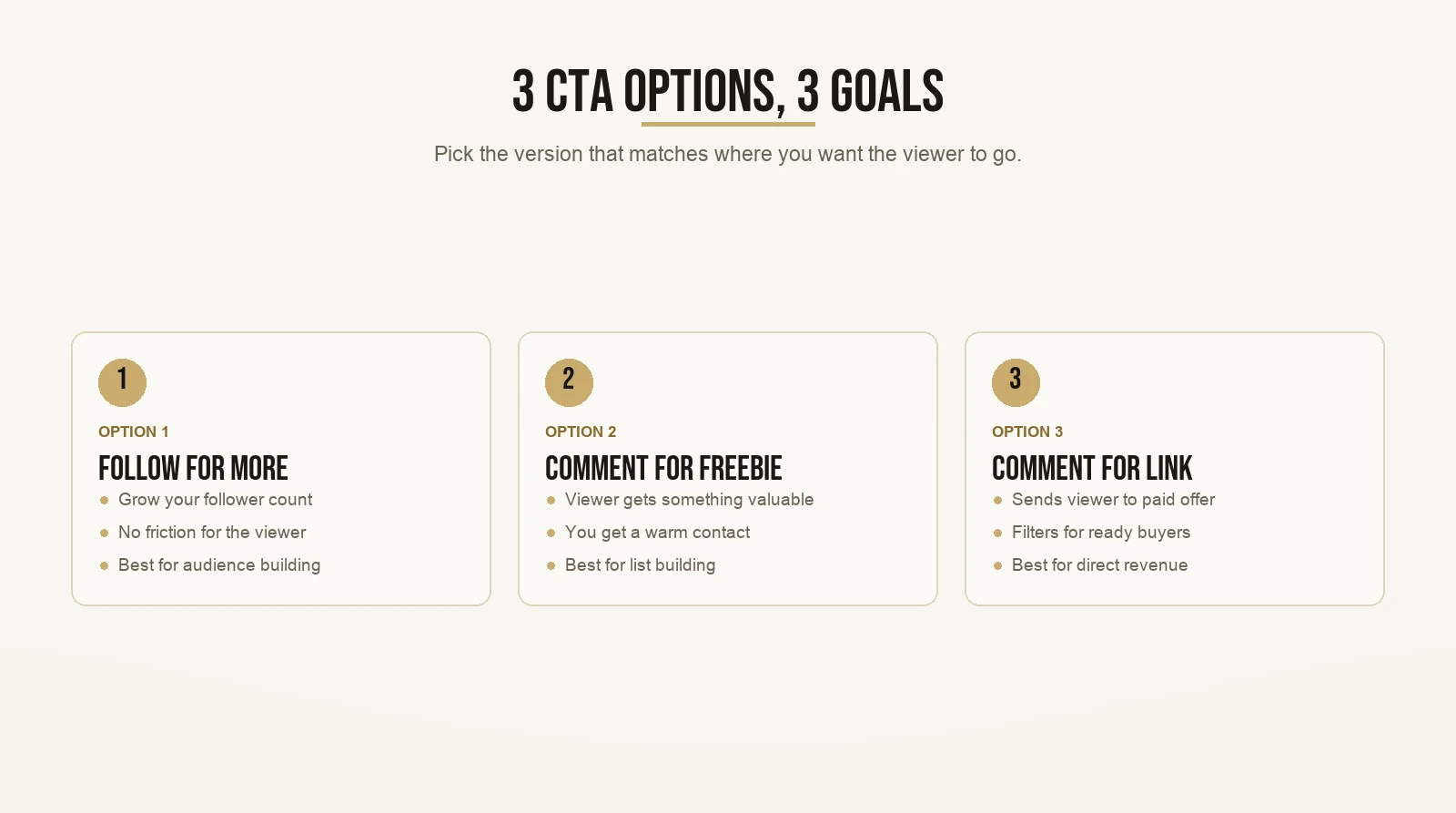
Building Block 3 is the call to action. There are three versions.
Option 1: “Follow for more [topic].” Use this when your goal is audience growth. It costs the viewer nothing and builds your follower count.
Option 2: “Comment [keyword] and I will send you [freebie] in the DMs.” Use this when you want to build trust and a warm list. The viewer gets something valuable for free. You get a warm contact who raised their hand.
Option 3: “Comment [keyword] and I will send you the link.” This drives people directly to a paid offer. A paid community page. A product. A booking link. Boom.
The reason Option 3 works so well is the filtering it does. A person who stops scrolling, watches your video to the end, and types a keyword into the comments has done three things in sequence. They noticed your content. They found it relevant enough to keep watching. They took action.
That person is not cold. They are warm before they ever land on a sales page.
A tool like ManyChat automates the DM delivery. The viewer comments the keyword. The DM fires automatically. They get the link. They decide whether to join. No manual follow-up required. No ad budget required. The content engine you are already running becomes the acquisition engine for your community.
Instagram users spend an average of 1 hour and 13 minutes per day on the platform. The audience you need is already there, scrolling, every day. The CTA is how you pull them from the feed into your world.
One note on the paid DM channel. Paid Messenger inbox ads were discontinued in November 2025. That was the main paid option for reaching someone in their inbox at scale. It is gone. Organic comment-to-DM via a tool like ManyChat is now the primary path. If anything, that shift strengthens the system above rather than weakening it.
What Is Contrarian Ideology, and Why Does It Matter for Community Growth?

Contrarian ideology is a framework for creating content that reaches people who have never heard of you. Instead of confirming what most people in your niche already believe, you challenge it with a better mechanism. That is what makes your content spread beyond your existing audience and bring new people into your funnel every week.
Here is the honest problem that hits most paid communities after the first few months.
The founding members are people who already know and trust you. They follow your content, they bought into the idea, they showed up at launch. That is great for month one. But those people were already yours. The community is not growing. It is just formalizing your existing audience with a price tag attached.
If you want the community to keep growing past month three, your content has to reach strangers. Not your current followers. People who have never seen a single post from you and do not yet know your name.
That requires a different kind of content.
Every niche has a majority belief. In the coaching and creator space, the common advice is: post consistently, show your face, use trending audio, hook them in the first three seconds. Content that repeats that advice gets engagement from the people who already follow you. They see it because they opted in. But it rarely reaches strangers, because it confirms what the mainstream already believes, and strangers scroll right past confirmation.
Contrarian content challenges that majority belief. Not to be dramatic or difficult. Because the majority belief is often wrong, or at best incomplete.
“Going viral is not about posting every day. It’s about the topic.” That sentence does not appeal to your loyal followers. It appeals to the creator who has been posting consistently for six months and is starting to think something is fundamentally broken with their strategy. That person has never heard of you. They are scrolling past more consistency advice when they hit your video, which says the exact thing they were starting to suspect, and they stop.
That is how you put new people at the top of the funnel every week. New people at the top of the funnel means new people in the community.
Hold on, Max. If I keep challenging what everyone else says, won’t I just sound contrarian for the sake of it?
Yes, and that is the trap. Contrarian ideology is not a personality. It is a diagnostic tool. Before you create a video, ask yourself what the mainstream believes about this topic and whether that belief is actually getting people results.
If the belief is correct, find the piece most people miss and teach that. If the belief is wrong, say so directly and show the better mechanism. You need evidence behind the challenge. A video that says “everyone is wrong” with nothing behind it loses trust fast. A video that says “the conventional advice is incomplete, and here is why your content stalls between 100 and 900 views” builds it. Specificity is the credibility.
Is a Paid Community a Revenue Stream or a Pipeline?
It is both. But almost every guide on how to build a paid community only explains the first half. Yes, recurring membership revenue is real and worth building. What almost nobody says is this: a paying member has already filtered themselves as a qualified prospect. They are a warmer lead for your higher-ticket offers than any follower who has never paid for anything.
Here is the business logic that most platform guides and how-to articles miss completely.
A person who pays to join your community has done four things in sequence. They found your content. They found it valuable enough to keep watching. They trusted you enough to pay before knowing exactly what they would get. And they took action. That full sequence is a qualification signal. It is freaking different from a free follower who liked a post once and never came back.
In practice, your paid community is full of people who are more likely than average to be interested in your higher-ticket offers. They already believe in you. They have already proven to themselves that you deliver value. The sale to a higher level of access is shorter because the trust is already there. The objection is not “who are you?” It is “is this the right time for me?” That is a completely different conversation to be in.
This is the piece that guides about platform selection and content calendars consistently miss. They treat the paid community as the destination. The more accurate frame is that it is a waypoint. It qualifies the people who join, deepens trust over time, and produces a pool of already-warmed leads for whatever comes next in your business.
But Max, doesn’t that mean I am using the community as a funnel? Won’t members feel sold to?
No, and here is why. The progression is genuine. The community delivers exactly what it promises: access, consistency, and connection with peers. The members who are ready for more will ask for it. That is not manipulation. That is a natural next step for someone who has already been getting results inside the community.
If you want to understand how those conversations work in practice, read how to sell coaching in your Instagram DMs. The same mechanics apply once a community member raises their hand.
What Should You Actually Teach Inside the Community?
Less than you think. Your paid community is not a course, it is access. The three things members pay for are direct access to you, accountability from being around peers doing the same work, and community. A weekly live Q&A delivers all three at once. You do not need a full curriculum to start, and building one too early often dilutes the thing members actually want.
Your paid community is not a course. That distinction matters.
A course delivers information. You record it once. Members consume it on their own schedule. The value is in the content library.
A community delivers access. The value is being able to ask you a question right now, about their specific situation, and get a real answer. That specificity is the product.
The three things that justify a recurring membership fee are access, accountability, and community.
Access means members can ask questions directly, attend your live sessions, and see your thinking before it goes public.
Accountability means they paid to be there, and the people around them are doing the same work. That environment makes people act.
Community means they are not alone. They can ask peers, share wins, and get honest feedback from people who understand the situation.
A single weekly live Q&A delivers all three at once. No content library required to start.
And here is what creators who have done this consistently will tell you: the live Q&A is worth more to members than twenty pre-recorded lessons. The lesson answers questions you anticipated. The Q&A answers the question the member has today, about their specific business, in real time. That is the product people stay for, month after month.
What Platform Should You Use to Build a Paid Community?
Start where your audience already spends time. If they are on Instagram every day, Instagram Subscriptions keeps everything in one place with no new app to download. If you need more structure, standalone platforms are the other option. The right platform is the one your specific audience will actually log into without friction.
If your audience is on Instagram daily, the case for Instagram Subscriptions is strong. There is no friction. Members find your exclusive content right inside the app they already use. No new login, no new interface, no barrier between them and your posts.
Meta introduced a subscribe button that surfaces directly in the Feed when followers see your content, and Instagram Subscriptions has passed one million active subscriptions. The behavior is validated. Audiences will pay for direct access to creators they trust, inside the platform they already use every day.
The platform is also moving in a helpful direction. Meta One, launched in September 2026, adds automated follow invitations for people who engage with creator content. A viewer who comments on your Reel can now be automatically invited to follow you, which puts them one step closer to your subscription offer. The tools are shortening the path from viewer to paying member. Pretty straightforward tailwind, and you do not have to do anything special to benefit from it if you are already using a CTA-driven content system.
For creators who want a dedicated community space with more features, a standalone platform has real advantages. Discussion threads, a resource library, and a member directory can feel more substantial. The trade-off is friction. Your member has to go somewhere new every time they want to access the community.
If you are building this from scratch, start with the option that removes the most barriers for your specific audience. You can migrate to a different platform once you have built the habit of people showing up. What you cannot easily recover is the momentum you lose by asking people to jump through extra hoops from day one.
What Breaks a Paid Community Before It Even Starts?
Building one before your primary offer is proven. Every creator who splits attention between a paid community and an unproven primary offer ends up doing both at 60 percent. Nothing gets maximized. The paid community amplifies what is already working. It does not carry a business that is not.
Okay, Max. What if my primary offer is doing well enough? How do I know when I am actually ready?
Here is the test. If a stranger saw your comment-keyword CTA on a Reel right now, commented the keyword, received your DM automatically, clicked through to your offer, and decided to buy, would the whole sequence work end to end without you scrambling to fix something in the middle?
If yes, you are ready to add a secondary offer like a paid community.
If no, the primary system still has gaps. Fix those first.
The paid community rewards patience. It is much easier to fill a room when you have an existing audience that already trusts you than it is to build trust and a community at the same time. The creators who build communities that compound are almost always the ones who waited until the content engine was running cleanly before they added the community layer on top.
How Do You Launch a Paid Community Without a Big Announcement?
You do not need a launch event. Add a comment-keyword CTA to one Reel per week pointing to the community, post three pieces of content inside before you open it, and set up one recurring weekly touchpoint. The content engine you already run does the acquisition work. You just need to give people something worth walking into when they arrive.
Here is the sequence:
Step 1. Pick one platform based on where your audience already spends their time. Do not overthink this. You can migrate later.
Step 2. Add a community CTA to your existing Reels rotation. Once per week, make Building Block 3 point to the community. “Comment [keyword] and I will send you the link to join.”
Step 3. Decide on one recurring touchpoint inside the community. One weekly live Q&A. One short teaching post every few days. One thing, consistently, before you commit to anything else.
Step 4. Post three pieces of content inside before you open it. A welcome video, one piece of teaching content, and the time of your first live Q&A. Give people something to land on.
Step 5. Show up to the weekly touchpoint every week, even when three people attend. Those three people get the most out of it. They will become your most loyal members. The community builds from consistency, not from a launch announcement.
There we go. That is the whole thing. The content engine handles acquisition. Your job is to make sure the room is worth walking into.
For the content system that feeds this, how to create a lead magnet that attracts clients and how to launch your offer on Instagram both connect directly to the steps above.
The Part Nobody Tells You
There is one thing every how-to guide on paid communities quietly glosses over.
The community does not run itself.
Templates, frameworks, and automation handle a lot of the operational weight. You can read more about the teaching philosophy behind this approach at Max’s own site. The through-line is that the frameworks do the heavy lifting, but only when you execute them consistently.
What the 7 Building Blocks do not replace is showing up every single week. Even when the numbers are small. Even when the week is packed. Even when you would rather not. A community that gets strong, consistent live sessions retains at a high rate. A community that gets occasional sessions and then goes quiet for two weeks does not.
The honest version of how to build a paid community looks like this. You build the content engine first. You add a comment-keyword CTA that points to the community. You use contrarian ideology to reach new people in your niche every week, not just your existing followers. You let Building Block 3 do the warm-lead work every time you post. You show up inside the community on a predictable schedule. You let the trust build.
And then you let the members who are ready for more raise their hand.
No shortcut in that sequence. But there is a sequence, and the sequence is what separates communities that compound from ones that stall.
Want the templates behind content that actually gets watched? Grab the templates here and start with the first one today.