
Key Takeaways
- A launch is not a single post. It is a timed conversion window with four distinct phases: heat-up, proof drip, open window, and close.
- Your warm audience converts far better than a cold one. The entire sequence is designed to activate them before you open anything.
- Instagram ranks Reels by predicting reshares first. Launch content has to earn that signal or it will not distribute.
- Stories is a warm-audience surface by design. Cold followers are progressively less likely to see your Stories, which makes it your primary launch conversion channel.
- Your bio is a time-sensitive landing page. It needs to change before the window opens.
- Broadcast Channels deliver launch messages directly to subscribers’ inboxes, with no feed algorithm standing between you and them.
What Does a Launch on Instagram Actually Mean?
A launch is a timed conversion window – usually three to five days – that moves warm followers from curious to committed. It has three phases before you ever open: a heat-up that activates your audience, a proof drip that builds specificity and urgency, and a close that gives people a real reason to act now instead of later. Without those phases, you are posting and hoping.
Most accounts post and hope. That is why most offer announcements get four saves and disappear.
Standard advice for how to launch on Instagram skips the sequence entirely. Set up your profile. Post consistently. Add a link in your bio. That is profile maintenance. It is not a launch. A real launch has a before, a during, and an after. Let’s crack into it.
Why Do Most Instagram Launches Stall Before They Even Open?
The most common reason: the warm audience was not warmed up. Creators announce an offer to followers who have not actively engaged in weeks. Those followers have low relationship scores with the account, see less of your Stories, and were never primed for a decision. The sequence fixes the order before it fixes anything else.
Hold on, Max. I’ve posted about my offer before and got almost nothing. Why would doing it in a sequence change that?
Because the problem is usually the order, not the offer.
When you announce before activating your warm audience, you’re asking followers who haven’t engaged with you recently to make a purchase decision. They don’t have enough context. And Instagram’s Feed now mixes posts from accounts you follow with recommended posts from accounts you don’t follow, so your warmest followers may be seeing your content less often than you assume.
There is also a content design problem. Most launch content is built to explain the offer. It describes what someone gets. It lists what is included. That type of content rarely earns the signal that matters most for distribution: reshares. Instagram ranks Reels by predicting reshares first, ahead of watch-throughs and likes. Content that voices a real frustration and resolves it in one sentence earns reshares. Content that explains an offer usually doesn’t.
What Is the CCN Framework and Why Does It Matter for a Launch?

CCN stands for Core, Casual, and New – the three audience rings around every creator’s account. Core followers engage with almost everything. Casual followers recognize you but engage inconsistently. New audiences have never heard of you. A launch sequence is a machine that moves Casual followers into Core territory before the window opens, so the people most likely to buy are already primed.
I teach this framework because it changes how you think about what you’re posting and who you’re posting for. You are not broadcasting to your whole following. You’re targeting the Casual ring during Phases 1 and 2. When the window opens, the Core ring is where the conversion comes from.
Instagram’s advertising reach stands at close to 2 billion accounts globally. The bottleneck for most creators is not the size of the platform. It is the activation level of the audience they already have. The CCN framework is how you fix that.
How to Launch on Instagram: The Four-Phase Sequence
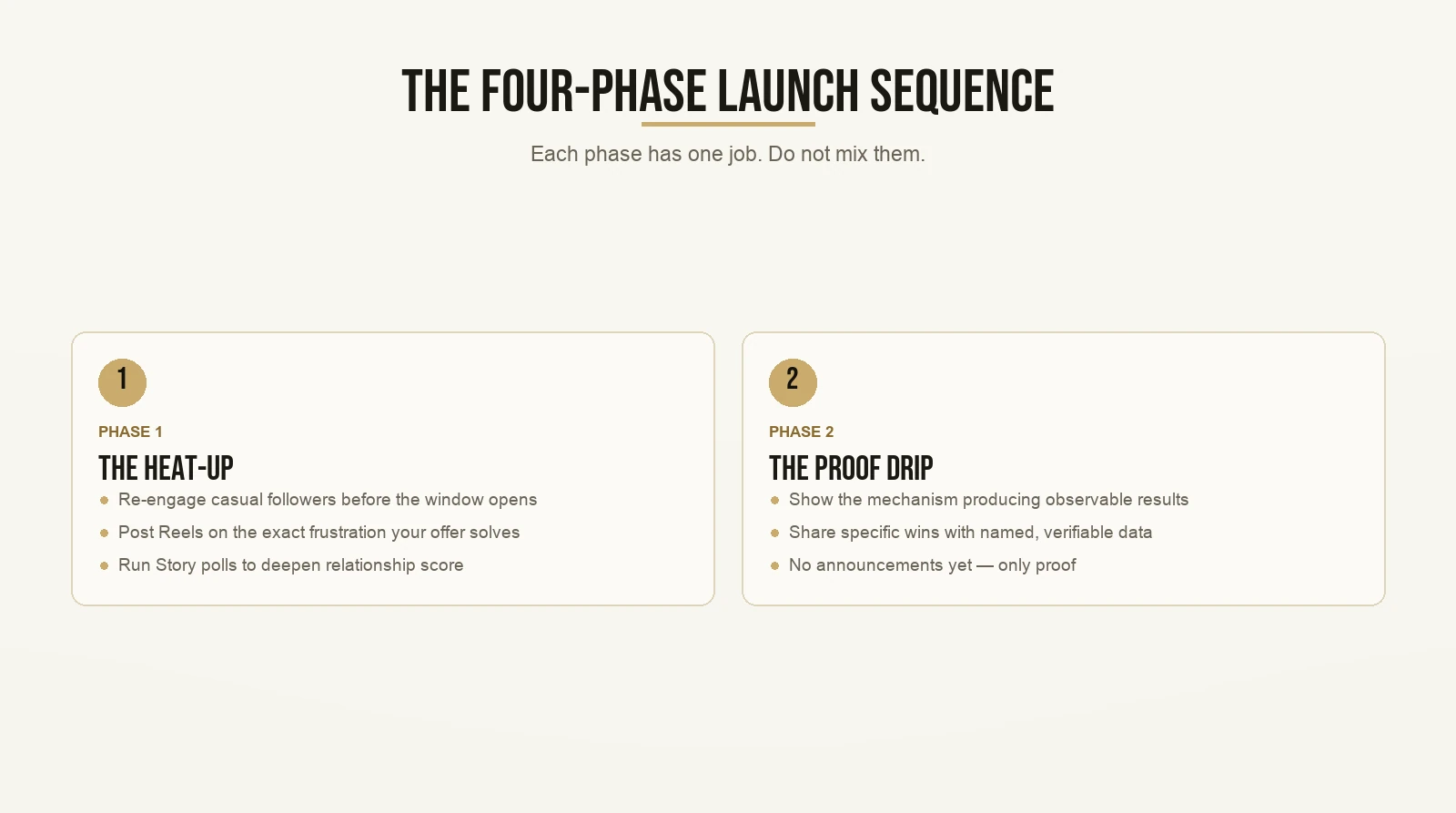
Here is the full sequence. Four phases, each with one job.
Phase 1: The Heat-Up (Seven to Fourteen Days Out)
The only job of the heat-up is re-engagement. You are not selling anything. You are pulling Casual followers back into active engagement so that by the time the window opens, they have watched several of your videos and replied to at least one Story.
This matters because Stories ranking is driven by three signals: how often someone watches your Stories, how often they engage with them via replies or Story likes, and overall relationship closeness. Stories is a warm-audience surface by design. Followers who engage with you during the heat-up will see your launch Stories later. Followers who haven’t engaged in months may not. You are building your Phase 3 audience by how you run Phase 1.
What to post during the heat-up:
- Two to three Reels built around the exact frustration your offer solves. These should be New audience topics: written so that someone who has never heard of you relates immediately. Do not mention the offer. Teach the mechanism. The goal is to pull in the Casual ring by reaching past the Core.
- Story sequences with a poll or question box on Day 1, Day 3, and Day 7. Ask something your buyer is asking themselves right now. “Do you feel like you’re posting consistently and nothing is converting?” The replies give you language to use in the proof drip. The engagement deepens the relationship score that governs whether followers see your launch content later.
- A pinned Reel that acts as a credibility anchor for new eyes hitting your profile. New arrivals during the launch need to understand immediately who you are and why your track record is real.
That pinned Reel connects directly to what the credibility bank framework describes. Your Highlights section should be built before the launch opens with at least three sections: who you are, what you do, and results from people you have worked with. New eyes hit the Highlights before they reach your bio link. A vague profile at that moment is a conversion killer.
Pretty straightforward concept. Almost nobody does it before they open the window.
Phase 2: The Proof Drip (Five to Seven Days Out)
The proof drip has one job: show the mechanism producing observable results.
You are not announcing anything yet. You are sharing specific, verifiable moments where the thing you teach worked. Not a vague win. Not an income figure. A specific transformation with named data.
“She ran this heat-up sequence and her Stories views went from 140 to 890 in four days.” That is a mechanism result. It is specific. It carries no income claim. It is more credible than a vague testimonial because it names the mechanism and shows the exact signal that changed.
Authority comes from how specific you are about how things work. That specificity is the credibility. You do not need dollar figures when you can name the mechanism and show the data point.
Three to four Stories per day in this phase. A mix of:
- A thirty-second video walking through one step of your process, no production needed
- A result screenshot showing an engagement metric, a reach number, or a conversion data point, not revenue
- A poll: “Would you want me to walk through the full sequence?” The response rate is what matters, not the answer. Every tap deepens the relationship score that determines who sees your Day 1 launch content.
Boom. By the time Phase 3 opens, your warmest Casual followers have watched your content, engaged with your Stories, and seen the mechanism work. The decision is almost already made before you ever say the window is open.
Phase 3: The Open Window (Launch Days One Through Three)
This is where you open.
Your first launch Reel needs to be designed for sends above everything else. In January 2025, Adam Mosseri named sends per reach as one of the most important ranking signals across all surfaces, stating: “One of the most important signals we use in ranking is sends per reach – think about creating something people want to send to a friend.” Content that people DM to a friend gets distributed harder to non-followers. A launch Reel that earns sends while simultaneously moving warm followers toward a decision is doing both jobs at once.
How do you write something people send? Voice the frustration they already have. Keep it under thirty seconds. End on a line that makes them think: “my friend needs to see this.”
Each of the three launch days has a specific role:
Day 1: The open. Announce the window is open. Make the Reel a genuine teaching piece, not an advertisement. The CTA at the end goes to your bio link. Your bio should now show exactly what happens when they click: one clear outcome, no vague journey language.
Day 2: The objection Reel. Voice the most common reason people don’t act and answer it directly. Short. Blunt. Sendable. Your question-box replies from the previous night’s Stories will tell you exactly what to address. Write it overnight and post it the next morning.
Day 3: The proof Reel. Show the mechanism working. Mechanism-specific results, not revenue figures. A before-and-after that names the specific variable that changed.
Stories run every day of the window. A countdown sticker on Day 2 and Day 3. Reply to every question-box response you received. This is where the relationship score built during the heat-up pays off.
If you have a Broadcast Channel, this is where it earns its place. Messages sent through Broadcast Channels land directly in subscribers’ DM inboxes with no feed algorithm involved. A short message on Day 1 – “window is open, here is exactly what you get” – reaches opted-in subscribers without competing for feed real estate. If you haven’t set one up yet, the complete Broadcast Channel guide covers everything from creating it to sending your first message.
Wait, Max. I’m under 1,000 followers. Can I use Instagram Live as a launch event?
No. Instagram added a 1,000-follower minimum for Live in August 2025. If you are under that threshold, a Broadcast Channel plus a Stories sequence is the functional alternative. For small warm audiences, it often converts better anyway because the relationship is more direct and there is no waiting around for a live to start.
Phase 4: The Close (Final Twenty-Four to Forty-Eight Hours)
Closes exist for one reason: people postpone decisions until something forces a change. The close creates that change.
The tone shifts here. Less teaching, more honest directness. “This closes tomorrow. The most common thing I hear from people who almost acted and didn’t: they told themselves they could start later. Later rarely shows up.”
One final Reel. One final Stories sequence with a countdown sticker. One Broadcast Channel message if you have it. Then the window closes, and it stays closed.
A launch that extends “just a few more days” trains your audience that your deadlines are suggestions. Every future launch starts with less urgency than the last. Run it clean, close on time, and move to the next cycle.
What Should Your Bio Look Like During a Launch?

Your bio is the conversion bottleneck – more than the Reel, more than the offer itself. When someone arrives from a reshared video or an Explore discovery, they spend about three seconds deciding whether to click the link or leave. The bio is what they read in those three seconds.
Most bios are vague. “Helping creators grow.” “Building a life I love and teaching you to do the same.” A cold follower who just watched a thirty-second Reel has no idea what happens when they click your link. That gap is where conversions die.
Max’s framework is direct: the bio answers one question immediately. What do I get when I click?
Not “start your journey.” Not “transform your results.” A concrete, time-aware outcome: “Get the five-step sequence – open until Friday.” Or “Watch the twelve-minute breakdown.” Specific. Actionable. Clear on timing.
This matters more during a launch than at any other time. Instagram’s Explore surface rewards content that accumulates saves and shares quickly – popularity signals matter more on Explore than on Feed or Stories. A launch Reel that performs well in the warm audience can push new cold eyes to your profile. A vague bio at that moment kills the conversion and signals to the algorithm that the content was not worth the push.
Change your bio before the launch window opens. Make it time-aware. Revert it when the window closes.
How Do You Make a Launch Reel Worth Resharing?
The hook is the single highest-leverage variable in any launch Reel. Instagram’s algorithm predicts reshares first across Reels, which means a launch Reel with a weak hook dies before the mechanism is ever taught and before a single send signal is earned. If your launch content is underperforming, the hook is the first thing to audit, not the offer and not the bio.
A strong launch hook voices the exact frustration in the exact words your buyer uses with themselves. Not “here is how to convert followers” but “you have been posting about your offer for weeks and nobody is biting.” That second version is specific to a moment they have already lived. They recognize themselves in it. They send it to the friend who is in the same situation.
From there: one idea per sentence. The body of the Reel teaches the mechanism in the simplest possible terms. No jargon. No overexplanation. One clear call to action at the end, no alternatives given.
If your hooks are still not stopping the scroll, the collection of Reel hook structures that consistently work is a good framework to start from.
Does Audience Size Matter for a Launch?
Hold up, Max. I only have 400 followers. Is this entire sequence actually worth running?
Yes. Completely. Here is the direct answer.
Four hundred warm, engaged followers who have watched your content, replied to your Stories, and seen your proof drip will convert better than four thousand cold followers who clicked Follow once and never came back. The sequence is about activation, not volume. It works at any size.
What changes at a small audience:
- The heat-up phase matters even more. Every Story view, every poll reply, every DM response is load-bearing. Your warm audience is your entire conversion asset, so you protect it carefully.
- The proof drip should include your own results alongside client results. If you haven’t run the mechanism for a client yet, run it on your own account and document the specific change you produced.
- The open window can run for two days instead of three. A tight window with forty engaged followers converting is more valuable than a five-day window where momentum drops off.
- You do not need Live. The Broadcast Channel plus Stories sequence outperforms Live for a small warm audience because the relationship is more direct and there is no attendance friction.
You get the gist. Don’t wait until you have a larger following to run a launch. Run it now with what you have, tighten the process, and by the time the audience grows, the sequence is already second nature.
The warm audience vs cold audience breakdown goes deep on exactly why a small activated audience consistently outperforms a larger cold one in real conversion scenarios. Read it before you convince yourself you need more followers first.
What Happens After the Launch Window Closes?
Two things, in this order: replicate what worked, and begin the next heat-up immediately. If a Reel earned strong reshares during the sequence, make more content on that exact thematic until it stops working. Don’t pivot to something clever. And start Phase 1 of the next cycle the following day, not after a break.
The silence most creators take as a reward after a launch is actually the moment the next launch asset is eroding. Warm audiences cool off fast. Treat Day 1 after the close as Phase 1 of the next cycle.
After the window closes, look at your Story views and Broadcast Channel open rates from the sequence. Those tell you which segment of your warm audience was most activated. The people who watched every Story and did not convert are the most valuable data point in the whole launch. A personal, direct reply to one of them is worth more than a hundred new Reel views.
You can see how creators who have run this full sequence across multiple cycles describe what it produces at Max’s results page.
Want the templates behind content that actually gets watched? Grab the templates here and start with the first one today.