
Key Takeaways
- Instagram’s Stories ranking algorithm weighs three signals: likelihood to tap, likelihood to like, and likelihood to reply with a message. Reply bait is not just a conversion tool. It is also a reach tool.
- The CCN framework explains why passive Story viewers and warm followers need different CTA language. Using the wrong frame for the wrong audience layer is why most Story CTAs fall flat.
- The funnel that actually books calls has three steps: a reply bait Story, one qualification question, and the calendar link. Most coaches skip step two and wonder why they get ghost-calls.
- The credibility bank (your highlight section, pinned posts, and bio) is what converts a curious viewer into someone who shows up to the call ready to work. Build it before you run any Story CTA.
- Public Story comments (launched September 2024) disappear after 24 hours. Private DM replies stay in your inbox permanently. Lead generation belongs in the DMs.
Most Story-to-Call Funnels Break Before the CTA Even Runs
Most of the advice on how to turn Instagram Story views into discovery calls starts at the CTA line.
Post a Story. Say “reply BOOK.” Automation drops the calendar link. Done.
That would be fine if the Story itself did not matter. But it does. Freaking a lot.
The Story is where the decision happens. A viewer either feels something and raises their hand, or they tap through and forget you exist. No keyword trigger rescues a Story that created no tension.
This post covers the whole chain. The specific frame inside the Story that makes a passive viewer want to reply. The two-message sequence that qualifies them before the calendar link appears. And the credibility bank that turns a curious reply into a yes on the call.
Let’s crack into it.
Why Does Instagram Distribute Stories to More Viewers When You Get Replies?
Replies are one of the three ranking signals that determine how many of your followers see a Story. More replies means more reach on your next one.
In January 2025, Instagram head Adam Mosseri confirmed the three Stories ranking factors: likelihood to tap, likelihood to like, and likelihood to reply with a message. Stories are built to connect people with their friends, not for discovery. A reply is the strongest signal that the Story actually triggered a real response.
This matters for your funnel. A reply bait Story that generates DMs is not just filling your inbox. It is signaling to the algorithm that your Stories are worth showing to more of your followers next time. The conversion win and the distribution win happen at the same time.
Sends are also a top-three signal for overall Instagram ranking. Mosseri said sends are “slightly more important for unconnected content,” meaning content your followers share with people who have never seen your account. When your Story prompts someone to forward it to a friend, that is double value. You get a new potential viewer and a ranking signal in the same action.
Most coaches post Stories as updates. They share a Reel. They add text to a photo. None of that reliably generates replies. Reply bait is a specific frame. We will get into it.
What Is the CCN Framework and Why Does It Change How You Write Story CTAs?

CCN stands for Cold, Casual, and Niche. These are the three audience layers that see your content. Each layer responds to a different kind of invitation. Your Story CTA needs to know which layer it is aimed at before you write a single word.
The CCN framework is how I think about every piece of content before I build it.
Cold viewers have never heard of you. They found your Story because a follower shared it or because the algorithm slipped it in. They do not know your method. They do not know your results. They know nothing about you yet.
Casual viewers know of you. They have seen your content a few times. They have not bought anything. They are warming up.
Niche viewers are your core audience. They follow you intentionally. They open your Stories on purpose. They already trust your voice and are the most ready to act.
Cold, casual, niche. You get the gist.
Here is the mistake most coaches make. They write CTAs for the niche viewer and post them where cold viewers will see them.
“Reply BOOK if you are finally ready to scale your coaching business.”
That line works for someone who has been following you for months and has been thinking about working with you. For a cold viewer, it reads like a stranger asking for a commitment before they know your name.
Hold up, Max. So what do I say to a cold viewer?
Give them something easy to do. “Reply YES if this hits” is lower friction than “reply BOOK.” A cold viewer who says YES is raising their hand. They are telling you they are interested. You have opened a conversation without asking them to commit to an hour on a calendar with someone they just discovered.
The CCN framework changes your CTA based on who is actually seeing the Story. If the Story is likely to travel because the topic is broad, write the reply bait for cold eyes. If the Story is hyper-specific and it is going to your warmest followers, you can escalate the ask.
This also explains why a Story format that works for one creator fails for another. The same words land differently depending on how warm your audience already is. Understanding your CCN layer first is not optional. It is the thing that makes the rest of this work.
What Is “Reply Bait” and How Do You Build It Into a Story?
Reply bait is a specific tension or open loop inside the Story that makes a passive viewer feel compelled to weigh in. It is not the CTA text at the end. It is the frame that makes someone feel the need to respond before the ask even appears.
There are three frames that reliably trigger replies.
The contrarian claim. Take a belief your audience holds, flip it, and state the flip plainly. “Posting every day is actually killing your reach.” Anyone who believes the opposite wants to push back. Anyone who has felt that itch to disagree and is not sure why wants to find out. That friction is the bait.
The identity call-out. Name a specific segment of your audience and describe their exact situation with precision. “If you have been posting for six months and you are still getting fewer than fifty views per Story, read this.” The viewer who matches that description feels seen. Feeling seen triggers a reply.
The open loop. Start the answer to a question your audience cares about. Then stop. “I tested three different Story CTAs last month. One got zero replies. One got forty-two. I will tell you which one actually worked…” Stop there. Next slide: the reply ask. “Reply CURIOUS and I will send you the breakdown.” The viewer wants the answer. The reply is the only way to get it.
A very very key point here. The reply bait frame is about the Story content itself, before any tool or automation. No platform feature can manufacture the tension that makes someone want to reply. That lives entirely in what you say and how you frame it. Get the frame right first. The tool is secondary.
What Is the Two-Message Qualification Sequence?
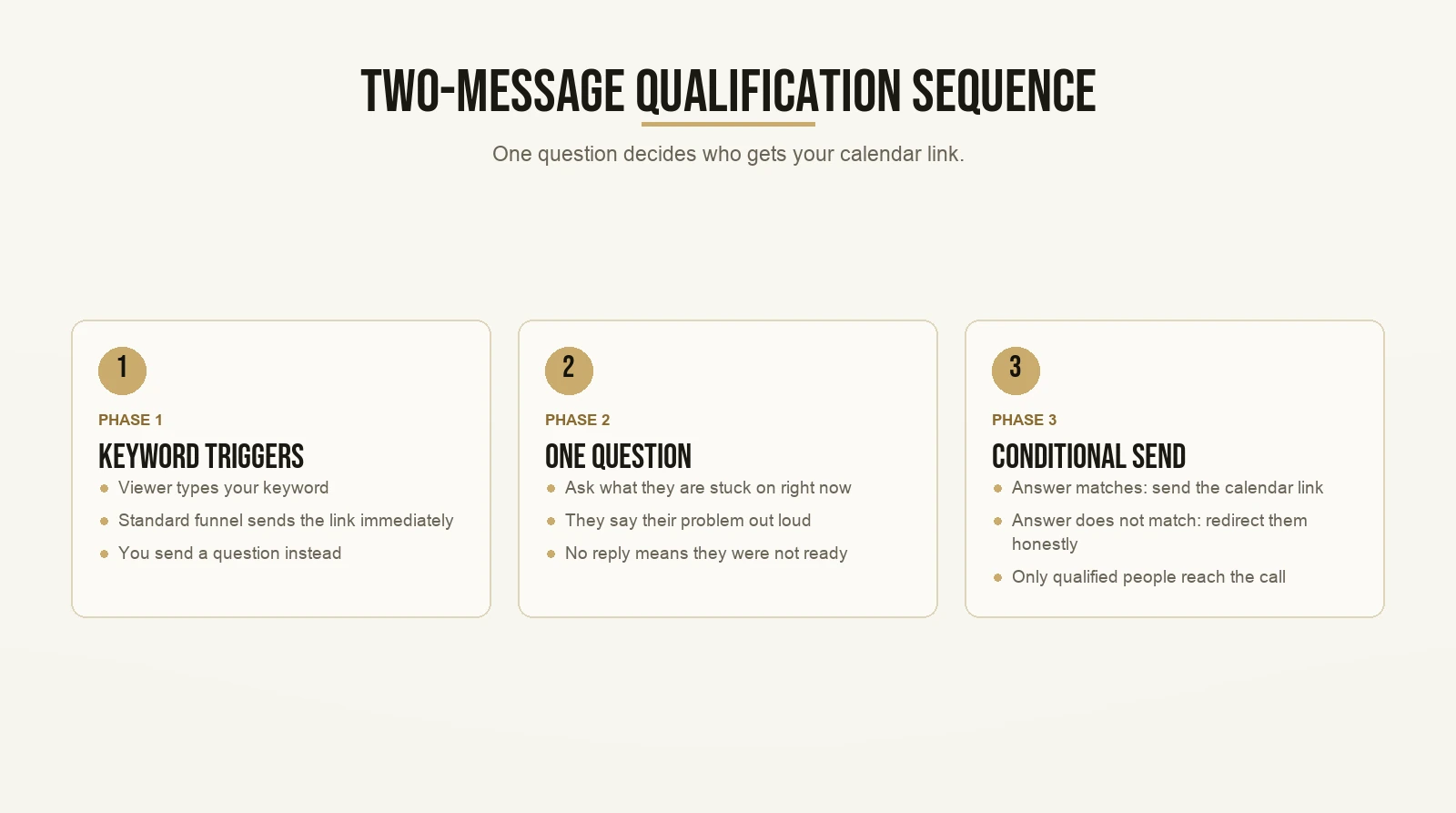
It is one question you ask before you send the calendar link. That question reveals whether the person who replied is actually a fit. Sending the link to everyone who types a keyword wastes both your time and theirs.
Here is why this matters. Instagram reached three billion monthly active users as of September 2025. A meaningful percentage of that audience is curious but not qualified. When a cold viewer stumbles on your Story and types your keyword, they are interested. They are not necessarily your client.
The standard automated funnel goes: viewer types keyword, automation sends calendar link. That is it. You end up with calls from people who have no budget, no real urgency, and no problem that matches what you solve. That is draining, and it is fixable.
The two-message sequence works like this.
Your first message: “Hey, thanks for reaching out. Quick question before I send anything: what is the main thing you are stuck on right now with [your topic]?”
One question. You are not asking for a resume. You are asking them to say out loud what their problem is.
Your second message depends on their answer.
If their answer matches what you actually help with, send the calendar link with one sentence of context. “That is exactly what we work on. Grab a time here:” and the link. Done.
If their answer does not match, be honest. “I do not think I am the best fit for that specific problem, but here is something that might help.” Point them somewhere useful. That is how you earn a reputation for being trustworthy, not just transactional.
Hold up, Max. What if they just do not reply to that question?
Then they were not ready. That is fine. A non-reply is not a loss. It is information. Someone who will not answer “what are you stuck on” is not ready to commit to an hour on a call with someone they just found. They saved you an hour that was going nowhere.
For a deeper look at how to handle the conversation once someone is in your inbox, see this Instagram DM script for booking discovery calls.
What Is the Credibility Bank and Why Does It Matter After Someone Replies?

The credibility bank is the collection of trust signals on your profile: your highlights, your pinned posts, and the bio that answers “why should I listen to you?” It is what closes the gap between a reply and a yes on the call.
Here is what actually happens after someone replies to your Story. You send the qualification question. They open it. Before they answer, many of them tap over to your profile. They are checking you out.
If your profile is empty, generic, or confusing, you lose them right there. The reply is in your inbox and you still lose them because there is nothing on your page that says this person knows what they are talking about.
The credibility bank fixes that.
Three highlights every creator should have on their Instagram profile:
- Who I am. Your hero story. Not a resume. The arc from the problem your audience has to the result they want, told in your own words. Your viewer sees themselves in the before.
- What I do. Your unique method. Not your offer. The mechanism. The contrarian thing you believe that most people in your space get wrong. This is where you stand out.
- Results. Testimonials, transformations, outcomes. The proof that the method works. Not for show. For the cold viewer who needs to know it is real before they get on a call with someone they just found.
A cold viewer who taps from your Story to your profile should be able to answer three questions in under thirty seconds: who is this person, what do they do, and has it worked for anyone. The credibility bank makes that possible.
You can see how real creators use this system across different niches at Max Tornow’s reviews page. The pattern holds across formats.
Super duper key: the credibility bank is not built the day before a campaign. It is built over time, one post and one Story at a time. Every testimonial slide, every honest breakdown of what worked and what did not, every moment of real teaching from your own experience is a deposit. For a detailed walkthrough of the format, this Instagram highlights strategy for coaches and service providers goes deep on the structure.
What Is the Difference Between Public Story Comments and Private DM Replies?
Public Story comments launched in September 2024, are visible to every viewer, disappear after 24 hours, and are capped at 60 characters. Private DM replies stay in your inbox permanently. For lead generation, private DM replies are the correct mechanic every time.
Instagram launched public Story comments on September 3, 2024. By default, only mutuals can leave them. Creators can open them to everyone or disable them per Story or globally.
The problem with using public comments for lead generation: the comment disappears when the Story does. The 24-hour window is not long enough for a full qualification sequence. A 60-character limit does not give someone space to tell you what they are stuck on. And the reply is visible to every viewer, which changes what people are willing to say. People are more guarded when others can read it.
A private DM reply persists. After the Story expires, the conversation is still in your inbox. The thumbnail of the original Story still appears in the thread. You can continue the conversation for days.
One practical note on mechanics. Whether a viewer can reply at all depends on your privacy settings. Go to Settings > Privacy > Story. If your reply settings are set to “people you follow,” someone who found your Story through a share sees no reply bar at all. They literally cannot reach you. If you want replies from new viewers, set it to “everyone.”
Business and Creator accounts can connect compliant automation tools through the Meta Graph API. Personal accounts cannot. If you are running a coaching business on Instagram and you are still on a personal account, switching to a Creator account is the first practical fix.
How Do You Build the Full Funnel, Step by Step?
Five steps. Build the credibility bank first. Write the reply bait Story using the right CCN layer for your audience. Place the CTA. Run the two-message qualification sequence. Send the calendar link only after the answer confirms fit.
Here is the whole chain laid out plainly.
Step 1: Build the credibility bank before you run any Story CTA. If someone taps your profile and sees nothing useful, the funnel is broken at that point. Do the highlight section first. Who I am, what I do, results. The bank needs to exist before you send traffic to it.
Step 2: Pick your CCN layer. Who is this specific Story actually for? A warm follower you have been building trust with for months, or a cold viewer who might see this because someone shares it? Write the content and the CTA for the layer that dominates your Story reach right now. If you are below ten thousand followers, most of your Story viewers are warm followers. Write for them.
Step 3: Build the tension before the CTA. Use a contrarian claim, an identity call-out, or an open loop. The tension comes before the reply ask. The CTA is the release valve for the curiosity you already created.
Step 4: Run the qualification question. Every reply gets the same message: “Quick question: what is the main thing you are stuck on right now with [your topic]?” Every one. No exceptions for someone who seems ready. The question takes five seconds to send. Let it do the filtering for you.
Step 5: Send the calendar link to confirmed fits only. One sentence of context. “That is exactly what we cover. Grab a time here:” and the link. Done.
For help building the Story scripts themselves, see how to write Instagram story scripts for coaches and how to use Instagram stories to grow your audience.
Does This Work for Coaches With a Small Following?
Small following means your Story viewers are almost entirely warm followers who opened your Story on purpose. That is actually a better starting position than cold reach. One well-qualified call from fifty warm viewers beats four ghost-calls from five hundred.
Pew Research found that 50% of U.S. adults use Instagram, and 80% of adults aged 18 to 29 are on the platform. The audience exists. The question is whether you are reaching it with the right frame.
A small following does not mean weak Story performance. It means most of your viewers chose to be there. They follow you intentionally. That is a more favorable starting point than a cold audience seeing your content for the first time.
The qualification sequence matters more with a small following because every call is a bigger percentage of your week. You cannot afford to sit on a call with someone who has no urgency and no real problem you solve. One well-qualified call from a careful funnel is worth more than three rushed calls that go nowhere.
There is also a compounding effect here. When your warm followers reply to your Stories, the algorithm learns that your Stories are worth showing. Your distribution grows. You start to reach more casual viewers, then cold ones. This is linear growth: you raise the baseline, view by view, reply by reply, and so on and so forth. The CCN framework keeps you focused on building each layer correctly instead of chasing one outlier and hoping it sticks.
The One Thing Most People Skip
Here is what I have seen. Coaches spend hours on the automation setup and thirty seconds on the Story itself.
They obsess over which tool to use, whether the keyword trigger fires correctly, how the calendar link lands in the inbox. All of that is infrastructure. None of it is the reason someone replies.
The reason someone replies is that the Story created tension they felt compelled to resolve. The credibility bank is the reason they trust you enough to book after they reply. The qualification question is the reason the people who do book actually show up ready to work.
Get those three things right and the infrastructure becomes very much secondary.
Read that again.
The mechanism works. That is what matters.
Boom. There we go.
Want the templates behind content that actually gets watched? Grab the templates here and start with the first one today.