
Key Takeaways
- Most instagram story scripts treat Stories as a content channel. This arc treats them as a seven-slide conversion system.
- Every slide does exactly one job. No slide does two jobs.
- The credibility bank is the framework that makes your arc work for cold audiences, not just your existing followers.
- The Link sticker is now available to every Instagram account regardless of follower count. The old 10,000-follower rule is gone.
- The Reveal sticker (launched May 2024) automates the DM trigger. You do not have to manually follow up with every viewer.
- Archive your best arc slides into your Highlights. That shelf compounds and converts cold traffic for months.
- Write all seven slides in one batch session. One slide a day kills the arc’s voice consistency.
What Are Instagram Story Scripts, and Why Do Most Creators Skip Them?
A Story script is a planned sequence of slides where each slide has a specific job to do. You run a defined arc with a beginning, a middle, and an end. That arc moves a viewer from “who is this person?” to “I want to talk to them.”
Most creators skip scripting because they think Stories should feel casual and off-the-cuff. They are right that Stories should feel casual. They are wrong that casual and strategic are opposites.
The viewer does not know you have a script. They just notice that this account feels clearer, more useful, and more worth following than the others. That feeling is architecture doing its job invisibly.
The problem with winging it: you end up posting polls about your morning routine, resharing your latest Reel, and adding a “tap the link” slide with no context. That is content. It is not a system. And it is why creators with solid engagement still get no DMs.
Why Do Most Instagram Story Scripts Fail to Convert?
They entertain the viewer without moving them anywhere useful.
A poll about coffee versus tea earns taps. It does not put the viewer one step closer to booking a call with you. An arc that names their exact problem, proves you understand the mechanism, surfaces a real objection, and opens a direct door – that earns DMs.
The difference is not production quality. It is intent. Every slide in a converting arc has a destination. Every slide in an entertainment arc has only engagement.
“But wait – don’t engagement metrics help my reach?”
Yes, up to a point. But here is the thing: a DM reply moves you to the front of that viewer’s Stories tray. Instagram ranks tray order by viewing history, engagement history, and closeness. A viewer who sends you a DM from slide six is more likely to see your next arc’s slide one before anyone else’s.
Entertainment stickers get taps. The arc earns DMs. DMs move you to the front. Being at the front earns more DMs. That compounding mechanic is what a poll about your dog cannot trigger.
What Is the Credibility Bank and Why Does Your Story Arc Depend on It?

The credibility bank is the framework for making your proof visible and persistent on Instagram – especially for cold audiences who have never encountered you before.
Here is the mechanism. Your Highlights section is the shelf. It should have at minimum three sections: “Who am I” (your hero story – where you started and where you arrived), “What I do” (your method, your contrarian approach, what makes your framework different), and “Client results” (proof that others have reached the outcome your audience wants). Highlights stay on your profile indefinitely until you remove them. Every cold viewer who lands from a viral Reel sees that shelf in the first few seconds of visiting your profile. They decide whether to trust you before they ever tap a single Story.
Your Story arc feeds the bank every time you run it. The credibility deposit on slide two gives you a fresh proof point to archive. The teaching moment on slide four shows your method at work. Those slides, once archived into the right Highlight, become permanent deposits that convert cold traffic for months without any extra work from you.
“Max, I’m just starting out. I don’t have a stack of client results to fill my Highlights yet.”
Fair. Here is the thing: the credibility bank does not require a full client roster to open. The “What I do” section is your method, your contrarian belief, the thing that makes your approach different. You can build that Highlight before you have a single paying client. The mechanism is the early credibility. Results get added to the shelf as they come in.
The shelf is what makes your story arc land with someone who arrived from a viral post and has never heard your name. Without it, you are pouring arc effort into a profile that gives cold visitors no reason to trust what they are about to watch. You can read more about how Max built the credibility approach behind this framework on his background page.
If you want to build the shelf itself from scratch, the Instagram Highlights strategy for coaches and service providers walks through the three-section setup step by step.
How Does the 7 Building Blocks Principle Apply to Story Scripts?

The 7 building blocks framework breaks any video into seven distinct parts, each with one specific job. No part does another part’s job. The hook earns the next second of attention. The body delivers one clear takeaway – not three. The CTA makes one ask.
This principle governs the story arc completely.
Building block five is the body, and Max’s rule for it is precise: after watching your video, the viewer should easily be able to say “I learned one new thing from this.” If they cannot name the takeaway, the video failed. The same rule governs slide four of the arc: one teaching moment, one mechanism the viewer can name clearly after seeing it. If you are cramming two ideas onto slide four because they both felt important, pick one and cut the other.
Building block seven is the CTA. One call to action. The most common mistake is stacking three asks onto the last slide: “Follow me, share this, and send me a DM.” All three fail because none of them gets the full weight of the slide. Pick the one that matters for this arc and make it the entire job of the last slide.
“Hold on – does every arc really need all seven slides? Can’t I run a shorter version?”
You can. But here is where most people go wrong when they cut: they cut the credibility deposit (slide two) because it feels awkward to write. That is the worst slide to cut. Cold traffic needs slide two. If you want to tighten the arc, cut slide three (the poll) and move straight from the deposit to the teaching moment. The poll earns micro-commitment but it is the most expendable.
The principle that runs through all seven building blocks is this: every part of the content does its own job and only its own job. Carry that into the arc below.
The 7-Slide Arc: Slide by Slide
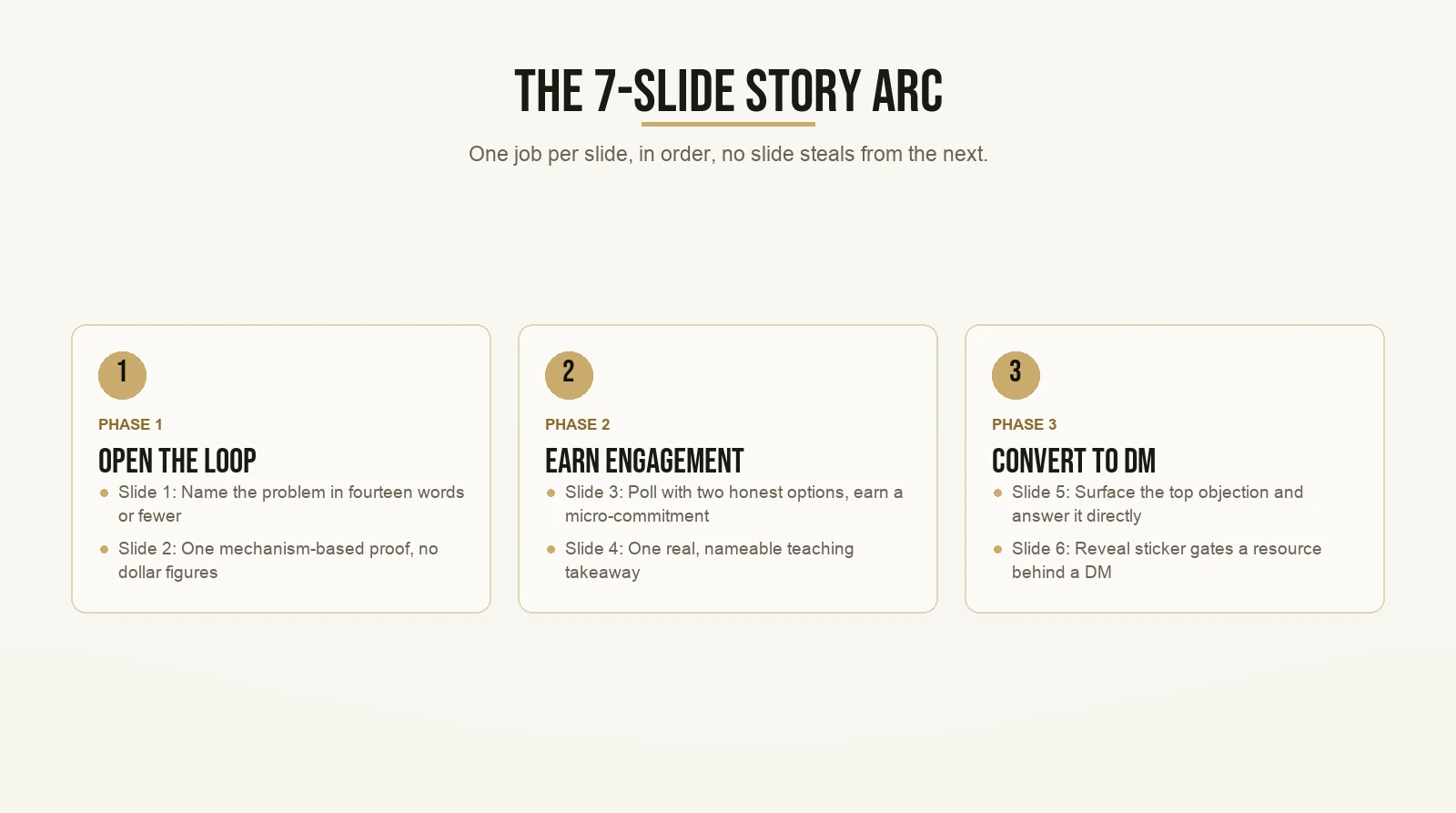
Here is the full arc. One job per slide. Write them in order and do not let any slide steal from the next one’s job.
Slide 1: The hook.
One sentence. One named problem or curiosity gap. Keep it at fourteen words or fewer if possible. The goal is to make the right person feel named.
Example: “If your Stories get views but no replies, here is exactly what is happening.”
You are not trying to be clever. You are trying to make the right viewer say “that is me.”
Slide 2: The credibility deposit.
One proof of mechanism. Not a dollar figure – a specific, mechanism-based result that proves you know how this works.
Example: “The coaches I work with shift from posting and waiting to running a structured arc. The DMs start before the follower count changes.”
Specific. Mechanism-based. No money. That is the deposit.
Slide 3: Their problem, in their language.
Use a poll sticker with two honest options that reflect two real versions of the same struggle. Both options should be true for different segments of your audience. This earns a micro-commitment and gives you genuine signal about where they are.
Example poll: “Biggest Stories block right now? / I don’t know what to post / I post but never get DMs”
Both are real. Neither is a trap. The poll is a qualifying question, not a trick.
Slide 4: The teaching moment.
Give them one real, usable piece of the mechanism. Not a tease – actual value. One takeaway the viewer can name after seeing the slide.
Example: “Most Story posts are one-directional: you talk, they watch. This arc is a conversation. Each slide asks something or answers something. That structure is what opens DMs.”
Read it back. Can the viewer name the one thing they just learned? If yes, it works. If they would struggle to say it, rewrite it.
Slide 5: The objection slide.
Surface the most common reason a viewer would stop here and not DM you. Answer it directly.
You have two options. Option one: use the Questions sticker to let viewers submit their objection in their own words. The replies arrive as DM threads. You surface the real objection for your specific audience and open conversations at the same time. Option two: write the objection yourself.
Example: “I know what you’re thinking. My audience is too small for this to work. Here is why that is backward: a small, engaged audience runs this arc better than a large passive one. The arc works because of intent, not size.”
Slide 6: The Reveal trigger.
This is the pivot from teaching to conversation. Use the Reveal sticker to blur a valuable resource and gate it behind a DM. When a viewer taps “Reveal,” Instagram sends a DM on their behalf automatically. No manual follow-up required.
Example blurred slide: “I put together a seven-slide script framework for coaches and service providers. Tap to unlock it and Instagram will send it to you automatically.”
This is super duper key. Before this slide, you are teaching. After this slide, you are in a direct conversation. The Reveal sticker is the native tool that makes this mechanic work without any friction on either side.
Slide 7: The direct CTA.
One ask. One clear action. One outcome the viewer can picture.
Example: “If you’re a coach or service provider and you’re tired of posting Stories that get zero responses, send me the word READY. We’ll figure out if this arc fits your setup.”
No pricing. No program name. No “if this resonates.” Just an open door.
How Do You Write Story Scripts That Sound Like You, Not Like a Template?
Say the slide out loud before you type it. Whatever you would tell a friend who just said “my Stories get no DMs” – that is your first slide draft.
This is the one move that prevents scripted Stories from sounding scripted. Grab your phone, hit voice memo, and talk. No camera, no audience, no pressure. Just you saying the thing. Then type what came out, clean up the run-ons, cut the throat-clearing, and what is left is the slide.
“Max, I always freeze when I try to record myself.”
Here is the fix: do not record a Story. Record a voice note to yourself. The camera is off. Nobody sees it. The goal is to capture your natural phrasing before your brain switches into “content mode” and starts writing for an audience.
Max’s rule is fifth grade reading level. One idea per sentence. Short sentences. Plain words. If your slide reads like a quarterly report, you have over-written it. If a fifth grader can follow the logic start to finish, you are in the right register. Read each slide out loud after you type it. If you trip over a word, rewrite the sentence.
What to Do After Someone DMs You from the Arc
Ask one question. That is your entire next move.
The viewer who DMed from slide six or seven is warm. They raised their hand. They are curious and partly convinced. Your job is not to pitch – it is to understand their situation before you say anything about what you do.
Start with: “Hey, glad this landed. What are you working on right now?” Or: “What’s the main thing you’re trying to fix in your content?” Two to three DM exchanges is usually enough to know whether this is a strong fit. If it is, invite them to a call. If it is not, point them toward something free and stay in touch.
The story arc opens the door. The DM conversation is where you walk through it. Rushing to the pitch in the first reply closes most conversations before they start. Taking one exchange to understand their situation keeps it alive.
For the full qualification process, how to qualify a lead in DMs before you ever mention price covers exactly what to ask and when.
How Do You Batch Your Instagram Story Scripts So You Never Run Dry?
Write all seven slides in one sitting, once a week. Never write one slide a day.
This is the batch creating principle. The reason is momentum. After writing one Story slide, you are warmed up. The second takes less time. By slide four, you are in the groove and the arc starts to flow. The voice is consistent across all seven slides because they all came from the same session, the same headspace, the same version of you.
When you write one slide per day, you start cold every morning. Your voice drifts. Slide one sounds like Monday-you. Slide five sounds like Friday-you. The arc stops hanging together and viewers sense it even if they cannot name why.
Here is the batch order. Start with slides one and five – the hook and the objection. These are the hardest and require the most creativity. Do them when you are freshest. Then write slides two, three, and four – the credibility deposit, the poll, the teaching moment. These are more structural and go fast once you have the hook established. Write slides six and seven last. These are almost mechanical: the resource you are offering and the keyword you want them to send. The structure is the same every arc.
Total writing time for a practiced person: 20 to 30 minutes. For someone new to the format: 45 minutes to an hour. One weekly session. That is the entire time investment.
If you want to house your Story arc scripts inside a full content bank alongside your Reels and carousels, how to build a content bank for Instagram shows how to organize everything in one system you can pull from any day.
Three Mistakes That Kill Story Conversions
Mistake one: entertainment stickers instead of intent stickers.
A “would you rather” poll about your favorite holiday destination earns taps. It tells you nothing about whether this viewer is a potential client. An intent sticker names a real problem and asks which version applies to that specific viewer. Use stickers to qualify and start conversations. If the answer would not help you understand the viewer’s situation, replace the sticker with something that would.
Mistake two: skipping the credibility deposit.
Slide two feels awkward to write. So people cut it and jump straight from the hook to the problem poll. The result: the viewer is curious but has no reason to trust that you know how to help them.
Cold audiences especially need slide two. A viewer who found you through a Reel three days ago has no history with you. One specific, mechanism-based proof point early in the arc gives them a reason to keep tapping. Without it, you are asking a stranger to follow you into a room they have no reason to enter.
Mistake three: a passive last slide.
“If this resonates, feel free to reach out!” is not a CTA. It is a wish. It does not tell the viewer what to do, how to do it, or what they will get when they do.
Name the action. Name the word they send. Name the conversation you will have. “Send me the word READY and we’ll talk for 20 minutes about your setup” is one sentence and it closes more conversations than four sentences of soft language.
Be direct. The people who would have been put off by a clear ask were not going to book a call anyway.
The One Thing This Arc Does That No Other Story Guide Covers
Every other instagram story scripts guide treats Stories as a content channel. You get a list of ideas: behind-the-scenes, polls, day-in-the-life, product features. Those are tactics. They are not architecture.
This arc is architecture. It has a sequence. Each slide has a job. The jobs add up to a journey. The journey ends in a conversation.
The credibility bank is what makes it durable. You deposit with every arc you run. The Highlights shelf compounds. Six months from now, a cold viewer lands on your profile from a Reel you posted last Tuesday and sees a shelf full of proof they can read in under a minute. That is the credibility bank at work, compounding in the background long after any individual arc has expired.
The 7 building blocks principle is what keeps each arc tight. One job per slide. One clear takeaway from the teaching moment. One ask at the end. No cramming. No trying to pitch and teach at the same time on the same slide.
Run the arc once a week. Batch the scripts. Archive the best slides into your Highlights. Qualify in the DMs. You can also read how this arc connects to your full Instagram growth system at how to use Instagram Stories to grow your audience.
That is the whole system. Pretty straightforward once you see how the pieces fit.
Want the templates behind content that actually gets watched? Grab the templates here and start with the first one today.