

Key Takeaways
- Instagram content pillars are not topic buckets. They are trust-building architecture. Each pillar should advance a specific buyer belief, not just fill a content calendar.
- The algorithm uses topical signals to route your content to non-followers through Explore, Reels, and the Home feed. Scattered topics confuse that routing system and quietly kill your reach.
- Build your pillars backward from your offer. Ask: what does a stranger need to believe before they are ready to pay you? Each pillar answers one of those belief gaps.
- Three to five pillars is the right number. Under three and you run out of variation. Over five and the algorithm cannot categorize you clearly enough to route your content.
- Instagram’s April 2026 originality update rewards accounts posting original perspective on a focused topic. Pillar-based accounts are structurally better positioned than re-posters or aggregators.
- Watch time and DM quality tell you if a pillar is working. Raw view counts tell you almost nothing on their own.
What are Instagram content pillars, and why does everyone define them wrong?
Instagram content pillars are the three to five core topics your account returns to consistently, so that both the algorithm and your audience know exactly who you are and what you stand for. Most creators pick them based on what they enjoy. That is the wrong starting point and the reason most accounts collect followers instead of clients.
The standard advice has been circulating since around 2019. Pick your passions. Add an educational category. Sprinkle in some personal content. Rotate. Call it a strategy.
Accounts built on that advice have plenty of likes. They have almost no clients.
Here is the honest truth about pillars. They are not organizational tools for your content calendar. They are trust-building architecture. Every pillar should be doing a specific job in the journey from stranger to buyer. If a pillar cannot be connected to that job, it is not a strategic asset. It is a time drain.
The question to ask is not “what do I enjoy posting about?” The real question is: “what does a cold viewer need to believe before they are ready to pay me?”
Build your pillars around the answers to that question. Your content starts doing sales work whether you are awake or not.
Why does the algorithm care about your Instagram content pillars?

Instagram’s recommendation system routes content to non-followers through Explore, Reels, and the Home feed using topical signals. A clear topic cluster tells the algorithm exactly who to send your content to. Scattered topics break that routing and collapse your reach over time.
This is not a theory. Instagram’s own creator documentation on recommendations explains the platform’s stated goal directly: helping creators reach new audiences, meaning people who do not follow you yet. The Explore tab, the Reels feed, and Home recommendations all serve non-followers specifically.
The way the system decides where to route your content is by reading topical signals. What category does this account fit? Who else engages with content in that category? Serve it to them.
If you post about fitness one week, business mindset the next, and travel photography after that, the algorithm gets confused. It cannot place you in a category. So it stops routing you to anyone in particular. Your reach quietly contracts.
But Max, my existing audience actually likes the variety. Why would I lock myself into narrow topics?
Because you are not posting for your current audience. You are posting to reach people who have never heard of you. And those people are being served content by a recommendation system that thinks in topical categories. Give it a clear category and it works for you. Give it a mixed signal and it parks your account in a general bucket where nobody relevant finds you.
DataReportal’s Digital 2026 report found that 55.1 percent of online adults globally used Instagram in the past month. That is a freaking enormous potential audience. But the only path to consistent reach is topical clarity. The algorithm is the gatekeeper between you and those strangers, and it only opens the gate for accounts it can categorize.
What does building pillars around your offer actually mean?
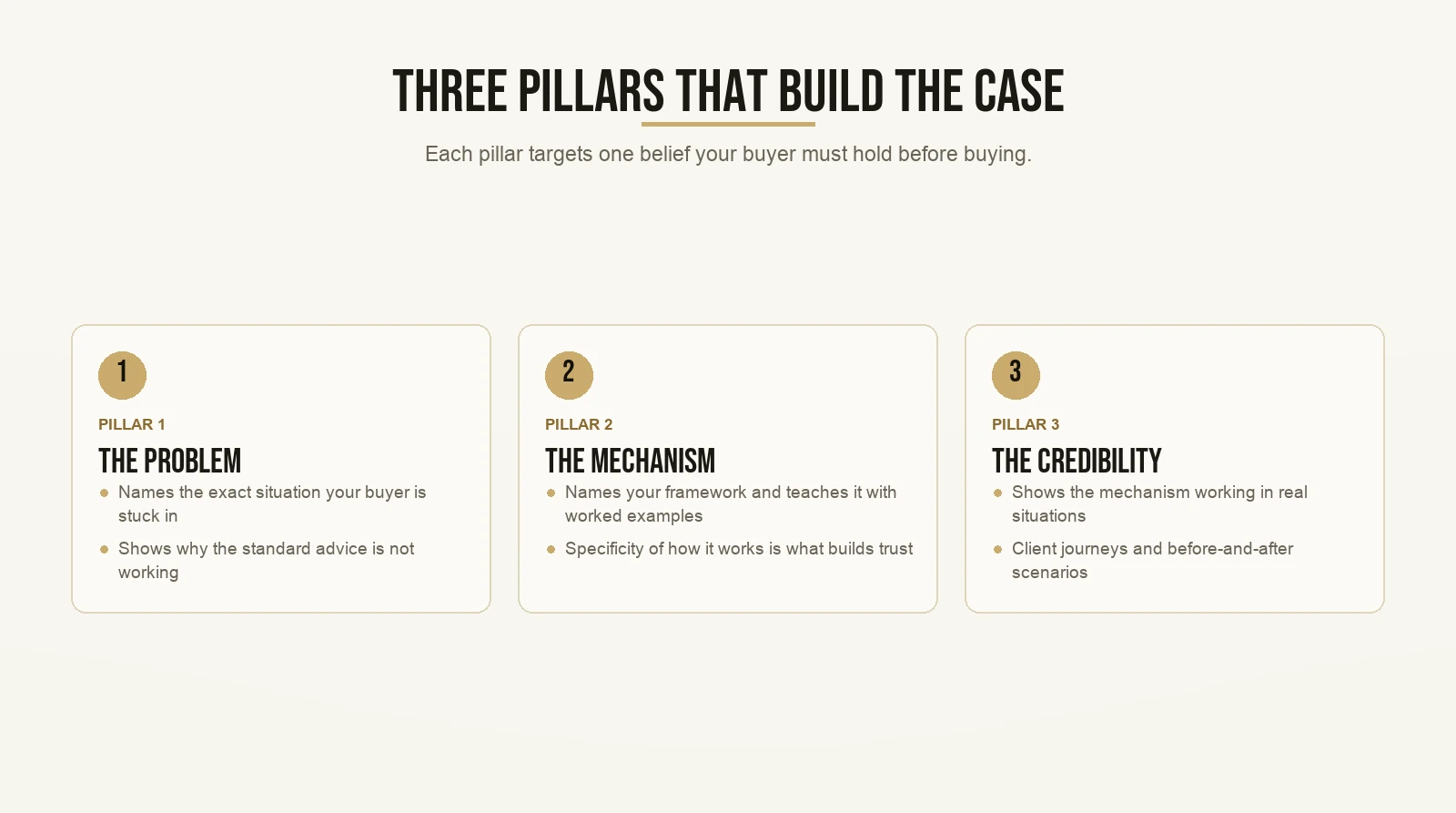
It means starting with the outcome your buyer wants and working backward to the specific beliefs they need to hold before they are willing to invest. Each pillar targets one of those beliefs. You are not building content categories. You are building the case for your offer, one post at a time.
If you are a business coach, your offer delivers more clients. So a buyer needs to believe three things. First, that their current approach to content is why they are not getting clients. Second, that there is a teachable system for fixing it. Third, that you are the person who can teach it.
Those three beliefs become three pillars.
Pillar one addresses the problem. It names the exact situation your buyer is stuck in right now and explains why the standard advice they have been following is not working. This pillar makes a stranger feel seen. That feeling is what stops the scroll.
Pillar two addresses the mechanism. It teaches the specific system you use. You name the framework. You teach it properly. You give worked examples. This is where authority is built, not through credentials or income claims, but through specificity. The more precisely you can describe how something works, the more a viewer trusts that you have actually done it.
Pillar three addresses credibility. It shows the mechanism working in real situations. Client journeys, before-and-after scenarios, process walkthroughs. No dollar figures needed and none allowed. The specificity of the situation is the proof.
Every post you create goes into one of those three buckets. Every piece of content advances one of those three beliefs. When someone has watched enough of your content across all three pillars, they are not just a follower anymore. They are a warm prospect who already trusts you before they ever send you a DM.
Compare that to the interest-based approach. “I like productivity, so I will post morning routines.” That attracts people who care about morning routines. But if your offer is business coaching, those followers are almost never buying from you. You built an audience that cannot convert.
This is super duper key. The offer-first pillar approach turns your content into a funnel. The interest-first approach turns it into a hobby.
How many pillars do you actually need?
Three to five. Under three and you run out of variation quickly. You burn through all your content angles and start repeating yourself before the audience has grown enough to handle it. Over five and the algorithm cannot categorize you clearly, so it treats you as a general account and routes you to the wrong people.
Start with three. Get those three dialed in before expanding. A fourth or fifth pillar should only be added when you have solid data showing your audience engages with a topic you are not covering, and that topic genuinely connects to your offer.
For most coaches and creators I work with, three pillars covers the entire buyer journey. Problem, mechanism, credibility. That is the whole case.
Max, what if my offer has five different objections to overcome?
Then your mechanism pillar does more work. You do not need a separate pillar for each objection. A pillar is a strategic category, not a single topic. Inside your mechanism pillar you can address multiple objections through different post angles, different hooks, different formats. The pillar stays focused. The angles within it rotate.
What does a pillar look like in a real account?
A pillar is a set of posts that all do the same job: build one specific buyer belief. In a health coaching account, the mechanism pillar might be every post that teaches the exact protocol with named steps and worked examples, so a viewer understands how the method works before they ever buy.
Let me walk through a worked example. Take a health coach whose offer is helping busy professionals lose weight without overhauling their entire lifestyle.
The buyer needs to believe three things: that their current approach is failing them for a specific reason, that there is a method that fits their actual life, and that this coach has seen it work.
Problem pillar: Posts that name the exact patterns busy professionals fall into. Specific. Named. “Here is why calorie-tracking apps make it harder, not easier, for people who travel for work.” That is not generic advice. That is a cold viewer who travels for work thinking: this post is about me.
Mechanism pillar: Posts teaching the specific protocol. “This is the exact swap I make when eating out that changes the outcome.” Named frameworks. Step-by-step walkthroughs. The method, not just inspiration. Anyone can post inspiration. Only you can post your specific method.
Credibility pillar: Client journey posts. Specific situations, specific outcomes. “She went from dreading Monday lunches with colleagues to eating freely without logging every bite.” No outcome figures presented as promises. The transformation is the proof, not the metric.
Notice what is missing from every single pillar. No motivational quotes that could have come from any account. No re-posts of other coaches’ content. No trending audio slapped on a post with no real substance. Those things feel like content. They do not do any of the three jobs.
You get the gist. Every post answers one question before you hit publish: which buyer belief is this building right now?
What does Instagram’s April 2026 originality update mean for your pillars?
Instagram now actively rewards original creators and reduces reach for accounts that primarily re-post or aggregate other people’s content. Pillar-based accounts built on original perspective are structurally advantaged under this policy. Re-posters and aggregators are being penalized in distribution, not just ignored.
According to Instagram’s original creator guidelines, original content is content you created entirely or that reflects your unique perspective. Simply re-uploading someone else’s photo or Reel does not qualify. Edits only count if they add new information or a genuine point of view, not just a text overlay describing what is already in the video.
The old growth hack of sharing trending content from other creators to ride their momentum is now a documented distribution risk. Accounts doing that are being suppressed, not rewarded.
Here is why pillar-based accounts are freaking well-positioned for this shift. When your pillars are built around your own mechanism and your own perspective, every post is inherently original. You are not sharing someone else’s framework. You are teaching yours. The algorithm rewards that. The audience trusts that.
This is not just a content philosophy anymore. It is a structural advantage in how the platform distributes your content going forward.
If you want to understand more about how Instagram routes original content to new audiences, the platform’s reach your target audience page outlines the signals the system uses.
How do you build credibility inside your pillars without making income claims?
Specificity is how. Not “my clients get results” but “here is the exact DM script we used that turned a cold comment into a booked call.” Mechanism-level detail is the proof. When you can describe exactly what happens and when, a viewer trusts you without needing a number attached.
Most people think credibility requires revenue screenshots or testimonials with big figures. It does not. And under the current platform environment, those types of posts create more problems than they solve.
Credibility in a pillar-based account comes from knowing the mechanism well enough to describe it precisely. “Videos that only interest your core audience stall between 100 and 900 views.” That kind of specificity signals that you have done this enough times to know what normal looks like. That is credibility. No dollar figure required.
The credibility bank framework works exactly this way. Each pillar post is a deposit. Each specific, named, worked example builds the trust balance in the account. By the time a viewer has watched fifteen to twenty of your posts, they are not a stranger anymore. They trust you before they ever message you. The credibility bank post goes deeper on how to structure those deposits if you want to see the full framework.
Holy moly, this is the part people skip. They chase views and ignore credibility building. Views give you reach. Credibility gives you clients. Boom.
What are the biggest mistakes people make with their content pillars?
The four most common mistakes are: pillars that are too broad to attract a specific buyer, content that speaks to the wrong audience tier, posts with no clear strategic job to do, and switching pillars before the algorithm has had time to categorize the account.
Mistake one: too broad. “Business tips” is not a pillar. It is a category with forty million accounts in it. “Why coaches lose leads in the DM conversation even after a great discovery call” is a pillar. It is specific, it names a pain, and it tells the algorithm exactly who to route it to.
Mistake two: mixing audience tiers. If your offer is for established business owners and your pillar content speaks to complete beginners, you are growing an audience that mostly cannot buy from you. Run every pillar post through one filter: is the person who watches this entire video the same person I want to book a call with?
Mistake three: posting without a job. Every post should be doing one of the three jobs: problem, mechanism, or credibility. If you cannot answer which job a post is doing, do not publish it. Pretty content with no strategic purpose is the enemy of a high-converting account.
Mistake four: switching pillars too fast. The algorithm takes time to categorize you. So does your audience. Changing pillars every few weeks resets that process from zero each time.
But Max, what if I get bored with my pillars after a month?
I digress slightly here because this is a real thing that happens. The boredom almost always means you are getting repetitive with your format, not that the pillar is wrong. The pillar stays. The angle, the hook, the format – those rotate. You can teach the same mechanism fifteen different ways. That is depth, not repetition. Commit to a pillar for eight to twelve weeks minimum before you evaluate whether it is the pillar that is the problem.
How do you know if your Instagram content pillars are actually working?
Watch time and DM quality are the two signals that matter most. Views tell you about your hook and your topic selection. Watch time tells you whether the right audience found the content and stayed. Saves and DMs tell you about buyer intent. A pillar is working when those last two climb, even if raw view counts stay modest.
Views in the first twenty-four hours are mostly a hook score. They tell you whether the opening line or the thumbnail earned a click. They do not tell you whether the pillar is reaching your buyer.
Watch time is the better signal. If people consistently watch past the thirty-second mark, the content is landing with the right audience. If watch time drops fast, either the hook over-promised or the wrong audience found the video.
Comments and DMs are where buyer intent lives. “This is exactly my situation” or “how do I actually fix this?” are buying signals buried in comment threads. Random likes from accounts that never engage again are vanity metrics. They feel good and tell you nothing.
The Instagram Insights explained post breaks down what each metric actually means and which ones to prioritize when you are evaluating whether a pillar is doing its job.
Videos that only appeal to your core buyer audience will often stall between 100 and 900 views. That is normal and fine. A pillar post that reaches 400 of exactly the right people is worth more to your business than a broad post that reaches 40,000 people who will never buy.
If your numbers feel disconnected from results, the warm audience vs cold audience breakdown explains why the type of follower matters more than the count when you are measuring whether your pillars are actually working.
How do you build your pillar plan before you start posting?
Start with your offer. Write in one sentence what your buyer gets. Then list the three to five beliefs a skeptic needs to hold before they are ready to pay you. Each belief becomes a pillar. Generate at least ten post ideas per pillar before you post anything, so you know the pillar has enough depth to sustain.
Here is the full five-step process.
Step one. Write your offer in one sentence. What does the buyer get? What specific situation are they in before they pay you, and what is different after?
Step two. List the three to five things a stranger would need to believe before they are ready to buy. Be honest. Not the surface-level objections. The real beliefs a skeptic holds. “I’ve tried this before and it didn’t work.” “My situation is too specific for a general system to help.” Those are the real objections. Those become your pillars.
Step three. Assign each belief to a pillar. Name the pillar for yourself. The name does not matter to your audience. It matters to you. It is a filter you run every post idea through: does this post advance this specific belief, or does it not?
Step four. Generate ten post ideas for each pillar before you start. If you can only think of two or three ideas for a pillar, it is probably too narrow. Expand it or combine it with another. A pillar needs to be deep enough to sustain weeks of content without running dry.
Step five. Start posting, and track the signals. You will not get it perfect in the first round. The data from your first eight to twelve weeks will show you which pillar generates the most buying signals. Double down on that one. Consistency is the variable nobody talks about because it is unglamorous. It is also the main variable that determines whether the strategy compounds.
For turning your pillar plan into a weekly schedule you can actually follow, the Instagram content calendar template makes it easy to check whether your pillar balance is right week to week.
If you want to see what this kind of focused, offer-aligned approach looks like when creators implement it properly, Max’s reviews page shows the pattern.
A quick checklist before you lock in your pillars
Run each proposed pillar through these five questions before you commit.
- Does this pillar advance a specific buyer belief? If yes, keep it. If no, cut it.
- Can I generate ten distinct post ideas for this pillar right now? If not, it may be too narrow or disconnected from your real mechanism.
- Does every post idea in this pillar appeal to my actual buyer, not just a general audience?
- Am I the original creator of the perspective I am sharing? If this pillar relies on re-posting or aggregating other people’s content, the originality policy will suppress it.
- Will I still believe in this pillar in twelve weeks? If the pillar does not genuinely connect to your offer and your method, you will abandon it under pressure. Pick pillars you can sustain, because consistency is what makes them compound.
If your pillars pass all five, you have a strategy. If they do not, you have a content calendar. There is a pretty big difference between the two, and that difference shows up in your DMs.
Anywho. The accounts that grow and convert are almost never the ones with the prettiest grids or the most followers. They are the ones where every piece of content is doing a specific job, in a specific topical cluster, for a specific buyer. That is what pillar discipline actually is. Pretty straightforward when you look at it that way.
Want the templates behind content that actually gets watched? Grab the templates here and start with the first one today.