
Key Takeaways
- Life coaching is completely unregulated in all 50 US states. No credential is legally required to coach or charge for it.
- ICF offers three individual credentials: ACC (Associate Certified Coach), PCC (Professional Certified Coach), and MCC (Master Certified Coach). Each has specific training and coaching hour requirements.
- ICF’s 2025 research found that 85% of practicing coaches already hold a credential. That makes a certificate a floor now, not a ceiling. Table stakes, not a differentiator.
- Credentials matter most in corporate and employer-sponsored channels. Individual consumer buyers find you through content first, then check credentials as confirmation.
- The credibility bank framework: a credential is one deposit. The bank needs many deposits before it pays out trust to a new visitor.
- The coaches building the biggest audiences are posting about their transformation system, not their certificate.
Most articles about life coach certification are comparison tables. They rank programs by price, accreditation status, and ICF alignment. They exit once they’ve told you which certificate is cheapest. You leave knowing the options. You don’t leave knowing whether any of them will bring you a client.
This post answers that question. And the honest answer is more useful than anything in a comparison table.
If you already have a coaching offer and clients coming in through word of mouth and referrals, you are at exactly the point where this question matters. You are not wondering whether coaching works. You are wondering whether a life coach certification is the next move, or whether your time is better spent somewhere else.
Let’s crack into it.
Is life coaching legally regulated?
No. Life coaching is completely unregulated in all 50 US states. There is no license, degree, or credential required to call yourself a life coach or to charge clients for it. ICF states this directly. You could start and charge legally tomorrow without any certification.
This is not an invitation to skip training. It is context. The reason credentials matter is not legal compliance. It is buyer trust and credibility signaling. Understanding that distinction changes how you make this entire decision.
So what credentials actually exist, and what do they require?
What life coach certification options actually exist?
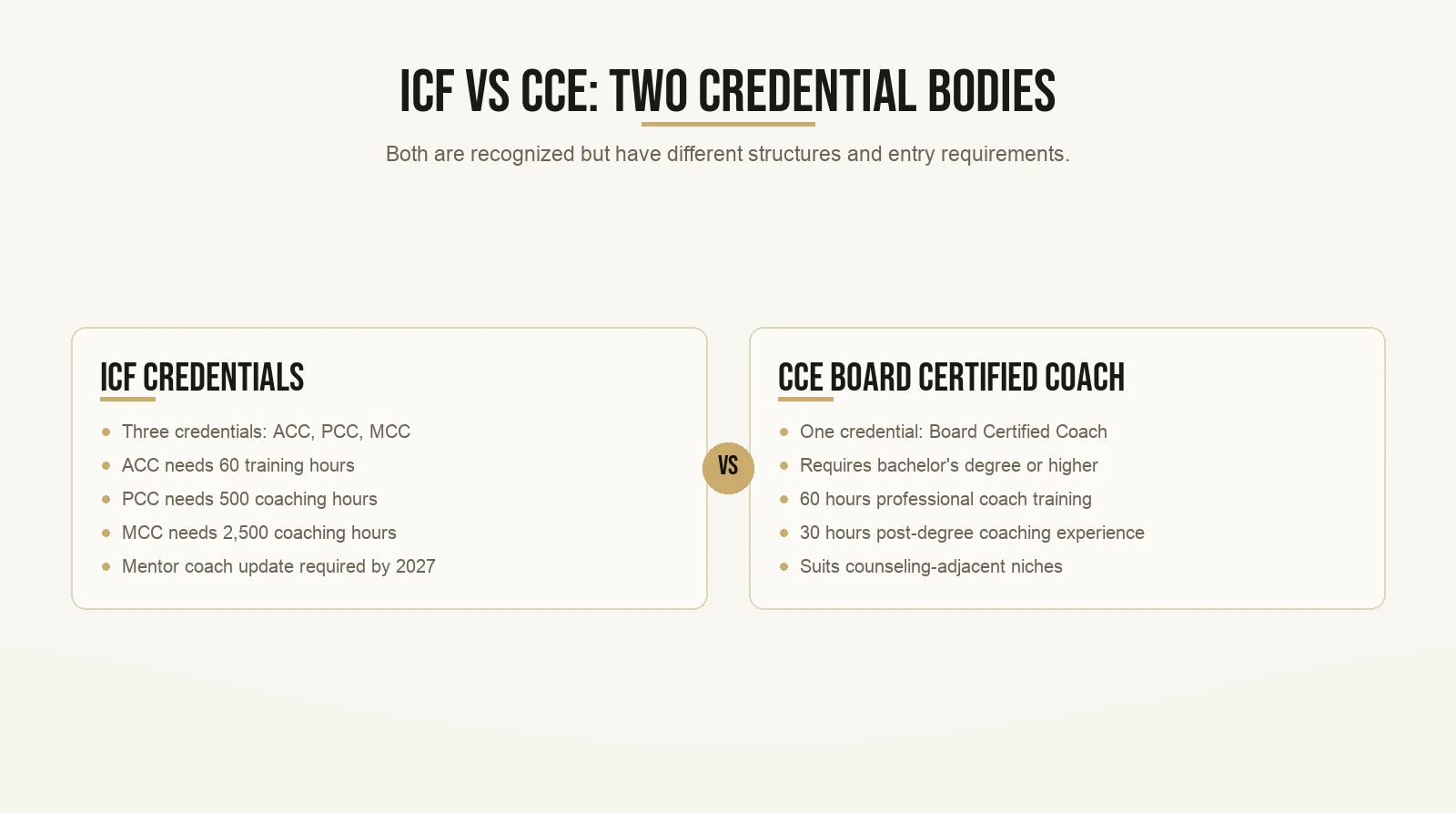
The two most recognized credential bodies for coaches are ICF (International Coaching Federation) and CCE (Center for Credentialing and Education). ICF offers three individual credentials: ACC, PCC, and MCC. CCE offers the Board Certified Coach. Each requires specific training hours and coaching hours before you can apply.
ICF: Three levels of individual credential
The ICF credential structure has three individual credentials.
ACC (Associate Certified Coach)
This is the entry-level credential. To apply, you need:
- At least 60 hours of coach-specific training from an ICF-accredited Level 1 or higher program
- 100 coaching hours with at least 8 clients (75 of those hours must be paid)
- 10 hours of mentor coaching over at least 3 months from a PCC or MCC
- One recorded performance evaluation
- Pass the ICF ACC exam (60 questions, passing score 460)
PCC (Professional Certified Coach)
One level up. Requirements: 125 hours of training from a Level 2 accredited program, 500 coaching hours (at least 450 paid), 10 hours of mentor coaching, two recorded performance evaluations, and passing the ICF Credentialing Exam.
MCC (Master Certified Coach)
The top credential. You must hold or have held a PCC first. Then: 200 training hours, 2,500 coaching hours (at least 2,250 paid), 10 mentor coaching hours, two recorded performance evaluations, and the exam. Most coaches working toward their first credential are on the ACC path.
A note on program terminology
ICF retired the ACTP and ACSTH program designations in 2022. Programs now run on Level 1 (60 to 124 contact hours, the ACC pathway), Level 2 (125 to 175 hours, the PCC pathway), or Level 3 (75 or more specialized hours). Any article using the old terms is citing outdated structure.
CCE: The Board Certified Coach (BCC)
CCE is an affiliate of the National Board for Certified Counselors. Their BCC credential requires a bachelor’s degree or higher, 60 hours of professional coach training, at least 30 hours of post-degree coaching experience, and passing the Board Certified Coach Examination. The pathway is pretty straightforward if you already have a counseling or mental health background. If your niche overlaps with healthcare or counseling-adjacent settings, this credential is worth researching.
One 2026 update worth knowing
ICF announced the Mentor Coach Specialization (MCS) in April 2026. Starting January 1, 2027, mentor coaches must hold the MCS to provide qualifying mentor coaching hours to credential candidates. If you are currently working toward an ICF credential, verify that your mentor coach is pursuing this designation before you log those hours.
What does a life coach certification actually signal to a buyer?
A credential signals that you completed structured training and logged real coaching hours with a verified body. It answers the question “are you trained?” before a buyer has to ask. That is genuinely useful. But it only does one job, and bringing people to your profile is not that job.
ICF’s 2022 Consumer Awareness Study found that 85% of clients say it is important for their coach to hold a credential. That sounds like a freaking strong case for certification.
But look at the full picture.
The 2025 ICF Global Coaching Study found that more than 50% of coaching clients are employer-sponsored. That is the corporate and B2B channel, where HR departments and procurement teams check credentials before writing a check. That buyer type makes up at least half of the entire coaching market.
If you are a solopreneur coach selling to individuals through social media, your buyer behaves differently. They find you through your posts. They decide you understand their problem. They check your credentials afterward, as confirmation.
Hold up. Are you saying credentials don’t matter for individual clients?
No. The 2022 study also found that 55% of clients whose coach held a credential reported being “very satisfied,” versus 27% for clients of non-credentialed coaches. That gap is real.
This distinction is very very key. Credentials confirm trust. They do not create the initial connection. Your content does that. Both matter, but they do different jobs.
And here is the insight that most comparison articles miss entirely. The 2025 study also found that 73% of coaches agree clients and organizations expect them to hold a credential. Combined with 85% already holding one, the market has spoken: credentials are now a threshold condition. Not having one is a liability. Having one when 85% of your peers already do is not a competitive advantage. It is the entry ticket.
Pass the threshold. Build the differentiator somewhere else.
What does the credibility bank framework say about certification?

A credential is one strong deposit in your credibility bank. But one deposit does not fill the bank, and a nearly empty bank does not pay out trust to a new visitor.
The credibility bank is a framework for how trust accumulates with a new audience. Every piece of evidence that you know what you are doing is a deposit. Vague claims you cannot back up are withdrawals. A new profile visitor sees the net balance in the first few seconds of scrolling your page. That balance is what decides whether they stay or leave.
Here is what a full credibility bank looks like for a coach building a practice through social media:
- Your credential in the bio (proof of completed, verified training)
- Specifics about who you have helped: not dollar figures, but real outcomes (“worked with 40 clients rebuilding confidence after a career pivot”)
- Posts that teach the mechanism, not just the result (“here is exactly why the boundary-setting exercise most coaches teach falls apart at week three, and what to do instead”)
- A first bio line that names your specific audience and what they get
- Consistent content that shows your framework in action
- A transformation story that connects your reader’s before to a clear after
Your credential is one item on that list. If it is the only item, the bank is almost empty.
But wait. How do I fill the bank if I’m just starting out?
You start building before the audience is large. Every post is a deposit whether 50 people see it or 5,000. The credibility bank is not just your follower count. It is the total picture a new visitor sees when they land on your page and scroll back through your content. That history is what they are reading.
Your credential belongs in the bio. It belongs in a pinned post. A well-structured Instagram profile for coaches treats the bio, highlights, and pinned content as one unified credibility statement, with the credential as one element of that statement, not the whole thing.
Contrarian ideology: why the unconventional move is to post first

Most new coaches follow a specific order: get certified, build a profile, start posting, get clients.
Max teaches a framework called contrarian ideology. The mechanism is this: find what everyone in your niche does by default, and ask whether doing the opposite, or doing something visibly different, makes you stand out. In most niches, it does.
Here is the default in coaching. Get certified. Post about getting certified. Lead every bio and every introduction with the credential. Wait for clients.
Here is the contrarian move. Start with your transformation system. Post about the exact mechanism that gets your clients their specific result. Make the content about their problem, not your paperwork.
Does this mean skip the certification entirely?
No. It means the order of operations matters.
A credential takes months to complete. Your audience can start forming right now. The coaches who are impossible to scroll past on Instagram are not the ones with the longest credential chain. They are the ones whose content names the exact thing their ideal client is already thinking about but has never heard named clearly.
That specificity stops the scroll. “I help women in their 40s stop over-explaining themselves in relationships” stops the scroll. “ICF-certified life coach” does not.
Think about the sales coaching space. For years, most sales coaches looked and sounded the same. Then coaches started appearing who were visibly different from the default. Not because of better credentials. Because their content made an identity-level claim that their audience had never seen before. The credential was still in the bio. But it was not what made anyone hit follow.
Same principle applies across niches. Relationship coaches, parenting coaches, nutrition coaches, career coaches. The credential is in the background confirming baseline training. The content is in the foreground doing the work of client attraction.
Contrarian ideology is not about being weird for the sake of it. It is about noticing the default behavior in your space and making a deliberate choice rather than just following everyone else. Read that again. A deliberate choice, not a default one.
If you want to see what that looks like in practice, coaches who’ve built their client base through content rather than referrals alone are a useful reference.
Who actually checks credentials before hiring a coach?
Two distinct buyer types exist in coaching, and they use credentials differently. Corporate buyers run formal qualification checklists and often require credentials before engaging anyone. Individual consumer buyers find coaches through content, decide based on whether the coach understands their specific problem, and check credentials as a final trust confirmation rather than as the starting point.
Corporate and employer-sponsored buyers
These are HR departments, leadership development teams, and organizational procurement functions. A recognized credential from a body like ICF can be a hard requirement before you even get a conversation. If you are building toward executive coaching, leadership coaching, or any B2B channel, the credential is not optional. It is the entry ticket into that conversation.
Individual consumer buyers
If you’re a business owner or a coach who sells directly to individuals, this buyer finds you through your content. They watch your videos. They read your posts. They send a DM when something you said described their situation exactly. Then, somewhere in that process, they look at your profile and confirm that you are trained. The credential answers their question. It doesn’t generate it.
Understanding which buyer you are building toward changes your priority order. If your ideal client finds coaches through Instagram and books calls through a DM, your content investment comes before your credential investment in terms of client pipeline. The credential still needs to happen. It just does not need to happen before the first post.
If you are building toward a consumer-facing coaching niche, the post on how to get clients as a relationship coach walks through the full client acquisition sequence for coaches who sell to individuals rather than companies.
How do you turn your certification into actual client trust?
A credential you earn and don’t surface is a missed deposit in the credibility bank. Use it in your bio’s third line, mention it in a pinned post alongside your transformation story, and post about what you actually learned during training. Each of those touchpoints adds a layer of verification for a prospect who is already interested in you.
The bio
Your first bio line states who you help and what they get. Your third bio line is your brag line. That is where credentials belong: “ACC-credentialed | 200+ coaching sessions” or something equally specific. Not buried. Not the headline. Present and easy to find.
The pinned post
A “who I am and why I coach” pinned post is the right place to mention your training alongside your transformation story. The credential does not need to lead. It needs to be present.
Content about the process
Getting a credential gives you real material to post about. What did you learn in 60 hours of training that changed how you actually coach? What surprised you about logging 100 coaching hours? That kind of post does double work: it deposits into the credibility bank and gives the algorithm content to show new audiences who have never heard of you.
The ICF Credentialed Coach Finder is a real directory that some clients use to search for verified coaches. Being credentialed makes you eligible to be listed there. For individual coaches building a consumer-facing practice, social content will drive more inbound. But if any part of your business serves corporate or employer-sponsored clients, being listed matters.
If you are at the early stage of mapping out the full path, the post on how to become a life coach covers the bigger picture: niche, offer, and what actually moves the needle on your first clients.
The honest answer about certification and clients
A life coach certification from a recognized body like ICF is worth getting. The 2025 study found 85% of coaches already hold one. The floor is real. The satisfaction gap between credentialed and non-credentialed coaches is real. Pass the threshold.
But certification does not bring clients to your profile. Content does.
Specifically: content that names the exact problem your ideal client is living with right now. Content that introduces a mechanism they have not heard named clearly before. Content that makes them feel seen in the first five seconds of watching.
Boom. That is the actual client acquisition mechanism.
The certificate is in the third line of your bio. The content is the whole rest of the page. Get the credential. Build the bank. Post the system.
Want the templates behind content that actually gets watched? Grab the templates here and start with the first one today.