
Key Takeaways
- Retirement coaching is about identity, purpose, and daily structure after leaving full-time work. Not financial planning.
- Three certifications are worth knowing: the CPRC from the Retirement Coaches Association, the Certified Retirement Life Coach from Retirement Life Plan, and the CRC from Retirement Options.
- The CPRC requires 10 modules, exams, and 15 hours of live practice coaching. Most coaches finish in 4 to 6 weeks.
- Pew Research found that 40% of U.S. adults aged 50 to 64 use Instagram. The clients you want are already there.
- Getting certified earns you a credential. Building a practice requires positioning and a way to reach people. Those are two separate jobs.
What does a retirement coach do?
A retirement coach helps people navigate the non-financial side of leaving full-time work. That means identity, purpose, daily structure, and the emotional weight of a major life change. The focus is not on portfolios or withdrawal rates. It is on who you become after your job title disappears.
The person who walks into their first year of retirement with a fully funded account and zero sense of purpose is just as stuck as the one who did not save enough. Sometimes more stuck. The financial safety net is there, but the identity is not.
That gap is what a retirement coach fills.
If you are reading this, you already know this gap exists. You have seen it in clients who came to you after leaving long careers. Or you have lived it yourself. The certification question usually comes after you have decided the work matters and you want to do it with proper credentials behind you.
What qualifications do you need to become a retirement coach?
There is no government-issued license for retirement coaching. Anyone can call themselves one. The qualifications that matter are the ones that make a skeptical 62-year-old trust you enough to hire you. That usually means a recognized certification, a clear methodology, and visible proof that your approach has worked for someone.
General coaching credentials from the ICF signal that you have proper coaching training. They do not specifically signal retirement expertise. The ACC requires 60+ education hours and 100+ coaching experience hours. The PCC requires 125+ education hours and 500+ coaching experience hours. A retirement-specific certification on top of an ICF credential gives you both general competence and niche credibility. That combination is the strongest signal you can send.
If you are brand new to coaching, this overview of life coach certification covers the foundational paths before you layer in a specialty.
What are the main retirement coach certifications?
There are three worth knowing: the CPRC from the Retirement Coaches Association, the Certified Retirement Life Coach from Retirement Life Plan, and the CRC from Retirement Options. Each has different requirements, a different ideal candidate, and different credit value for ICF renewal. Here is what each one actually involves.
CPRC – Retirement Coaches Association
The Certified Professional Retirement Coach (CPRC) requires 10 training modules, a score of at least 70% on each module quiz, a 70%+ score on the final exam, and 15 hours of live practice coaching with at least three different people. At least three of those coaching hours must involve delivering the RQ assessment.
No payment plan is available.
Most coaches finish in 4 to 6 weeks. No hard deadline on the coursework.
Annual maintenance includes a credential renewal fee plus a separate RCA membership fee. The first module is free, so you can try it before committing.
The CPRC earns 31 Core Competency hours and 9 Resource Development hours toward ICF continuing education. It also counts toward CFP Board (28 principal topic hours) and SHRM (32 PDCs).
One important distinction: the CPRC is not an ICF credential. It awards ICF continuing education credits. If you want a formal ICF credential, you pursue that separately through the ICF’s own credentialing process.
Certified Retirement Life Coach – Retirement Life Plan
The Certified Retirement Life Coach is built for coaches who already have coaching training or experience. It includes 10 self-study modules, over 10 hours of content, and three 90-minute live webinars. Approved for 15 ICF continuing education hours.
Available as a guided cohort or self-paced. The next cohort runs November 6 to January 10, 2027.
CRC – Retirement Options
The Retirement Options CRC uses 10 pre-recorded sessions, two proprietary assessments (the Retirement Success Profile and the LifeOptions Profile), two supplemental books, and a certification exam requiring 75% or above to pass. Retirement Options does not publish their cost or ICF hours on the process page. Contact them directly for those figures before relying on anything from aggregator sites.
Is a retirement coach certification worth it?
Here is the honest answer: the certification alone does not get you clients. What it does is give you a framework to teach from, a credential you can name, and a signal of seriousness to skeptical prospects who are deciding whether to hand you their trust. A 62-year-old who spent 30 years in a senior role does not hire someone without credentials. The certification lowers the barrier to yes.
Think about what the credential signals specifically. A CPRC tells a prospective client that you have trained in coaching methodology designed for retirement transitions. That means you have tools they have not encountered in therapy or financial planning. The credential names a method. That is what makes it worth getting, not the letters after your name.
There is also a positioning argument. If your belief is that retirement readiness is primarily psychological, a retirement-specific coaching credential backs that claim with training a financial advisor does not have. The credential and the content strategy reinforce each other. But you still have to answer the harder question: how do you get in front of the right people?
Most certified retirement coaches answer this the same way. They network with financial advisors. They ask for referrals. They wait. That works. It is also slow, and it caps at the size of your personal network.
There is a faster path, and it starts with a surprising fact about who is already on Instagram.
Is Instagram actually relevant for retirement coaches?
But Max, my clients are in their 60s. Instagram is for young people. Why would I bother?
According to Pew Research, 40% of U.S. adults aged 50 to 64 use Instagram. That is not a niche corner of the platform. That is a massive cohort of people actively planning their next chapter, reachable right now without cold-calling anyone.
Read that again. Four in ten Americans between 50 and 64 are on Instagram.
These are not passive scrollers. They are searching. They are consuming content about what comes next. They are following people who speak to where they are headed. If you are not one of those voices, someone else will be.
Here is something else worth understanding about views in this niche. A video that reaches 5,000 people who are actively planning retirement is worth more to your practice than a video that gets 50,000 views from a general personal development audience. The tighter the match between your content and your viewer, the more likely that viewer is to reach out. Specific audiences convert at higher rates. That is not a consolation prize for small numbers. That is how niche content works.
If you want to see how coaches in similar niches have built practices through consistent content, here are some of their accounts.
Contrarian Ideology: how to stand out in a niche full of sameness

Every other retirement coach online is saying some version of the same thing: retirement is a financial milestone, hit the number, and you are free.
That is the conventional belief in this niche. If you repeat it, you are invisible.
The framework for breaking out of that is called contrarian ideology. Here is how it works.
You start by listing the mainstream beliefs in your niche. Then you write down what you actually believe, stated plainly, even if it sounds like a direct disagreement. You build your content around that contrast.
For a retirement coach, the contrast might look like this:
What your audience is told: Retirement readiness is a financial question.
What you believe: Retirement readiness is primarily psychological. Identity, purpose, and daily structure matter more in year one than the portfolio does.
What your audience is told: Once you retire, you will figure out how to fill your time.
What you believe: The people who struggle most in their first year are the ones who never designed their days. Structure does not disappear when work ends. It has to be rebuilt.
What your audience is told: Retirement is the reward. The hard part is over.
What you believe: The transition into retirement is one of the most identity-challenging periods in a person’s life. Treating it as a finish line is what causes the crash most people never see coming.
State these beliefs plainly and repeat them consistently. They attract the person who already suspects this is true but has never heard it said out loud. And they push away everyone who is not your ideal client. Both outcomes are exactly what you want.
You do not need to be hostile. You just need to be clear. If your niche is not crowded yet, you do not need to be very contrarian to stand out. If dozens of retirement coaches are already saying the same thing on every platform, contrarian ideology is the mechanism that gets you seen.
Name the belief. State it plainly. Build content around it.
Credibility Bank: building trust with a stranger in five seconds

Every time a new person lands on your profile, they have never heard of you. They are deciding in a few seconds whether you are worth following. In that window, they need answers to three questions: who are you, what do you actually do, and has this worked for anyone?
The framework for answering all three fast is called the credibility bank. It maps directly to your Instagram highlight section, and it has three specific slots.
Who am I: Your hero story. Where you were before you became a retirement coach, what changed, and where you stand now. Not a resume list. A narrative the people you want to help can see themselves in.
What I do: Your method. Not your packages. Not your pricing. The mechanism behind how you work. What you do differently from every other retirement coach, stated in the same language as your contrarian beliefs. This is where your beliefs become a visible methodology.
Client results: Proof. Before-and-after accounts from people who worked with you. A screenshot of a meaningful message. A short video from a client describing what changed. Something that shows the transformation is real.
The “what I do” slot is not a sales pitch. “I help people rebuild their identity and daily structure after they leave full-time work” is a method. It gets the follow. “I offer coaching packages at X” is a pitch. It gets skipped.
A cold audience needs to scan those three highlights and immediately understand why you are worth their time. Set this up before you spend another day posting content.
One more thing on the profile. Your Instagram display name is searchable. If your display name is just your personal name, you are invisible to anyone searching “retirement transition coach” or “life after work coach” on Instagram. Put the keywords in your display name. It is a freaking easy win that most coaches miss completely.
For a step-by-step walkthrough of the bio, highlights, and pinned posts, this post on setting up your Instagram profile as a coach has it all in one place.
What should a retirement coach actually post about?
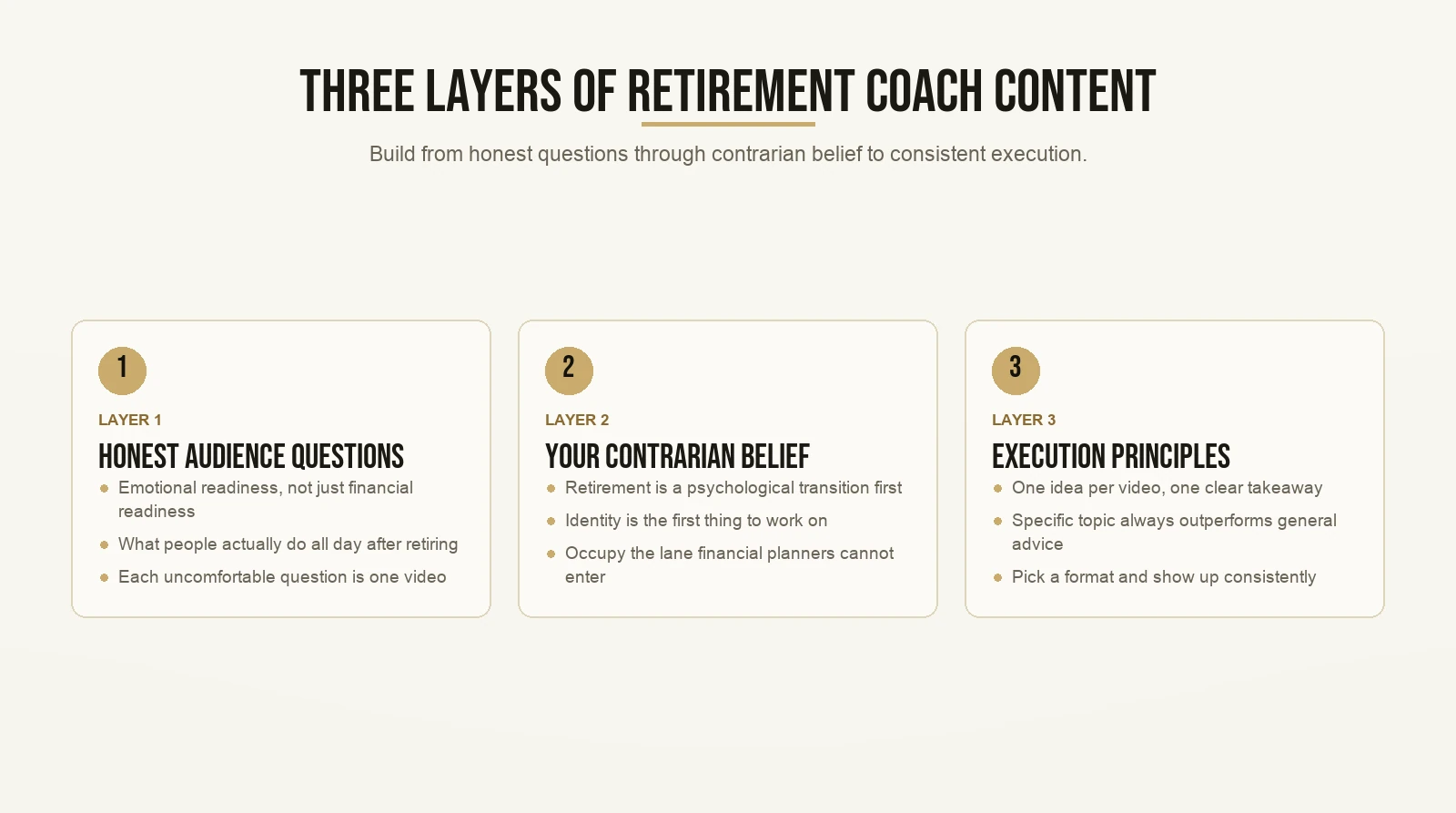
Start with the questions your audience is genuinely asking. Not the sophisticated ones. The honest, slightly uncomfortable ones.
“How do I know if I am emotionally ready to retire?”
“What do people actually do all day after they stop working?”
“Why do I feel anxious about retirement when I have already saved enough?”
None of those are questions a financial advisor answers. All of them are questions a retirement coach answers. Each one is a video.
The next layer is your contrarian belief put into action. If you believe retirement is primarily a psychological transition, say that plainly in your content. Show the mechanism. Explain why identity is the first thing to work on, not the last. That kind of content occupies a lane no financial planner can compete in. That is the point.
One more thing worth noting here. The clients you are after are in their 50s and 60s. They are not new to short-form video. They watch Instagram Reels and they search on the platform just like younger users do. The idea that this audience needs a fundamentally different approach to content is itself a conventional belief you can flip. They want the same thing everyone wants: specific, useful content from someone who genuinely understands what they are going through.
A few practical notes on execution:
- Keep each video to one idea. A two-minute reel that covers three different concepts loses people. One idea, explained well, with a clear takeaway at the end.
- Specific always beats general in a defined niche. “What to do in your first 90 days of retirement” outperforms “retirement tips” every time. The more precise the topic, the more it resonates with the exact person you are trying to reach.
- Reels, carousels, talking-head videos: the format matters less than the consistency of showing up with useful content. Pick what you can execute week after week and stick with it.
If you are already getting solid referrals but want to stop relying on them entirely, social content and referrals are not competing strategies. A client who found you through a referral checks your Instagram before they book. This post on marketing for coaches who rely on referrals covers exactly how those two channels reinforce each other.
How much can a retirement coach earn?
It depends almost entirely on how you find clients. A coach who relies on financial advisor referrals grows as fast as those relationships allow, which can mean long gaps between new clients. A coach with a consistent content presence reaches people who are already searching and already warming to the idea before they ever send a message.
The credential builds legitimacy. The content strategy builds the pipeline. Both matter. Only one of them scales beyond your personal network.
Niche context is worth understanding here. Retirement coaching for people in their 60s is a defined audience. Content aimed precisely at someone 18 months from their target retirement date and quietly worried about what comes next performs differently than broad life-coaching content. The tighter the match between your content and your viewer, the more valuable each view is. You get the gist.
For more on the mechanics of turning that content presence into actual client conversations, this guide on getting clients as a career coach covers the overlap between content and conversion.
What qualifications do professional coaches need?
The ICF offers three credential levels: ACC, PCC, and MCC. Each requires progressively more education hours, coaching experience hours, and mentor coaching hours. The ACC requires 60+ education hours, 100+ coaching experience hours, and 10 mentor coaching hours, renewed every three years with 40+ continuing education credits. The PCC requires 125+ education hours and 500+ coaching experience hours.
For a retirement coach, pairing an ICF credential with a retirement-specific certification is the strongest combination. It signals both general coaching competence and niche expertise. The CPRC awards 40 ICF continuing education hours in total, which counts toward credential renewal.
If you are brand new to coaching, the CPRC is accessible without prior coaching experience. The Certified Retirement Life Coach is better suited to coaches who already have a coaching background. Neither path blocks the other. Some coaches earn the retirement certification first, build the practice, then layer in the ICF credential once the business has momentum. Pretty straightforward.
Want the templates behind content that actually gets watched? Grab the templates here and start with the first one today.