
Key Takeaways
- Reels are the only format Instagram shows primarily to non-followers. If growth is your goal, Reels come first.
- Stories reach followers only. Use them to deepen relationships with people who already found you, not to attract new ones.
- Carousels get a second distribution window. Instagram re-shows them to users who scrolled past slide 1 without swiping.
- Trial Reels let you test a topic with strangers before your existing audience sees it.
- Instagram penalizes Reels with TikTok watermarks, horizontal bars, or low resolution. These technical errors kill reach before your content gets a fair shot.
- Portrait ratio (4:5) beats square (1:1) for single feed photos. More vertical height means harder to scroll past.
- Hashtags don’t increase reach. The head of Instagram confirmed this in 2025.
Every creator hits the same wall eventually.
You’re posting consistently. The content looks good. But the account is barely moving.
Most advice tells you to post more, post at better times, or stuff your caption with hashtags.
Here’s the real problem: you’re using the wrong format for the wrong job. Instagram runs a separate ranking algorithm for each surface. Reels, Feed, Stories, and Explore each have different ranking signals and different audiences. Using Stories to grow is like fishing in an empty lake. The lake only holds fish you’ve already caught.
This guide maps every type of Instagram post to the job it actually does – and tells you exactly which format to use based on where you are right now. Let’s crack into it.
What Are the Main Types of Instagram Posts?
Instagram gives you five formats: Reels (short vertical video), carousels (a swipeable set of images or videos), static photos (a single image), Stories (24-hour posts visible to followers), and Lives (real-time video). IGTV is gone – it merged into standard video posts.
Each format has its own algorithm. Each reaches a different audience. And each serves a completely different job in your content funnel.
Knowing which format does what is not optional. It is the foundation of everything.
Which Format Actually Reaches New People?
Reels. Full stop. Instagram’s ranking documentation confirms that Reels are shown primarily to non-followers. Feed posts and Stories go mainly to people who already follow you. If your goal is to grow your audience, Reels is the format you build around. Everything else is secondary until you have an audience to serve.
Think of it this way. Every Reel is a potential first impression with someone who has never heard of you. Every Story is a conversation with someone already in your world.
But Max, I see accounts with big followings that almost never post Reels. How do they keep growing?
They built their audience before Reels dominated discovery, or they have an off-platform traffic source feeding their Instagram. If you are building from scratch right now, you have neither. Reels is the discovery engine. Use it.
Before you invest time shooting any Reel, do the freaking research first. Use a tool like Sort Feed on your desktop browser to look at another creator’s feed sorted by view count. Find the posts that got five times their typical views. Those are your 5X outliers – proof that a topic already works at scale. Study the hook and the format, then bring your own angle. The full breakdown of what makes those videos tick lives in the 7 building blocks of a viral video.
What Makes a Reel Rank or Get Buried?
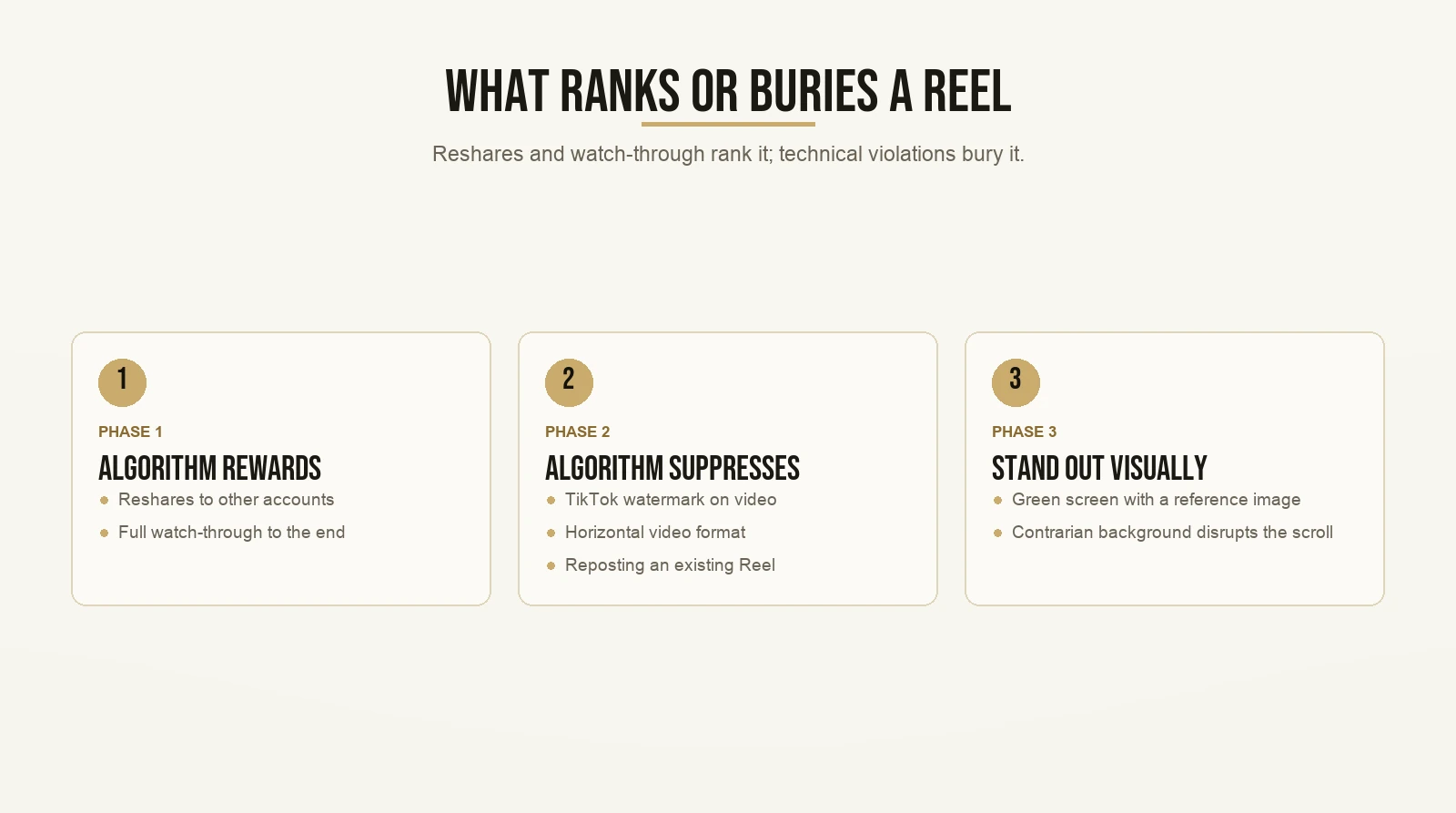
A Reel ranks when it gets reshared and watched all the way through. Instagram’s ranking page names reshares and full watch-through as the top signals. Not likes. Not comments. Not hashtags.
Read that again. Reshares and watch-through. Those are the two things that tell Instagram a video is worth showing to more people.
But Instagram also suppresses Reels that break specific technical rules. Here is what kills a Reel before the algorithm gives it a real chance:
- TikTok watermark. Instagram identifies and demotes Reels that carry a competitor’s watermark. If you repurpose content across platforms, remove the watermark before uploading to Instagram. Download without the watermark, then upload. Never the other way around.
- Horizontal video. A landscape video dropped into a vertical frame creates black bars at the top and bottom. Those bars signal low production quality and waste screen space. Film everything in 9:16 vertical.
- Borders or decorative frames that push the content area inward.
- Low resolution. Blurry or pixelated footage gets demoted.
- Already posted to Instagram. Reposting an old Reel on the same account doesn’t recycle the reach. Instagram flags it as duplicate content and suppresses distribution.
One technique worth learning: the green screen effect. Open Instagram, tap ‘+’, select the green screen filter, and add any image or video as your background. You stay in frame while the reference plays behind you. It works because it creates visual contrast. Most creators stand in front of a blank wall. A background that references an article, a screenshot, or a before-and-after disrupts the scroll. And the first second of attention is the only second that matters.
This is the contrarian visuals principle in practice. Stand out with what you look like, not just with what you say.
How Do Carousels Get You More Reach Than a Single Photo?
Carousels consistently outperform single images. Adam Mosseri, the head of Instagram, said it directly: carousels often get more reach than single photos. The mechanism is a second distribution window. If a user sees slide 1 and scrolls past without swiping, Instagram may re-show that carousel later, starting from a later slide. Static photos don’t get this second chance.
That makes your slide structure important.
Slide 1 is your hook. One job: make someone stop and swipe. The same logic that makes a Reel hook work also makes a carousel hook work. Earn the next second first.
Slides 2 through 9 deliver the depth. Each slide advances one idea. Not two. One.
Slide 10 is your call to action.
Hold up, Max. I thought carousels were just for infographics and quote cards. Can you actually teach with them?
Absolutely. Carousels are one of the strongest formats for breaking down a process, a list, or a step-by-step concept. They also work well if you’re camera-shy. The topic and slide 1 do the heavy lifting. You don’t have to be on video for a carousel to perform. If you want specific structures that consistently get saves and shares, this breakdown of carousel formats covers the ones that work best.
What Are Stories Actually Good For?
Stories are a follower retention tool. Instagram’s ranking system shows Stories primarily to people who already follow you. If you’re using Stories as your main growth strategy, you’re talking to the same audience in a loop. Your reach isn’t growing. It’s circling.
That said, Stories have a real and important job once you have followers to serve.
Stories keep you human. A Reel is a produced piece of content. A Story is a conversation. Behind-the-scenes clips, quick updates, polls – these make a follower feel like they actually know you. That relationship is what converts over time.
But Max, my Stories get way more views than my Reels. Doesn’t that mean they’re working better?
No. It means the people who already follow you are engaged. That’s good, but that’s not growth. If your Stories are outperforming your Reels, it’s a sign your Reels aren’t reaching non-followers the way they should be. Stories are not the reach engine. Reels is. The sequence matters: Reels bring people in, Stories deepen the relationship after they arrive.
What Is a Trial Reel and When Should You Use One?
A Trial Reel is a Reel you share only to non-followers first. Your existing audience doesn’t see it until you choose to publish it. Instagram tests the content with strangers in the discovery layer, and you use the results to decide whether to push it live. Instagram confirmed Trial Reels are globally available to eligible creators on professional accounts – Creator or Business account required.
The best use case: testing a new topic or format without risking your regular engagement metrics.
Here’s why that matters. Every Reel you post is partly judged by how your current followers respond to it. If you post about a topic your regular audience doesn’t care about, low engagement from your followers can hurt the post even if the content itself is strong. Trial Reels give you a sandbox. The experiment happens in the discovery layer, not in front of the people who already know you.
Hold up, Max. What’s the point of showing it to non-followers if they’re not my target clients?
You’re testing the hook, not the relationship. If a complete stranger watches 80 percent of a 30-second Reel, the hook worked. If they reshare it, the topic resonates. Those signals are meaningful regardless of whether the viewer is a potential buyer. A Trial Reel that performs well tells you it’s worth publishing to your full audience. One that flops quietly gives you data without the cost.
Should You Still Post Static Photos?
Static photos still have a role, but it’s a shrinking one. Single images rank below carousels in most feed scenarios and don’t have the discovery ceiling of Reels. If you’re choosing between a static photo and a carousel on the same topic, make it a carousel almost every time.
That said, if you do post a single image, use portrait orientation. Instagram’s help documentation confirms the maximum supported ratio is 4:5 before the image gets cropped. Portrait takes up more vertical screen space than square. More space means harder to scroll past. Square (1:1) is no longer the right default for single feed photos.
The simple rule: if it can be a carousel, make it a carousel. If it has to be a photo, make it portrait.
How to Match the Format to Your Stage of Growth
Format choice should shift as your account grows. Here is how I think about the three stages.
Stage 1: Building your audience.
Your one job is reaching people who have never heard of you. Reels should make up the majority of your output. Add carousels when the topic benefits from a multi-slide format. Keep Stories light. You don’t yet have a following that is looking forward to daily check-ins from you.
Stage 2: Building trust.
You now have real followers. Reels still drive growth, but now you need to show the human behind the content. Stories earn their weight here. A follower who watches your Reels and your Stories has a much stronger connection to you than someone who only sees your produced content. Your carousels can go deeper and more nuanced at this stage.
Stage 3: Converting.
The mix shifts toward engagement and conversion. Reels keep feeding the top of the funnel. Stories with direct calls to action serve the people already in your world. Lives and broadcast channels work for your highest-intent followers. The goal is no longer pure reach. It’s trust at depth.
This stage logic connects directly to the framework behind the 7 building blocks of a viral video. Hook and story elements live in Reels. Credibility and offer elements come alive in Stories and Lives. Different formats carry different parts of the same funnel. Understanding which one does what is the difference between an account that grows and one that plateaus.
One thing most creators underestimate: the followers who find you through Reels become your most responsive audience over time. This breakdown of warm vs. cold audience dynamics explains why that happens and how to use it when you’re ready to monetize.
What Mistakes Kill Your Reach Before You Even Start?
Most reach problems trace back to a short list of fixable errors. Any one of these can suppress a post before the algorithm gives it a real shot.
Horizontal video. This one is pretty straightforward. Film everything vertically in 9:16. Black bars at the top and bottom are an immediate signal of low production quality, and they waste screen space you need.
The watermark. If you export from any app that adds its own logo, remove it before uploading to Instagram. This applies specifically to TikTok exports. Instagram identifies and demotes watermarked Reels. The correct workflow is to export without the watermark, not to edit it out later.
No hook in the first two seconds. Watch-through is the number-one distribution signal. If viewers leave immediately, the algorithm reads that as failure and stops pushing the post. The hook is not the intro. It is the gate that determines whether anyone sees the rest of what you made.
Hashtags as a strategy. Let me be direct. Hashtags don’t increase reach. Instagram introduced interest controls called “Your Algorithm” in 2025, where users now set their own topic preferences directly. That interest graph is what determines who sees your content. Consistent topic signals over time get you matched to the right people. Hashtags don’t move that needle. Stop spending time on them.
Skipping the research step. Before you shoot any Reel or build any carousel, check whether the topic has a track record. Find posts in your niche – or adjacent niches – that got five times the creator’s average views. Those are your 5X outliers. Topics with no 5X examples anywhere are genuinely hard to crack. Start where the proof already exists, then bring your own perspective.
The Short Version
Format is a decision, not an afterthought.
Reels: reach people who don’t know you yet. That is the only job.
Carousels: teach or list with depth. Slide 1 is always the hook. You get a second distribution shot that single photos never receive.
Stories: maintain relationships with people who already follow you. Use them after someone finds you, not to get found.
Static photos: portrait (4:5) only, used sparingly, not for growth.
Trial Reels: run your experiment in the sandbox before you show it to the world.
The mix changes as your following grows. But the logic stays the same. Match the format to the job, and match the content to the signal that format rewards.
For the strategic side of building reach once your formats are right, this guide on increasing your Instagram reach covers what drives sustainable growth beyond format choices alone.
And if you want to see how other creators have applied this framework, Max’s client results show what happens when format discipline is paired with strong content fundamentals.
Want the templates behind content that actually gets watched? Grab the templates here and start with the first one today.