
Key Takeaways
- Organic Instagram growth is not about the most views. It is about the right views. Ten thousand views from your ideal client beat a million views from people who will never book a call.
- Instagram uses an audition system. A small batch of non-followers sees your Reel first. Strong engagement signals earn wider distribution. Weak signals stop it cold.
- The CCN framework determines who your content actually attracts. Get it wrong and you fill your account with followers who never become clients.
- DM shares are now the highest-weight signal for reaching people who don’t follow you yet. Make content worth forwarding to a specific person.
- Hashtags are not a ranking signal. Instagram’s official ranking page does not mention them.
- Buying followers damages every post you publish going forward. The mechanism is structural, not just reputational.
- Two growth patterns exist: exponential and linear. Both work. Chasing either one instead of focusing on the process is how you burn out.
What Is Organic Instagram Growth, Really?
Organic Instagram growth means getting followers, views, and clients without paying for ads or buying engagement.
But here is where most people get it wrong. They optimize for the number. More views. More followers. More reach. The bigger the count, the better they feel.
The better question is: reach to whom?
A video of a cat on a skateboard can get ten million views. But how many of those viewers are going to book a call with you? How many are going to follow you because they care about what you teach?
Almost none.
Now compare that to a video where you speak directly to a problem your specific client is wrestling with. Maybe it gets 40,000 views. But 60% of those viewers are exactly the kind of person you work with. A much higher percentage follows. A much higher percentage eventually reaches out.
That is the ideal-client-per-view ratio. It is the number that actually matters for your business. And almost none of the popular guides on organic Instagram growth even bring it up. They are all measuring the wrong thing.
How Does the Instagram Algorithm Actually Work?

Instagram does not have one algorithm. It runs separate systems for Feed, Explore, Reels, and Stories. Each one uses different signals.
For Reels, the system makes predictions about how likely a viewer is to watch to completion, like, share, or visit the audio page. Content that earns the best predictions gets distributed to more people.
Here is the part most guides skip. For Reels, Instagram starts with an audition. Your video gets shown to a small batch of non-followers first. If that batch engages, the system expands the audience. If they don’t, the video stalls.
This is why posting quality matters more than posting time. The audition happens regardless of when you post. If your first few hundred non-follower viewers don’t stick around, the timing of your upload means nothing.
Instagram’s own ranking documentation also confirms that the algorithm actively reduces distribution for Reels that are low-resolution, watermarked, muted, bordered, or mostly text. This includes TikTok and CapCut watermarks. If you cross-post from TikTok without removing the watermark, you are losing distribution before the audition even completes.
The CCN Framework: Who Is Your Content Actually Talking To?

This is the most important concept in organic Instagram growth. And it is the one no competitor article covers.
CCN stands for Content Core Niche. The framework is about one thing: who your content actually attracts.
Here is the difference between getting it right and getting it wrong.
A fitness coach who posts “5 ways to get a flat stomach” is targeting a general fitness audience. Millions of people care about that. But most of them are not going to book a coaching call.
A fitness coach for women in their 50s who posts “Why your belly fat won’t budge no matter how much cardio you do after menopause” is targeting a very specific person. Fewer total viewers. But a much higher percentage of those viewers are the exact client this coach works with. They save the video. They follow. They DM.
That is CCN in action. The subject matter is the same fitness category. But the content is built for one specific person.
Hold up. Doesn’t a narrow niche mean fewer views?
Sometimes, yes. In the short run, a niche video may get fewer total views than a broad one. But here is the freaking key: the followers you get from the niche video are far more engaged. They save your posts. They DM you. They show up to your offers.
And Instagram’s algorithm rewards saves and DM shares more than passive likes. Those are the signals that earn expansion. A niche video that earns 1,000 saves from the right person beats a broad video that earns 100,000 likes from random accounts who forget you by morning.
Your CCN is probably one or two sentences long. It names the specific person and the specific outcome. Every piece of content you post should pass the CCN check: is this built for that person, or am I writing for whoever might show up?
For more on building the foundation your content strategy runs on, see this guide to building a personal brand on Instagram.
What Are the Top Signals Instagram Uses to Rank Reels?
Adam Mosseri, head of Instagram, publicly named three ranking signals: watch time, likes per reach, and sends per reach.
That last one is the one to pay attention to. Sends per reach means DM shares. How often does someone watch your Reel and immediately forward it to a friend?
Mosseri was direct about it: sends are slightly more important for unconnected content. Unconnected content is exactly where organic growth happens. It is the people who do not follow you yet, seeing your content for the first time.
So the practical question is not “is this shareable” in a vague sense. The question is: would someone watch this Reel and immediately think of one specific person in their life who needs to see it?
That is a different content standard than “is this good information.”
A video that teaches something accurate but general rarely earns a forward. A video that nails a specific frustration or situation someone’s friend is living right now earns forwards every time. That is the content that passes the audition and keeps expanding.
The Viral Video Checklist: Does Your Reel Pass Before You Post?
Most people post and hope. That is not a strategy.
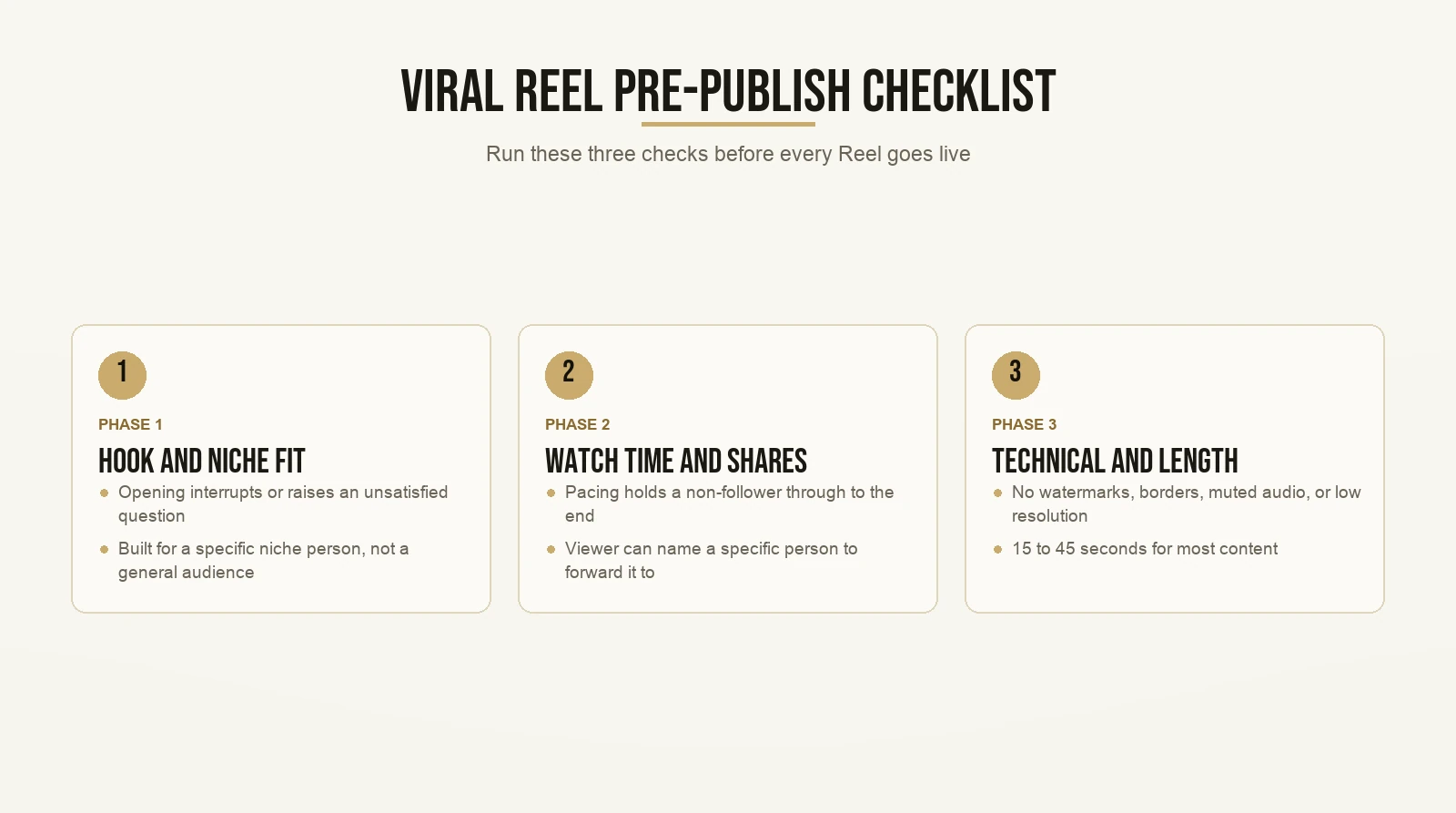
Before a video goes live, I run it against the viral video checklist. It is a pre-publish check that catches the most common reasons a Reel underperforms before it ever reaches the audition.
The checklist covers every element that affects whether the test batch engages or scrolls past:
Hook (first 1-3 seconds)
Does the opening give the viewer a reason to keep watching? A hook is not a greeting. It is a pattern interrupt or an unsatisfied question. If the first second could be cut without losing anything, cut it.
CCN check
Is this built for the specific person in your niche? Or is it broad enough to interest a general audience that will never convert?
Watch time
Is the pacing tight enough that someone who has never heard of you stays through the end? Cut everything that doesn’t move the point forward. Pauses, filler phrases, and transitions that coast are all points where a non-follower exits.
Sends potential
Who would the viewer forward this to? If the answer is nobody specific, the content is probably too general.
Technical quality
No TikTok or CapCut watermarks. No borders. No muted audio. No low resolution. Instagram’s ranking documentation confirms these suppress distribution before the audition registers your content.
Length
For most content, 15 to 45 seconds. Shorter videos are easier to get right because completion rate is the clearest watch-time signal. If you go longer, the video has to be tight enough to hold viewers who don’t know you yet.
Run this checklist before every post. No single action produces a breakout on demand. But it removes the most common self-inflicted suppressions, which is where most accounts lose distribution before the algorithm even has a chance to decide.
Should I Use Hashtags for Organic Instagram Growth?
No. Instagram’s official ranking page does not mention hashtags as a ranking signal. Not even once.
That silence is the data point. The page covers every major signal in detail: watch time, DM shares, likes, comments, profile visits. Hashtags are not on the list.
The algorithm can now categorize your content based on what is in the video, who watches it, and what other accounts it resembles. It does not need keyword tags from you. You are not adding information by tagging your niche. The system already knows. Spending mental energy on hashtag strategy is spending it in the wrong place.
Does Instagram Now Let Users Control What the Algorithm Shows Them?
Yes, and this is a bigger deal for creators than it looks.
Instagram launched a “Your Algorithm” feature in December 2025. It expanded to Explore in April 2026 and then to Feed, Reels, and Explore unified in June 2026.
Users can now see the topic interests Instagram has inferred for them. They can edit those interests and add new ones. When a post is recommended based on an inferred interest, it shows a label the user can tap to adjust their preferences.
For creators, here is what this changes. Content that clearly signals its niche gets sorted more accurately into the right interest pools. If your content is all over the place, the algorithm guesses what pool you belong in. A guess means you get shown to people who are unlikely to engage.
Accounts with tight, consistent niching get more accurate distribution. Generalist content faces more headwinds now, not less. This change rewards exactly what CCN is designed to produce.
What Is the Difference Between Exponential and Linear Growth?
There are two growth patterns. Neither one is better than the other. Both are real, and both happen to real accounts.
Exponential growth means nothing happens until everything happens. You post consistently for weeks or months. View counts are decent but not exciting. Then one video hits. Really hits. Tens of thousands of followers in a short window because one piece of content breaks out. That is the boom moment. It exists.
Linear growth means you raise the baseline over time. Early on, your videos stall around 1,000 views. You make adjustments. Now the baseline is 2,000. Then 5,000. Then 10,000, and so on. No single breakout, but steady upward movement that compounds.
Hold up. How do I know which pattern I’m on?
You don’t, early on. That is the point. The work is the same either way. Post consistently. Study what earns engagement. Get better. If you are watching the analytics every hour hoping for a breakout moment, you miss the smaller adjustments that make the linear path work. And if you quit right before the exponential moment, you never know it was coming.
This is why focusing on the process is structural advice, not soft advice. The accounts that stick with it long enough to find their pattern are the ones who are not white-knuckling every post’s view count.
Old Account vs. New Account: Which One Should You Use?
This question comes up constantly. Here are the rules.
If your old account has been inactive for multiple months, start fresh. The audition system rewards recent engagement history. A dormant account has none.
If your old account is in a different niche than the content you are creating now, start fresh. Old followers from the wrong niche suppress your signals. They don’t engage with the new content. The algorithm reads that as evidence your content is poor.
If your old account has fake followers, start fresh. Non-negotiable. Fake followers never engage. That means every audition batch for every post you publish is partially occupied by dead accounts. The Phase 1 signal dies, and the video never expands.
If your old account has active, genuine followers in the right niche, you can post on it. That is the one case where the history helps you.
When in doubt, start fresh. The cost is a few weeks of build time. The cost of posting to a poisoned account is every post going nowhere until you fix it.
Why Buying Followers Breaks Organic Instagram Growth
Bought followers are not just useless. They are actively damaging.
Here is the mechanism. Instagram runs your Reel through an audition. A small batch of non-followers sees it first. If they engage well, the video expands.
Fake followers also appear in that test group. They were never real people. They don’t watch anything. They don’t save, share, or comment. The audition result comes back: poor engagement, stop distributing. The algorithm files that away. Your account’s signal quality drops. Every post after that starts with a worse baseline.
According to Pew Research, 50% of US adults use Instagram. That is roughly 130 million real people who could see your content if the algorithm trusts your signals. Buying fake accounts actively reduces your access to those real people. The numbers look better. The reach gets worse.
Why Boosting Posts Trains the Algorithm Against You
Most people think boosting is a shortcut to organic growth. It is the opposite.
When you boost a post, you pay Instagram to distribute it. That distribution bypasses the organic audition system entirely. It goes to a targeting segment you selected with your budget, not to the signal pool that teaches the algorithm who organically responds to your content.
Once the budget runs out, organic signals have not grown. Your account has not earned wider non-follower distribution. You are right back where you started, except you spent money and the algorithm learned nothing useful about your real audience.
The right use of boosting, if you use it at all, is to amplify a post that has already performed well organically. That one has already proven it earns real engagement. Amplifying it costs less per result and gives the algorithm accurate signal. Boosting weak content cold teaches the algorithm to ignore organic signals entirely.
How Often Should You Post for Organic Growth?
Post as often as you can keep the quality high. The minimum is every other day. Daily is better if the standard holds.
Notice what that rule actually says. Quality has to stay high. Posting daily with weak hooks and generic topics is worse than posting every three days with something sharp. The audition does not grade on frequency. It grades on engagement per view.
If you miss your ideal posting time, post anyway. Consistency matters more than timing. There is always randomness in what gets picked up. Don’t let a missed window become a skipped day. A slightly off-peak post that is strong beats no post at all.
Which Platform Should You Focus On?
Focus on one platform first.
Pick the one you already spend time on and enjoy enough to post consistently. For me personally, it is Instagram. The audience tends to be more bought in than on TikTok. But for many people, TikTok or YouTube Shorts is the better fit.
The best platform is the one you will actually stick with. Same logic as the best diet: it is the one you can maintain long-term.
Once you are producing consistently on one platform, you can repost to others without adding creative load. Same video, different tabs. Your mental focus stays on one place. Your distribution goes everywhere.
What Does Organic Instagram Growth Look Like in Practice?
According to Pew Research, 80% of US adults ages 18-29 are on Instagram. But the audience skews older every year. That same study found 19% of US adults 65 and older use the platform. The gap is narrowing.
If your ideal client is in their 40s, 50s, or 60s, they are on Instagram. More of them every year, not fewer.
What organic growth looks like depends on your pattern. Exponential accounts look flat early. Consistent posting, modest views, no visible momentum. Then one video lands and the account jumps. Linear accounts look like slow improvement. The baseline edges up post by post. No breakthrough moment, but compound progress.
In both cases, the leading indicator is the quality of who is following and engaging, not the raw count. Ten followers who send DMs and ask about your offer are worth more than a thousand who watch and scroll on.
I’ve documented results from real accounts at various stages of this process in these case studies. The pattern holds across niches. The accounts that treated it as a skill to build consistently outperformed the ones that treated it as a numbers game.
For what to do once those followers are watching and engaging, this guide on how to find clients on Instagram walks through the conversion side.
Running the Viral Video Checklist Alongside CCN: The Combination That Works
Here is how the two frameworks connect in practice.
CCN tells you who you are talking to and what they need to hear. It is the targeting layer. Without it, even technically great videos land in front of the wrong audience and produce weak audition signals.
The viral video checklist tells you whether the video is ready to go. It is the execution layer. Without it, even well-targeted content loses distribution to fixable technical problems or a weak hook.
You need both. A perfect hook aimed at the wrong person still earns a poor audition. A perfectly targeted video with a five-second intro of you saying hello still loses viewers in the first second.
Run CCN first when deciding what to make. Run the checklist last before you post. That sequence catches most of the avoidable failures before they cost you distribution.
If you want to go deeper on what a strong Reel looks like structurally, this guide on how to go viral on Instagram Reels breaks down the mechanics in full.
And if you’re a coach who is running out of topics, this post on what coaches should post on Instagram when they run out of ideas goes through the whole ideation process.
The One Thing Every Successful Account Gets Right
I’ve seen accounts go viral on the first video. I’ve seen accounts post for months before anything clicked.
The common thread across every account that worked: they focused on getting better, not on getting results. The results follow the skill. They always do.
The skill is specific. It is the hook. It is the CCN clarity before you film a single frame. It is running the viral video checklist before every post. It is understanding which of your videos earned shares versus which ones earned passive likes. That difference tells you whether your content is spreading to new audiences or staying inside your existing bubble.
Organic Instagram growth is teachable. The mechanism is not luck. It is a topic your specific audience already cares about, aimed at people who have never heard of you, built with enough precision that the audition system knows exactly who to show it to next.
Want the templates behind content that actually gets watched? Grab the templates here and start with the first one today.