
Key Takeaways
- The best time to post on Instagram on Monday is somewhere between 9 am and 1 pm or 6 to 9 pm in your audience’s time zone. Those are your defaults until your Insights give you a better number.
- Timing is a ranking signal Instagram uses for Feed and Stories. For Reels, the algorithm tests your content on strangers first. The mechanism works differently for each.
- Your Instagram Insights is the only data that reflects your actual audience. Generic timing tables reflect millions of other accounts, not yours.
- Missing your window is not a reason to skip posting. Post anyway. Consistency beats perfect timing every single time.
- Content that hooks a stranger will outgrow content timed perfectly for your existing followers. Both matter. But the content comes first.
What is the best time to post on Instagram on Monday?
A reasonable starting window is 9 am to 1 pm and again from 6 to 9 pm in your audience’s time zone. Those windows line up with commute time, the lunch scroll, and the post-work wind-down.
That is the short answer. The rest of this post explains why that answer matters less than most articles will tell you, what actually drives reach on a Monday, and how to find the window that fits your specific audience instead of everyone else’s average.
Why does posting time on Monday actually matter?
Timing matters because it affects which followers see your post first. And first impressions are what the algorithm measures.
Instagram lists “what time a post was shared” as a ranking signal for the Feed and Stories algorithm. When you post while more of your followers are active, more of them see it. More of them engage with it. The algorithm reads that early engagement as a quality signal and distributes the post further.
That is the whole mechanism. Posting time is not magic. It is a proxy for early engagement volume. More engagement in the first hour means wider distribution.
So the Monday windows matter because they correspond to peak activity for the average U.S. audience. Morning commute. Lunch. Post-work. Those windows are real.
But Max, if timing boosts early engagement, shouldn’t I be obsessing over getting it exactly right?
Not quite. Early engagement matters. But which viewers engage first matters more. That is the piece most timing articles skip entirely. Keep reading.
Now, one more thing before we move on. For Reels, the mechanism is different.
Instagram distributes Reels to people who do not follow you first. The initial audience is strangers, not your followers. The algorithm is predicting whether someone who shares certain interests will watch it all the way through, like it, or send it to a friend. Your followers’ active hours have almost nothing to do with that initial test. The content does.
Adam Mosseri, head of Instagram, has stated that watch time, likes, and sends are the top ranking signals for Reels. Timing helps your content enter the algorithm’s initial test pool. After that, the content takes over.
This is super duper key. Most creators are optimizing for the wrong audience when they think about timing.
What’s the real problem with Monday timing tables?
Every article ranking for this keyword lists the same numbers. 9 am. 11 am. Noon. 6 pm. They all cite “studies from Hootsuite, Later, Sprout Social, Buffer” without linking to the actual study, naming the sample size, or defining what “best” even means.
That is not a source. That is a recycled claim.
Here is the actual problem. Those tables are aggregate data across millions of accounts in every niche, every country, every audience type. Your followers are a specific group with their own habits. A nutrition coach serving women in their 40s and 50s has a completely different audience schedule than a business coach working with 28-year-old startup founders. The table treats both of them the same. It has no choice.
This is where contrarian ideology becomes useful.
Contrarian ideology: the framework
Contrarian ideology is one of Max’s core content frameworks. The premise is simple. Most creators in your niche are saying the same thing. When you say the same thing, you blend in. The contrarian move is to take the position that challenges the conventional wisdom, then back it up with the real mechanism.
Applied to Monday timing: every other article says “post at 11 am.” The contrarian position is “the table is not the answer. Your Insights are.”
But Max, isn’t that just splitting hairs?
No. It is actually more useful than the conventional advice. Read that again. A creator who posts at 11 am every Monday because a list said to is not learning anything about their audience. A creator who checks their Insights, posts at their actual peak, and watches the first-hour numbers is running a real experiment. Every post teaches them something. One of them is building a system. The other is following a template that was never designed for their specific account.
The contrarian position earns trust because it replaces a vague instruction with a specific mechanism. You name what everyone else got wrong, explain the real reason, and give the reader the actual tool. Boom. You are the only source on the page that admitted the table was not the answer.
That is contrarian ideology in action. It is not about being contrary for its own sake. It is about digging to the mechanism when the surface-level answer is not good enough.
Who is actually on Instagram on Monday?
Pew Research Center data from 2025 shows that 50% of U.S. adults now use Instagram, up from 40% in 2021. The 18 to 29 bracket leads at 80% usage. Usage drops significantly for adults 55 and older.
If you are a coach whose clients tend to be in their 40s, 50s, or 60s, the aggregate Monday numbers are even less useful for you. That audience has a different relationship with their phone than a 24-year-old. They tend to check Instagram during defined windows: before work starts, at lunch, or in the early evening. They are less likely to be scrolling at midnight.
DataReportal’s 2026 Global Overview puts average daily Instagram use for U.S. adults at 33 minutes. For ages 18 to 24, it is 53 minutes. The older your audience, the shorter and more deliberate their session. That makes their timing window narrower, and hitting it matters more.
Dating coaches, parenting coaches, fitness coaches working with people in midlife, and business coaches whose clients have been in their industry for 20 years are all talking to people whose Monday scroll habits look nothing like the averages behind those timing tables. The general window is a starting point. Your Insights is where you find the real number.
How do you find your actual best time on Monday?
Pretty straightforward. Here is the method, step by step.
- Open Instagram on your phone.
- Tap your profile photo in the bottom right.
- Tap the three-bar menu in the top right, then tap Insights.
- Tap Total Followers.
- Scroll down to Most Active Times.
- Switch the toggle to Hours.
- Find Monday. Look at the bars.
The bar chart shows hourly activity for your specific followers. The tallest bar on Monday is your window. That is your number, not the one from a published list.
No tool subscription. No third-party app. Just your own data.
One caveat: if your account is newer and has fewer than a few hundred followers, the Insights chart is noisy. There are not enough data points for hourly numbers to be reliable. In that case, use the general Monday windows as your starting point until your audience builds.
For a broader look at how to use performance data to build a real content system, the guide on organic Instagram growth covers what metrics to track beyond timing alone.
The CCN problem with over-optimizing for timing
Here is where most coaches and business owners get stuck when they first start posting on Instagram.
They research the best Monday windows. They schedule posts at 11 am sharp. Their Reels still sit under 500 views a week later. They think the problem is the timing. It is almost never the timing.
This is a CCN problem.
The CCN framework: who actually follows you
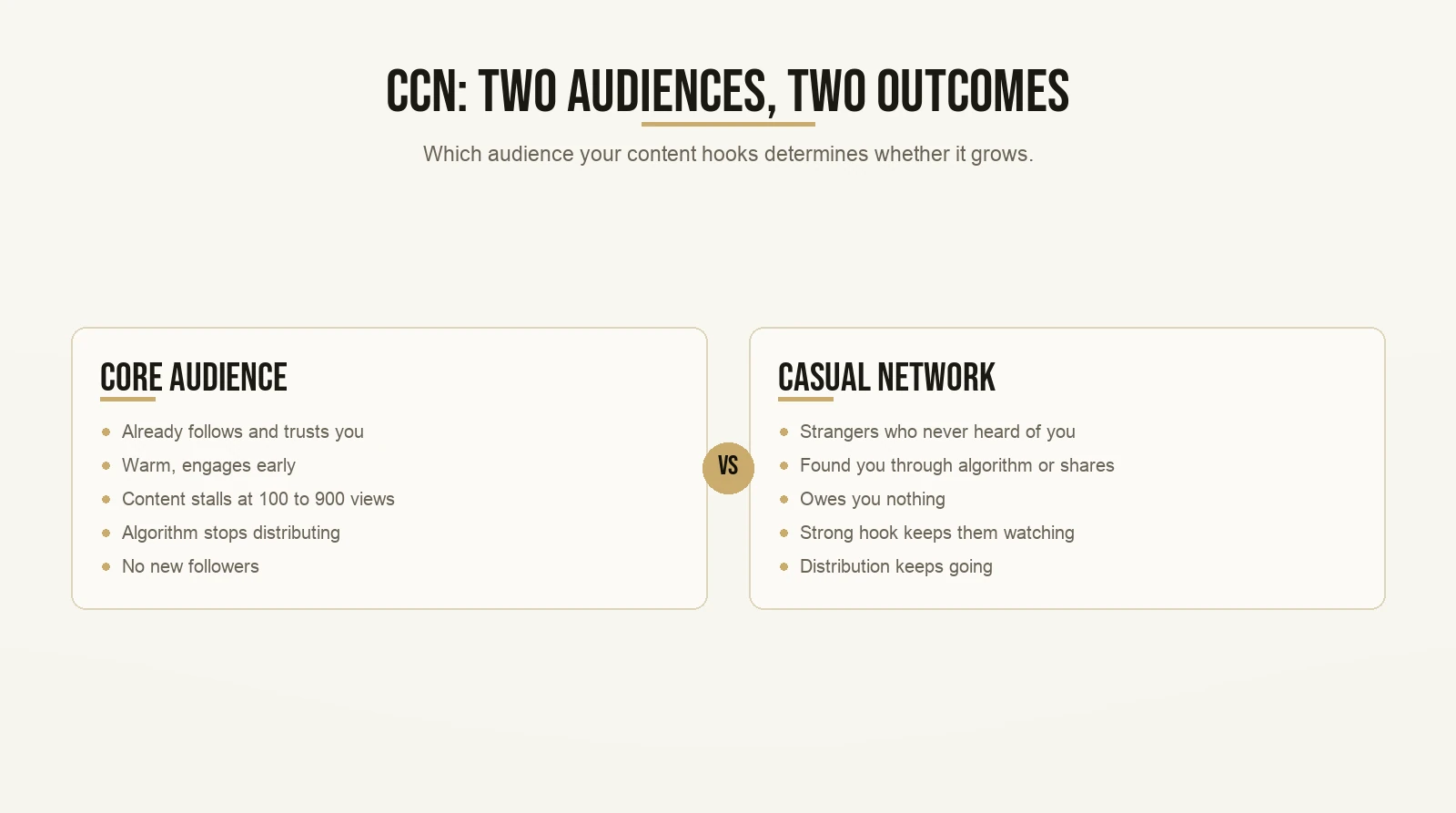
CCN is the framework that determines which viewers actually convert into followers and then into clients. The core insight is this: any piece of content has two potential audiences.
The first is your core audience. These are people who already follow you, already trust you, and already engage with your content. They are warm. Content timed well for them gets clean early engagement.
The second is the casual network. These are strangers. People who have never heard of you. They find your content through the algorithm’s distribution, through a share, or through Explore. They owe you nothing, and they have no reason to stick around unless your content hooks them immediately.
Here is the part that separates growing accounts from stalled ones. Videos that only resonate with your core audience stall between 100 and 900 views. Read that again. The algorithm shows them to your followers, gets engagement from the warm crowd, and stops. No new people. No new followers. No growth.
Videos that hook the casual network are the ones that break out. The algorithm shows them to strangers, the strangers watch and engage, and the distribution keeps going. Those are the videos that bring in people who had absolutely no idea you existed last week.
Over-optimizing for posting time is a core-audience move. You are trying to reach the people who already follow you. That is not a growth strategy. You get the gist.
The CCN-aware creator asks a different question before every post. Not “what time should I post this?” but “does this piece of content hook someone who has never heard of me?” If the answer is no, the timing is irrelevant. If the answer is yes, then posting at a reasonable window is enough to get the content into the algorithm’s initial test pool. The content does the rest of the work.
For coaches who currently get most of their clients through referrals and word of mouth, this is the actual shift that matters. The content your existing clients respond to is often not the content that grabs a stranger mid-scroll. The hook, the topic, and the angle have to work for someone who owes you nothing. The guide on Instagram Reel ideas for coaches breaks down how to structure content that speaks to someone who has never heard of you.
Coaches who make this shift tend to see growth curves that look nothing like what they expected. The results from people who’ve done this work reflect that difference.
What happens if you miss your Monday window?
Post anyway.
But Max, if I miss my window, doesn’t that basically mean my post is dead before it starts?
No. Missing your ideal window by one hour does not kill your reach. It slightly reduces the size of the initial audience that sees the post, which slightly reduces the chance of a strong first-hour signal. That is the full extent of the damage.
A great piece of content posted at 2 pm on a Monday will still outperform a freaking mediocre piece of content posted at exactly 11 am. Every time. The algorithm measures engagement quality. It does not measure clock precision.
Max’s rule: consistency over perfection. Still post. Do not think “my ideal time was 6 pm and now it is 7.” Just post the thing.
This is very very key for coaches who are building a posting habit from scratch. The enemy is not a suboptimal time slot. The enemy is the spiral that starts with “I missed my window” and ends with “I will just wait until next Monday.” That is how a content habit dies. One missed window becomes two, and two becomes a month of silence.
There is something else worth knowing. Instagram’s algorithm tracks how consistently an account has been posting over time. Accounts that show up regularly, even at imperfect hours, are treated as active accounts worth distributing. Accounts that go dark for weeks and then suddenly flood the feed are treated differently. Regularity signals to the algorithm that you are still here.
If you are running short on what to actually post, the guide on what coaches should post on Instagram when they run out of ideas is a good starting point. Running out of ideas is a far more common problem than bad timing, and it kills far more accounts.
What makes Monday actually different from other weekdays?
Honestly, not that much from a content standpoint.
Monday has a small behavioral advantage because people re-engage with their phones after the weekend. They are commuting, checking in, and picking up habits that went quiet on Sunday. The 9 am to 1 pm window benefits from that re-engagement.
But the post-work window (6 to 9 pm in your audience’s time zone) exists on every weekday. Monday’s version is not dramatically stronger than Wednesday’s or Thursday’s.
But Max, so why does everyone make it sound like Monday at 11 am is some magic window?
Because it averages out to a good window across a massive sample. It is not wrong. It is just not specific. If your Insights show that your audience is most active on Tuesday at 7 pm, post on Tuesday at 7 pm. The keyword in the title of this post is a search query. It is not a prescription. Your audience’s actual schedule beats any day-of-week ranking every single time.
What about the “Your Algorithm” feature?

In late 2025, Instagram began rolling out a feature that uses AI to summarize what topics it thinks each user cares about. Users can review and edit that list manually. It started in the Reels tab in December 2025, expanded to Explore in April 2026, and reached the main Feed by mid-2026.
What this means practically: content-to-audience matching is now more explicit and more user-controlled. The algorithm is doing direct topic matching between your content and a viewer’s stated interests. A fitness coach posting a Reel about training principles is being matched to users who have fitness-related topics in their preference profile, somewhat independent of when the Reel was posted.
This is another way of saying the same thing. Timing is a factor. Content-to-audience match is the mechanism. Instagram’s own documentation on how its algorithm works names the ranking signals explicitly. Post timing is on the list. It is not at the top. You need both, but they are not equal.
Anywho, the practical conclusion is the same: get the content right, post within a reasonable window, and let the algorithm do the matching.
The Monday posting playbook
Here is how to put all of it together into something you can actually use.
Step one: pull your Insights. Open Most Active Times, find your Monday peak, and write it down. That is your target window going forward.
Step two: prepare content ahead of time. If your window is 8 am on Monday, have the video ready Sunday night. Do not be finishing the edit at 7:58 am. That is how quality slips and mistakes get posted.
Step three: post within your window when you can. Post outside it when you have to. The window is a target, not a gate.
Step four: check first-hour performance. After you post, watch the early engagement. For Reels: watch time, likes, and sends are the key signals. If all three are strong, the algorithm will keep distributing. If they are flat, the issue is almost certainly the content, not the time you posted.
Step five: change one variable at a time. If you change the topic and the posting time in the same experiment and the numbers shift, you do not know which change caused the difference. Lock in your time window first. Then experiment with topics, hooks, and formats.
Building a full week-by-week content structure around these signals is a different exercise than finding the right Monday window. The guide on Instagram growth strategy goes deeper on planning and sequencing your content across the week.
The bottom line on Monday timing
Post between 9 am and 1 pm or between 6 and 9 pm in your audience’s time zone. Pull your Insights and sharpen the target from there. Post consistently, even when you miss the ideal window. And build content that hooks someone who has never heard of you, not just someone who already follows you.
The coaches who grow on Instagram are not the ones who cracked the perfect Monday time slot. They are the ones who figured out what their specific audience genuinely cares about, made content that speaks to a stranger, and kept showing up long enough for the algorithm to figure out who to show it to.
The time is a detail. The content is the thing.
Want the templates behind content that actually gets watched? Grab the templates here and start with the first one today.