
Key Takeaways
- An instagram reels overlay is text you add manually. It is separate from auto-generated captions. Two different layers, two different jobs.
- The overlay is a second hook. It speaks to the viewer scrolling with no sound, who will never hear your verbal hook. If it repeats what you already said out loud, it does nothing for that person.
- The best overlay does not summarize the video. It creates a curiosity gap: a different angle on the same topic that only gets resolved by watching.
- The CCN framework explains why this matters: content that only interests your core audience stalls. An overlay aimed at strangers is how you speak to a cold viewer who has never heard of you.
- The 7 building blocks of a viral video include the hook. The text overlay is the visual execution of that building block, built for a completely different viewer than your verbal hook serves.
- Trial Reels let you test overlay variants with non-followers for free before your audience sees anything.
- Place text inside the safe zone so Instagram’s UI buttons do not cover it.
What is an instagram reels overlay, and why does it matter more than most creators think?
An instagram reels overlay is text, stickers, or graphics you layer on top of your video inside the Instagram editor. You write it. You control where it sits, when it appears, and how long it stays on screen.
It is not your auto-generated captions. Instagram creates captions automatically from your audio using speech recognition. Those live at the bottom of the screen and follow your words. You did not write them.
It is not an overlay ad either. Meta’s overlay ads are banner-style ads that appear on other people’s Reels during playback. Advertisers buy those. Completely different product.
The instagram reels overlay you control is the text you choose to place on your own video. Most tutorials treat it as a design step: pick a good font, check the contrast, stay inside the safe zone. None of that is wrong. But none of it is the point.
The point is what you write and why.
Why do you have two different audiences watching the same Reel at the same time?
Because some people watch with sound on and some watch with sound off. They make the same keep-or-scroll decision, but they are using completely different information to make it.
The viewer with sound on hears your verbal hook in the first two or three seconds. Their decision is driven almost entirely by what you say out loud.
The viewer with sound off reads the screen. That is the only signal they have. The decision happens just as fast.
If your overlay says exactly what your verbal hook says, the silent viewer gets the same hook twice in the same two seconds. That is not twice the impact. It gives them nothing new to pursue, so they scroll.
But if your overlay says something related to your verbal hook, something that opens a gap the video has to close, you now have two hooks doing two separate jobs. The verbal hook keeps the listener. The text hook keeps the reader. One Reel. Two audiences served.
Neither one is abandoned.
What is the CCN framework, and why does it change how you think about overlay text?

CCN is the framework that determines who your content actually reaches and whether it can travel beyond the people who already follow you.
Here is the short version. Every Reel starts by reaching your core audience. Those are your existing followers. They already know you. They have some baseline trust. If a video only appeals to them, it stays there. The algorithm sees the engagement pattern and does not push the Reel to strangers. It stalls. Typically between 100 and 900 views, sometimes lower.
For content to break past your core and get distributed to cold viewers, the topic and the hook both need to speak to someone who has never heard of you. That person has no context. They do not know your credentials. They do not know your story. All they have is what they see on screen in the first two seconds.
If you want to understand the full system behind this, here’s more on where this approach comes from.
That is where the instagram reels overlay becomes load-bearing at the CCN level. Your verbal hook often assumes context. It might reference your niche, your past content, or your specific angle on a topic. A follower fills in that context automatically. A stranger cannot.
Your text overlay, if you write it right, needs zero context to land. It speaks directly to a stranger’s problem. That is the version of the hook that breaks past your core.
But if I write for strangers, won’t I lose my actual followers?
No. A hook that works for someone who has never heard of you also works for someone who has. The follower brings more context to it and gets more out of the video. The stranger brings none, so the hook does the heavy lifting for them.
Writing for the stranger does not cost you the follower. Writing only for the follower costs you the stranger, and costs you the reach.
What are the 7 building blocks of a viral video, and where does the overlay fit?

The 7 building blocks are the structural elements every viral Reel shares. The hook is one of them. The topic, the format, the credibility signal, the retention mechanic, the call to action, and the shareability angle are the others.
Most creators understand that the verbal hook is one of the seven. Fewer realize the text overlay is the visual execution of that same building block, optimized for a completely different viewer than the verbal hook serves.
Think of the hook building block as having two sides. One side is what you say. The other side is what you show. A Reel that only executes one side has half a hook. Half a hook still works for some viewers. But it leaves the other half behind.
Max, does that mean I need two completely different hooks for the same video?
Not exactly. The verbal hook and the text overlay are not two competing hooks. They are two versions of the same hook, each aimed at a different type of viewer. They work together. A viewer who catches both gets a fuller picture. A viewer who catches only one still gets enough to make a decision.
The other six building blocks still matter: the topic has to be right, the format has to match the platform, the credibility signal belongs inside the video rather than in the first line of text. But the hook is the one building block the overlay directly affects. Get it right and the rest of the seven have a better shot.
How do you write overlay text that actually makes someone stop scrolling?
Four patterns work consistently: name the problem specifically, say who it is for, contradict the expected answer, and keep it under 12 words. Each one forces the silent viewer to make a decision before the scroll reflex kicks in.
Here is each one in practice.
Name the problem, not the solution. “Why your Reels stop at 300 views” makes someone stop. “How to grow on Instagram” does not. The problem is specific enough to feel personal. The solution is generic enough to describe everyone and reach no one.
Say exactly who it is for. “Why coaches with under 2,000 followers get ignored by the algorithm” targets the right person and filters out the wrong one. That filtering is not a problem. It sharpens the signal the algorithm uses to decide who else to show your content to.
Contradict the expected answer. If everyone assumes the cause of a problem is X, an overlay that says “it is not X” creates instant curiosity. “Your Reels are not failing because of your hook” works because the reader assumed the hook was the problem. Now they need to know what you think the real problem is.
Keep it under 12 words. If it takes more than a second to read, the scroll happens before they finish. Twelve words is about the outer edge. Eight is better.
Should the overlay repeat what I say out loud?
No. Repeating your verbal hook in the overlay gives silent viewers nothing new to chase. The overlay works best when it creates a complementary curiosity gap, a different angle on the same topic that only gets resolved by watching the full video.
Here is what to do instead. Write your verbal hook first. Then write an overlay that approaches the same topic from a different door: one that names the problem more sharply, or frames the stakes differently, or names the person you are speaking to.
Say you are a parenting coach and your Reel is about why kids go quiet during discipline conversations.
Verbal hook: “I’ve seen this pattern in family after family, and it almost never has anything to do with the child’s behavior.”
Text overlay: “Why your kid shuts down when you try to correct them (and what it actually means)”
Same topic. Different door. The viewer with sound on gets the authority signal in the verbal hook. The viewer with sound off gets the problem framed in a way that makes them need the answer. Both stay. Neither one was wasted.
Where do you put the overlay so people can actually see it?
Keep it inside the safe zone, away from the bottom 20% and top 15% of the frame. Those areas get covered by Instagram’s UI buttons, username display, and caption preview. Text placed there disappears for some viewers.
For exact positioning, Instagram notes that you can edit text position after saving a draft, so you can test and adjust until nothing overlaps.
For timing: put the overlay on screen in the first one to three seconds. That is when the scrolling decision happens. Some creators hold the hook text for five to eight seconds before removing it. Others use a sequence: one text hook at the start, a callout in the middle labeling the key point, a text CTA at the end.
If you are new to this, start with one overlay per Reel, in the first three seconds, centered in the safe zone. That is enough. You can add complexity later. The one-overlay habit is what matters right now.
How is a text overlay different from Instagram’s auto-generated captions?
Overlays are text you add manually in the editor. Captions are transcripts auto-generated from your audio by Instagram’s speech recognition. Overlays are a hook strategy. Captions are an accessibility layer. Neither replaces the other, and they are separate tracks in your editor.
Instagram auto-generates captions from your audio using speech recognition. They appear at the bottom of the screen, word by word, as you speak. They are useful for accessibility. They help viewers who are hard of hearing and viewers in loud environments. They are not a hook strategy. A caption that reads “So the other day I was thinking about something” is the transcript of your introduction. You have not said anything worth stopping for yet.
The Edits app manages both layers separately. Auto-captions on one track, manual overlay text on another. You can adjust the style, opacity, position, and language of each one independently. You do not have to choose between accessible captions and a strong text hook. You use both.
One more reason to keep the two layers distinct: as of July 2026, Instagram now translates both your voice and your on-screen text simultaneously into more than 14 languages. If your verbal hook and your overlay say something slightly different, the translation handles each layer on its own. Your curiosity-gap strategy works in Japanese, Korean, French, and German without any extra work from you.
How do you test which overlay text actually performs?
Post each version as a Trial Reel. Instagram shows Trial Reels only to non-followers. After 24 hours you see plays, likes, comments, and shares. The version that performs with cold strangers is the one that works at the level that matters.
Instagram launched Trial Reels globally in December 2024. When you post a Trial Reel, it goes to non-followers only. Your existing audience does not see it until you decide to share it with them. If it performs well, one tap sends it to your followers. If it does not, it disappears quietly. Your engagement rate is not touched.
This is the legitimate free testing tool for overlay text. Write two versions of your hook overlay. Post one as a Trial Reel. After a day, post the second version as another Trial Reel. Compare plays and early engagement. The version that performs with strangers, people who have no prior relationship with you and no reason to give you the benefit of the doubt, is the one that is working at the CCN level. That is the one worth posting to your followers.
You need a professional account to use Trial Reels. If you do not have one, switch. It is free, and this feature alone is worth the switch.
Do I have to reshoot the whole video just to test a text change?
No. If you shoot on camera, the footage is the same. You are only swapping the overlay text layer in the editor. If you use a static or app-style format, the whole edit takes five minutes. The footage does not change. Only the text changes. That is the point.
What is the biggest overlay mistake coaches make?
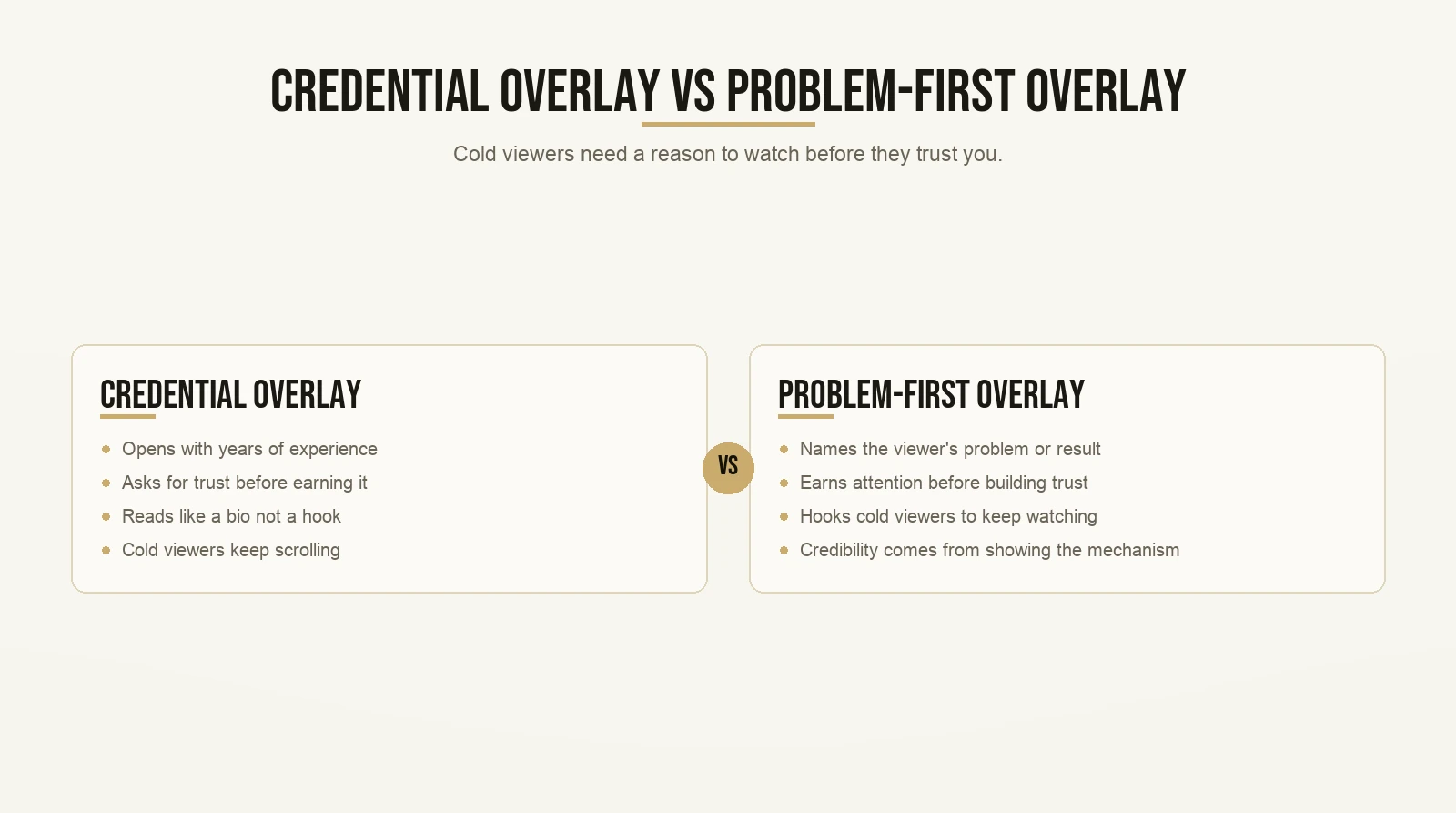
Writing credentials in the overlay. An overlay that opens with your years of experience asks a cold stranger to trust you before you have given them any reason to. The overlay has one job: make a cold viewer stop. Credentials come later, inside the video.
An overlay that reads “I’ve been a relationship coach for 11 years” is not a hook. It is a bio. Cold viewers do not care about your experience before you have done anything to earn their attention. Telling them your credentials in the first second is asking them to trust you before you have given them any reason to. They keep scrolling.
The overlay should say something about the reader’s problem or the reader’s desired result. Not your background.
Your credentials belong inside the video, after the hook has earned attention. That is where the credibility bank gets built: through specific claims about how things work, through the mechanism you show them. “Coaches who rely only on referrals plateau because their audience never grows” is a credibility signal. It tells the viewer you understand the problem. A credential count does not.
But my referral clients already trust me before they ever reach out. Isn’t that how credibility works?
Right, and that is the exact difference. Referral clients arrive pre-warmed. Someone they trust has already vouched for you. Cold viewers on Reels have not been vouched for. All they have is your overlay text.
This is also why coaches who have built successful practices through word-of-mouth often struggle on Instagram at first. The referral model delivers trust upfront. The content model earns attention first and builds trust after. Different order. Different first move.
For more on building a client pipeline from content when word-of-mouth is your whole current system, the guide on getting clients as a relationship coach walks through the full shift.
What overlay formats work best for coaching content?
Three patterns work consistently for coaches: the problem-naming overlay, the contrarian overlay, and the result-without-the-dread overlay. Each one starts from the viewer’s situation rather than the coach’s expertise.
The problem-naming overlay. “Why [specific problem] keeps happening even when you [obvious attempt to fix it].” Specific enough to feel like it was written for them. Broad enough that a lot of people recognize the situation. Example: “Why clients go quiet after a great discovery call.”
The contrarian overlay. “It’s not [the thing they blame].” The reader expects the problem to have one cause. Your overlay says it is something else. They need to know what you mean. Example: “You’re not getting ignored on Instagram because of your posting schedule.”
The result-without-the-dread overlay. “[Specific outcome] without [the thing they are avoiding].” Clear benefit. Removes the objection in the same line. Example: “Fill your calendar this month without sending a single cold DM.”
For a broader set of formats built specifically for coaching content, the Reel ideas post for coaches has models you can work from directly. And if you want to see how the overlay fits into the wider format conversation, the instagram reel template guide covers the structural decisions that surround it.
Does overlay text help Instagram show your Reel to more people?
Probably. Instagram’s topic-based personalization matches Reels to non-followers by topic, and text on screen is the clearest topical signal available. Instagram has not confirmed this officially, but naming your topic explicitly in the overlay is low-cost behavior with plausible upside.
Instagram launched topic-based personalization for Reels in December 2025. It expanded to Explore in April 2026 and covered Feed, Reels, and Explore fully by June 2026. The algorithm matches content to interested non-followers based on topic. It has to read something in your Reel to categorize it. Text on screen is the most explicit signal available.
Naming your topic directly in your overlay, “Instagram growth for coaches,” “prenatal nutrition strategies,” “mindset work for women in sales,” gives the algorithm a clean label. Instagram has not confirmed this is how it works. But the cost of naming your topic in the overlay is zero. The potential upside is more accurate distribution to interested non-followers. Do it anyway.
Worth noting: Reels up to three minutes are now recommendation-eligible for US creators. A longer Reel puts more pressure on the opening seconds. A text hook in the first frame has to earn far more watch time than it used to when a 15-second clip was the ceiling. The overlay is more load-bearing now, not less.
The fastest way to improve your overlay text right now
Go to your last five Reels. Look at the overlay text on each one.
For each one, ask a single question: does this text describe what the video is about, or does it say why a specific person needs to watch it right now?
If the answer is “describes what it is about,” rewrite it. Turn the topic into a problem. Turn the problem into something specific enough to feel personal. That is the entire swap.
Then post your next Reel as a Trial Reel first. Let strangers see it before your followers do. The number they give you in 24 hours is an honest answer from people who had no reason to be generous.
If you want to see how the overlay fits into the full system, the organic Instagram growth guide covers how hook strategy, topic selection, and distribution all connect.
Want the templates behind content that actually gets watched? Grab the templates here and start with the first one today.