
Key Takeaways
- Fertility coaching sits inside the physical health mega-niche. The niche is specific, and that specificity is a commercial advantage, not a limitation.
- There is no single governing body for fertility coach certification. You build credentials in two layers: a portable coaching credential and fertility-specific training.
- The ICF is the most widely recognized independent coaching body. Its entry-level ACC credential requires 60 hours of education, 100 hours of coaching experience, and passing the ICF ACC Exam.
- Outcome claims like “get pregnant faster” carry legal exposure under FTC rules, even when a client writes the testimonial. You share it, you own it.
- Two frameworks, contrarian ideology and the CIA frame, give you a repeatable content system that builds authority without ever hinting at a clinical result.
What Does a Fertility Coach Actually Do?
A fertility coach helps clients work through the lifestyle, mindset, and decision-making that come before, during, and after fertility treatment. The role is about partnership and clarity, not clinical care. Coaching sits alongside medical treatment, never inside it.
That line matters more than most coaches realize. The ICF defines coaching as partnering with clients in a thought-provoking and creative process to help them reach their potential. A fertility coach does not diagnose. A fertility coach does not treat. A fertility coach helps a client get clear on her goals and take action on the things inside her control.
For the coach building a practice, that boundary is not just ethical. It is the whole business strategy.
Here is what that looks like in real life. A client comes to you overwhelmed by a protocol her reproductive endocrinologist gave her. She is not confused about the medical part. She is confused about the lifestyle adjustments, the emotional weight of the process, and whether she is doing everything she can on her end. That is the coaching space. You help her think. You help her decide. You help her show up consistently.
You are not her doctor. You are the person who helps her get clear.
How Do You Become a Fertility Coach?
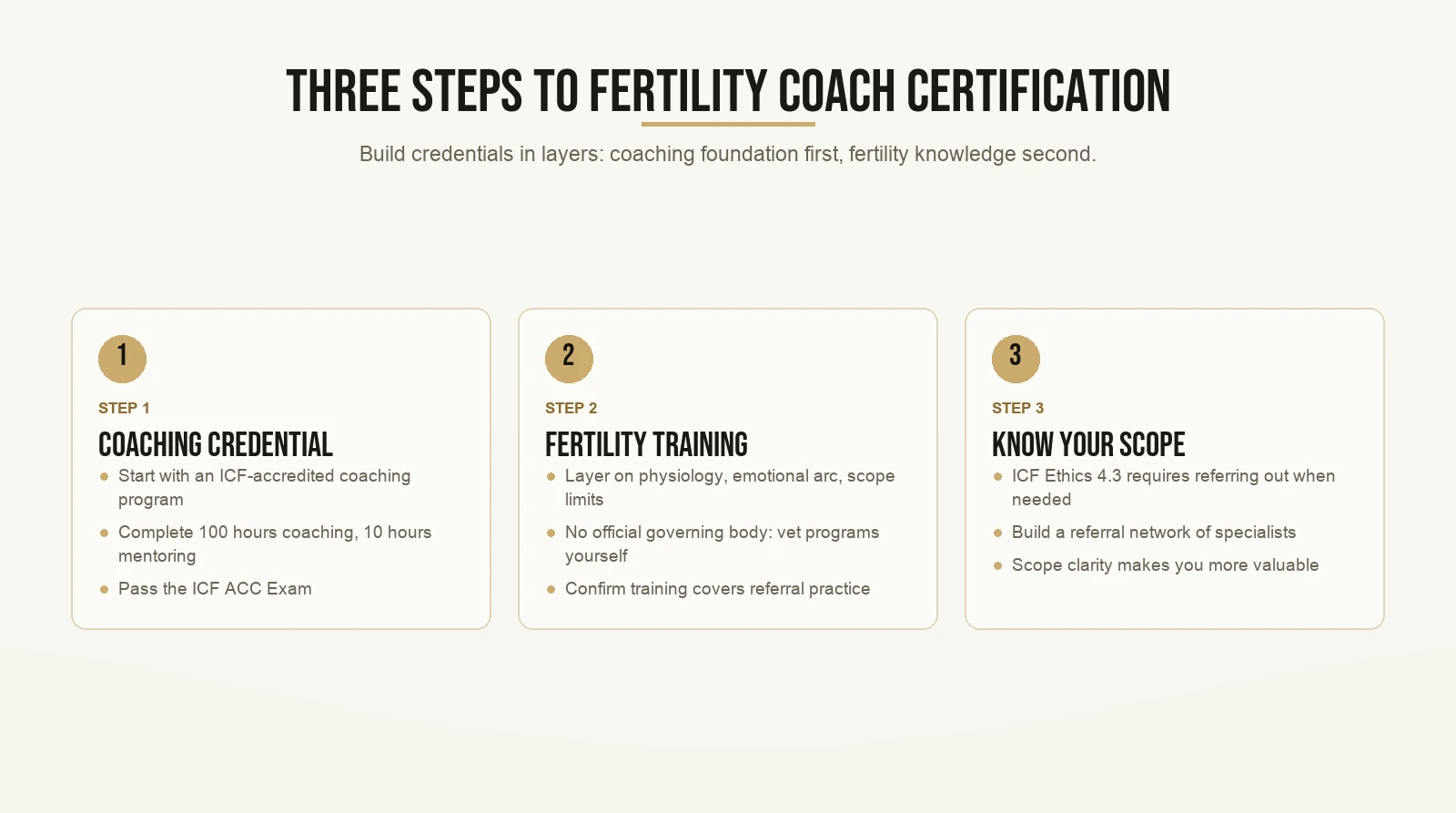
You build your credentials in two layers. The first layer is a portable coaching credential, ideally from the ICF, that proves you know how to coach. The second layer is fertility-specific training that proves you understand the context. Most coaches skip the first layer. That is a mistake they usually regret when a prospective client starts comparing options.
Step 1: Get a real coaching credential.
Start with a credential that travels. The ICF ACC credential requires:
- 60 hours of coach-specific education from an ICF-accredited program
- 100 hours of coaching experience, with at least 75 of those paid
- 10 hours of mentor coaching spread over at least three months
- A performance evaluation
- Passing the ICF ACC Exam
That is not a weekend course. It is a real credential with real requirements. When a prospective client compares you to someone who took a two-day online program and called themselves certified, that credential is the differentiator.
Step 2: Add fertility-specific training.
Once you have a coaching foundation, layer on training specific to fertility. Look for programs that cover the physiological basics, the emotional arc of a fertility journey, and the scope limits that keep you out of medical territory.
There is no single official body governing fertility coaching certification the way the ICF governs coaching broadly. That means you have to vet programs yourself. Ask: who teaches this? What does the curriculum cover? Does it teach coaching skills or just domain knowledge? Does it prepare you to refer out when a client’s needs go beyond your scope?
Step 3: Know your scope inside and out.
ICF Code of Ethics Standard 4.3 is clear. If the value a client gets from coaching shifts, or if the client’s needs go beyond your competency, you are expected to discuss that and refer out where appropriate. That is not a weakness. That is what professional coaches do.
In a fertility context, “refer out” might mean a reproductive endocrinologist, a therapist, a registered dietitian, or a functional medicine practitioner. Know your referral network. It makes you more valuable, not less. You get the gist.
What Is the Most Recognized Coaching Certification?
The ICF credential is the most portable and widely recognized coaching certification in the world. It has three levels: ACC, PCC, and MCC. The ACC is the entry point. The PCC requires 125 hours of education and 500 hours of coaching experience. The MCC requires 200 hours of education and 2,500 hours of experience.
The ICF credentials overview is where you start. The ICF is independent of any specific niche, and that is exactly the point. When a prospective client sees “ICF-credentialed” on your profile, they know it means something. The ICF set the bar. You did not set it yourself.
In a niche like fertility coaching, where no regulated body issues a universally recognized certificate, an ICF credential gives you an anchor that no program-specific certificate can match.
One thing to note: ICF is introducing a new PCC-MCC Exam starting November 10, 2026. If you are currently working toward your PCC, check the current requirements before that transition date. The timeline and requirements are on the ICF site.
A domain-specific fertility training program and an ICF credential are not competing options. They are meant to be stacked. One proves you know how to coach. The other proves you know the context you are coaching in.
For a look at how this same credential-stacking logic plays out in a related niche, life coach certification walks through the same framework in detail.
Why Can’t You Promise Outcomes?
Because the FTC says you cannot, and it does not matter if the claim comes from a client testimonial rather than your own words. The FTC applies the same substantiation standard to advertiser-shared testimonials as to direct claims. You share it, you own it. That rule applies fully in health-adjacent niches like fertility coaching.
This is where most coaches in health-adjacent niches get it wrong. They think: “I am not making the claim. My client is.” The FTC does not see it that way.
The FTC’s guidance on health claims is direct. Advertisers cannot make claims through consumer testimonials that they could not substantiate if they made the claim themselves. The standard is identical. If you share a client testimonial that says “I got pregnant three months after working with her,” you are making that claim. And you cannot substantiate it. Not because your coaching did not help, but because you cannot establish clinical causation.
The FTC finalized a rule in August 2024 banning fake reviews and unsubstantiated testimonials, with civil penalties per violation.
“But Max, that seems extreme. I’m a small fertility coach, not a pharmaceutical company.”
It does not matter. The FTC’s health products compliance guidance applies to anyone making health-related claims in advertising, and social media posts are advertising.
Here is the thing. This is not meant to scare you. It is meant to free you.
Method-over-outcomes content performs better anyway. It positions you as a teacher, not a salesperson. It attracts people who are in the research phase, which means they are serious, not casually scrolling. And it gives you content that ages well because a solid methodology does not expire.
The coach who teaches the method builds more trust than the coach who promises the result. Read that again.
Are Fertility Coaches Worth It?
Yes, if you build the practice correctly. The fertility coaching niche is small by search volume, but it is commercially dense. A small audience of highly motivated, highly specific people is worth more than a large audience of casual viewers. The person searching for fertility coaching is not browsing. They are already inside the problem.
That distinction drives everything about how you build your content strategy.
This is not a niche where you post a funny reel and watch your calendar fill up. This is a niche where 200 people who deeply trust you is a full practice. Your content goal is to earn that trust consistently, not to chase views for their own sake.
If you already have an offer and you already get clients through word of mouth, the freaking question is not whether the niche is worth it. The question is why you are not showing up online when people are already searching for exactly what you do.
If you are working through the same pivot in a related practice, marketing for coaches who rely on referrals covers the same shift in more detail.
Contrarian Ideology: The Content Move That Fits This Niche

Here is the most crowded belief in fertility coaching content right now: to sell coaching in a sensitive health niche, you need to show results. Before and after. Client wins. Outcomes.
That belief is wrong. It is also, as we just covered, legally dangerous.
That is your contrarian ideology.
“Ah Max, you and your fancy names for stuff.”
Fair enough. Let me explain what contrarian ideology actually is and why it is freaking powerful here.
Contrarian ideology has two parts: contrarian beliefs and contrarian visuals. For now, focus on the beliefs.
A contrarian belief is not just being difficult for its own sake. It is identifying what your niche assumes to be true, and then offering a better-supported alternative. You fill out a simple table. On one side: what the market tells coaches. On the other side: what you actually believe works better.
Here is what that table looks like for a fertility coach:
| What the market says | What you believe |
|---|---|
| Show results to build trust | Teaching your method builds more durable trust than showing an outcome you cannot legally claim |
| Fertility content needs to be clinical and serious | Specificity and consistency are your differentiators, not seriousness |
| A broad wellness audience gives you better reach | 200 people who trust you completely is a full practice |
That third row comes from a core idea about small niches. Context matters. Getting 5,000 views from people actively searching for fertility coaching is worth more commercially than getting 500,000 views from a general wellness audience. The niche is small. That is not a problem. That is a filter. The people watching are already considering your offer.
Once you have your contrarian beliefs, every piece of content can come back to one of them. That consistency is what builds the credibility bank over time, not individual viral moments. The coaches who stay consistent in a small specific niche compound their authority in ways that broad-audience creators never do.
For a broader view of how this teaching approach applies to coaches building practices on social media, read the background on where these frameworks come from.
The CIA Frame: Building Trust Through Method
You have your contrarian beliefs. Now you need a structure to teach them without accidentally drifting into outcome territory.
That structure is the CIA frame. Pretty straightforward.
CIA stands for Context, Insight, Action.
- Context: Set the scene your viewer is living in. Describe the situation without diagnosing.
- Insight: Explain what your methodology says about that specific situation.
- Action: Give the concrete step the viewer can take today.
Here is a worked example. Say your contrarian belief is that tracking lifestyle variables gives a client more agency than tracking only cycle data.
- Context: “You are doing everything your doctor told you to do. You are tracking your cycle. You are taking the supplements. But you feel like you have no control over what happens next.”
- Insight: “Most fertility protocols focus entirely on what is happening inside your body. But your nervous system, your sleep quality, and your stress response all affect the hormonal environment you are trying to support. Those are coachable. That is where we work.”
- Action: “This week, track your sleep quality alongside your cycle data. Note how you feel on low-sleep days versus high-sleep days. Bring that to our next session.”
Notice what that content does not do. It does not say “do this and you will get pregnant faster.” It teaches a mechanism. It positions you as someone with a repeatable process. It invites the viewer to take a specific step.
That is the CIA frame. Boom. And it is entirely repeatable. Context, Insight, Action. Every piece of content you make can follow this structure.
The CIA frame also keeps you in scope by design. You are never promising a clinical outcome because you are never describing one. You are describing a coachable process. That is a freaking powerful distinction in a health-adjacent niche where one careless sentence can expose you to real legal risk.
What Does “Method-Over-Outcomes” Content Look Like in Practice?
It looks like teaching, not testifying. Each piece of content answers a specific question your prospective client already has, paired with a specific mechanism from your methodology. The goal is to show that you have a repeatable process, not to demonstrate a result you achieved for someone else.
Here are five content angles pulled directly from the contrarian beliefs we built above:
- “Why I stopped using before-and-after framing in my coaching practice”
- “The three lifestyle variables most fertility protocols completely ignore”
- “What I actually track with clients in the first 30 days”
- “Why ‘just stay positive’ is the worst advice anyone gives during a fertility journey”
- “The difference between a fertility coach and a fertility counselor, and which one you actually need”
Every one of those teaches something specific. None of them say “get pregnant faster.” All of them set up the next logical step, which is a conversation with you.
That is the credibility bank at work. Each piece deposits a small amount of trust. Over time, the balance builds. When a prospective client finally reaches out, they already understand your methodology. The conversation is almost over before it starts.
For coaches building practices in adjacent pregnancy and prenatal niches, the same content principles apply with only minor adjustments to the scope questions. Parenting coach certification covers how this plays out in a closely related space.
For reels specifically, Instagram reel ideas for coaches walks through how to turn content angles like these into actual posts worth watching.
Is It Worth Posting When 5,000 Views Is the Ceiling?
Yes. Not all views are created equal. In a specific niche like fertility coaching, 5,000 views from the right people is commercially more valuable than 50,000 views from a general wellness audience. The person watching your content is already inside the problem. That is the only kind of viewer who becomes a client.
“Hold on, Max. I’m not going to get a million views in a fertility niche. Is it even worth showing up?”
Yes. Here is why.
Think about the horse photographer coach analogy. Not a photographer. Not a photography coach. Not a horse photographer. A coach who teaches other photographers how to take photos of horses. Super specific. And in a niche that specific, 5,000 views from the right audience is commercially more valuable than half a million views from a general one. The niche is tiny. The intent is high.
Fertility coaching works the same way. The audience is small by social media standards. The intent is very high. The person watching a video about navigating an IVF protocol is not casually scrolling. They are in it. And they are looking for someone who understands the space.
Here is a practical move. Go look at accounts in adjacent niches: women’s health, integrative nutrition, hormonal health. Find their outliers, meaning the videos that got five times their normal view count. Look at the hook. Look at the format. Look at the takeaway. Note which of those building blocks would travel into the fertility coaching space.
You are not copying content. You are noting which structures already work with your target audience and adapting them to your own methodology. That is the viral library approach, and it is how you build a content system instead of guessing from scratch every week.
The algorithm rewards consistency and specificity. Post often enough to stay visible. Stay specific enough that every video is a clear signal to your exact client. That is the long-term game. And in a niche like this, the long-term game is the only one worth playing.
I digress. The short version: show up, teach your method, and trust the process to compound.
Frequently Asked Questions
Can a fertility coach promise clinical outcomes?
No. Promising a clinical outcome like pregnancy is outside a coach’s scope and carries real legal risk under FTC rules. The FTC holds coaches to the same substantiation standard as direct advertisers, even when the claim appears in a client testimonial. Method-based content builds trust without that exposure.
Do fertility coaches need a medical background?
Not necessarily, but you do need to understand the medical context your clients are living in. Knowing the basics of reproductive care, what a fertility protocol involves, and when to refer out is essential. A clear referral network is a professional requirement, not an optional add-on.
What does a fertility coaching session look like?
Sessions focus on what is inside the client’s control: lifestyle, mindset, decision-making, and next steps. A coach helps a client get clarity and build accountability around the coachable variables in her process. Sessions do not involve diagnosing, interpreting medical results, or recommending treatments.
What is the ICF Code of Ethics and why does it matter for fertility coaches?
The ICF Code of Ethics sets the professional standard for credentialed coaches. Standard 5.1 requires coaches to work within their competency level and describe their qualifications accurately. Standard 4.3 requires referring clients out when their needs go beyond the coaching scope. In a health-adjacent niche like fertility, both standards are load-bearing.
How should a fertility coach handle client testimonials on social media?
Carefully. The FTC treats a shared testimonial as a claim made by the coach. If a client says they achieved a health outcome after working with you, sharing that post makes you responsible for the claim. Focus instead on testimonials about the process: clarity gained, decisions made, protocols navigated with more confidence. Those build credibility without creating legal exposure.
Want the templates behind content that actually gets watched? Grab the templates here and start with the first one today.