
Key Takeaways
- Instagram collab posts let up to three creators share a single feed post, carousel, or Reel. Once a co-author accepts the invite, the post appears on their profile and enters their followers’ feeds as a new post.
- The invite does not go live automatically. The partner must accept it manually before it reaches their audience.
- Pick a partner whose followers do not already follow you. The whole point is the gap, not the overlap.
- The collab drives traffic to your profile. Your profile converts that traffic. Both have to be ready before you post.
- A collab tag and a Paid Partnership label are two separate things. If money or products changed hands, you need both.
- Instagram’s Friends tab in Reels, launched August 2025, gives collab posts a secondary distribution channel through mutual connections.
You just dropped a Reel. Your followers saw it. Maybe they loved it. But your audience is the same audience it was last week.
If you want to grow, you need to get in front of people who have never heard of you. Instagram collab posts are one of the best tools for that. A co-authored post sits on both profiles and reaches both audiences. For free.
But there is a right way to do this and a very wrong way. Most creators are doing it the wrong way. Let’s crack into how to do it right.
What are instagram collab posts?
Instagram collab posts let up to three accounts co-author a single piece of content. Feed photos, carousels, and Reels all work. Once any invited creator accepts, the post appears on their profile grid and enters their followers’ feeds as a new post – exactly like something they published themselves.
Instagram rolled out the collab feature for feeds and Reels in 2023. Both public and private accounts can use it. One rule applies to private accounts: they can only invite someone who already follows them back.
This is not a mention. It is not a shoutout. The other creator’s followers see the post in their actual feed. That is what makes it different from everything else on the platform.
What types of posts work as instagram collab posts?
Collab posts work on feed photos, carousels, and Reels. Stories are not supported. For most creators, Reels are the best format because they get pushed to non-followers through the Explore page and the Reels feed.
Static images and carousels have their place. But Reels are built to reach people who do not follow either account. For a collab post, that distribution is the whole point.
If you are not sure which format fits your content goals, the guide on which types of Instagram posts to use and when has the full breakdown.
Who should you actually invite as a collaborator?
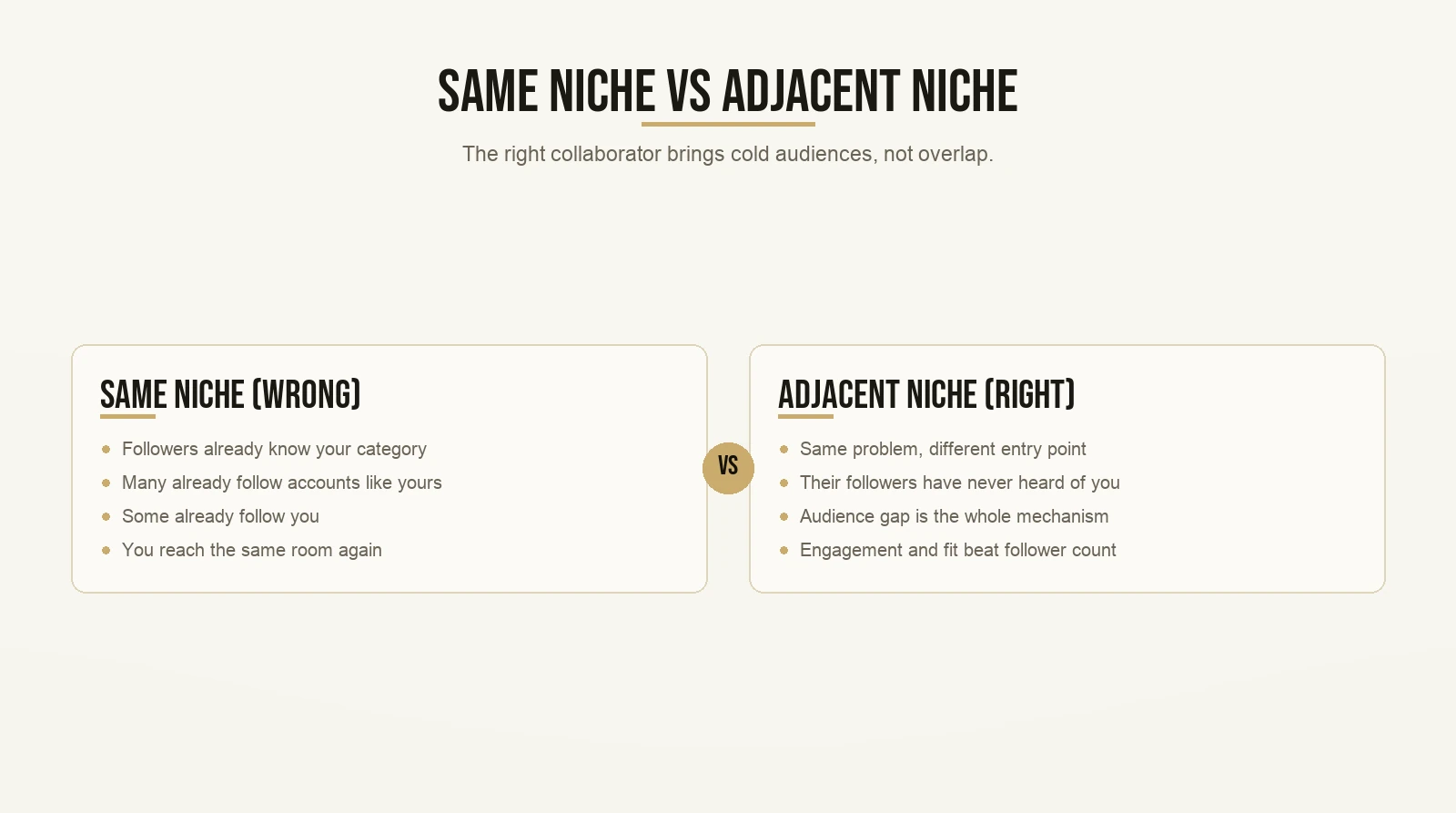
The right collaborator is someone whose followers do not already follow you and whose audience has the problem you solve. You want adjacent niches, not your own niche. Same audience need, different entry point.
This is where the entire SERP gets it wrong.
Every article says: “Partner with someone in your niche.” That is exactly backwards. If you partner with someone in your niche, their followers already know what you do. Many of them already follow accounts like yours. Some of them already follow you. You are preaching to a room that already knows the sermon.
Hold up. If I’m not supposed to go same-niche, where do I actually look?
Look for adjacent niches. Same problem, different angle.
Say you teach coaches how to grow on Instagram. Good collab partners are not other Instagram coaches. Good partners are:
- A productivity coach whose audience runs businesses but has not started posting.
- A fitness creator whose followers want to monetize their knowledge.
- A mindset coach whose audience is entrepreneurially minded but not yet on social.
Their followers have the problem you solve. They have never heard of you. That is the freaking point. The audience gap is the whole mechanism. You are not looking for overlap. You are looking for cold.
A creator with 50,000 engaged followers in an adjacent niche is worth more to you than one with 500,000 scattered followers who are half-asleep in the feed. Engagement rate and audience fit beat raw follower count every time.
For context on the scale of the opportunity: Instagram’s global advertising audience hit 1.99 billion in mid-2026, up from 1.74 billion in early 2025. The pool is enormous. You do not need the biggest creator in the world. You need the right one.
How do you send a collab invite on Instagram?
Create your post or Reel, go to the tagging screen, tap “Tag People,” then “Invite Collaborator,” search the account, and publish. The invited creator receives a notification and must manually accept before the post reaches their audience.
Here are the steps in order:
- Create your post or Reel as normal.
- On the tagging screen, tap “Tag People.”
- Tap “Invite Collaborator.”
- Search for the account you are adding.
- Publish.
That part is pretty straightforward. The part that trips people up is what comes next.
The invited creator must manually accept the invite before the post appears on their profile grid or enters their followers’ feeds. Until they accept, the post sits on your profile only and reaches your own audience only.
This is super duper key. Read that again. The partner’s audience sees nothing until they say yes. We will cover how to handle that in a minute.
What should the collab post itself look like?
The post must work for someone who has never seen your content before. Lead with the problem, not with who you are. Deliver the mechanism fast. Include at least one specific detail that shows you actually understand the situation.
Most creators treat the collab post as a logistics exercise. They focus on the invite process and forget that someone from the partner’s audience is going to see this video cold. That viewer does not know you. They have no reason to care.
Your content has to do three things at once.
Lead with the problem. Not with who you are. A cold viewer does not care about your intro. They care about the thing that is bugging them. Start there.
Get into the mechanism fast. What is the actual thing that helps them? Teach that in the first thirty seconds or the first paragraph. Cold viewers do not stick around for a long setup.
Include a specific detail that builds credibility without bragging. “Accounts that only post for their existing audience typically stall between 100 and 900 views” tells the viewer that you know exactly where the problem lives. That specificity is the credibility signal. It does more than any bio or follower count ever will.
For the full breakdown on building hooks that stop a cold viewer mid-scroll, the guide on Instagram Reel hook ideas that stop the scroll covers the full framework.
How does your profile convert the new visitors?

A profile ready for cold visitors needs three things: a highlight section covering who you are, what you do, and results; a pinned Reel that teaches your method; and a one-line bio naming the problem and the person you solve it for.
The collab drives traffic to your profile. Your profile converts it. These are two separate jobs and most creators only think about the first one.
When someone from the partner’s audience clicks your name, they land on your profile. That visitor has about three seconds to decide if you are worth following. If your profile does not immediately signal who you are and why they should stay, they are gone. And you never get them back.
Here is the framework I use. Three things need to be ready before you drop any collab post.
The highlight section. At minimum three highlights: who you are, what you do, and results from the people you have worked with. A cold visitor should be able to understand your entire deal in under sixty seconds by tapping through those highlights.
A pinned Reel. One video that explains your method. Not a promo. Not a testimonial montage. The actual mechanism. Show them how you think and why it works.
Your bio. One line. Problem you solve. For whom. That is all it needs to be.
This is the two-step. The collab sends the traffic. The profile closes it. Run the collab before your profile is ready and you are running a promotion for a store with no front door.
The full guide on building a profile that works for cold visitors is at how to improve your Instagram profile.
What do you do right after the collab post drops?
Get into the comments immediately. Answer every question from cold viewers. Then move new followers into a DM conversation or onto your email list before they scroll past you and forget you exist.
Most creators hit publish and walk away. Boom – that is the mistake.
When the collab drops and the partner’s audience starts landing on your content, be in the comments. Answer questions. Respond to pushback. A cold viewer who leaves a comment and gets a real, specific answer converts to a follower at a much higher rate than one who gets silence.
Also: a follow is fragile. The algorithm can cut your reach any time. Move new followers into a DM conversation or onto your email list. That is how you actually own the relationship.
Hold on. How do I get new followers into a DM without coming off pushy?
Your pinned Reel or bio does the work. Something like “Drop a word in the comments and I’ll send you [the resource].” They opt in. You respond. That is the delivery mechanism. They asked. You followed up. There is nothing weird about it.
What is the acceptance problem and how do you fix it?
The collab post does not reach the partner’s audience until they manually accept. Every hour it sits unaccepted is an hour their audience sees nothing. Fix this before you publish by agreeing on the publish time in advance and sending a reminder.
This is a real issue that nobody warns you about.
You publish the post. You send the invite. And then nothing happens. The other creator is busy. They missed the notification. Their assistant did not flag it. Every hour that passes, the post is live on your side but invisible to their audience.
Fix it before it happens.
When you agree to do the collab, lock in the publish date and time together. The day before, send a short reminder. Thirty minutes before you post, send another one. Tell them directly: “I’m posting at 2pm. You’ll get a notification to accept. Please tap it within the hour so we catch the audience while the post is fresh.”
Two messages. Very very key difference in outcome. You get the gist.
What is the Friends tab and why does it matter for collab posts?
In August 2025, Instagram launched a Friends tab inside the Reels feed that shows public content your connections have engaged with. This gives collab posts a secondary distribution channel: cold viewers who follow neither creator can still find the post if a mutual connection engaged with it.
Instagram’s Friends tab surfaces public Reels that people you follow have liked or commented on. That means a viewer who does not follow either of you can still see your collab post through a mutual connection’s activity in their feed.
Every time someone from the partner’s audience engages with the post, they potentially push it to people in their own network. That is third-degree reach you did not pay for.
This does not change how you build the post. But it makes the early engagement window more important than ever. The more genuine engagement the post gets in the first few hours, the further it travels. Get into the comments right after publishing and stay active.
Do you need a Paid Partnership label on a collab post?
Yes, if any exchange of value was involved. A collab tag means you co-created the post. A Paid Partnership label means a commercial relationship existed. They are separate disclosures and Instagram requires both when money or anything of value changed hands.
A lot of creators do not know this and get the two confused.
Instagram requires the Paid Partnership label whenever there is any exchange of value: payment, gifted products, services, or affiliate commissions. The collab tag does not cover this. You need both.
If the collab was a genuine creative partnership with nothing exchanged on either side, you probably do not need the Paid Partnership label. But the moment anything changed hands, it is required on top of the collab tag.
When in doubt, add the label. Disclosing when you did not strictly have to costs you nothing. Not disclosing when you should have is a compliance problem.
Do hashtags help a collab post reach more people?
No. Instagram has publicly confirmed that hashtags do not improve reach. Do not waste time stacking them on a collab post when that energy could go into the content itself or the early engagement window.
The old advice says: “Pile on hashtags when you drop a big post.” That advice is dead.
What actually drives reach on a collab post is content quality, early engagement from both audiences, and the Friends tab ripple through mutual connections. Those are the three levers. Hashtags are not one of them. Put your energy where it actually moves the needle.
The full collab post sequence, start to finish
Put it all together and the sequence looks like this:
- Find the right partner. Adjacent niche. Audience gap. A real relationship, not a cold DM out of nowhere.
- Build the post for cold viewers. Problem-first hook. Mechanism in the content. A specific detail that signals you know your stuff.
- Get your profile ready. Highlight section set up. Pinned Reel live. Bio written for cold visitors, not warm ones.
- Handle the acceptance logistics. Agree on publish time. Send the reminders. Do not leave it to chance.
- Drop the post. Get into the comments immediately. Be present when the traffic arrives.
- Convert new followers. Move them into a DM or onto your list. A follow is a starting point, not a finish line.
- Let the Friends tab work. Early engagement compounds. Stay active in the post for the first few hours.
No ads. No shoutout fees. A well-chosen partner, a post built for cold viewers, and a profile that can close the deal. That is the whole mechanism.
Building credibility for a cold audience
When someone finds you through a collab post, they know nothing about you. Your follower count does not convince them. Your bio alone does not convince them. What convinces a cold viewer is specificity.
“I help coaches who are already posting but stuck under 500 followers turn their content into a client pipeline” says far more than “I help coaches grow on Instagram.” The specific version lands with the exact person you are talking to. The vague version lands with nobody.
You build credibility through mechanism, not through claims. The more precisely you can describe the problem and the way you solve it, the faster a cold visitor decides you are worth following. That specificity is what I call the credibility bank. Every precise, verifiable claim you make about your method adds a deposit.
Max’s student results page shows what this looks like applied at scale: specific outcomes, documented methods, a clear audience. You can build the same kind of credibility library over time if you are consistent about documenting your method and what people get from applying it.
The full framework for doing this is in the guide on building your credibility bank.
Want the templates behind content that actually gets watched? Grab the templates here and start with the first one today.