
Key Takeaways
- Instagram for introverts is not about hiding. It is about picking the right format for where you are right now.
- The majority of Reels shown to users come from accounts they do not follow. Instagram built it that way.
- The CCN model sorts your audience into three types. Beginners almost always post for the wrong one.
- Simple Clip Simple Text (SCST) and Whiteboard formats reach strangers without a face. The algorithm does not care what you look like.
- The top ranking signals for Reels are reshares, watch-through rate, and likes. None of them favor a talking head.
- Building Block 3 of the 7 Building Blocks framework is Format. Choosing the right one is one of the biggest levers a new creator has.
Is Instagram Even Worth It for Someone Who Hates Being On Camera?
Yes. Instagram is a content distribution platform. Whether you want to grow an audience or attract clients, the mechanism works with or without your face.
Here is a number worth sitting with. A 2025 Pew Research survey of 5,022 U.S. adults found that half of all American adults use Instagram. It is one of only three platforms to clear that threshold, alongside YouTube and Facebook. Globally, Instagram reaches 1.74 billion users through its advertising tools, placing it third in ad reach outside China. And it is the clear favourite social platform for users aged 16 to 34, ahead of every other network in that age group.
Your clients are here. The only decision is how to show up.
What Do Most Introverts Get Wrong About Instagram?
They post content for the audience they already have, which is usually tiny.
That sounds harmless. But if you have a few hundred followers, or zero, posting for your existing audience means your videos go almost nowhere. They stall out below 1,000 views. Sometimes below 100. You post, nothing happens, you assume you need to be more on-camera, you feel worse, you post less.
The fix is not more courage. It is a better model. And that model is called CCN.
What Is the CCN Model and Why Does It Change Everything for Instagram for Introverts?
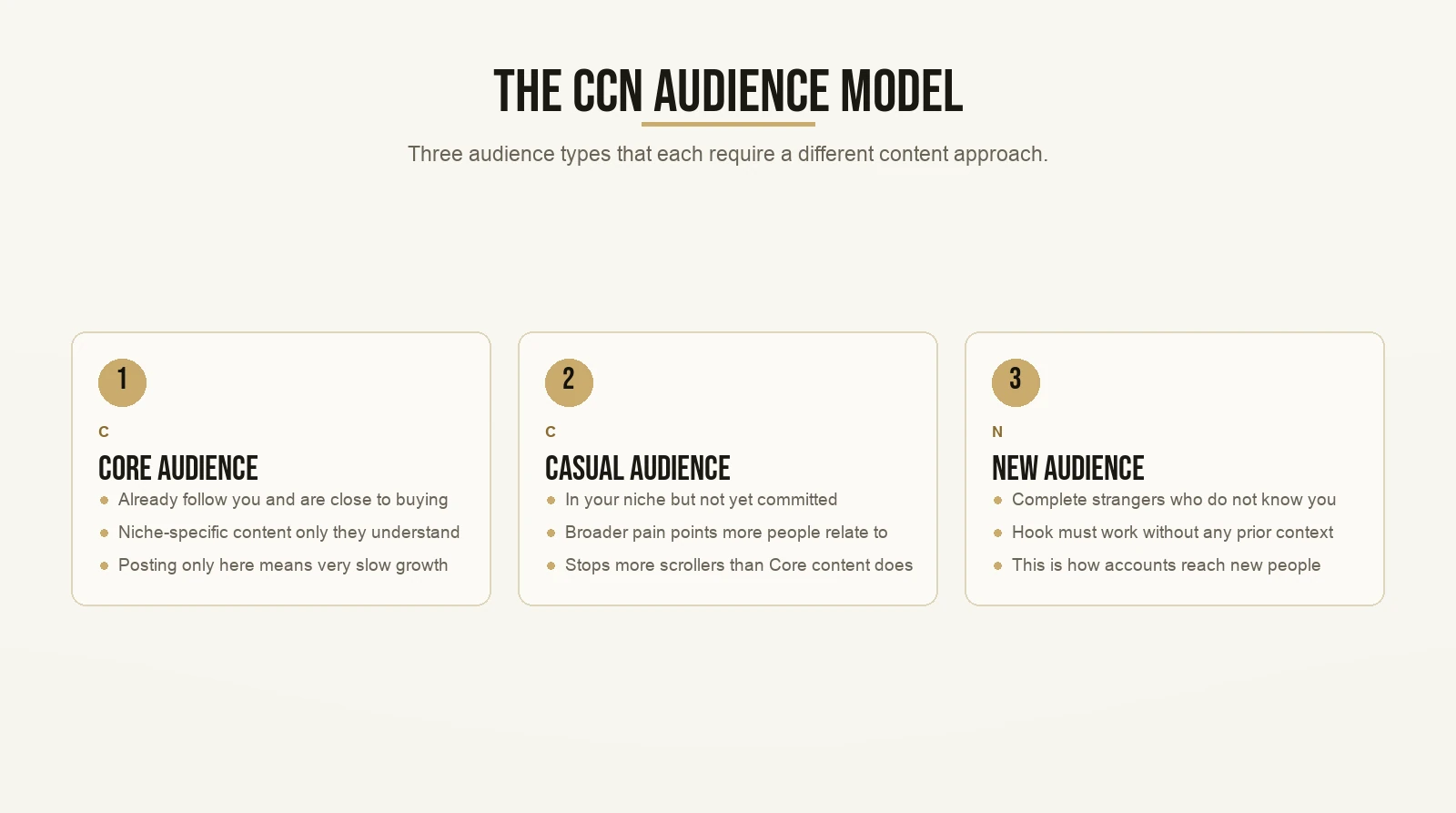
CCN stands for Core, Casual, and New. It describes three types of audience your content can speak to. Each one is a different person with a different relationship to you.
Core audience content is for people who already know you, follow you, and are close to buying from you. A post like “How I Periodize My Carb Cycling During a 12% Cut” speaks to your most committed fitness followers. Nobody else clicks on it. If 90% of your content looks like that, your account grows very slowly, because most people in the world are not already your committed follower.
Casual audience content speaks to people in your niche who have heard of you but are not yet committed. “Why You’re Not Losing Fat Even Though You’re Eating Healthy” lands here. It is a broader pain point. More people in the fitness space relate to it and stop scrolling.
New audience content is for strangers. People who have no idea who you are. The hook has to be a universal frustration or a pattern interrupt that lands even without context. “You’re Not Overweight Because Of Food” is that kind of line. It stops someone mid-scroll because it challenges a belief they already hold. They don’t need to know your name for it to work.
Here is why this matters specifically for instagram for introverts. If you are camera-shy and just starting out, your Core audience is tiny. Posting for them is posting into a near-empty room. New audience content is what puts your videos in front of strangers. Strangers are how accounts grow.
“Okay but Max, if I don’t have a following yet, who’s going to watch my New Audience content?”
That is exactly the right question. The answer is: Instagram will distribute it for you, if you give it content that earns distribution.
Why Does Instagram Show Your Reels to People Who Don’t Follow You?
Because Reels were built for discovery.
Instagram’s own published guidance says it directly: “Reels are also designed to help you discover new things, with an emphasis on entertainment. Much like Explore, the majority of what you see is from accounts you don’t follow.”
Read that again. The majority.
You do not need an existing audience for your Reels to reach new people. You need a Reel that earns the next second of attention. The ranking signals that decide distribution are reshare likelihood, watch-through rate, likes, and audio page visits. Not one of those things cares about your follower count. Not one of them favors a face on screen.
A whiteboard Reel that gets reshared two hundred times will out-distribute a talking-head Reel that people abandon at the three-second mark. Every single time.
Instagram also states explicitly that it does not suppress your content to push you toward buying ads. The quote is: “It’s a better business to make Instagram more engaging overall by growing reach for those who create the most engaging content.” Your reach grows through better content, not bigger budgets.
That is a very important thing to know if you have been told the platform is pay-to-play.
What Are the 7 Building Blocks of a Viral Video?

Max teaches that every video has seven core building blocks. Master them and you understand why videos blow up or stall. The seven are not a mystery. They are the levers you adjust every time you create. Topic, hook, format, script, delivery, editing, and caption. Change one and the whole video changes.
For instagram for introverts, the most underestimated lever is Building Block 3: Format.
“Max, what the hell is a format?”
It is the style of the video, the way it is filmed and shown on screen. That is it. And here is the thing most creators overlook: format is one of the freaking biggest decisions a new creator makes. Wrong format for your stage and your watch time collapses. Right format and you can hold attention without ever appearing on screen.
Max’s own manifesto names it directly. Just talking into the camera does not perform nearly as well as it did in 2021. That is not a problem for camera-shy creators. It is an opening. You are not settling for a second-rate format. You are choosing formats the algorithm currently rewards.
This also matters for how you think about originality. Meta has been reducing reach for reposted and unoriginal content. When you write your own hook text, design your own slide, or sketch your own diagram on a whiteboard, that is original content. Instagram can tell. Your face is not what signals originality. Your content is.
Which Camera-Free Formats Should You Know?
There are several formats that work without a face. A Reel made from photos is one of the easiest. Here are the main ones for beginners.
Simple Clip Simple Text (SCST). Text on screen over a relevant clip in the background. This is the recommended starting format for a reason. It is fast to produce, easy to replicate, and when the hook is strong, it holds attention completely without a face. If you are starting from zero, start here.
Whiteboard. You explain a concept while writing or drawing on a whiteboard or digital equivalent. Hands on screen. The concept builds in real time. This format naturally slows a viewer down because there is something to follow visually. It works very well for coaches and educators who are teaching a mechanism.
Dialogue. Two characters, often played by the same person, having a conversation. One is confident, one plays the skeptic or the beginner. The format dramatizes a teaching moment. You can run this entirely off-camera with text overlays and voiceover. The face is optional.
Props. Physical objects used to illustrate a point. The concept becomes something you can see and touch. No face required.
Clones. Two versions of the same approach, usually one bad and one good, contrasted side by side. Often done with text and clips. Works for any niche where there is a wrong way and a right way to do something.
Each of these is a legitimate format that reaches strangers. Not workarounds. Not beginner training wheels you graduate from. They are formats that earn distribution when paired with good topic selection.
For a full breakdown of when to use each format type, types of Instagram posts and which format to use when goes deeper into matching format to content goal.
How Do Format and CCN Work Together?
They are the same decision, made at the same time.
If your goal is New Audience content, which it should be when you are just starting, you need a format that holds a stranger’s attention without requiring them to already trust you. SCST and Whiteboard do that. A stranger does not need to recognize your face to follow along with clear text on screen. They just need the content to deliver on the hook.
Here is how the mechanism works in practice.
Say your niche is productivity and your New Audience topic is: “You’re not bad at time management. Your system is.”
You build a SCST video. The hook text on screen says exactly that. The next slide introduces the actual mechanism. Each slide is one sentence. The background clip is a desk, a planner, a clock – something relevant. The video is 30 to 45 seconds. No face, no voiceover required.
That video is a New Audience topic in a SCST format. Topic covers Building Block 1. Format covers Building Block 3. When a stranger watches to the end and reshares it, Instagram logs that signal. That is the vote that earns more distribution. It happened without you being on screen for a single frame.
Hook quality is its own separate lever and worth studying on its own. Instagram reel hook ideas that stop the scroll walks through the structural patterns that perform best.
Do You Ever Have to Go On Camera?
Blunt answer: no.
Accounts with tens of thousands of followers have been built entirely on SCST and whiteboard formats. No face, ever. They grow because their content solves a specific problem for a specific person. The audience follows the value, not the face.
That said, there is a format worth knowing about for creators who eventually want to move toward on-screen presence. It is called Yap. It is a natural-seeming format where you talk directly into the camera while doing something simple – walking, making coffee, setting the phone down. It is not performance-camera. No backdrop, no ring light, no scripted energy. It feels closer to a phone call than a TV appearance.
If you ever want to move from fully off-camera toward something more personal, Yap is the natural next step on the ladder. You get comfortable with casual presence before you sit down for a polished talking-head video. But this is optional. The algorithm does not reward faces. It rewards watch time and reshares.
What Are Trial Reels and How Do They Help a Brand-New Account?

Instagram added a feature called Trial Reels that tests your content with non-followers before deciding how widely to distribute it.
This is a direct advantage for new accounts. Your first Reels go to strangers first, before they go to your existing followers, if you have any. If those strangers watch and engage, Instagram expands the reach. If they don’t, it limits it.
This makes your topic and format decisions the thing that actually matters at the start. Not your follower count. Not your posting history. The quality of the content in front of those cold eyes.
Check help.instagram.com for the current details on Trial Reels, as the feature has continued to develop since launch.
What Does the Presence Strategy Look Like Once You Have Traction?
Volume and iteration, running in parallel.
Here is what many creators miss at this stage. Once you find a format and topic angle that earns distribution, the instinct is to repeat it exactly. Same structure, same rhythm, same style. And for a while that works well.
But at some point it doesn’t. The audience has seen the pattern. The algorithm has shown it to most of the people it was going to reach. If you have not been testing new angles and formats alongside your winners, you get caught flat-footed when performance dips.
The strategy is to keep volume high and keep innovating in parallel. Post consistently in your working format. At the same time, test one new format or topic angle every one to two weeks. Not to replace what works. To find what works next.
A lot of creators become well-known over six to twelve months and then start declining in reach because they stopped innovating fast enough. They repeated what worked until it stopped working, and by then it was too late to have a new winner ready.
The solution is not complicated. Keep posting. Keep testing. Never become complacent about the format that is currently working.
If you want to see how other creators have navigated this kind of growth, results from people who’ve built audiences using this approach show what consistent, mechanism-led content can produce.
How Do You Know Your Content Is Actually Reaching New People?
Check your Reels insights.
Instagram shows you reach broken down by followers and non-followers. If the majority of your reach is coming from non-followers, your content is distributing. That is the goal.
If most of your reach is from followers, you are in Core territory. You likely need to shift your topics toward New Audience territory, or test a higher-contrast hook that works for someone who has never seen your content before.
Watch that number more than your follower count. Follower count is a lagging indicator. Reach from non-followers tells you whether distribution is working right now.
“But Max, isn’t a small, loyal following worth more than reach from strangers who don’t know me?”
Sure, eventually. But you need to reach the strangers first before they can become the loyal following. CCN is sequential. You earn Core audience trust by reaching New and Casual audiences first. Skipping to Core without building the other two is why most accounts stall.
For a full picture of what else might be limiting your growth beyond format, why your Instagram isn’t growing covers the most common structural reasons accounts plateau, most of which have nothing to do with being on camera.
The Short Version
Instagram for introverts is not a special category of Instagram. It is Instagram, used with the right formats.
Here is what you actually need:
- New Audience topics. Strangers do not know you yet. Your Core audience is too small to grow on.
- SCST or Whiteboard format. These hold attention without a face. The algorithm rewards watch time, not aesthetics.
- A strong hook. The first two seconds decide whether anyone watches the third.
- Consistency with parallel testing. One good video teaches you what to test next. Nothing else does.
You do not need a ring light. You do not need a script that forces you to look natural on camera. You need a topic a stranger cares about and a format that delivers it clearly.
That is the whole mechanism. The platform distributes the content that earns distribution. Format is Building Block 3 of the 7 Building Blocks because it is the thing you control completely, every single time you create. Topic is Building Block 1 for the same reason. Get those two right, aim them at New Audience territory using CCN, and you have a working system that does not require your face.
Use it.
Want the templates behind content that actually gets watched? Grab the templates here and start with the first one today.