
Key Takeaways
- A five-day challenge is a trust-building sequence, not a follower event. Design every day toward one end state: a call booking.
- The CCN mechanic (Comment, Click, Nurture) delivers daily content via DM and sends the algorithm’s most rewarded signal at the same time.
- Use Instagram Broadcast Channels to push each day’s teaching directly to opted-in participants without extra friction.
- The credibility bank fills across five days through specific teaching. Vague tips drain it. You can only invite someone to a call after earning that conversation.
- DM sends and shares are the top non-follower distribution signals on Instagram in 2025-2026. A challenge built on CCN is doing two jobs at once.
Running a challenge on Instagram sounds simple. Post every day for five days. Use a hashtag. Get some engagement. That is what the articles say.
That is also why most challenges end with a pile of posts and zero new clients.
This is different. What follows is a structure built to do one thing: take a cold viewer who found you on day one and put them in a position to book a discovery call by day five. Every decision, from delivery method to the day five invitation, serves that outcome.
Why Most Instagram Challenges Fail Before Day Three
The typical advice on how to run a challenge on Instagram goes like this. Pick a simple daily prompt. Use a hashtag. Stay consistent. Engage with every participant.
That advice is not wrong. It just optimizes for the wrong thing.
Challenges built around hashtags and prompts are follower events. The challenge ends and you have some new followers and a hashtag archive. You do not have a client pipeline.
The structural problem is that there is no designed end state. Nobody asked: what do we want the participant to believe, feel, and do by day five? Without that answer, the challenge is five days of content with a vague hope of turning into business.
Fix the end state first. A cold viewer shows up on day one knowing nothing about you. By day five, you want them to have watched you teach, tried your method, seen something shift, and raised their hand when you offered to go deeper. That is a designed arc. Every structural decision flows from it.
What Is a Five-Day Instagram Challenge, Really?
A five-day challenge is a public proof-of-method. You teach your framework in the open, day by day. Participants try it and see early results. By day five, they understand your approach well enough that a conversation about working together feels like the obvious next move, not a cold ask.
This reframe changes everything. The challenge is not content for engagement. It is a live demonstration of how you think and what you can do for someone. Treat it that way and every day becomes a credibility deposit instead of just a prompt.
According to DataReportal’s 2025 Global Overview Report, Instagram reaches 1.67 billion adults through its advertising tools as of early 2025. There is no shortage of people who could benefit from what you teach. The shortage is structure that converts a viewer into a prospect.
How Does the CCN Mechanic Work in a Challenge?
CCN stands for Comment, Click, Nurture. A viewer comments a keyword on your post. An automation fires a DM with the next step. In a challenge, CCN is both your delivery system and your primary algorithm lever. It gets participants into your Broadcast Channel and generates the exact DM signal Instagram rewards most.
Here is the mechanic in practice.
You post your day one challenge announcement. You tell viewers to comment the word “CHALLENGE” to get daily content delivered directly to their inbox. Someone comments. The automation fires a DM with a link to join your Broadcast Channel. They tap it and they are in. Boom. From that point forward, you push each day’s teaching directly to the channel. Every participant gets a push notification. No searching. No remembering to check your profile.
Wait, Max. Why does any of that matter for the algorithm?
Good question. Adam Mosseri confirmed in 2025 that sends-per-reach is one of the top distribution signals for reaching non-followers on Instagram. When someone sends your post to another person in a DM, that is a send. It tells Instagram: this content is worth pushing beyond the accounts that already follow this creator.
A challenge built on CCN generates DMs automatically. Every comment triggers a DM back. Every participant who shares a daily prompt to their Stories adds another send signal. You are feeding the algorithm the exact metric it uses to extend your reach beyond your current audience.
Comments alone do not do this. Mosseri has not listed comments as a top distribution signal. The articles that tell you to optimize for comment counts are chasing the wrong metric entirely.
CCN does three things at once. It delivers daily content without anyone having to hunt for a hashtag. It builds a direct line between you and every participant. And it generates the algorithm signal that pushes your posts to cold audiences who have never seen you. That is a freaking powerful setup for a single mechanic.
For a closer look at how to work those comment responses into your client pipeline after the challenge ends, see the post on how to respond to comments on Instagram to get clients.
How Do You Structure the Five Days?
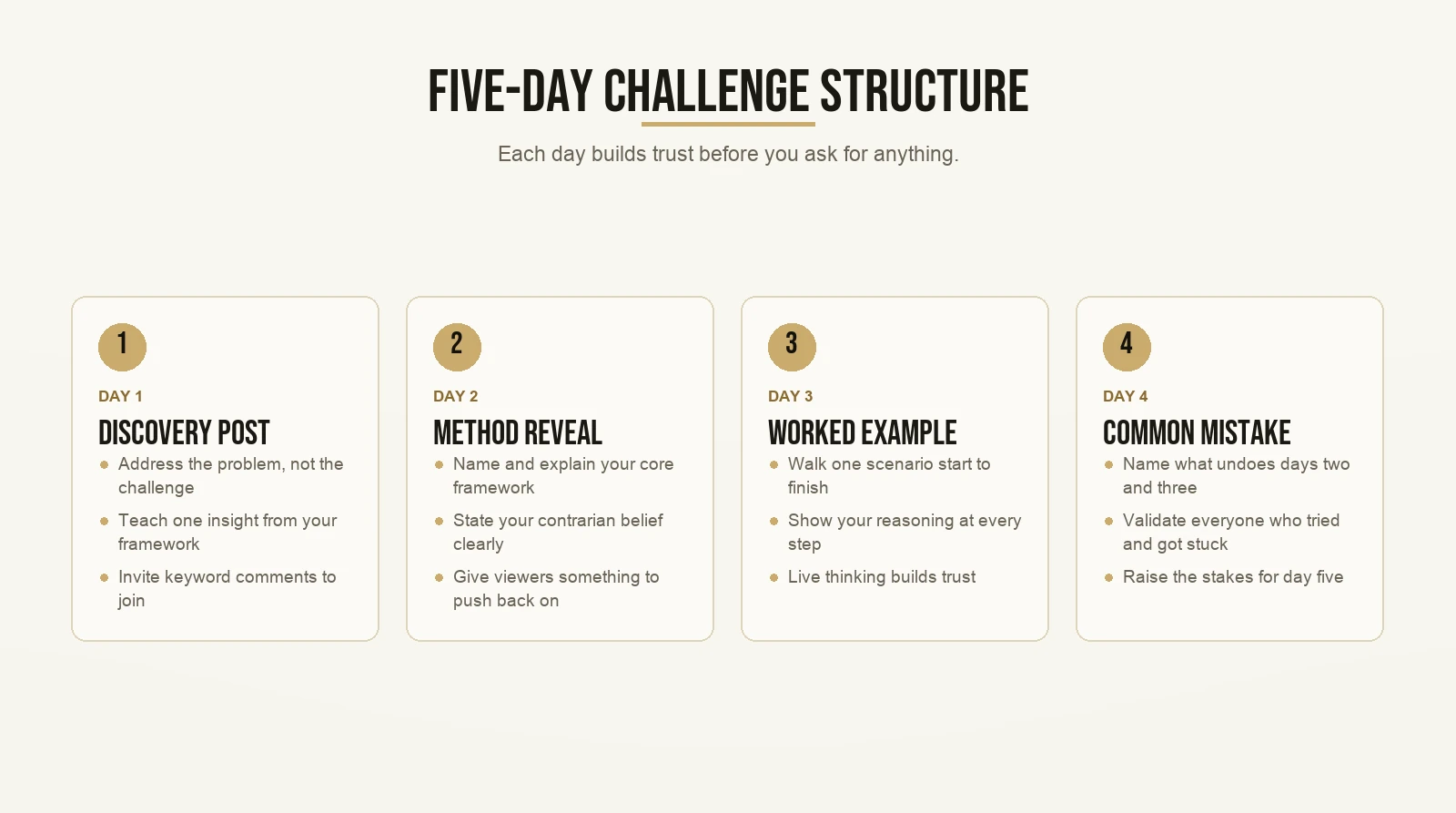
Each day is a trust milestone, not just a posting day. Day one brings in cold viewers and starts the CCN flow. Day two reveals the core method. Day three shows it working. Day four names the mistake. Day five delivers the invitation. Every day makes a deposit before you ask for anything.
Here is the day-by-day breakdown.
Day One: The Discovery Post
This is your reach post. It should address the problem your challenge solves, not the challenge itself.
Wrong framing: “Join my five-day content challenge!”
Right framing: “Your posts are getting views but not clients. Here is the exact reason why.” Then you teach one insight from your framework and invite viewers to comment the keyword to join.
The day one goal is simple. Get comments. Get participants into your Broadcast Channel. Leave them curious about what day two will teach.
Day Two: The Method Reveal
Introduce the core framework your challenge is built on. Name it. Explain the mechanism. This is also the place to introduce what Max calls contrarian ideology: the belief that separates your approach from the generic advice filling everyone else’s feed.
An example of how this lands in practice. Most growth advice says post more. The contrarian view is that posting more of the wrong content makes you invisible faster. One video aimed at strangers with a hook built for a cold audience outperforms thirty posts aimed at followers who already know your story. Name that belief. Defend it with specifics. Give the viewer something to push back on. That tension is what keeps them in for day three.
Day Three: The Worked Example
Walk through a real application of your framework. Take one scenario from start to finish and show your reasoning at every step. This is the most important day for trust. A viewer who watches you reason through something in real time thinks: “This person actually knows how this works.” A tip list does not create that reaction. A live walkthrough does.
Day Four: The Common Mistake
Name the one mistake that undoes the results from days two and three. This does several things at once. It validates everyone who tried the method and got stuck. It shows you have seen this pattern enough to name it. And it raises the stakes for day five.
Day four posts tend to get shared. “This is exactly what I was doing wrong” is one of the highest-shared reactions on the platform. Write day four to land that feeling.
Day Five: The Invitation
Frame this as a next step for people who have been in it all week and want to go further. It is not a pitch. It is an offer to continue the conversation.
“I have seen a lot of you working through this framework over the past four days. Some of you are ready to take it further with direct support. If that is you, comment [KEYWORD] and I will send you a link to book a time to talk.”
CCN again. Comment triggers DM. DM delivers the booking link. The participant does not feel sold to. They feel invited. That distinction is everything.
What Is the Credibility Bank, and How Do You Build It During a Challenge?

The credibility bank is the trust balance you build with a cold audience before you ever ask for anything. Every specific, actionable teaching point is a deposit. Vague tips drain it. You can only invite someone to a call after depositing enough that the request feels natural, not pushy.
This is super duper key to understand.
A cold audience shows up on day one knowing nothing about you. They are watching, not trusting. Your job is to earn enough credibility that the day five invitation lands like an obvious next step.
Every time you teach something specific enough to be immediately actionable, you make a deposit. Every time you name a mechanism and back it up with a worked example, you make a deposit. Every time you give away the real framework instead of a vague summary of it, you make a deposit.
“Post consistently” is not a deposit. That is a platitude anyone can say.
“Your first post needs a hook that speaks to someone who has never heard of you, not to the followers who already know your backstory” – that is a deposit. It is specific. It is actionable. It shows you understand the mechanism well enough to teach it.
Hold up. What if I am just starting? What if I do not have years of results to point to yet?
Here is the thing. Credibility does not come from your bio or your years in business. It comes from the specificity of what you teach. A coach who can explain the exact mechanism behind a result will build trust faster than a veteran who speaks only in generalities. The bank fills through precision, not time served.
You can see the full breakdown of the credibility bank framework in the post on turning your experience into proof that sells. It applies to every post you publish, not just challenge days. And if you want to see what a fully-built credibility presence produces over time, the results from Max’s students show what consistent depositing looks like in practice.
How Do You Deliver Daily Content to Participants?
Use Instagram Broadcast Channels. Participants opt in once via the CCN DM. You push each day’s content directly to their inbox. They get a push notification. They do not have to search a hashtag or remember to check your profile. It is the cleanest delivery rail available natively on the platform.
Instagram launched Broadcast Channels in February 2023 as a one-to-many messaging tool. You send text, video, voice notes, and polls to the channel. Participants can react and vote. They cannot reply publicly, which keeps your inbox clean and the experience focused.
The full CCN-to-channel flow:
- Participant comments the day one keyword.
- Automation sends a DM with the Broadcast Channel join link.
- They tap and join.
- Each morning you post that day’s teaching to the channel.
- Participants get a notification and see the content directly in their inbox.
After the challenge ends, the channel stays open. Every member is a warm contact who opted in to hear from you. Use it for future content drops, early access announcements, or the next challenge. The challenge builds the channel. The channel becomes an asset that outlasts any single week of posts.
What Should You Post on the Feed vs. the Channel?
Feed posts are reach posts. They pull in cold viewers who have not joined yet. Channel posts are for participants already in. Go deeper in the channel. Keep the feed open enough that someone who found you on day three can still follow what is happening and decide to join.
If your feed posts become too specific to the challenge, you stop attracting new people mid-week. The feed is the public classroom. Anyone can walk in. The channel is the workshop. Only people who raised their hand are there.
Each day’s feed post should frame the universal problem your challenge addresses and hook a cold viewer. Each day’s channel post goes deeper into the mechanism you introduced on the feed. Participants get extended teaching. Cold viewers get a reason to join late. Both audiences are served without compromise.
Does the Hashtag Still Matter for Running a Challenge?
No, not for discovery. Instagram no longer distributes content through hashtag follows. Use one challenge hashtag so participants can find each other’s posts. That is its only job now. Do not build your reach strategy around it.
Pew Research reports that 47% of U.S. adults use Instagram as of January 2024. The platform is large enough that topic-interest routing alone can get your challenge in front of the right people. You do not need hashtag reach to make that happen.
Pick one simple, memorable hashtag. Include it in your posts. Do not stress about it further. The reach work is done by your hook, your topic framing, and the sends that CCN generates.
What About the Legal Side of Running a Challenge?
If your challenge involves a prize, Instagram requires a disclaimer stating the promotion is not sponsored, endorsed, administered by, or associated with Instagram. A value-based teaching series with a call invitation at the end is not a contest. If there is no prize, this requirement does not apply.
Full requirements are at Instagram’s promotions policy page.
Most challenges for coaches and service providers are value-based, not prize-based. If you do add a prize element, put the disclaimer in the post caption where it is visible. Not buried in a comment.
How Do You Follow Up After Day Five?
Two tracks. Participants who commented the day five keyword move into a call-booking DM flow immediately. Everyone who watched but did not respond goes back into your regular content feed. Keep depositing. Some will be ready weeks or months later. The challenge opened the relationship.
For the people who raised their hand, move the conversation into the DMs quickly. The call booking link handles the logistics. The call itself is where you qualify the fit and have a real conversation.
For everyone else: the challenge opened a relationship. Your content keeps it warm. Not every viewer who watched four days of your teaching is in a buying window right now. That is fine. The relationship exists. Keep depositing.
But Max, what if the day five response is really low? Does that mean the challenge failed?
It is a data point, not a verdict. Low day five responses mean the credibility bank was not full enough by day four. You did not make enough specific deposits across the week. Run the diagnostic: at which day did participants stop engaging? Fix that day’s teaching. Run the challenge again. Each cycle teaches you something the first run could not.
What Makes a Challenge Topic Actually Work?
The topic has to be specific enough to attract the right person and broad enough to reach someone who has never heard of you.
“Five-day content challenge” is too vague. It does not tell anyone what they walk away with.
“Five-day Reel script challenge for coaches” is better. It names the format, the deliverable, and the audience in one phrase.
The best topics come from the most common stuck point in your niche. What is the one thing your ideal client keeps trying and failing at? Build the challenge around solving that one thing completely. Not introducing everything you know. One problem, solved fully, in five days.
That focus makes the day five invitation feel logical. You solved their problem in a week of free teaching. They can extrapolate what you could do with more time and direct access. That extrapolation is the conversion mechanism.
For more on how challenge content fits into a longer sequence, the post on how to create a content series on Instagram covers the sequencing logic that keeps an audience moving from content to conversation.
How Do You Know If the Challenge Is Working?
Do not measure by follower count. It is a lagging indicator and the wrong metric for a challenge designed to convert.
Measure these four numbers:
- Day one keyword comments: how many people entered the CCN pipeline
- Broadcast Channel joins: how many converted the comment to an active commitment
- Day five keyword comments: how many raised their hand for a call
- Calls booked: how many of those scheduled a real conversation
Those four numbers show you exactly where the challenge is working and where it is leaking. High day one comments but low channel joins means your DM automation has a setup problem. High channel joins but low day five responses means the credibility bank is not full enough by day four. Not enough specific deposits across the week.
Fix the leak. Run it again.
One note on production: do not let it slow you down. Raw, in-the-moment Reels filmed on your phone outperform polished carousels in 2025-2026. The algorithm favors authenticity and originality over production value. A challenge that launches imperfectly next week beats a perfect one that never ships. Get it out. Iterate from real data.
Want the templates behind content that actually gets watched? Grab the templates here and start with the first one today.