
Key Takeaways
- Instagram does not list posting frequency as a ranking signal for Reels or Feed posts
- Reels is a recommendation engine: the majority of viewers don’t follow you, and each video competes on its own quality signals
- The rule: post as often as you can while keeping quality high, minimum every other day, daily if possible
- Trial Reels lets you test uncertain content with non-followers before it affects your feed’s engagement baseline
- Consistent low-quality posting trains the algorithm to expect low engagement from your account
- The real question is not how often you post. It is whether the video is good enough to post
How Often to Post on Instagram: Why the Number Isn’t the Point
Everyone asks this. How often should I post on Instagram?
Type it into Google and you get charts, tables, and very confident recommendations. Three to five times a week. Seven if you really want to grow. Post every day, never miss.
Those answers come from scheduling tool companies. They pull data from accounts that already pay to use their tools and build frequency rules from that sample. It is self-serving data dressed up as research.
Here is what Instagram’s own documentation actually says. The answer is simpler than any frequency chart.
What does Instagram actually reward?
Instagram has two main surfaces where your content lives: Reels and Feed. They work very differently. Most creators treat them the same. That is the first mistake.
In 2023, Instagram head Adam Mosseri published a detailed breakdown of how the platform’s ranking actually works. For Reels, the signals that drive distribution are: how likely someone is to reshare it, how much of it they watch, whether they liked it, and whether they visited the audio page. That list does not mention how often the creator posts. Not once.
For Feed posts, the ranking signals are: information about the post itself, information about the person who posted it, your past activity on Instagram, and your history with that specific person. Again, no mention of posting frequency.
Instagram also addressed the myth that inconsistency gets you algorithmically penalized. The direct quote: “we don’t suppress content to encourage people to buy ads. It’s a better business to make Instagram more engaging overall by growing reach for those who create the most engaging content.”
Read that again.
Growing reach for those who create the most engaging content. Not the most frequent content. The most engaging content.
This is super duper key. The freaking algorithm is not keeping score of how many times you posted this week. It is evaluating each video on its own performance. A Reel with strong watch completion and high reshares gets pushed to new audiences regardless of whether it was your first post this week or your seventh.
Is posting more often the key to more reach on Instagram?
For Reels, no. Reels is a recommendation engine where most viewers don’t follow you. Each video competes on its own content quality signals, not on your posting cadence. For Feed posts, frequency is still not a named ranking signal, but consistency helps maintain your relationship with existing followers.
The reason Reels doesn’t reward frequency is right there in Mosseri’s explanation. “The majority of what you see [in Reels] is from accounts you don’t follow.” That is a recommendation engine. It routes content based on the viewer’s interest signals, not on how often the creator has been active.
Your Reel competes against every other Reel that could interest that viewer right now. If your video wins, Instagram pushes it. If it loses, it stalls. Your posting cadence had nothing to do with that competition.
What does matter: did the person finish watching? Did they reshare it? Did they tap the audio? Those are the signals that tell the algorithm whether this video is worth showing to more people like them.
How often should I post on Instagram?
Post as often as you can while keeping quality high. Minimum every other day. Daily if possible. If you’re new, start at every other day and build toward daily as your output quality improves.
This is not a hedge. It is the actual answer. The constraint on your posting frequency is not your calendar. It is your ability to produce content that earns algorithmic distribution.
Here is a concrete number to make this real. A video that only appeals to your existing followers will stall between 100 and 900 views. The algorithm reads the low watch completion and low reshare rate as a signal to stop pushing. It stops distributing. One strong video that pulls in non-followers does more for your account than seven mediocre ones.
If you’re a business owner who already has a presence: the number to focus on is not how many posts you publish per week. It is how many of those posts are getting strong watch completion and reshares. That is the real growth lever.
If you’re just starting out: aim for every other day. Get faster at making good videos. When you can consistently hit every other day with quality content, push toward daily. Don’t rush that timeline by forcing weak videos out to meet a schedule.
But Max, doesn’t that mean I need to build my whole skill set before I can start growing?
No. You build the skill set by posting, watching the data, and adjusting. You just cannot substitute volume for quality and expect it to work. The skill builds faster when every post you send out is the best you can currently do.
What is Trial Reels and why does it matter for how often you post?

Trial Reels is an Instagram-only feature that tests your content with non-followers before it appears in your followers’ feed. It is the official mechanism for iterating on quality without risking your feed’s engagement baseline.
Instagram built Trial Reels to give creators a way to experiment with new content and formats without committing those experiments to their main feed. Here is the practical mechanism. You make a Reel you’re not sure about: a new format, an unfamiliar topic, an angle you have never tried before. Instead of publishing it directly to your feed, you submit it to Trial Reels first.
Instagram shows it to non-followers who match the interest profile for that type of content. You get the data: watch completion rate, reshares, overall performance with a cold audience. Then you decide. Post it to your feed, leave it in testing for more data, or scrap it.
Hold up. Doesn’t that mean every video should go through Trial Reels before posting?
No. Trial Reels is for experiments, not for your standard content. Use it when you are genuinely uncertain: testing a new format, a topic outside your usual territory, a hook that feels risky. For your regular content, you should already have a quality process that tells you whether it is ready to post.
Here is why this changes the frequency math. It breaks the false choice. You do not have to decide between posting something weak to stay on schedule or skipping the day and falling behind on consistency. You can test the uncertain video in Trial Reels, see real performance data, and make the call with information instead of guessing.
Most creators either do not know this feature exists or use it wrong. The ones who understand it are the ones who can separate “I am unsure about this piece of content” from “this piece of content is weak.” That separation matters for both quality and consistency. A streak of low-engagement posts lowers what the algorithm expects from your account. Trial Reels is the tool that helps you protect that baseline while still experimenting.
What is contrarian ideology and how does it apply to your posting schedule?

Contrarian ideology is Max’s framework for getting attention from people who do not follow you yet. The mechanism: take the most common belief in your niche and argue the opposite of it, with evidence. Not to be provocative for its own sake. Because the common belief is almost always oversimplified, and content built on oversimplified beliefs looks identical to everything else on the platform.
I will admit: “contrarian ideology” is a bit of a mouthful. The concept itself is pretty straightforward. Find the thing everyone in your space says. Make the case against it. Earn the curiosity of people who have heard the common version a hundred times already.
Here is how it connects directly to the posting frequency question.
The most widely repeated belief about posting on Instagram is: post every day, be consistent, never miss. Every scheduling tool repeats it. Most creator coaches teach it. Most creators accept it as obvious fact. That is exactly the condition contrarian ideology is designed to exploit.
The contrarian argument: “post every day” is the wrong goal. The right goal is posting as often as you can while keeping quality high. If you can hit every day with quality, great. If keeping quality high means every other day, every other day is the right answer. Those two goals produce different behavior and different results.
When you build content around contrarian ideology, you are specifically targeting non-followers. You are challenging something they already believe. That creates tension. Tension makes people finish the video. Finishing the video sends a strong watch completion signal. Strong watch completion is the primary driver of Reels distribution to new audiences.
That is the flywheel. Contrarian content earns watch completion. Watch completion earns distribution. Distribution reaches non-followers. Non-followers become followers.
The scheduling tool companies who insist on daily posting are, by the way, a natural contrarian target for anyone creating content in the social media growth space. “Here is why posting every day is wrong” is a post that actually travels. Because it challenges a belief the target audience already holds and delivers a better mechanism in its place.
Contrarian ideology works best when it is one spoke in a structure, not the only thing you post. Understanding your content pillars is the right starting point for building the base that makes contrarian angles land.
What is the viral video checklist and how does it answer the frequency question?
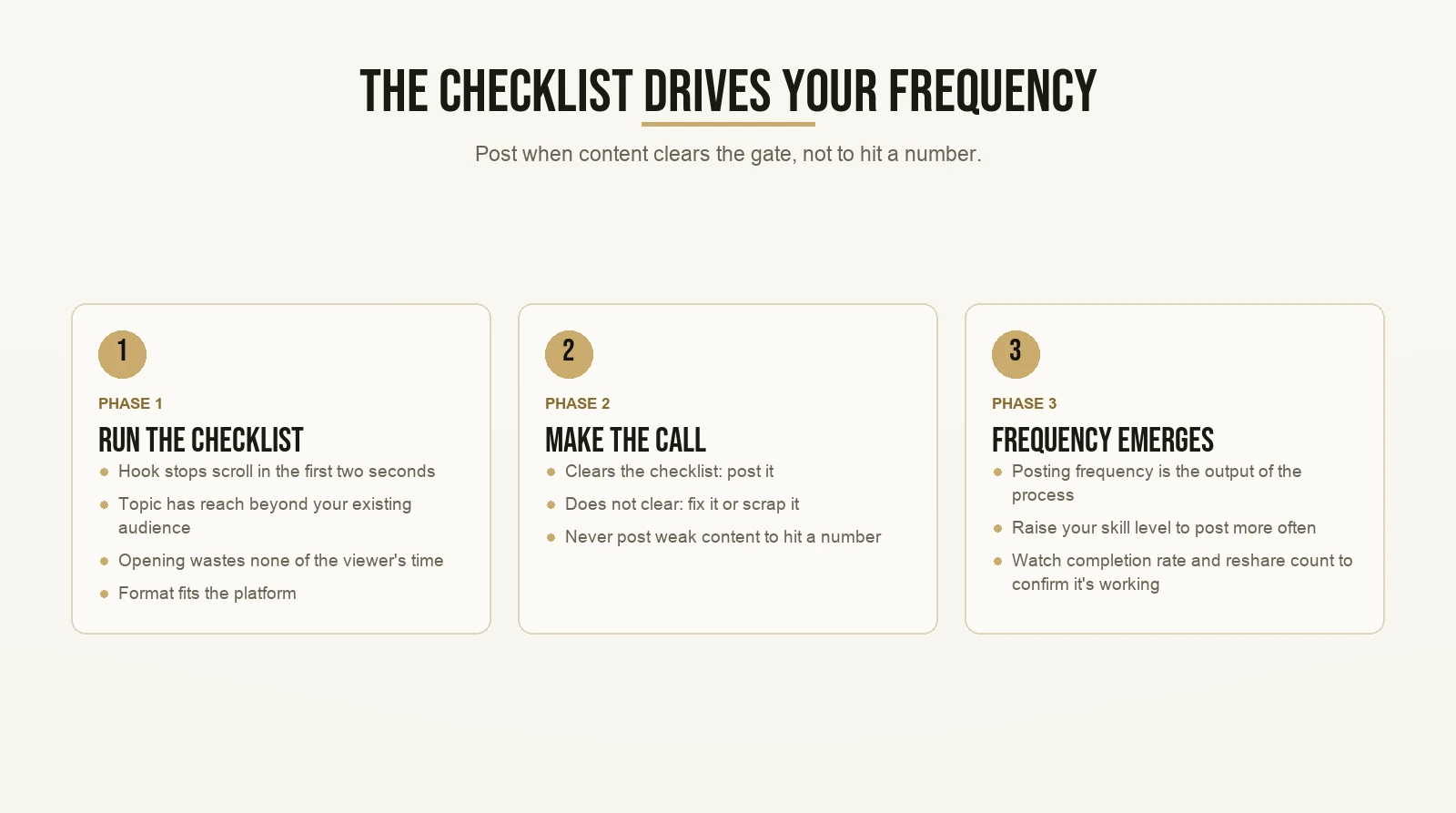
The viral video checklist is Max’s quality gate. It is the set of conditions a video needs to meet before it is worth posting. When you run every piece of content through it before you schedule, the frequency question answers itself.
You do not decide how often to post by picking a number from an article. You decide based on how often you can produce content that clears the checklist.
Here is the mechanism. Every video that earns organic distribution has specific things working in its favor. The hook stops someone scrolling in the first two seconds. The topic has reach beyond your existing audience. The opening does not waste the viewer’s time with background they do not need. The format fits the platform. When a video has those elements, the algorithm has something to work with. When it doesn’t, posting it anyway just generates low-engagement data that trains the algorithm to expect weak performance from your account.
Run the checklist before you schedule. If the video clears it, post it. If it does not, fix it or scrap it. Your posting frequency is the output of that process. Not a target you set in advance and work backward from.
But Max, what if I keep scrapping videos and I end up posting only once a week?
Then post once a week with content that clears the checklist. Get faster at making videos that clear it. The target is daily. But you reach daily by raising your skill level, not by sending weak content out the door to hit a number.
I have seen creators post every day for months and go nowhere. I have seen creators post three times a week with strong content and build real momentum in the same timeframe. The number alone is not the variable. The quality of each post is the variable.
Reading your Instagram analytics tells you whether your current frequency and quality combination is actually working. Watch completion rate and reshare count are the two numbers to focus on.
Should I post Reels every day on Instagram?
For beginners: not yet. Start with 15 to 45-second videos every other day and focus on quality first. When your videos regularly hit good watch completion, push toward daily.
For people already posting: the question is not whether to go daily. The question is whether your current content is clearing the algorithm’s quality signals. If your average Reel stalls at a few hundred views, posting more of the same content will not fix it. Getting better at making content that people finish and share will fix it.
A quick diagnostic: look at your last ten Reels. What is the average watch completion rate? How many reshares did they get? If both numbers are low, you do not have a frequency problem. You have a content quality problem. Fix that first, then increase volume.
For anyone building from the beginning and thinking about the full picture, growing on Instagram from zero covers what the first phase actually looks like. Frequency is one variable. It is not the only one.
Does the posting time matter on Instagram?
It helps at the margins. It does not override content quality. Timing is the last thing to optimize, not the first.
The rule: post when your ideal audience is most likely to be online. For most audiences, that is evenings after work. If your audience spans the US and Europe, late evening European time hits afternoon East Coast and early afternoon West Coast simultaneously.
But here is what matters more than timing: still post if you missed your ideal window. Consistency over perfection. An imperfect post at 7pm beats no post at 6pm. The algorithm has a random element built in, and a video can get picked up hours after it goes live if the early viewers had strong watch completion. The first-hour signal matters, but it is not the only window.
Do not skip a post because you missed your ideal time. Post it.
What about Reels versus Feed posts? Does the frequency question apply differently?
Yes. Reels and Feed are separate distribution systems with different mechanics, and the frequency question applies differently to each.
Reels is a recommendation engine. Instagram’s ranking documentation explains that the majority of what appears in the Reels feed comes from accounts the viewer doesn’t follow. Reels distributes based on content quality signals. Your Reels output is what drives new audience growth.
Feed posts go primarily to people who already follow you. Feed maintains the relationship with your existing audience. It does not drive significant new follower growth on its own, but it keeps your current followers engaged and warmed up. Posting to your feed a few times a week is useful. Daily is fine if the content is worth it.
One note worth including here: hashtags are not a meaningful discovery tool anymore. Instagram’s own ranking documentation does not list hashtags as a signal for Reels distribution. The algorithm categorizes content far better than any hashtag can. If you want to understand what actually drives discovery now, getting found on Instagram without hashtags covers the current state of that.
What does the data say about Instagram’s scale?
A few anchoring numbers, because context helps frame why content quality is so heavily weighted.
Pew Research found in 2023 that 47% of U.S. adults use Instagram, based on a survey of 5,733 adults. That places Instagram third among social platforms in the U.S., behind YouTube and Facebook.
DataReportal’s analysis of Meta’s own advertising reach data shows Instagram at 1.74 billion monthly users globally as of January 2025. Instagram users spend an average of 1 hour and 13 minutes per day on the platform.
Here is what those numbers mean for the frequency question. There are over a billion people on Instagram every month. The algorithm’s job is to show each of them content they will watch all the way through and share with someone else. It does not reward how often you post. It rewards how well your content performs when you do post.
Your job is to make content that earns that distribution. Not content that shows up on a schedule. Content that performs.
The real answer to how often to post on Instagram
Here it is.
Post as often as you can while keeping quality high. Minimum every other day. Daily if possible. For beginners, start at every other day and build toward daily as your skill and output speed improve.
Never sacrifice quality to hit a number. A strong video every three days builds more algorithmic momentum than weak videos posted daily. The algorithm tracks engagement rate, watch completion, and reshare likelihood across your account over time. Consistent low-performance posts lower the baseline expectation the algorithm has for your content.
Use Trial Reels for content you are unsure about. Run every video through a quality checklist before you schedule it. Let your posting frequency be the output of your quality process, not a target you work backward from.
The mechanism is simple. The execution takes reps. The reps get faster as you go.
If you want to see how this plays out for creators who have already been through the process, the reviews page gives you a realistic picture of what the journey looks like.
Want the templates behind content that actually gets watched? Grab the templates here and start with the first one today.