
Key Takeaways
- “I’ll think about it” is not one problem. It is two. Diagnosis comes before the reply.
- Every objection falls into one of two buckets: a logistics problem or a belief problem. They need completely different responses.
- The CCN framework explains why some leads arrive cold and some arrive ready. Your content determines which one shows up in your DMs.
- The 7 building blocks – specifically the CTA mechanic – is the system that pre-warms leads through a comment keyword before you ever have a sales conversation.
- A scripted reply is what causes the scripted feeling. A genuine diagnostic question fixes it.
- Voice notes are drastically underused. When a conversation goes cold, one warm voice note beats ten text blocks every time.
- If you hear “I’ll think about it” on most conversations, the problem is upstream in your content, not in your DM replies.
Why Is “I’ll Think About It” So Hard to Handle?
“I’ll think about it” feels like a polite no. Most of the time it is not. It is a person who is interested but not yet convinced of something specific. The problem is you do not know what that something is yet.
Most advice on how to handle objections in DMs gives you a reply to copy and paste. That is the wrong move. A canned reply is exactly why the conversation feels scripted. And scripted conversations die.
The fix is not a better line. It is a better question.
I have tested this both ways. Scripts feel smooth to write and terrible to receive. The moment you pull out a template, the person on the other end can feel it. They go quiet, or they give you another layer of polite deflection, and then you are nowhere.
Are There Two Types of Objections in DMs?
Yes. Every “I’ll think about it” falls into one of two buckets. Knowing which one you are in changes everything about what you say next.
Bucket one: a logistics problem.
The person wants to work with you. Something practical is in the way. Timing, cash flow, a partner who needs to be consulted, a project that needs to wrap up first. The desire is there. The path is blocked.
Bucket two: a belief problem.
The person is not sure it will work. For them, specifically. They may have tried something similar before. They may not yet see how your process applies to their situation. The doubt is not about cost. It is about outcome.
These buckets need completely different responses. A logistics problem can be solved with a bridge. A belief problem cannot be solved with price flexibility. If someone does not believe your process will work for them, a lower price does not fix the doubt. It just signals desperation.
Hold on, Max. How do I know which bucket I’m dealing with?
One question. “Is it the timing, or is it whether it will actually work for you?”
That is the diagnostic. Their answer tells you exactly which conversation you are now in.
Read that again. One question does the whole job of splitting the room.
What Do You Actually Say After They Answer?
If it is a logistics problem:
They say something like: “The timing is just off right now” or “I have a project wrapping up and I need to wait.”
This is good news. They want in. The work is practical. Ask when the timing would be better. “Got it, totally makes sense. When would it make more sense to pick this back up?” Then follow up on that date without apologizing for it.
Do not panic. Do not discount. Do not send them a wall of extra reasons to buy. You are solving a scheduling problem, not a sales problem. Those are different jobs.
If it is a belief problem:
They say something like: “I have tried things like this before and they did not stick” or “I am honestly not sure it fits my situation.”
This is where most people start listing features or forwarding testimonials. Do not do that.
Ask about the specific concern. “What makes you feel like it might not be the right fit?” Let them tell you. Then respond to the exact thing they said, not the general category.
Mechanism over enthusiasm. Every time.
Not: “This is incredible and it has worked for so many people.” Instead: “The reason accounts stall between 100 and 900 views is usually that the content is aimed at people who already follow the creator. The fix is a topic that speaks to someone who has never heard of you. Here is how that would look specifically in your niche.”
That specificity is what closes. Not energy. Not social proof in bulk. The right mechanical explanation for their exact situation.
How Does the CCN Framework Explain Why Some Leads Arrive Cold?

The CCN framework maps your audience into three tiers: Core, Casual, and New. These tiers determine who your content reaches, and how much trust those people arrive with when they eventually enter your DMs.
Your core audience already follows you. They know your frameworks. They trust your teaching. A core audience topic sounds like: “How to warm up DM leads using a three-step voice note framework.” That one only resonates with people already deep inside your world.
Your casual audience is broader. They know the problem space but do not follow you yet. A casual topic sounds like: “Why your Instagram DMs are not converting and what to fix.” More people relate to that pain.
Your new audience has never heard of you. A new audience topic sounds like: “Why you are posting every day and still not growing.” Even people outside your niche relate to that frustration. That is how you reach a huge pool of people who would genuinely benefit from what you do.
Here is why this is super duper key for objection handling.
The tier your content reaches determines who walks into your DMs. Core audience viewers already trust you. They have spent time with your teaching. They arrive with the heavy trust-building already done.
New audience viewers clicked because of a relatable headline. They are arriving basically cold. They are interested, but they do not know you yet. That gap is what creates the belief objection in the first place.
But Max, does that mean I should only post core audience content so people arrive warmer?
No. Core content does not grow your account. New audience content does. The point is not to avoid new audience topics. The point is to have a warm-up system in place so that by the time someone enters your DMs, they are not a stranger. That warm-up system is built into the 7 building blocks.
What Is the 7 Building Blocks CTA Mechanic and Why Does It Matter Here?

The 7 building blocks is the framework for how a viral video is structured from open to close. One of those seven blocks is the CTA, or call to action. And this building block is not just a closing line. It is the trigger that starts the warm-up sequence.
Here is the mechanic, pretty straightforward.
You end a video by telling your audience to comment a specific keyword. Something like: “Comment the word ‘clients’ below and I will send you the breakdown.” When someone comments that keyword, a tool like ManyChat picks it up automatically and sends them a DM with the resource.
Now something specific has happened. That person has:
- Watched enough of your video to want the freebie
- Taken a deliberate action by commenting
- Received something genuinely useful from you in their DMs before you ever asked them for anything
They raised their hand. They initiated contact. That last point is important – Meta requires the person to initiate before you can send an automated message, so the mechanic works with the platform rather than around it.
When you follow up that DM with a conversation, you are not cold-approaching a stranger. You are continuing a relationship with someone who already took action on your content and got value from you. Boom. The entire quality of the conversation changes before a single objection can appear.
Compare that to cold outreach. “I’ll think about it” from someone who went through the keyword comment sequence means they are interested but not fully ready yet. That is a lead worth working. The same words from a cold outreach target usually means please stop messaging me.
The CTA mechanic is not a cute trick. It is the structural reason why some creators close conversations easily and others grind through resistance. For a closer look at how the comment mechanic turns posts into client conversations, this breakdown of how to respond to Instagram comments to get clients covers the full sequence.
Why Can’t Automation Handle Objections?
It cannot. That is not an opinion; it is a structural constraint.
Click-to-message ads grew more than 50% year over year in Q4 2025 in the US, and more businesses are now entering DM conversations through automated first touches. Meta is expanding its Business AI tools across its apps with 24/7 automated customer response layers for WhatsApp and Instagram.
So the context is this: automated DMs are becoming the norm. Which means the moment you send a human, non-scripted reply, it stands out.
Automation handles delivery well. The freebie, the keyword reply, the first message – that is fine. But the moment someone says “I’ll think about it,” a real person needs to take over. An automated follow-up to a real objection kills the conversation. People can tell. Once they feel like they are talking to a bot, the trust is gone and there is no recovering it.
Instagram ranks as the second-favourite social platform globally among social media users, and research on why people actually use it points consistently to connection as the draw – not transactions. That is the platform’s social contract. A human, non-scripted reply is a competitive advantage right now, not just a nice detail.
Do Voice Notes Actually Help With Objections in DMs?
Yes. Significantly. And almost nobody teaches this part properly.
When a conversation starts going cold – replies slow down, answers get shorter, the energy drops – send a voice note instead of another text block.
A 30-second voice note does several things at once. It proves a real person is on the other end. It carries tone, warmth, and attention in a way text cannot replicate. It is almost impossible to dismiss the same way someone dismisses a paragraph of text. And unlike a template reply, it cannot be copy-pasted – so it reads as personal before they even process the words.
A couple of articles on how to handle objections in DMs briefly mention voice notes as optional. None of them actually develop why it works. On Instagram, where the whole register of the platform is relational, a voice note signals something no text block can: that you are paying attention to this specific person, not running a funnel.
Keep it short. Keep it warm. Use their name at the start. Repeat back the specific concern they mentioned in their own words. Then ask the one next question.
You do not need to close on the voice note. You just need to re-open the conversation. That is the whole job.
What If the Problem Is Upstream in Your Content?
Here is the uncomfortable truth about how to handle objections in DMs.
If you are getting “I’ll think about it” on nearly every conversation – not occasionally but routinely – the problem is not your DM reply. The problem is what happened before the DM.
Your content may not have built enough credibility before the ask. Your videos may be reaching the right audience tier in CCN terms, but not demonstrating the mechanism clearly enough for people to believe it applies to them. Or the offer has not been proven out publicly enough for someone arriving cold to trust it on first hearing.
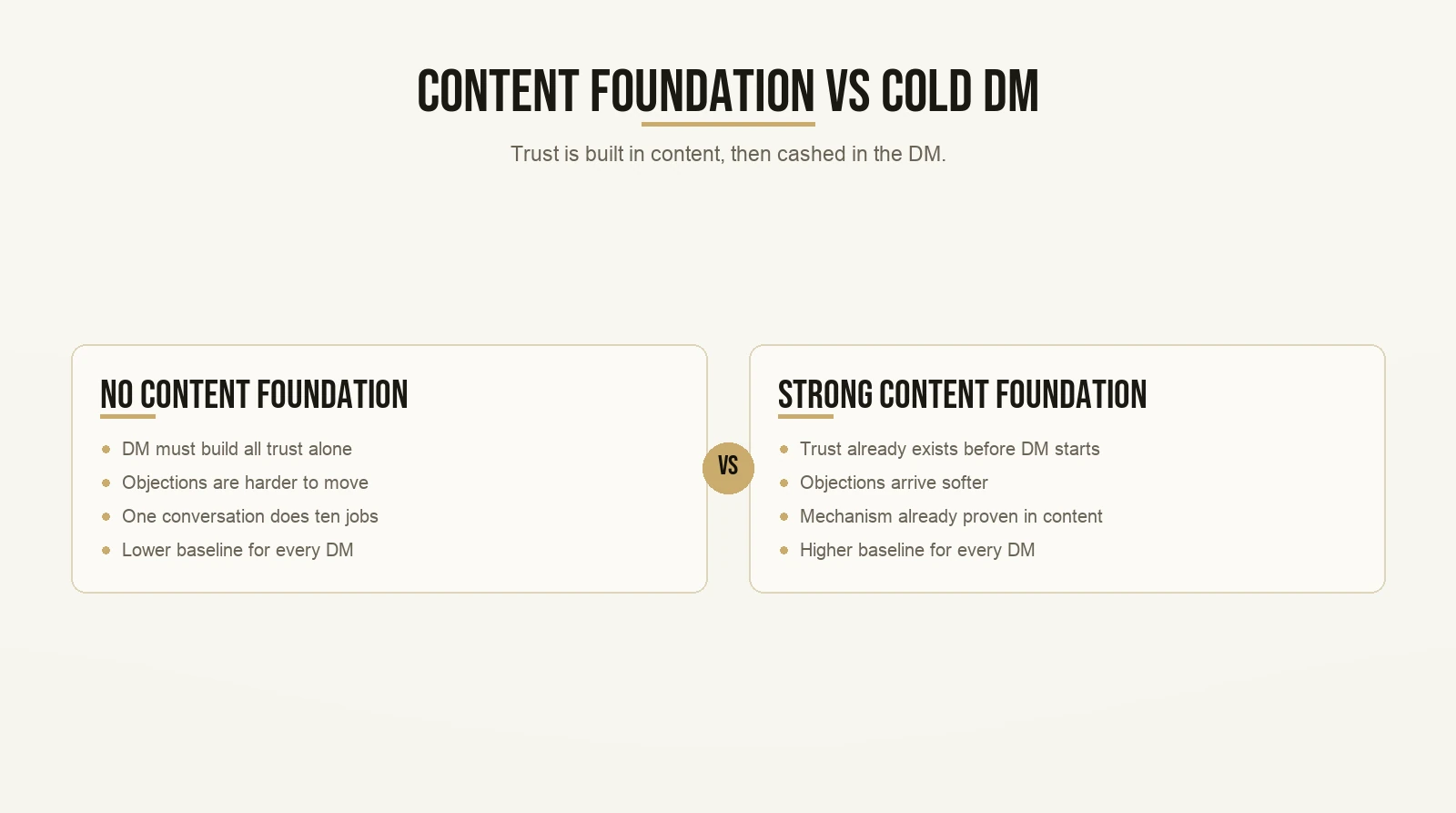
The DM is not where trust is built. It is where trust is cashed in.
Think about the credibility bank. Every post you publish either adds to it or does not. When someone enters your DMs after watching three teaching posts, a mechanism breakdown, and a video that diagnosed their exact situation, they already believe the process works. The objection you get from that person is softer. It is easier to move because most of the work is already done.
When someone enters your DMs without that foundation, the DM conversation has to do all the trust-building on its own. That is a much harder job. You are doing the work of ten touchpoints in one conversation, and it shows.
You can see what other creators have found after applying these frameworks and notice what the consistent pattern is. It is not the platform or the niche. It is the system being in place before the DM ever starts.
But Max, does that mean I have to fix my whole content strategy before I can close anyone?
No. You can close now. Use the diagnostic sequence below. But if you are grinding through objection after objection and losing most of them, the content is the higher-leverage fix. It raises the baseline of every DM conversation going forward, not just the next one.
For the full picture of how to build that trust through your content, here is how to position yourself as an expert on Instagram so leads arrive pre-sold on the mechanism.
What Does the Full DM Sequence Look Like?
This is not a script. It is a sequence. The difference matters.
A script assumes you know what the person is going to say. A sequence gives you the right move at each stage based on what they actually say. Same structure every time. Different content every time.
Step one: acknowledge without rushing.
“Of course, totally makes sense.” One sentence. Two seconds of warmth before anything else. Do not immediately fire back a counter-argument. That reads as desperate.
Step two: ask the diagnostic question.
“Is it the timing, or is it whether it will actually work for you?” Then wait. Resist the urge to add more to that question. Let them answer.
Step three: reflect before you respond.
Read their answer carefully. Say it back in their words before you go any further. “Got it, so the main thing is the timing right now.” This proves you actually heard them. It is a small move and it is very very key.
Step four: respond to the specific thing they said.
Not the objection you assumed they had. Not the most common one on your list. The exact words they used. If it is logistics, build a bridge. If it is belief, get specific about the mechanism and how it applies to their situation specifically.
Step five: offer one clear, small next step.
Not “let me know what you decide.” That puts the work back on them and lets the conversation die without resolution. Instead: “Would it make sense to jump on a quick call Thursday so you can ask any questions before deciding?” Give them one specific, easy option. One. Not three.
There we go. That is the whole thing. No magic. No scripts. Just listening to what is actually there and responding to it directly.
For the broader architecture of how to go from content to booked calls, here is how to book discovery calls from your social media content.
The Bottom Line on How to Handle Objections in DMs
Objection handling is not a DM skill you bolt on at the end of a funnel. It starts upstream with your content.
The CCN framework tells you what audience tier your videos reach and whether those people arrive with trust already built or arrive cold and skeptical. The CTA building block – the keyword comment mechanic inside the 7 building blocks – converts a viewer into a pre-warmed DM lead who has already raised their hand.
Once they are in the DMs, the job is clear. Diagnose before you reply. Two buckets: logistics or belief. One diagnostic question splits them. Respond to the specific thing they said. Send a voice note when the conversation goes cold.
And if the objections are constant, the content is the fix. A better DM reply does not solve an upstream credibility problem. But the right content means that by the time a conversation starts, the close is most of the way there already. I digress, let’s crack into applying this.
Here is how to structure your full DM selling approach once the content foundation is in place.
Want the templates behind content that actually gets watched? Grab the templates here and start with the first one today.