
Key Takeaways
- An offer post has three parts: the frame, the proof line, and the CTA. Each part does a specific job.
- The frame is a filter. Its job is to disqualify the wrong reader so the right reader feels found.
- The proof line must work for a cold audience – someone who has never seen your content before. Vague positioning claims fail this test. One concrete transformation sentence passes it.
- The best CTA for an offer post is not “link in bio.” A comment-keyword trigger sends the person a DM automatically and removes four friction points at once.
- Instagram now weights sends per reach above all other distribution signals. A well-built offer post earns sends – and each send is a distribution event that pushes the post to new audiences.
Learning how to write a coaching offer post on Instagram that gets DMs is one of those skills that looks simple from the outside and bites people the moment they try it. Three parts. Each with a specific job. Get all three right and the right person raises their hand.
Why do most coaching offer posts on Instagram fail to get DMs?
Most offer posts fail because they try to appeal to everyone and lean on credentials the reader has never seen. Neither mistake is obvious in the moment of writing. The fix is a three-part structure – the frame, the proof line, and the CTA – where each part does one specific job.
When a post starts with “I help coaches grow their business,” every coach scrolls past. Not because they do not need help. Because nothing in that sentence tells them the post was written for their specific situation.
The second failure mode is subtler. Most offer posts assume the reader already knows who you are. You know your track record. The person scrolling does not. They found your post through a share or a suggested reel. They have never seen your highlights. They have never watched your other content. If the post assumes prior familiarity, it will not convert a cold reader.
Both problems have the same solution: a three-part structure. Frame, proof line, CTA. Learn what each part is supposed to do. Write to that job. The right people will start raising their hands.
What is the frame, and why is it a filter not a headline?
The frame is the opening of your post. Its job is not to attract everyone. Its job is to make the wrong person feel like this post is not for them – so the right person feels like you wrote it just for them. Narrow framing creates stronger resonance, not weaker reach.
Most coaches write their opening line like a headline. They try to cast the widest possible net. That is backwards.
Here is a wide frame: “Want to grow your Instagram following?”
Here is a frame that filters: “If you have been posting consistently for six months and your DMs are still quiet, this is for you.”
The second frame excludes beginners. It excludes people who are not yet posting. It excludes people who are happy with their results. What it does is stop the scroll for one specific person: the coach who is putting in the work and not seeing it turn into conversations.
That person does not feel sold to. They feel found.
Hold up, Max. Won’t a narrow frame cut my reach in half?
Yes. That is the point. You do not want reach from people who are not your ideal client. A hundred DMs from the wrong people is a hundred conversations that go nowhere. Ten DMs from the right people is ten real opportunities. Narrow the frame and trust the filter.
Here is the counterintuitive part. A narrow frame actually helps your distribution on Instagram right now. When your frame describes a specific situation, the people who recognize it send the post to someone they know who fits that description. That send is the platform’s primary signal for pushing content to new audiences. A post written for everyone gives no one that feeling – and earns no sends. More on that mechanism in a later section.
The most effective frames share one feature. They name a situation the reader is already living, not a desire they have not yet fully formed. “I want to grow my Instagram” is a desire. “I have been posting for six months and my DMs are still quiet” is a situation. Situations are more specific. Specific things get sent.
How does the credibility bank work inside a single post?

The credibility bank is the system for making your track record legible to a cold audience. Every piece of content you publish either builds or draws down your credibility balance. An offer post draws on that balance. The proof line is the mechanism for depositing credibility instantly, even for a complete stranger who has never seen anything you have made.
Every teaching post is a deposit. Every documented transformation is a deposit. Every specific result you put on the record is a deposit. When you make an offer, you draw on that balance. The higher the balance, the more willingly people say yes.
The problem with offer posts is that most readers arrive cold. They have not seen your other content. They have no balance with you. You have a fraction of a second to establish your track record before they scroll on.
That is why the proof line exists. It is the compressed version of the credibility bank for someone who has never heard of you.
The proof line that fails the cold audience test: “I help coaches grow their businesses with my proven system.”
That sentence says nothing. Proven to whom? What kind of coaching? What does “grow” mean?
The proof line that passes: “I teach Instagram strategy to coaches who already have clients and want to stop trading time for referrals.”
That sentence tells a stranger what you do, who you help, what problem you solve, and what the reader is moving away from. It takes seven seconds to read. It deposits credibility immediately.
Your Instagram highlights are the long-form version of the credibility bank. They carry your hero story, your methodology, your client results. If you want to see how to structure your highlights so they do this job automatically, that post covers the full architecture. But inside a single offer post, you compress the whole thing into one or two sentences. The goal is the same: make a cold reader understand your track record before they decide whether to keep reading.
What makes a proof line land for a cold audience?
Specificity. One concrete sentence that names who you help, what changes for them, and what they are moving away from. Generic claims feel like marketing because they are. Specific claims feel like truth because they contain detail that only someone who has done the real work would know.
You do not need five proof points. You need one good one.
“I’ve helped over 200 coaches” – weak. No context, no transformation, no reason to believe it.
“I teach Instagram strategy to coaches who already have clients but no system for attracting new ones without running paid ads” – strong. Specific audience, specific problem, specific constraint.
The second example does not mention results at all. It still works. It works because it describes a real situation so precisely that the right reader thinks you read their mind.
But Max, what if I don’t have client results yet? What do I use for the proof line?
Use your own story. What was your situation before you figured this out? What changed, and how? A single specific sentence about your own before-and-after still passes the cold audience test. It is more honest than a vague claim and far more interesting to read. The credibility bank draws on your personal transformation story just as much as it draws on client results. Define first, refine later. Your proof line gets sharper as you see who responds to your content.
If you are a coach who already has clients and wants more, this structure is for you specifically. If you are just starting out and building from zero, the same structure works – you just anchor the proof line in your own experience rather than client results.
How do the 7 building blocks apply to an offer post that gets DMs?

The 7 building blocks are the framework for structuring any piece of content that needs to work: hook, intro, body, loop ending, CTA, visuals, and topic alignment. The CTA block is the one most coaches ignore in offer posts – and it is the one that determines whether a reader becomes a lead or just scrolls on.
Each building block plays a distinct role. You do not need all seven in every format. But ignoring the CTA block in an offer post costs you in a very specific way.
Here is what the CTA block teaches.
There are three versions of the CTA, each mapped to a different goal:
- You want to build a following. CTA: “Follow for more [your topic].”
- You want to deliver something free and build trust. CTA: “Comment [keyword] and I’ll send it to your DMs.”
- You want to move someone toward a paid offer. CTA: “Comment [keyword] and I’ll send you the link” – or to start a real conversation if you are selling something high-ticket.
Most coaches write a goal-three post and end it with a goal-one CTA. They write a post designed to convert and close it with “link in bio.” That is the mismatch that kills conversions.
“Link in bio” asks the reader to stop reading, navigate to your profile, find the link, click it, and then take the next step. That is four friction points. Each one loses people.
A comment-keyword CTA removes all four. The reader comments one word. An automated DM arrives with whatever you promised. The entire interaction stays inside Instagram. No navigation, no context-switching, no lost momentum.
This is not a workaround. Instagram’s Messaging API supports this as an official, first-party capability. The mechanic is mature and approved by Meta. For a step-by-step breakdown of what to say once the DM arrives, the Instagram DM script for booking discovery calls post covers the conversion conversation in full.
Why does a well-structured offer post earn sends on Instagram?
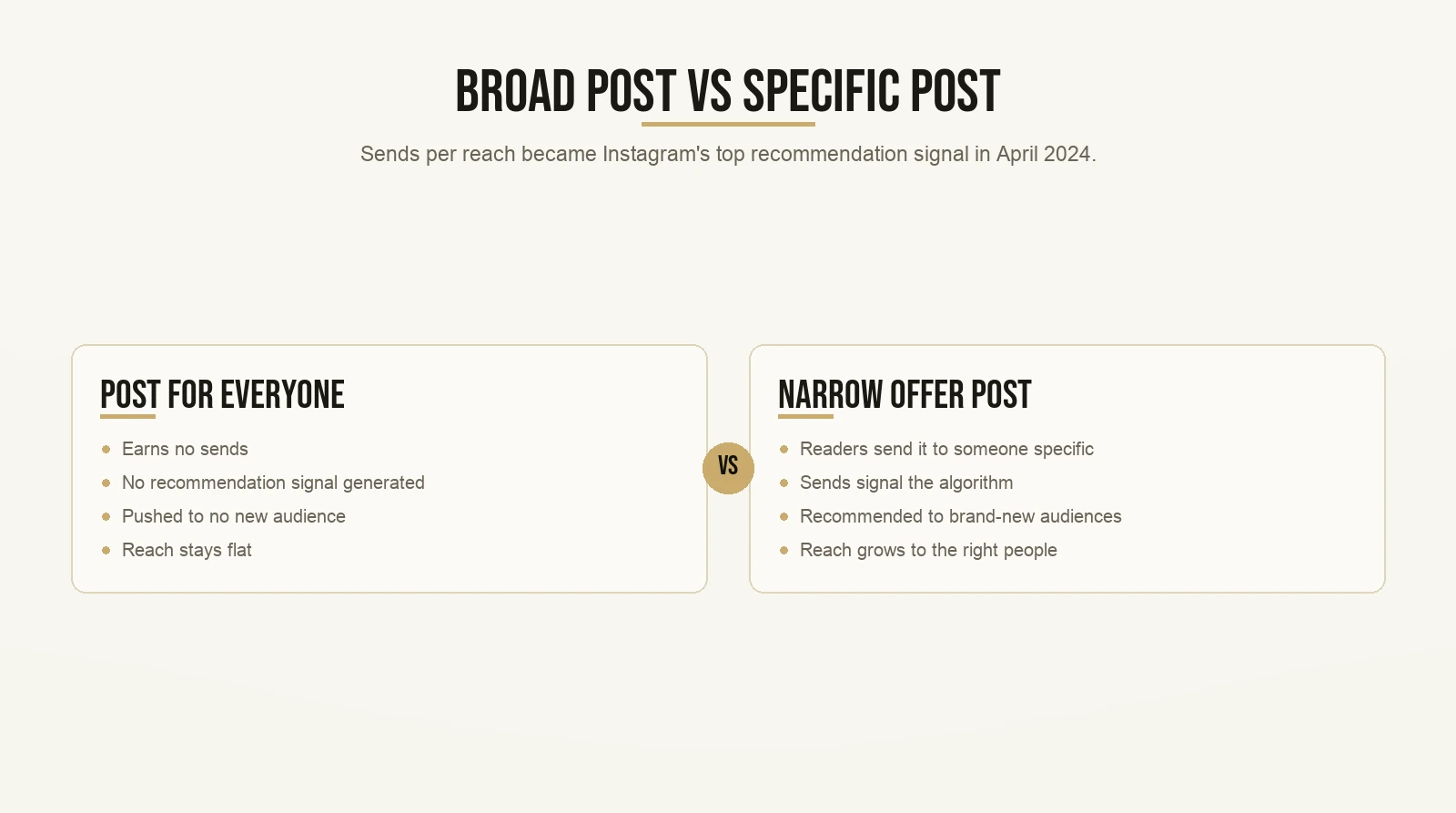
Because a well-framed post describes a specific situation so precisely that readers send it to someone they know who fits that description. That send is the platform’s primary distribution signal right now. A post written for everyone earns no sends and gets pushed to no one.
Instagram changed the rules in April 2024. The platform’s own head, Adam Mosseri, stated on his account at @mosseri that “sends per reach” is the most important metric for content to be recommended to new audiences. When someone shares a post via DM, that tells the algorithm that a brand-new audience will enjoy it too. Comments, saves, and likes still count – but sends carry the most weight in recommendations.
Instagram’s advertising-eligible audience reached 1.74 billion users globally as of January 2025, with growth of more than 5% year over year. That is not a platform in decline. More than 60% of that audience is under 35, so it skews young. But according to Pew Research’s 2025 survey data, 62% of US adults aged 30 to 49 use Instagram. If your coaching clients are in their thirties and forties, this platform reaches them regularly.
And they are engaged. An earlier Pew study found that 59% of Instagram users visit the platform daily. That was 2021 data, before Reels fully took over. The point is that Instagram is a high-frequency environment. A post that earns sends keeps circulating for days, not hours.
This matters specifically for coaches. Your ideal client is probably not the person most active on the internet. They are busy. They check Instagram regularly but they do not spend hours scrolling. The posts they send are the ones that describe their exact situation – the ones that made them think of someone specific. That is your targeting mechanism. Not hashtags. Not follower counts. The sends.
The narrow frame helps your reach, not hurts it. A post that resonates with a specific group earns sends from that group. The sends tell the algorithm who to show the post to next. You get more reach – but it is reach from the right people.
How do you write a coaching offer post on Instagram that gets DMs step by step?
Start with the frame and name the specific situation your ideal client is in right now. Add a proof line that deposits credibility with a stranger. End with a comment-keyword CTA that removes friction. Three parts, four to eight sentences, each one doing exactly one job.
Here is what the anatomy looks like assembled.
Frame (1-3 sentences). Name the specific situation your ideal client is in right now. Be narrow. Exclude the wrong people by describing the right person’s problem precisely enough that they feel called out.
Example: “If you have been posting consistently for six months and your DMs are still quiet, this is for you.”
Proof line (1-2 sentences). Tell a cold audience who you are, who you help, and what changes for them. Name the real problem, not a polished version of it.
Example: “I teach Instagram strategy to coaches who already have clients and want a repeatable way to attract new ones without running paid ads.”
CTA (1 sentence). Tell them the one thing to do. Use a comment-keyword trigger. Make the action trivially easy.
Example: “Comment STRATEGY below and I’ll send you the first step.”
That is the whole post. Three parts. Four to eight sentences. Each sentence doing one specific job.
One thing worth testing: read the post out loud before you publish it. If you would not say the proof line to someone you just met at an event, rewrite it. The post is a first impression from a stranger. It should sound like a confident person describing what they do, not like a brochure.
Notice what this post never does. It does not ask for the sale outright. It does not mention pricing. It does not name a program. It frames the right person, establishes credibility with a stranger, and offers a no-friction first step. The DM conversation handles the rest.
That is why this kind of post does not feel like a pitch. It is not one. It is an invitation – but a specific one, written for exactly the right person.
What are the most common mistakes coaches make with offer posts?
Vague frames that appeal to everyone, proof lines built on credentials the reader has not yet given you permission to trust, the wrong CTA for the goal, and drawing conclusions from a single post. Each mistake has a simple fix once you understand what each part of the post is actually supposed to do.
The vague frame. Starting with “I help coaches grow” instead of naming a specific situation. Read your first two sentences and ask: could a coach in any other niche have written this? If yes, rewrite it until the answer is no.
The weak proof line. Using credentials that require trust the reader has not yet given you – “certified coach,” “ten years of experience.” These fail the cold-audience test. A concrete before-and-after sentence passes it.
The wrong CTA for the goal. Writing a conversion-intent post and ending with “link in bio.” Match your CTA to your goal. If you want DMs, the CTA must generate DMs directly, not redirect people somewhere else.
Posting once and concluding it does not work. A post that earns sends gets distributed over days, sometimes longer. One post is not enough evidence. Write the post well and let it run.
If you are still building the fundamentals of your Instagram captions, the Instagram captions that convert post covers the baseline before you get to offer-specific structure. And if you want to see how offer posts fit inside a complete content plan, the Instagram launch content plan for coaches post shows exactly where to place them relative to your teaching content.
For context on the approach behind all of this and why the mechanism-first teaching style exists, Max’s background and track record is worth a read.
How to write a coaching offer post on Instagram that gets DMs: the short version
Three parts. Frame, proof line, CTA.
The frame filters. It names a specific situation so precisely that the wrong person exits and the right person stops scrolling.
The proof line deposits credibility with a stranger. It tells them who you are, who you help, and what changes for them – in one or two sentences, without credentials that require prior trust.
The CTA removes friction. It asks for a comment, not a click away from the page. It triggers a DM automatically. The conversation continues in private.
Every piece of this structure also serves the algorithm. A well-framed post earns sends. Sends drive distribution to new audiences who look like the people who already engaged.
Frame, proof line, CTA. Build it in that order, keep each piece tight, and see what happens in your DMs.
Want the templates behind content that actually gets watched? Grab the templates here and start with the first one today.