
Key Takeaways
- A launch is a three-phase arc: build desire, handle doubt in public, then open the door. Posting in the wrong order is the most expensive launch mistake.
- Reels reach strangers. Stories warm up people who already follow you. Broadcast Channel messages go directly to your most committed followers. Each surface has a different job.
- The credibility bank is the pre-launch phase almost every coach skips. It is the reason your audience trusts you enough to buy when the moment comes.
- The 7 building blocks let you create new launch content fast by swapping one element at a time from content that already proved it resonates.
- Three platform-native tools do the heavy lifting on launch day: the Countdown Sticker, Reminder Posts, and Broadcast Channel messages. None of them cost anything.
What Is an Instagram Launch Content Plan for Coaches?
An instagram launch content plan for coaches is a day-by-day map of what to post, where to post it, and what job each piece is doing. It is not a post calendar. A calendar tells you when. A launch plan tells you what each post is supposed to move in the reader’s mind before they ever see your offer.
Most coaches treat a launch as a single announcement. They post a teaser. They post the open-cart announcement. They wonder why sales did not come in the way they hoped.
The announcement is not the problem. The preparation is missing.
Your audience needs to travel through three stages before they are ready to say yes. They need to want what you sell. They need their doubts handled in public. And they need one clear moment to act. Skip a stage or run them out of order and the launch stalls. This post gives you the full sequence, day by day.
Which Instagram Surfaces Does Your Launch Content Plan Actually Use?
A launch uses three surfaces in parallel: Reels for cold reach, Stories for relationship depth, and Broadcast Channel for direct access to committed followers. Each surface has a completely different job, and running the same content on all three is a missed opportunity.
Here is what I mean by different jobs.
Reels reach strangers. According to Instagram’s own ranking explanation from Adam Mosseri, the top signal for a Reel is how likely someone is to reshare it. A Reel designed to be DM-shared will travel far past your existing followers. That is the cold-reach surface.
Stories reach people who already watch you. Instagram’s ranking for Stories uses viewing history and closeness signals. Stories do not surface to strangers. They go deeper with the people already paying attention to your account. That is the relationship surface.
Broadcast Channel is your most direct line. When you launch a Broadcast Channel, your followers receive a one-time notification to join. Anyone who joins has opted in. These are your warmest leads in the entire launch. That is the commitment surface.
Most coaches use only one or two of these. A full instagram launch content plan for coaches uses all three, with a specific role assigned to each one at each phase.
What Is the Credibility Bank, and Why Does It Come First?

The credibility bank is the pre-launch phase where you stack authority before asking for anything. You post specific teaching content that answers the exact questions your buyer needs answered before they can say yes. Each piece makes a deposit. By launch day, you have already earned the trust.
Here is why this phase is the one coaches most often skip.
If the first post your audience associates with your offer is the sales post, their guard is already up. But if the ten posts before it all taught them something specific and useful, their guard is down. You have been making deposits into their trust. The ask lands completely differently.
The credibility bank is not random helpful content. It is targeted. Each piece maps to a belief your buyer must hold before they will pay you. Let me give you a worked example.
Say you help coaches get clients on Instagram. Before you launch, your credibility bank posts might include:
- A Reel showing exactly how to respond to a comment so it becomes a DM conversation
- A Story series walking through one real coaching inquiry step by step
- A Broadcast Channel message sharing the single thing you would change if you were starting your account today
Each one of those answers an unspoken question your buyer is carrying: “Does this person actually know what they are doing?”
Build the credibility bank for at least seven days before you say anything about an offer. Ten days is better. This is the part that most instagram launch content plans for coaches leave out entirely, and it is usually the reason a launch underperforms.
Phase One: Days 1-7, Building the Credibility Bank

This phase runs on Reels and Stories only. No selling. No teasing. Not even a subtle hint that something is coming.
Your goal for Reels in this phase is mechanism content. Specific how-tos. Named frameworks with a worked example behind each one. Counterintuitive takes that make someone stop mid-scroll and think.
A few notes on format. For cold reach, aim for 15 to 90 seconds per Reel. That is the range where the recommendation system tends to push content to new audiences. Longer formats work better once people already know you. At this stage, you want reach from strangers.
For Stories, this phase is all about closeness. Show behind the scenes. Run a quick poll. Reply to every response you get. The more two-way conversation you have right now, the more Instagram prioritizes your Stories in your followers’ feeds later. That matters a lot when your launch Stories go live.
Do not overthink the posting frequency. Post as often as you can hold quality. Minimum every other day. If a great idea hits you mid-plan, post it right away and skip whatever you had scheduled for that day. The idea matters more than the schedule.
What Goes Into Every Launch Reel?
Every Reel is built from the same set of 7 building blocks. The ones you will work with most during a launch are the topic, the hook, the angle, and the format. You can swap any one of them out and create a completely new piece of content from a base that already proved it resonates.
This is how launch content compounds instead of starting from zero each week.
Here is how the move works. Say you post a Reel about the one mistake coaches make when pricing their first offer, and it performs well. That is an outlier. Now swap one building block at a time.
- Same topic, different hook: “What most coaches get told about pricing is completely backwards”
- Same hook, different angle: Instead of naming the mistake, show the fix in full detail
- Same angle, different format: Turn the talking-head Reel into a text-on-screen list with a voiceover
Each swap creates a genuinely new video. A different hook attracts a different person than the first one did. A different format catches a different scroll pattern. The audience overlap between the two posts is smaller than you would guess.
Hold up. Am I just recycling content if I do this?
No. You are building on what already worked instead of guessing from scratch. Recycling is posting the same video twice. Using the 7 building blocks is compounding proven signals. There is a real difference.
If you want a repeatable process for building Reels that do the reach work during a launch, how to film Reels on your phone that sell your coaching offer goes deep on execution.
Phase Two: Days 8-14, Building Desire
This phase shifts from teaching to problem-awareness. You are still not selling. You are making your audience feel the gap between where they are and where they want to be.
Your Reels in this phase answer the questions your ideal buyer is silently carrying. Not “what is Instagram?” but “why is my content getting zero saves even though I post consistently?” Write for someone who already has a business and already posts. They are stuck, and they know it. That is your person.
Your Stories in this phase get more personal. Share a real moment. Not a case study with revenue figures attached, but the thing you figured out the hard way. The question a client asked in a DM that changed how you think. The belief you used to hold that turned out to be wrong.
Your Broadcast Channel in this phase sends one short message per day. One idea. Two to three sentences. Make it feel like a text from someone who knows a lot and is not yet trying to sell you anything.
This is also when you drop the Countdown Sticker in your Stories for the first time. When followers see it, they can tap to share your countdown to their own Stories. That is free organic amplification built directly into the platform. Drop it now, before any real urgency, so your audience is already familiar with it when it counts.
How Do You Turn Objections Into a Multi-Day Public Arc?
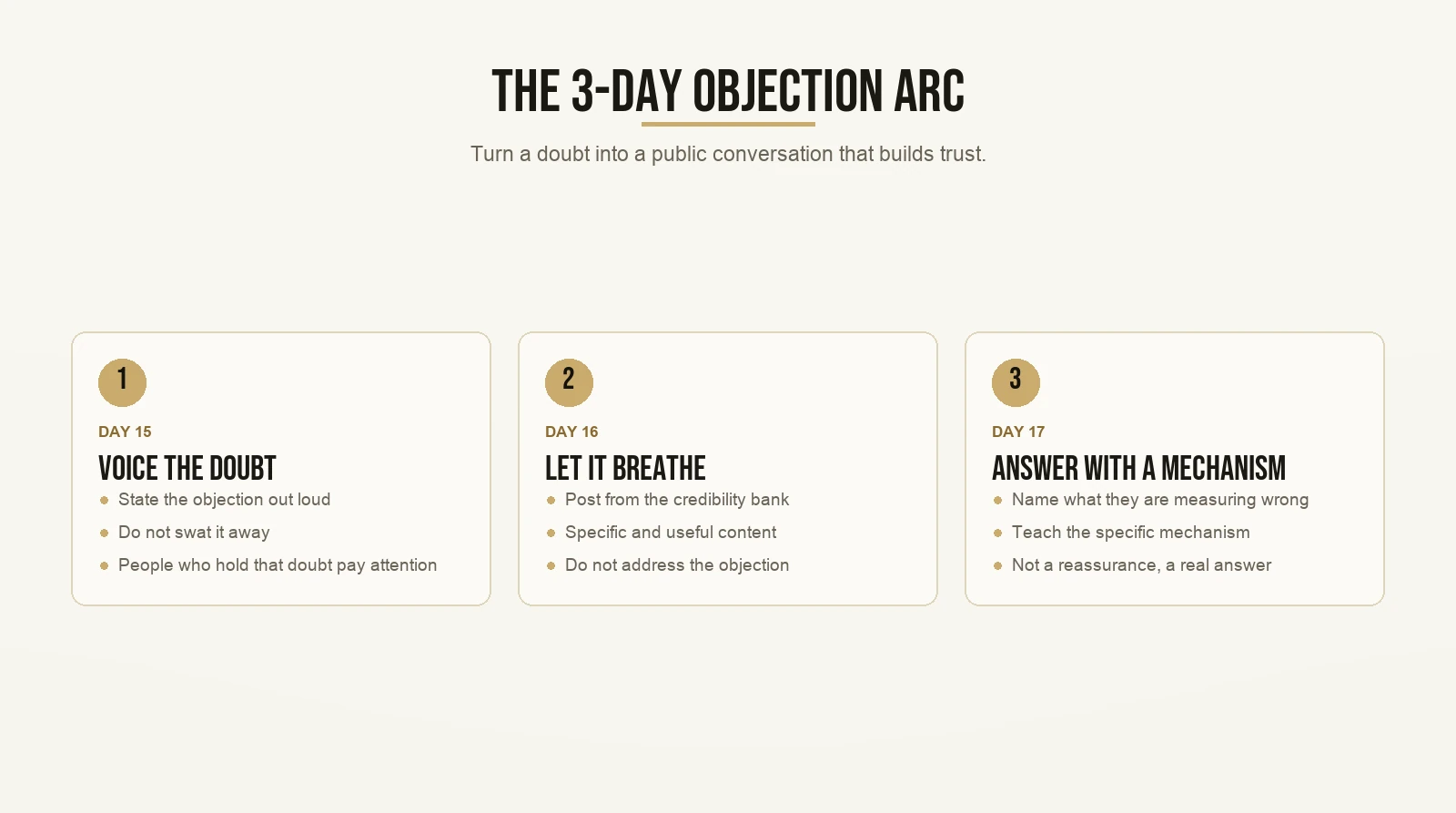
The objection arc is three pieces of content spread over three days: one post that voices the doubt out loud, one day where you let it breathe without answering it, and one direct Reel that answers it with a specific mechanism. This creates a public conversation rather than a one-line rebuttal, and it performs significantly better than a single myth-busting post.
Most coaches either ignore objections entirely or post one quick “myth vs. reality” Reel and move on.
Neither of those works as well as making the doubt a visible conversation.
Here is why. When you voice the doubt out loud without immediately swatting it away, the people who hold that doubt pay much closer attention. You said their thought exactly. They come back the next day to see if you are going to take it seriously. When you answer it on day three with a specific mechanism, not just a reassurance, they trust you more than if you had answered it in thirty seconds on day one.
Here is what the arc looks like in practice.
Day 15: “A lot of coaches tell me Instagram is too slow. You post for six months and nothing changes. I want to sit with that for a second because it is not a crazy thing to believe.”
Day 16: Post something from the credibility bank. Specific and useful. Do not address the objection. Let it breathe.
Day 17: “Here is what I actually think about Instagram being too slow, and why the coaches who believe that are measuring the wrong thing.” Then teach the mechanism.
Running the objection as a three-day arc instead of a single post is freaking powerful. It is also the part of a launch that nobody else is teaching.
But Max, what if I voice the doubt and people actually agree with it and leave?
If they leave over that, they were never going to buy. The people who stay are the ones who were waiting for someone to take their concern seriously. Those are your buyers.
Phase Three: Days 15-21, The Objection Arc
Run three full objection cycles across these seven days. Three acknowledgments. Three “let it breathe” days. Three direct Reel answers.
Pick your three biggest real objections. Not the ones you wish your audience had. The actual ones. The ones that show up in your DMs, in your comments, in the questions people ask right before they say no.
For coaches, these tend to be:
- “I don’t have time to post consistently enough to make this work”
- “I already tried Instagram and grew maybe 50 followers in six months”
- “I’m not sure my niche is specific enough to build a real audience“
Each one of those is a three-day arc. That is nine pieces of content that practically write themselves because you already know exactly what you want to say.
One thing to keep in mind. You are not trying to convince skeptics to buy. You are giving your almost-buyers the final pieces of evidence they needed. The people who were never going to buy will not buy anyway. The people who were on the fence and needed someone to take their concern seriously: they are the ones who convert.
Which Platform-Native Tools Should You Use on Launch Day?
Three tools do most of the heavy lifting: the Countdown Sticker (which followers can share to their own Stories), Reminder Posts (which send a push notification to anyone who taps “Remind Me”), and Broadcast Channel messages (which reach your opted-in followers directly). Using all three multiplies your launch-day touchpoints without spending anything.
Here is how to deploy each one.
Countdown Sticker. Post a Story with a Countdown Sticker timed to your cart open. Followers who see it can tap to share it to their own Stories. Every share puts your launch in front of that person’s audience. You do not have to ask. The feature does it automatically.
Reminder Posts. Create a feed post announcing your launch date and turn on the Reminder feature. Followers who tap “Remind Me” receive a push notification at the moment you open the cart. This is a direct line to anyone who expressed intent ahead of time. Use it.
Broadcast Channel. The moment your cart opens, send a short message to your channel. One line about what just opened. One line about where to go. These people opted in to hear from you. Keep it short. They are already warm.
Phase Four: Days 22 Through Close, Opening the Door
Launch day starts with a Reel. Not a sales post.
Here is why. Instagram’s ranking algorithm weighs speed of engagement heavily, especially in Reels. If your first launch-day post is an announcement and nobody outside your existing followers reshares it, the day starts flat. But if your first post is a genuinely useful Reel that gets shared, the algorithm gives you reach right when you need it most. Then the sales post lands on a warm, expanded audience.
The launch-day sequence:
- Morning: A Reel that teaches the core mechanism your offer solves. Make it shareable.
- Midday: A Story announcing the cart is open, with a clear link in bio.
- Afternoon: Activate your Reminder Post for followers who missed the Story.
- Evening: A Broadcast Channel message to your opted-in list.
- Night: A Story with the Countdown Sticker running to your close date.
Hold that sequence on day one. Then drop to one or two touchpoints per day for the rest of the cart window. On close day, escalate again: a morning reminder, a final Countdown Story, a Broadcast Channel message a few hours before close. That is it.
How Do You Know Which Launch Content Is Working?
Watch your outliers. An outlier is any post that performed noticeably above your recent baseline in reach, saves, or shares. You are not comparing yourself to other accounts. You are comparing this week’s content to your own average from the previous few weeks.
When you find one, do not just celebrate it. Ask which building block drove the performance. Was it the topic? The hook? The format?
Then build your next piece by keeping that block and swapping one other. That is how you compound what is working instead of starting from scratch every week of the launch.
Hold up. What if I have no outliers in a launch week?
That means you are posting too much of the same format, the same angle, or the same topic. The fix is to experiment more. Try a format you have not used. Take a completely different angle on a topic that already performed. No outliers is not a failure. It is a signal to break the pattern.
For the full breakdown of reading your metrics without getting lost, how to read your Instagram analytics covers the process in detail.
Do You Need a Big Following to Run a Successful Launch?
No. Reshare rate is the primary signal for Reels reach, not follower count. A Reel that gets DM-shared ten times on a 500-follower account outperforms a post with 500 likes and no shares. Design your launch Reels to be shareable, and the algorithm will push them further than your following alone could.
The coaches who run effective launches on small accounts are not luckier. They are more specific. Clear takeaways. Named mechanisms. Counterintuitive angles that make someone think “my friend who coaches needs to see this.” That is what drives the DM-share.
Instagram updated its ranking in 2024 to give preferential reach to original content creators. If you teach from your own experience and create original content, you have a genuine reach advantage over accounts that repurpose other people’s posts. It does not cost anything.
If you want to see what real coach accounts look like after building this approach, the results section at Smartphone Freedom Lifestyle shows the pattern clearly.
What Does the Full 30-Day Launch Arc Look Like?
The 30-day arc has four phases: credibility bank for seven days, desire-building for the next seven, objection arc for the next seven, and cart open for the final nine. The phases stack in order because each one depends on the trust built in the one before it.
Here is the complete instagram launch content plan for coaches, compressed into one view.
Days 1-7 (Credibility Bank):
- Reels: mechanism content, specific how-tos, counterintuitive takes
- Stories: polls, behind-the-scenes, two-way replies
- Broadcast Channel: one daily insight, two to three sentences
Days 8-14 (Building Desire):
- Reels: problem-aware content, the gap your offer closes
- Stories: personal moments, what-would-you-do polls
- Broadcast Channel: one specific insight daily
- Stories: drop the Countdown Sticker for the first time
Days 15-21 (The Objection Arc):
- Reels: voice the doubt, pause, answer it with the mechanism (three full cycles)
- Stories: save-worthy content, short social-proof clips
- Broadcast Channel: one supporting insight per arc cycle
Days 22-30 (Open Cart):
- Day 22 morning: shareable Reel on core mechanism
- Day 22 midday: open-cart Story with link in bio
- Day 22 afternoon: Reminder Post activated
- Day 22 evening: Broadcast Channel message to waitlist
- Day 22 night: Countdown Sticker Story
- Days 23-29: one touchpoint per day
- Close day: morning reminder, final Countdown Story, Broadcast Channel message a few hours before close
For staying consistent through all four weeks without burning out, how to stay consistent on Instagram without burnout covers the rhythms that hold up at launch intensity.
What Are the Biggest Mistakes Coaches Make in a Launch?
The most expensive mistake is starting the credibility bank too close to the open cart. Seven days is a minimum. Anything less and the trust deposits have not had time to compound. Your audience will feel the ask coming before they feel the value.
Here are the others:
- Posting the same Reel format every day. The algorithm reads repetition as stale content. Swap one building block at a time to keep the signals fresh.
- Ignoring Broadcast Channel entirely. It is the only surface on Instagram where you can message opted-in followers directly without depending on feed algorithm luck.
- Treating objection content as a single post. One myth-busting Reel is background noise. A three-day arc is a conversation that people come back to.
- Boosting launch posts that have not already performed organically. You are training the algorithm to skip organic reach, and you commit to paying for it every time.
- Measuring the launch by likes. Saves and reshares are the signals that matter during a launch. Likes are easy. Reshares mean someone thought another person needed to see this. That is the signal worth chasing.
If you want to see how Stories fit into the launch arc more specifically, how to write Instagram Story scripts for coaches gives you a repeatable structure for the warmth work each phase requires.
Want the templates behind content that actually gets watched? Grab the templates here and start with the first one today.