
Key Takeaways
- An Instagram reel template is not a drag-and-drop editing preset. It is the narrative structure that determines whether someone watches to the end or exits in three seconds.
- Instagram now measures Skip Rate (exits in the first three seconds) and sends per reach as its top signals for non-follower distribution. Your template structure drives both.
- The CCN framework – Challenge, Conflict, New Understanding – creates an open loop viewers need to close. It is one of the most reliable watch-time structures available.
- The credibility bank explains why educational templates earn saves and replays. Every specific insight you deliver before asking for anything is a deposit.
- Trial Reels rolled out globally in December 2024. They let you test two different structures against real non-follower audiences for free, before you commit to your feed.
- Instagram launched a retention chart in August 2025. A sharp dip at a specific second tells you exactly where your template structure breaks down.
- Reels over 3 minutes are not shown to non-followers. Template length matters.
What Is an Instagram Reel Template, Really?
An Instagram reel template is the narrative structure of your video. It decides where the tension lives, when you reveal the payoff, and whether the viewer watches to the end or exits in three seconds. This is different from the editing template Instagram built into its camera, which only shapes the cut.
There are two completely different things called an “Instagram reel template” and most articles on this topic confuse them.
The first is Instagram’s built-in editing template feature. It launched in July 2023. Tap “Use Template” on any eligible Reel and Instagram auto-applies the audio, clip count, and timing. Useful for syncing clips to a beat. That is all it does.
The second is a content template. It is the narrative architecture underneath the edit. It determines whether a stranger who has never heard of you keeps watching past the five-second mark. That is the thing that moves your numbers.
This article is entirely about content templates. If you are comfortable finding editing presets inside the app already, the guide at how to find templates on Instagram covers that process step by step. Come back here when you want to work on the structure underneath.
Why Does Template Structure Control Your Reach?
Because Instagram measures whether people watch, share, and save your Reel. The platform measures Skip Rate (exits in the first three seconds) and sends per reach as its top signals for non-follower distribution. Your template structure determines both numbers before the algorithm ever sees your content.
Hold up. Isn’t this just about having a good hook?
Not exactly. The hook controls Skip Rate – whether people exit in the first three seconds. But watch time past that point is determined by the structure that follows. A strong hook with no structural reason to keep watching drives up your Skip Rate improvement, then collapses your completion rate immediately after. Both matter. They require different structural thinking.
Adam Mosseri, head of Instagram, confirmed in January 2025 that the top three ranking signals are watch time, likes, and sends. Sends – how often someone shares the Reel to a friend – are the most important signal for reaching non-followers. He also confirmed Instagram measures both seconds watched and percentage watched, so longer videos are not penalized if people actually stay.
In April 2025, Instagram replaced the View Rate metric with Skip Rate. Skip Rate is the percentage of viewers who exit in the first three seconds. A high Skip Rate tells the algorithm your opening is not working and pulls back distribution.
More than 200 billion Reels are played daily across Instagram and Facebook. The competition for attention is real. The right structure is not optional.
Let’s crack into the 12 structures.
The 12 Instagram Reel Template Structures
Not all 12 drive the same signal. Some are built for watch time. Some are built for sends. Some earn saves and replays. Know which metric you are targeting before you pick a structure.
1. The Open Loop
State the promise in the first five seconds. Withhold the resolution until the end.
“I tested three different hooks on the same Reel. One got 12,000 views. One got 900. One got 40. Stay to the end and I’ll show you exactly which hook was which.”
The viewer’s brain treats an open loop like an unfinished sentence. It needs to close it. Watch time follows almost automatically.
Where it breaks: if the promise is generic, the viewer does not believe you can deliver. “I’ll show you how to grow faster” is not a promise. “I tested three hooks on the same Reel” is a promise.
Best for: watch time, replays.
2. The CCN Loop
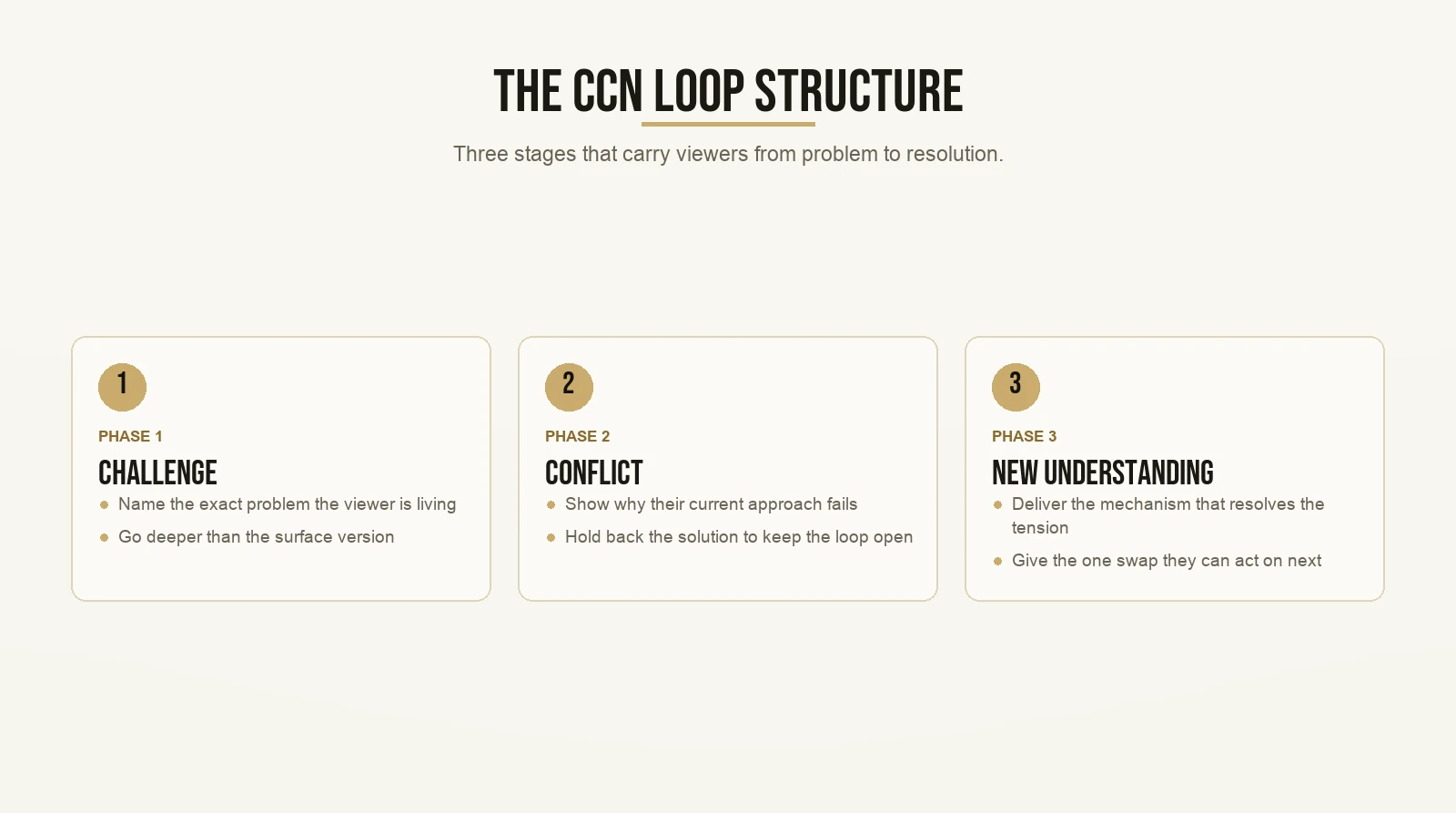
This is one of Max Tornow’s core content frameworks. CCN stands for Challenge, Conflict, New Understanding. It is the most repeatable watch-time structure on this list.
Here is how it works.
Challenge. Name the specific problem the viewer is already living. Not the surface version. The one they have not been able to solve. “You’ve been posting Reels every day for three months and your account is still stuck under 500 followers.”
Conflict. Show why their current approach fails. Do not solve it yet. “The reason is not your content quality. It’s your template structure. Your videos are interesting to people who already know you. The algorithm needs content that interests strangers. You’ve been writing for your existing audience.”
New Understanding. Deliver the mechanism. The insight that resolves the tension. “Stop opening with your credentials. Open with the problem your viewer woke up with this morning. That one swap is where most creators unlock the first wave of non-follower reach.”
Read that again.
The structure works because the Conflict stage creates an unresolved open loop. The viewer’s brain knows a problem exists. It needs the resolution. That need carries people to the end of the Reel.
CCN works because it mirrors the way a viewer’s doubt actually moves – from “I have this problem” to “I understand why” to “here is what I do next.” Use it any time you are teaching a concept or correcting a common mistake.
Best for: watch time, saves.
3. The Contrarian Statement
Say the opposite of what your viewer expects.
“You do not need a large audience to get clients from Instagram.”
“Posting more often will not fix your reach problem.”
When something contradicts an existing belief, your brain flags it as important. You stop scrolling to find out if the claim holds up.
The contrarian statement has to be true and provable. A false contrarian hook earns the click but loses trust the moment the video fails to back it up. The credibility bank gets depleted every time you overpromise. More on that in structure 8.
Pair the contrarian statement with the CCN structure underneath it and you have a freaking powerful combination.
Best for: Skip Rate reduction, sends.
4. The Before-After Bridge
Show where someone was. Show where they ended up. Fill in the bridge with the mechanism.
“Three months ago she was getting under 200 views per Reel. Today her Reels routinely pass 20,000 views. The only thing that changed was her template structure.”
No income figures needed. The transformation is the hook. The mechanism is the content.
This structure drives sends because viewers share it to someone they know who is in the “before” state right now. If you’re a business owner or coach, this is one of your highest-converting structures.
Best for: sends, DMs.
5. The Myth vs. Reality
Name a widely held belief. Show why it is wrong. Explain the correct mechanism.
“Myth: The algorithm rewards accounts that post consistently. Reality: The algorithm rewards Reels that get watched and shared. You can post every day and still get zero non-follower reach if your structure is wrong.”
This structure drives saves. Viewers bookmark myth-busting content because it contradicts something they have been told many times and they want to return to it.
The stronger the myth – the more authoritative the source it came from – the more powerful the Reel.
Best for: saves, sends.
6. The How-I Story
Tell a personal experience as a teachable moment.
“I used to script my Reels for three hours and get 400 views. Then I changed one thing. I stopped writing for people who already follow me and started writing for someone who has never heard of my name. Same effort. Very different results.”
The mechanism is identification. Viewers see themselves in the “before” state and stay to find out what changed.
Keep the personal detail specific. “I got better results” is too vague to hold attention. “Videos that only interest your core audience stall between 100 and 900 views” is a claim a viewer can test against their own experience right now.
Best for: watch time, follows.
7. The Step-by-Step Tutorial
Number your steps. Deliver them in sequence. Make each step stand on its own.
“Here are the five things I check before I post any Reel. Step 1: Does the first three seconds create a question in the viewer’s mind? Step 2: Is the answer revealed at the end, not the middle?…”
You get the gist.
This structure drives saves. Viewers bookmark tutorials to reference the steps later. One structural note: make step four slightly more insight-dense than the others. That variation in value delivery carries people from step three to step five rather than feeling like the tutorial runs flat halfway through.
Best for: saves, replays.
8. The Credibility Bank
This is another of Max Tornow’s frameworks, and it explains something that confuses a lot of creators.
Why do some accounts with small followings convert viewers into clients while larger accounts get ignored?
The credibility bank.
Every piece of value you deliver before asking for anything is a deposit into the credibility bank. The viewer tracks this deposit unconsciously. When you finally ask for a follow, a save, or a click, they answer based on how full the bank is.
Hold up. If I lead with the mechanism and not my credentials, won’t people assume I’m just some random person?
That is exactly backwards. A random person introduces themselves first because they need the credential to earn attention. Someone who genuinely knows the subject leads with the subject. The mechanism IS the credential.
A credibility bank deposit looks like this in a Reel: teach a specific mechanism with a worked example before you introduce yourself or ask for anything. No credentials. No “I’ve helped hundreds of people.” Just the mechanism, taught well.
“Videos that only interest your core audience stall between 100 and 900 views. The reason is not the editing. It’s the opening five seconds. If your hook only interests someone who already knows your work, the algorithm cannot extend your reach to strangers.”
That one claim, taught clearly, is a deposit. Do it three times in 60 seconds and the bank is full before you ask them to follow you.
If you’re just starting out and your following is small, this structure is super duper key. It lets you earn trust before you have the follower count that signals social proof. Use it when your primary goal is saves, replays, and inbound DMs rather than viral reach.
Best for: saves, DMs, replays.
9. The Question First
Open with a question the viewer is already asking themselves.
“Do you know why your Reels stop getting reach after three days?”
“Are you still posting at random times and wondering why your views are all over the place?”
A direct question feels personal. It interrupts the scroll because it names the exact person and the exact frustration.
“Want to grow on Instagram?” is too vague to stop anyone. “Are you a coach posting Reels three times a week and still not landing discovery calls?” names the exact situation. That specificity is the hook.
Best for: Skip Rate reduction, relevance to a specific audience.
10. The Trend Hijack
Attach your message to something already circulating in the feed.
Find a trending sound or format that has already proven it can stop scrollers. Borrow the shape. Fill it with your own message.
The mechanism works in two stages. The familiar shape earns the initial watch because the viewer has seen it before. Your content twist creates contrast. That contrast drives shares.
One honest caveat: this structure has a short shelf life. Once the format goes stale, the familiarity signal disappears. Trend hijacks produce spiky, short-term results rather than consistent ones. Use them to reach new audiences fast, not as your foundation.
Best for: initial reach, sends, new followers.
11. The Social Proof Story
Tell the story of a transformation without using income figures. Focus on the skill change, the decision, or the shift in approach.
“She went from posting and getting ignored to building an audience of people who DM her asking to work with her. The change was not her offer. It was the structure of her Reels.”
No revenue figures needed. The transformation is compelling on its own. Viewers send this to someone they know who is currently in that situation.
The transformation has to be specific enough to be believable and general enough for the viewer to project themselves into it. “She changed how she opened her Reels” is specific and projectable. “She learned to post better” is too vague to land.
Best for: sends, DMs, trust-building.
12. The Educational Stack
Start with the answer. Then go deeper.
“The hook is the most important part of your Reel. Here is why. Instagram measures Skip Rate: the percentage of viewers who exit in the first three seconds. A high Skip Rate pulls back distribution. The hook is the only thing that directly controls Skip Rate.”
This structure frontloads the value. Viewers who already know the answer stay to understand the mechanism. Understanding is what gets saved and shared.
Use this when your audience is past the beginner stage and wants the why, not just the what. It is pretty straightforward to execute: lead with the conclusion, then justify it with the mechanism.
Best for: saves, shares, authority-building.
How Do Trial Reels Let You Test Template Structures Before Publishing?

Trial Reels show your Reel only to non-followers. After 24 hours you see plays, likes, comments, and shares. Post the same concept using two structurally different templates as Trial Reels, compare the retention curves, and publish the stronger structure to your feed. It costs nothing.
Trial Reels rolled out globally on December 10, 2024. They are the most underused tool for template testing available right now. Instagram also added an auto-share option: if performance is strong in the first 72 hours, the Reel can automatically publish to followers.
Hold up. Do I just post the same video twice with a different hook?
No. Meta retrained its algorithm to detect near-duplicate Trial Reels. Two versions that are too similar – same video, one word changed in the hook – both get flagged as duplicates and receive no reach. You post two versions and one lands at zero views. That is not a test.
The fix is structural difference. Mirror the raw video horizontally before adding text. Speed up a section slightly. Change the visual format, not just the hook word. Make the two versions genuinely different enough that a viewer would not recognize them as the same underlying video.
Post both as Trial Reels. Compare the retention curves after 24 hours. The one with the healthier curve goes to your feed. The other stays archived.
One more thing worth knowing: if one Trial Reel gets zero views, it does not affect your regular feed distribution. Meta confirmed this. A failed Trial Reel is contained. It does not touch your algorithm standing for feed posts.
How Does the Retention Chart Help You Fix Your Template Structure?
The retention chart shows the percentage of viewers still watching at each second of your video. A gradual downward slope is healthy. A sharp dip at a specific second marks a structural problem. Find that second, identify what your video is doing at that moment, and test a structural fix with a new Trial Reel.
Instagram launched this chart in August 2025. Instagram describes it as: “Retention shows you the moments in your Reel that keep or lose your viewers’ interest.”
If the retention chart shows a sharp dip at second eight, that is where your template breaks. Maybe the opening promise was strong but the delivery fell flat at that point. Maybe you introduced credentials at second seven instead of continuing the mechanism. That second tells you exactly where to make the structural change.
Read the chart as a diagnostic. Find the second where the line drops sharply. Watch your own video to that exact point. That second is where viewers decided the Reel was no longer worth their time.
Then run a Trial Reel with a structural fix targeting that specific moment. Compare the two retention curves side by side.
Most people are not doing this yet because the feature only launched in August 2025 and most content advice has not caught up. For a deeper look at reading your metrics in general, how to read your Instagram analytics walks through each metric and what to do when the numbers are off.
Does Your Template Length Actually Matter for Reach?
Yes. Instagram officially states that Reels over 3 minutes are not shown to non-followers through the recommendation algorithm. Any template structure designed for a cold audience needs to fit under 3 minutes. Most of the 12 structures in this article deliver the full mechanism in 60 to 90 seconds when scripted tightly.
Any structure designed for a cold audience – CCN, Open Loop, Contrarian Statement, Before-After Bridge – should fit comfortably under that threshold. The CCN loop in particular is most powerful when it runs tight. The tension in the Conflict stage dissipates when the video runs long.
Longer content is better suited for your existing followers, who already know your work and will stay for a more in-depth format. I digress – the point is simple: if you want new eyeballs, keep it under 3 minutes.
How Do You Choose Which Template Structure to Use?
Match the structure to the signal you are trying to move. Use CCN or the Open Loop when watch time is low. Use the Before-After Bridge or Social Proof Story when sends are low. Use the Credibility Bank or Educational Stack when you want saves and replays.
If your watch time is low, run the CCN Loop or the Open Loop. Both create a reason to stay that is built directly into the first five seconds.
If your sends per reach are low, use the Before-After Bridge, the Myth vs. Reality, or the Social Proof Story. These are the structures viewers share to someone they know who is in that exact situation.
If you want saves and replays, use the Credibility Bank or the Educational Stack. These are the structures that make people bookmark content for future reference.
If you are testing a new topic or audience, run Trial Reels first. Test two structurally different versions. Read the retention chart. Commit to the one that holds attention with cold viewers before you publish it to your feed.
Once the structure is right, the next step is making sure the production supports it. How to film Reels on your phone that sell your coaching offer covers the production side once your template choice is locked in.
If you want to understand the full system behind these frameworks and where they fit together, Max Tornow’s about page gives you the broader picture.
Want the templates behind content that actually gets watched? Grab the templates here and start with the first one today.