
Key Takeaways
- Instagram storytelling for business is not a creative writing problem. It is an architecture problem.
- The algorithm rewards watch time and sends per reach. Your story arc needs to earn both.
- Cold audiences need credibility fast. Warm audiences can handle depth and mechanism.
- The Credibility Bank is the system that stores your proof and deposits it into every piece of content.
- Contrarian Ideology is the belief system that separates your content from everyone else in your niche.
- Your Highlights section is the only permanent story surface on your profile. It is your cold traffic infrastructure.
- Every story has four beats: hook, belief inversion, mechanism, insight close.
Why Most Instagram Storytelling Advice Misses the Point
Most advice on instagram storytelling for business tells you to be authentic and share your journey.
That is not wrong. But it is incomplete.
Here is what it skips. The algorithm does not care how good your story feels. It cares how long people watch, and whether they care enough to send it to a friend.
Adam Mosseri confirmed that Instagram’s three ranking signals are watch time, likes per reach, and sends per reach. Watch time and sends specifically drive Reels distribution to cold audiences: people who have never heard of you.
So the real question is not “can I tell a good story?” It is “does my story make someone stay and share?” Those are very different problems. Solving them requires a system, not just a feeling.
This post is about that system.
What Is the Story Arc That Actually Works on Instagram?
A working story arc has four beats: stop the scroll, install credibility, teach the mechanism, and close with an insight worth sharing. For cold audiences, credibility has to land within the first thirty seconds. For warm audiences, you can move faster to the mechanism. The beats do not change; the pacing does.
Most people structure their story as a timeline. “First this happened, then this happened, and here is what I learned.” That is raw material. A story is what you extract from that timeline.
The difference is the belief inversion. A timeline reports what happened. A story argues a point, proves it through a specific mechanism, and closes with an insight the reader can use. That structure earns watch time because the viewer needs to stay to find out if you are right.
Let’s crack into the two frameworks that make this work.
What Is the Credibility Bank, and How Does It Power Your Stories?

The Credibility Bank is where you store proof that you can solve the problem your audience has. Every story draws from it. Without deposits in the bank, your content sounds like opinion. With deposits, it sounds like fact. That distinction is what separates scrollable advice from content people send to a friend.
Here is how it works.
You do not fill the Credibility Bank with dollar figures or revenue screenshots. You fill it with specific, believable evidence that you have lived through the problem your audience is dealing with right now.
Think about the hero story structure. You start where your audience is today: struggling with the exact thing they are struggling with. You show the process of solving it. You show the specific moment that changed things. That is a deposit.
Every time you reference that transformation in a video, you are making a withdrawal. It builds compound trust over time.
But Max, what if I don’t have client results yet? Does the bank stay empty until I do?
No. Start with your own transformation. Your lived experience with the problem is a deposit. Client results add weight over time, but the bank is open the moment you have a story about change.
The super duper key insight is this: specificity is the credibility. Not “I struggled and then figured it out.” Instead: “I posted for six weeks with zero engagement, changed one thing in my hook, and my watch time doubled inside ten days.” The second version earns trust. The first one is just noise.
There is a lot more to unpack on how to build this into your Instagram strategy.
And here is the algorithm connection. When your story is specific enough to feel true, people watch longer. They send it because it answers something their friend was already wondering about. Watch time goes up. Sends go up. Distribution follows.
Videos that only interest your core audience tend to stall between 100 and 900 views. They are not specific enough or surprising enough to earn a send from a cold viewer. The Credibility Bank fix is not to pile on more proof. It is to make the proof you already have more specific.
How Do Cold Audiences and Warm Audiences Change Your Story?
Cold audiences and warm audiences need different entry points into the same story arc. A cold viewer needs credibility before they will listen to anything else. A warm viewer already has context and wants depth. Build for cold audiences in your Reels. Warm up your existing followers through Stories. The material is the same; the starting point shifts.
But Max, I post for my followers. Why should I care about cold audiences?
Because your followers are already convinced. Cold audiences are where growth comes from. Every follower you have ever had started as a cold viewer. If your content cannot convert cold traffic, your following stops growing the moment the algorithm stops pushing you.
Pew Research shows that roughly 50% of U.S. adults use Instagram. Most of them have never seen your content. That is the pool you are fishing in. Reaching them requires content that builds trust from scratch, fast.
A cold viewer who lands on your profile from a viral Reel is running a quick audit. They want to know: who is this person, can they actually help me, and is this worth following? If your story does not answer those three questions in the first thirty seconds, they leave. Early exits drop your watch time. Low watch time tells the algorithm your content is not worth showing more people.
Failing the cold audience test does not just hurt your follower count. It actively shrinks your reach.
This is why the Highlights section is critical. Instagram Highlights are the only non-ephemeral story surface on your profile. Everything else disappears after 24 hours. Highlights stay permanently under your bio.
That permanent real estate is your cold traffic infrastructure. A new visitor clicks through three Highlights and gets the Credibility Bank in a five-minute self-guided tour. By the time they go back to your feed, they are already warm. Your Reels and feed content can then go deeper because the trust is already there.
Understanding the difference between these two audiences shapes your whole content strategy.
What Is Contrarian Ideology and Why Does Your Story Need It?

Contrarian Ideology is the belief system that makes your content different from everyone else in your niche. Not different for show: different because you genuinely hold a position that conventional advice gets wrong. That inversion is the second beat of every story, and it is the main thing that makes viewers send your content to a friend rather than just watching and scrolling on.
Here is why this is not optional.
Most creators in any niche teach roughly the same things. They use the same frameworks, the same tips, the same examples. A viewer who has spent any time in a niche has heard most of it before.
What they have not heard is your specific take on why the conventional wisdom misses something important.
Hold up. Does that mean I should just pick fights to get attention?
No. That is manufactured controversy, and people can smell it. Contrarian Ideology is not about being edgy. It is a genuine belief you hold about your niche that most people in your niche do not teach.
Here is a worked example.
Most social media advice focuses on follower count. The bigger the number, the better. That is the conventional view.
The contrarian belief: followers who can be monetized are worth more than raw follower count. A thousand engaged buyers beat a hundred thousand passive scrollers. That belief shapes every piece of content, every story, every lesson you put out.
When you lead your story with that belief, you filter your audience. People who agree lean in. People who do not agree scroll past. That filtering is exactly what you want. The people who agree are the ones most likely to eventually become clients.
Here is what that looks like as a story structure. Instead of “five ways to get more followers,” you tell the story of a creator who had a large audience and still could not sell anything. You walk through why the numbers looked good but the results did not come. You reveal the mechanism: follower quality beats follower quantity. That story is specific, credible, and directly contradicts the advice most people are hearing everywhere else.
That is Contrarian Ideology working as a storytelling system.
When you build your “What I do” Highlight, anchor it to your contrarian beliefs, not your product or your service. You are not selling in the Highlight. You are stating your belief system so the right people self-identify as your audience.
Positioning this belief system is the foundation of your expert authority on Instagram.
Does Instagram Storytelling for Business Actually Drive Distribution?
Yes, but the story format itself has no direct algorithmic advantage. What drives distribution is watch time and sends per reach. A story that earns both gets shown to cold audiences at scale. One that earns neither stays inside your existing following. The format is the vehicle. The architecture is what moves it.
About 65% of Instagram’s Android users open the app every single day, spending roughly an hour and thirteen minutes on it. That is a freaking large pool of potential reach. But most of that time is split across Reels, Stories, the Explore feed, and DMs.
The sends signal deserves special attention. A send means someone cared enough to put your content into a DM conversation. That is a high-intent signal and it is hard to fake.
What makes a story send-worthy: it says something the viewer wants their friend to hear. That is almost always one of two things. Either a belief the viewer already holds but has never heard stated so cleanly. Or a fact that changes how they see a problem they are both dealing with.
Contrarian Ideology produces the first kind. Credibility Bank content produces the second kind, when the evidence is specific enough to be surprising.
One more development worth knowing. In 2026, Instagram gave users a dashboard to toggle topic categories on and off from their home feed. Cold reach is more volatile than it was. A viewer can opt your topic out, and your content stops appearing in their feed.
Content that earns a DM share bypasses this filter entirely. It arrives in DMs, not the algorithmic feed. Sends are one of the two surfaces that escape the topic toggle. That is another reason to engineer for sends, not just for views.
How Do You Build the Story Arc in Practice?
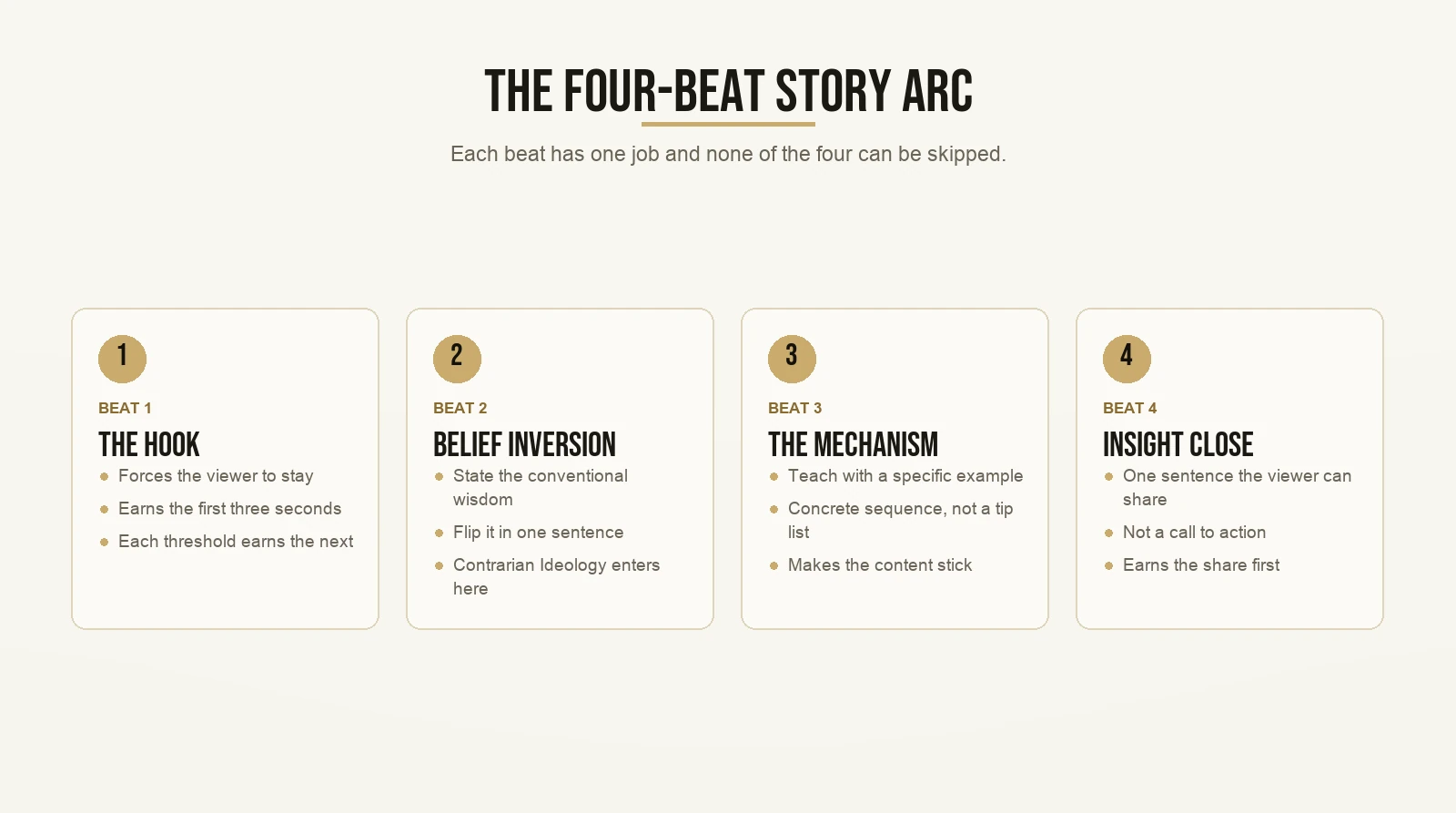
Four beats, each with one job. Hook earns the watch. Belief inversion establishes your position. Mechanism delivers the proof. Insight close earns the share. None of the four can be skipped on cold-audience content without losing either watch time or distribution.
Here is what each beat does in practice.
Beat one: the hook. Not a teaser. A statement that forces the viewer to stay in order to get the answer. “Here is what everyone gets wrong about growing on Instagram” is a hook. “Let me share my Instagram journey” is not. The hook earns the first three seconds. Those three seconds earn the next ten. You do not earn the whole video up front. You earn it threshold by threshold.
Hook writing is a skill that pays off on every single post you make.
Beat two: the belief inversion. Right after the hook, state the conventional wisdom and flip it. “Most people think storytelling is about being authentic. It is actually about being specific.” One sentence. Clean. That is the inversion. This is where Contrarian Ideology enters the story structure. It is not a section at the end. It is the second beat.
Beat three: the mechanism. This is the teaching section. Explain why the inversion is true using a specific example from your Credibility Bank. Not a vague anecdote. A concrete sequence of events that shows exactly how the mechanism works.
What not to do here: do not just list tips. Tips are forgettable. A mechanism is what makes content stick. “Post more stories” is a tip. “A cold viewer who lands on your profile from a viral Reel has about thirty seconds to decide if you are worth following, and your Highlights are the only permanent story surface that keeps working while you are asleep” is a mechanism. See the difference.
Beat four: the insight close. End on one sentence the viewer can take away and share. Not a call to action. Not “follow for more.” An actual insight.
“The most viral stories are not the most emotional ones. They are the most specific ones.” That is an insight close. Read that again. It is the line that earns the send. In longer formats, the call to action comes after. But the insight close earns the share first.
What About Instagram Stories vs. Reels for Business Storytelling?
Reels reach cold audiences through algorithmic distribution. Stories warm up the people who already follow you. Highlights convert cold visitors automatically around the clock. These three surfaces need each other. Running one without the other two leaves part of the system broken.
About 50% of all time spent on Instagram is now watching Reels. Cold viewers find your Reels through the algorithm. They did not choose to look for you. Your hook and story arc have to earn their attention from scratch.
Instagram Stories appear at the top of your followers’ feeds and disappear after 24 hours. They are a warm-audience tool. Behind-the-scenes content, daily context, polls that drive replies. The kind of content that builds a relationship after someone already trusts you.
Highlights are the bridge. They take story content and make it permanent so it works for cold visitors on demand.
Use Reels to bring cold audiences to your profile. Use Stories to deepen the relationship with warm audiences. Use Highlights to convert cold traffic automatically. That three-layer system is what makes instagram storytelling for business actually function as a business tool, not just a creative outlet.
How Do You Structure Your Instagram Highlights for Maximum Trust?
Three Highlights are the minimum for any business account: who you are, what you believe and teach, and what results real people have gotten. Each one answers a different question a cold visitor is silently asking. Miss any one of them and part of that visitor’s trust decision is left open.
Most creators either skip the Highlights section entirely or fill it with random saved stories. Neither approach works for cold traffic.
The first Highlight is your hero story. Not your product. Not your credentials. The story of where you started, what you tried, what changed, and where you are now. Keep it under five slides. Specific beats comprehensive every time.
The second Highlight is your belief system. What do you teach that most people in your niche get wrong? Why does that matter for your audience? State the belief clearly. This is Contrarian Ideology made permanent. The right people self-select immediately.
The third Highlight is results. Specific proof that your approach works for real people. Not polished marketing copy. Real outcomes with real details. Vague proof is easy to dismiss. Specific proof from a real person is hard to argue with.
You can see how different creators have structured this across a range of niches and business types.
When a cold visitor clicks through all three, they finish with enough context to make a decision. That is the job of the Highlights section. It converts the cold traffic your Reels send to your profile while you sleep.
What Are the Biggest Instagram Storytelling Mistakes for Businesses?
The biggest mistakes in instagram storytelling for business are architectural, not creative. Most creators build content for the audience they already have and never build the trust infrastructure that converts cold traffic. That is a growth ceiling built into the strategy itself.
Here are the most common ones.
Storytelling only for warm audiences. If every post assumes the viewer already trusts you, you are only reaching existing followers. That is not growth. That is maintenance. Instagram storytelling for business has to work on cold traffic.
Confusing a timeline with a story. A timeline reports what happened. A story argues a belief, proves it through a mechanism, and closes with an insight. The timeline is the raw material. The story is what you extract from it.
Treating Highlights as an archive. Highlights are not a scrapbook. They are trust infrastructure for cold traffic. Keep them tight, intentional, and current. Random Highlights signal a disorganized brand to the very people you most need to impress.
Optimizing for likes instead of sends. Likes are easy to count and satisfying to watch. But sends per reach is the signal that drives distribution to cold audiences. Ask yourself on every post: would someone send this to a friend? If the answer is no, the story is not finished yet.
Confusing authenticity with vagueness. “Be authentic” does not mean “be unspecific.” Authenticity earns trust. Specificity earns credibility. The strongest accounts on Instagram are both honest and precise. You need both.
How Often Should You Tell Stories on Instagram for Business?
Every post is a story. This is not a frequency question. It is an architecture question. The goal is not to tell one powerful story per month when inspiration strikes. It is to build a story architecture that lives inside every piece of content you make, every day you post.
When you internalize the four beats, instagram storytelling for business stops being a separate practice and becomes how you think about content. Every Reel has a hook, a belief inversion, a mechanism, and an insight close. Every Story has a job in the warmup sequence. Every Highlight has a role in the cold traffic infrastructure.
Consistency beats brilliance. An account that posts three times a week with a real story arc beats one that posts once a month with a masterpiece. Pick a cadence you can hold for months. Then hold it.
You get the gist. The architecture is simple. Four beats. Two frameworks. Three Highlights. The hard part is internalizing the system until it runs automatically. Once it does, every piece of content you make starts doing the work of building trust with people who have never heard of you, and that is where growth actually comes from.
Want the templates behind content that actually gets watched? Grab the templates here and start with the first one today.