
Key Takeaways
- Instagram Live surfaces at the front of the Stories bar, ahead of every static Story, and sends a push notification to followers’ phones. No other format on Instagram does both at once.
- Live reaches your warm audience: people who already follow you and have engaged with your content before. Reels reach cold strangers. These are different jobs, and mixing them up is one of the most expensive content mistakes you can make.
- The CCN framework explains which format serves which audience tier. Get this right and your content calendar becomes a system instead of a guessing game.
- The CIA framework gives your Live a clear three-part structure: Credibility opening, Insight block, Action close. No rambling. No wasted sessions.
- A repeatable monthly system: warm-up Reels plus a countdown Story before the Live, a structured 30-minute session, then 3 to 5 Reels clipped from the replay after. One Live feeds the whole month.
- You can schedule a Live up to 90 days in advance so followers can set a reminder and show up ready.
What Is Instagram Live for Business, and Why Are Coaches Using It Wrong?
Instagram Live is a real-time video broadcast where followers join, comment, and ask questions as you teach. It lives in the Stories surface, fires a push notification to active followers, and jumps to the front of the Stories bar. Most coaches treat it like a spontaneous Story post. That mental model costs them the most powerful conversion tool they have.
Most coaches know Instagram Live exists. Most of them also treat it like a bigger, louder Story post. They go live when the mood strikes, talk for a while, and wonder why the audience was small and nobody followed up.
The problem is not the effort. The problem is the mental model.
Live is not a spontaneous thing. It is the most powerful conversion slot in your entire content calendar. But only if you understand what it actually does and where it fits in your system.
This post is that system.
How Does Instagram Live Actually Surface to Followers?
When you go live, your broadcast jumps to the front of the Stories bar, ahead of every static Story, and sends a push notification to active followers’ phones. That combination of placement and notification is unique to Live. No other format on Instagram does both at once.
Instagram has confirmed this directly. Live is ranked inside the Stories surface, which uses viewing history, engagement history, and the closeness of the relationship between the viewer and the account.
That is the key phrase: closeness of the relationship.
The people who see your Live first are not random. They are the followers who have watched your Stories before, engaged with your posts before, and built up a pattern with you over time. Instagram surfaces your Live to the people who already trust you the most.
That changes everything about how you should use it.
Why Live Reaches a Different Audience Than Reels
Hold on. If Live reaches my followers and Reels also reach my followers, what is the real difference?
The difference is who else they reach, and why.
Reels are built for cold discovery. The algorithm evaluates a Reel on whether it will entertain or inform a complete stranger enough that they engage or share. When a Reel scores well, it pushes out to non-followers through Explore and the Reels tab. That is how you build an audience. Reels are your cold-discovery engine.
Live works on the opposite logic. Instagram’s own explanation of how Stories are ranked is built around signals like how often a viewer has watched a particular account’s Stories, how often they have engaged, and how close the relationship is overall. The people who show up to your Live are not strangers. They are your warmest followers.
And warm followers behave completely differently from cold ones. A cold viewer just found you. They are evaluating you. They are not ready to buy. A warm follower has been watching your content for weeks. They trust you. They know what you teach. They are much closer to taking the next step.
Reels build the audience. Lives convert it. Both are necessary. But treating them as interchangeable is one of the most expensive content mistakes a coach can make.
CCN: The Framework That Tells You Which Format Does Which Job

This is where Max’s CCN framework becomes super duper key. It is the clearest way to understand why Live and Reels need to work together, not replace each other.
CCN stands for Casual, Core, and Niche. It describes the three tiers of any audience you are building.
Your Casual audience is cold. These are people who have never heard of you. They stumbled onto one of your Reels through Explore or the Reels tab. They are scrolling fast. A great hook stops them, but they are not yet invested in who you are or what you teach.
Your Core audience is warm. These are your followers. They saw enough of your content to hit follow. They recognize your face. They have watched some of your Stories and read some of your captions. They are building trust with you over time.
Your Niche audience is hot. These are your most engaged followers. They comment consistently. They reply to your Stories. They watch everything you post. They are deep in your world and actively looking for a way to work with you.
Here is how this maps to format selection.
Reels are Casual content. Their job is discovery. They reach strangers and turn them into Core followers.
Stories are Core content. Their job is relationship-deepening. They keep warm followers engaged and move them toward Niche.
Lives sit at the Core-to-Niche transition. They activate your warmest followers and give them a reason to take the next step. When you skip Lives, you leave a gap at the exact moment followers are most ready to convert. They have watched enough of your content to be interested. They just have not had a live, unedited interaction with you yet. Live closes that gap in a way no pre-recorded format can.
But hold on, Max. What if I do not have a big following yet? Should I even go live?
Yes. Start now. A Live with ten viewers and a tight CIA structure does more for your business than a perfectly produced Reel that nobody shares. The system you build with ten viewers is the exact same system that scales to ten thousand. The structure is the point, not the audience size.
How Do You Warm Up Your Audience Before a Live?
Going live without preparation is like launching cold. Even warm followers need a reason to show up. A proper warm-up week primes your audience for the topic and dramatically increases how many people actually tune in.
Here is the structure.
Seven days before the Live. Post a Reel on the exact topic you plan to teach during the Live. If your Live is about converting DM conversations into clients, post a Reel on one specific DM tactic. The Reel does the cold-discovery work and warms up existing followers at the same time.
Three days before. Post a countdown Story. Tell your followers the date, the time, and the single biggest thing they will walk away knowing. Use Instagram’s countdown sticker. When a follower taps the reminder, they get an automatic calendar notification the moment you go live. That one tap removes the barrier of remembering to show up.
You can also schedule the Live inside Instagram up to 90 days in advance. A scheduled Live appears as a preview card in Stories and Feed, so your followers see the announcement multiple times before the broadcast.
The day before. Post a Story asking one question related to your Live topic. Something like: what is the one thing about signing clients through Instagram that still confuses you? The replies give you real questions to answer during the broadcast. The people who replied are primed to tune in because they want to hear their own question addressed.
For a deeper look at how to use Stories as part of this warm-up system, see how to use Instagram Stories to grow your audience.
CIA: The Framework for Structuring a Live That Actually Converts
Most Lives ramble. The presenter has a rough idea of what to cover, goes live, gets distracted by comments, answers a tangent, wraps up without a clear next step, and ends the broadcast. The audience enjoyed it but does not know what to do next.
The CIA framework fixes that.
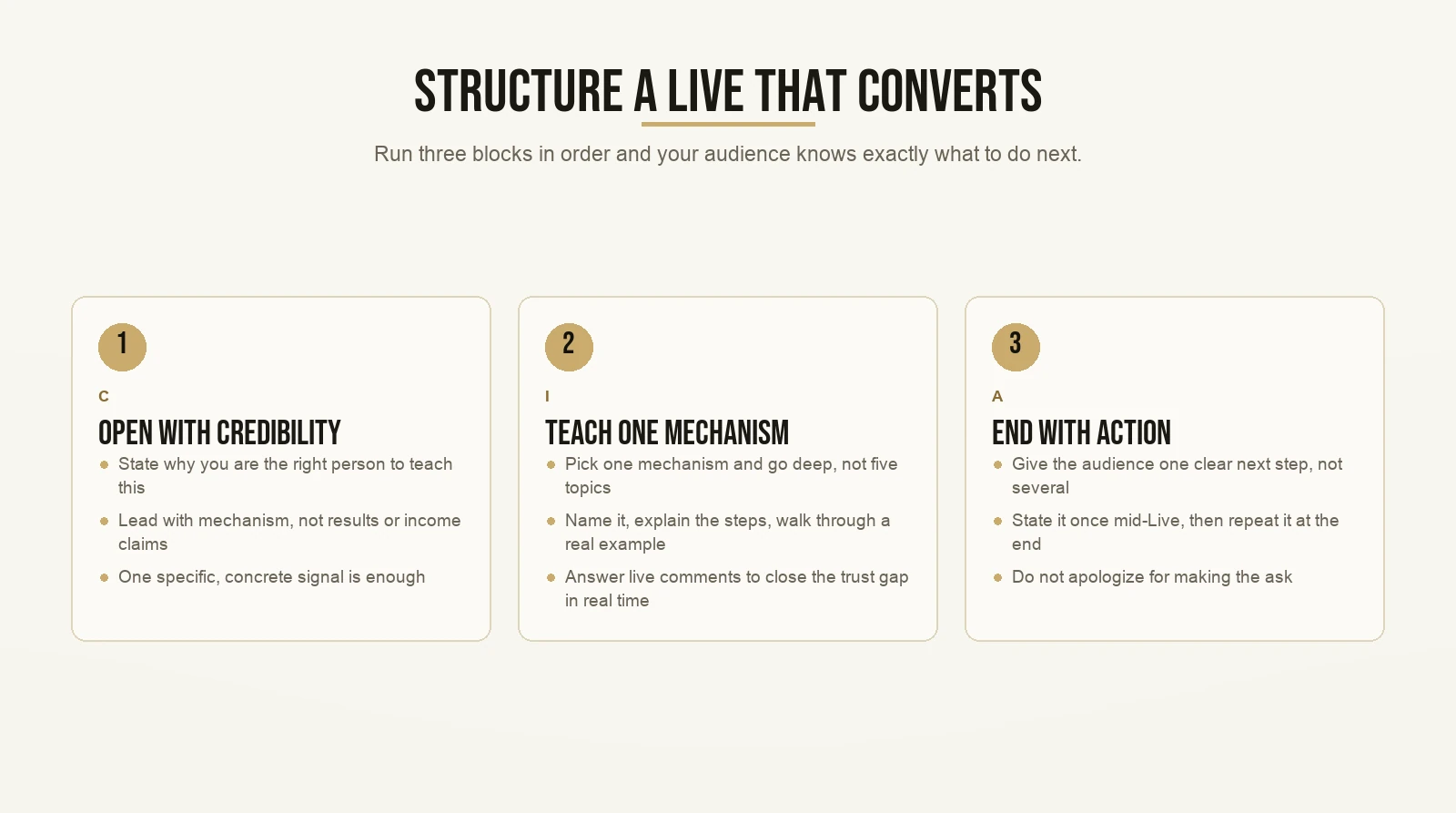
CIA stands for Credibility, Insight, Action. Every Live you run should follow these three blocks in order.
Block one: Credibility (3-5 minutes). Start by establishing why you are the person to teach this topic. Not a long bio. A specific, concrete signal that you have done the thing you are about to teach.
Here is what most people get wrong: they think credibility means showing off results. It does not. Credibility comes from mechanism. “I have worked with coaches who went from posting into silence to a full DM inbox in under 60 days, by making one specific change to how they end their Reels.” That is specific. That is a mechanism the viewer can picture working. That is credibility without a single income claim.
If you want to see what outcome-focused framing looks like in practice, the results page shows how to present proof without making the numbers the point.
Block two: Insight (20-25 minutes). Pick one mechanism and go deep. Not five topics. One.
Name the thing you are teaching. Explain why it matters. Show the step-by-step. Walk through a worked example. Give the viewer something they can use before the Live ends.
The temptation is to cram everything in because you are excited and have a lot to share. I understand that. But shut up and give the value. Pick one mechanism. Teach it completely. Walk through the worked example. A Live that teaches one thing well, with steps and a real example, converts at a higher rate than a Live that mentions ten things briefly. The viewer who walks away thinking “I know exactly what to do next” is the viewer who shows up in your DMs afterward.
Answer questions from the comments during this block. That live interaction is what separates a Live from any pre-recorded format. The viewer who asks a question and gets a direct answer on camera is now deeply invested in what you are doing. That investment is the trust gap closing in real time.
Block three: Action (3-5 minutes). End with one clear next step. One.
It could be a comment keyword. “Type the word LIVE in the comments and I will send you the guide I just mentioned.” It could be a link in bio. It could be an invitation to reply to your next Story.
Say it once during the Insight block when it is most relevant, and say it again clearly at the very end. Do not apologize for it. Your audience came to learn and to get a result. Pointing them to the next step is part of delivering on that. Boom.
What Do You Do After the Live?
The Live is 30 minutes. The content it generates should last the whole week. Save the replay immediately, post it as a permanent video within 24 hours, and pull at least 3 Reels from the sharpest moments. One session fuels 7 to 10 days of content.
Right after the broadcast ends, save the replay to your camera roll. Then share it as a permanent video post on your profile so followers who missed the Live can watch the full session later.
Then watch the replay and find the three to five moments where the teaching was sharpest. The moment where you made a specific point and the comments blew up. The moment where you answered a question and you could see people getting it. Each of those moments is a Reel.
Clip them. Add a caption that sets up the point before the clip starts. Post one per week over the next month.
These Reels do the Casual-audience discovery work that the Live itself cannot do. Cold viewers find you through the Reel, see that it came from a Live, and follow you to catch the next one. The CCN cycle continues and feeds itself.
For a bigger-picture look at how all the formats work together, see the guide to types of Instagram posts and which one to use when.
How Often Should You Go Live for Business?
Once a month is the right starting point for coaches and service providers who are also posting Reels and Stories regularly. A Live done well accounts for roughly three weeks of your content calendar, including the warm-up week before and the clip-extraction week after.
Here is the math. A Live has a warm-up week before it and a clip-extraction week after it. That is three weeks of your content calendar touched by one session. If you try to go live every week on top of posting Reels and Stories, something will slip in quality.
Monthly Live, consistent weekly Reels, and regular Stories is a system most coaches can actually sustain without burning out. Start monthly. Build the system. Let the quality compound. You can always add a second monthly Live once the first one is dialed in.
The bigger mistake is not frequency. It is randomness. A monthly Live on a predictable schedule trains your audience to show up. A random, unannounced Live trains them to miss it.
Does Going Live Work If You Hate Being on Camera?
Yes, with the right setup. Instagram’s Practice Mode lets you run a private broadcast before going public. The co-host feature turns a monologue into a conversation. The first few broadcasts feel uncomfortable. That discomfort goes away faster than most people expect.
Hold up, Max. I am an introvert. I freeze on camera. Am I supposed to just push through?
Kind of. But there are tools that make it much easier.
First: Practice Mode. Before your first public Live, run a private broadcast using Practice Mode. Nobody sees it. You run through your CIA structure, check your lighting and audio, and get comfortable talking to a camera before any viewer shows up. The first Practice Mode session feels awkward. The third one feels routine.
Second: co-host. Instagram lets you bring another person onto your Live. Invite a colleague, a peer in a different niche, or a past client who is comfortable on camera. A conversation is much easier than a monologue. You are bouncing ideas back and forth instead of performing to a lens.
Third: smaller scope. Your first Live does not need to be a 45-minute masterclass. Set a 20-minute Q and A on a specific topic and tell your audience that is exactly what it is. The contained scope means less to worry about, and you still deliver real value.
The discomfort is real. It also goes away faster than you think. The fifth Live feels nothing like the first one. For more on showing up as a creator without it feeling forced, the post on Instagram for introverts covers the practical side before your first broadcast.
What Does the Full Monthly Live System Look Like?
Here is the complete system in one place. Four weeks. One Live. A full month of content that runs the CCN and CIA frameworks from end to end.
Week 1: warm-up. Post a Reel on the Live topic. Post a countdown Story with a reminder sticker. Post a question Story the day before to collect real questions from followers.
Week 2: Live week. Run the CIA structure: 3-5 minute Credibility opening, 20-25 minute Insight block with live Q and A, 3-5 minute Action close. Save the replay immediately. Post it as a permanent video within 24 hours.
Weeks 3 and 4: clip extraction. Pull 3-5 Reels from the replay. Post one per week. Use Stories to direct warm followers back to each clip. Begin warming up the audience for next month’s topic by posting the first Reel on the new subject.
Four weeks. One Live. No guessing what to post. No last-minute scramble. Just the system running the way it is designed to run.
For the DM side of what happens after a Live, when warm followers reach out ready to learn more, see how to sell coaching in your Instagram DMs.
A Fast Checklist Before You Hit Broadcast
These are the basics. Get them right every time.
- Lighting. Natural light from a window is the easiest option. A ring light or camera light is second. Overhead room lighting creates shadows on your face and looks flat on camera. Viewers make a judgment call in the first few seconds. Good lighting is not optional.
- Audio. Use headphones with a mic or a clip-on mic if you have one. Clear audio matters more than video quality. A slightly grainy video with great audio is watchable. Great video with muffled audio is not.
- Outline. Have your CIA talking points written on paper or on a second device next to your camera, not on your phone. You want your eyes close to the lens, not looking down at a screen.
- Day-of announcement. Even if you already ran the countdown Story, post a quick Story the morning of the Live reminding followers it is happening today.
- Know your Action close. Write out the exact words you will say at the end and say them out loud before you go live. The CTA is the one part you cannot improvise.
According to Pew Research Center, half of U.S. adults use Instagram. The audience is there. The only question is whether your Live gives them a reason to show up, a reason to stay, and a clear next step when it ends.
Get those three things right and the format does the rest. Instagram for Creators also offers tools like Badges and Subscriptions that let you monetize Lives directly, but for most coaches the bigger payoff is the DM that comes in after a viewer spent 30 minutes watching you teach in real time with no edit, no retakes, and no script to hide behind.
That trust builds fast. Faster than any static post. That is freaking unique to Live, and it is the reason this format belongs in your monthly rotation.
Want the templates behind content that actually gets watched? Grab the templates here and start with the first one today.