
Key Takeaways
- The Instagram Collab feature lets up to five accounts co-author a single Reel. The post lives on every collaborator’s grid with pooled likes, comments, saves, and shares.
- Partner selection is the whole game. You want an account whose followers already buy, not just scroll.
- Two frameworks explain why collabs work: the credibility bank (your partner loans you their earned trust with their audience for the duration of that reel) and CCN (cold audiences need a track record signal immediately; a collab delivers it before you say a word).
- Adam Mosseri confirmed in January 2025 that sends per reach is the top signal for reaching non-followers. A collab earns sends from two engaged audiences at once.
- You do not need a large following to pitch. You need a qualified topic and a clear value exchange for the other creator’s audience.
- Running a Trial Reel on your topic before pitching gives you real performance data to include in the pitch instead of asking someone to bet on an untested idea.
If you want to know how to use Instagram collaborations to reach coaching clients, most advice online gives you one sentence: “do a Live with someone in your niche.” That works. But it is not the mechanic that compounds. This post is about Collab Reels, the co-authorship feature that pools reach across multiple profiles and transfers credibility from an established audience to you. Here is how to identify the right partner, qualify them before you pitch, and structure the pitch so they actually say yes.
What Is the Instagram Collab Feature?
The Collab feature lets you invite up to four other accounts to co-author a single Reel or feed post. Each invited account must accept the invite. Once live, the post appears on every co-author’s profile grid simultaneously with likes, comments, saves, and shares all pooled into one count.
That is not a repost. Reposts are copies. A Collab is one original piece of content living on multiple grids at the same time.
That distinction matters now more than it used to. Since April 2026, accounts that post mostly reposted content are removed from Instagram recommendations entirely. A properly executed Collab is original to every co-author’s grid. The algorithm treats it as fresh content for each audience it reaches. Meta’s official help page on collaborative posts lays out the full mechanic: one invited post, one pooled engagement count, live on every collaborator’s profile.
Why Most Coaches Fail at Using Instagram Collaborations to Reach Coaching Clients
Most coaches think “Instagram collabs” means going Live together or swapping story shoutouts. Those are fine tactics. But neither one compounds.
A Live ends when it ends. A story disappears after 24 hours. A Collab Reel stays on both profile grids indefinitely. It keeps accumulating engagement. Every time someone sends it to a friend, the algorithm pushes it to more non-followers. The organic life of a Collab Reel is longer than almost any other format on the platform.
The other reason coaches skip it: they pitch the wrong people or pitch with nothing to say. They send something vague to a large account, get ignored, and decide collabs are not worth the effort.
They are worth the effort. You just need a framework for who to pick and what to say.
The Credibility Bank: Why Collabs Work When Solo Content Does Not

Here is the first framework you need. It is called the credibility bank.
Every creator builds a credibility bank with their audience over time. Every Reel they post, every comment they answer, every story they share – it is all a deposit. Their followers develop a strong sense of who this person is and whether they deliver real value. That accumulated trust is the credibility bank.
When you post a solo Reel to a cold audience, you start from zero. They do not know you. There are no deposits in your credibility bank as far as they are concerned. They decide in the first two seconds whether to keep watching based only on your hook.
A Collab Reel changes your starting position.
When a creator whose audience already trusts them co-authors a Reel with you, they loan you a portion of their credibility bank for the duration of that reel. Their followers see the post on a grid they trust, notice you as the co-author, and arrive at your content pre-warmed. You are not a cold stranger. You are someone their trusted account just vouched for.
Read that again.
You are not starting cold. You are starting vouched for.
That is the entire mechanism behind why a well-matched collab outperforms most solo cold-audience content. You bypass the “who is this person and why should I care” question that kills most first impressions. I have watched coaches with fewer than 3,000 followers build real client pipelines through collabs with the right partners, simply because the credibility transfer did the work that solo posting could not do fast enough.
You can see how Max applies this principle with his own clients on his results page – the consistent pattern is credibility built through proof of the mechanism, with the right partnerships accelerating that with cold audiences faster than solo content typically can.
The CCN Test: Are You Reaching the Right Cold Audience?
The second framework is CCN.
CCN is the principle that cold audiences need to understand your track record immediately. Not eventually. Not after they visit your profile and scroll your highlights. Right now, in the moment they first encounter your content.
Cold viewers have no existing reason to stick around. Something in the first few seconds has to signal: this person delivers value, and here is why I know that. Without that signal, genuinely good content still gets scrolled past.
Most coaches fail this test on solo content. The teaching is solid but the credibility signal is missing. They lead with the tip instead of leading with why they are the right person to give it.
The Collab Reel solves the CCN problem before you open your mouth.
When a trusted creator co-authors a Reel with you, the placement itself is the credibility signal. The viewer finds the post on a profile they already follow and respect. Your face appears. You are already contextualized as someone worth watching. The CCN requirement is satisfied by the partner’s presence on the post, not by anything in your hook.
That is a real structural advantage over posting cold and alone.
But here is the catch. It only works if your partner passes the CCN test themselves. An account whose audience does not trust them cannot transfer credibility they do not have. That gives you a post with two names on it, nothing more.
The CCN filter applies to partner selection as much as it applies to your own content. Ask yourself: does this creator’s audience already understand and trust their track record? If yes, a collab with them passes CCN for you. If no, find a different partner.
What Does a Complementary Account Actually Mean?
A complementary account is one whose audience overlaps with the kind of person you serve, without their offer competing directly with yours. Both audiences share an underlying desire. They just approach it from different angles.
A business coach and a mindset coach are complementary. A fitness coach and a nutrition coach are complementary. A social media coach and a copywriting coach are complementary – the same person who wants to grow on Instagram probably also wants better captions. Same buyer, different tool.
What is not complementary: two coaches who teach the same thing to the same person with overlapping offers. That is competition, not collaboration.
Hold up. What if both accounts are business coaches but to slightly different sub-audiences?
The tie-breaker is the offer, not the topic. If your audience would genuinely buy their thing and their audience would genuinely buy yours, it works. If you are both essentially competing for the same sale from the same person, skip it.
Does the Partner’s Follower Count Matter?
Not as much as you think. A 20,000-follower account whose audience comments on sales-adjacent content and buys things is worth more to you than a 200,000-follower account full of passive scrollers.
According to DataReportal, 64.6% of Instagram’s global audience falls between 18 and 34 years old – a demographic that engages and buys. But the demographic does not tell you whether the specific account in front of you has trained their followers to take action.
The first filter is not size. The first filter is: does this audience buy?
An account with a smaller following that sells something consistently is a better collab partner than a large account with no offer and no commercial engagement. You get the gist. Monetizable followers beat empty views every time.
How to Use Instagram Collaborations to Reach Coaching Clients: The Four Qualification Checks
Before you pitch anyone, run through these four checks.
One: Does this account have an active offer?
Go to their bio. Is there a link? Does it go to a landing page, a booking form, a product, or a community? If there is no link, or the link goes nowhere, their audience is not being trained to take action. Skip.
Two: Does their audience engage on sales-adjacent content?
Scroll their last 20 Reels. Find any posts that reference their coaching, their method, or their offer. Look at the comments. Are people asking how to work with them? Are they saying “I needed this” or “DMing you now”? That is buyer-ready engagement. If only the entertainment clips get comments and everything offer-related gets silence, their audience is not primed to act.
Three: Is their content style compatible with yours?
You do not need matching aesthetics. But if their production quality is wildly different from yours, the joint post will feel forced to both audiences. You want enough visual overlap that the collab looks intentional, not like two strangers stitched together.
Four: Are they posting consistently?
A grid that went quiet three months ago has a smaller active audience than one posting every other day. Check recency, not just quality. A dormant grid limits your reach even if the existing content is excellent.
If all four pass, this is a qualified partner. Now you can think about the pitch.
What Does the Sends-Per-Reach Signal Have to Do With This?
Sends per reach is the metric that determines whether your content reaches people who do not follow you. Adam Mosseri confirmed in January 2025 that the top three ranking signals are watch time, likes, and sends. For content reaching non-followers specifically, sends per reach is the primary driver.
A “send” means a viewer forwarded the Reel to someone else via DM. It is the clearest signal that a viewer found the content genuinely valuable – valuable enough to tell another person about it.
Here is why this matters for collabs.
A well-matched Collab Reel reaches two distinct engaged audiences at once. Both audiences are watching because they trust the creator on whose grid they found it. If the topic lands, both audiences send it to their networks. You earn sends from two follower pools simultaneously.
That compounds the unconnected-reach signal. The algorithm reads those sends and pushes the Reel further into non-follower territory. Two qualified audiences sending to their own networks feeds the algorithm more signal than a single larger passive audience would on its own.
That is why a collab with a smaller, highly engaged account can outperform a solo Reel on a much larger one. The algorithm responds to sends per reach, not raw follower count.
How Do You Find the Right Partners?
Start with the accounts your own audience already engages with, then expand to adjacent niches through keyword search. Run every candidate through the four qualification checks. You are looking for an account with an active offer and an audience that buys, not just a large following.
In practice: go to your most-commented Reels and look at the accounts that show up most often. Follow a few. See who they follow in turn. You are looking for creators your audience already trusts, because if your existing followers trust someone, there is a strong chance that creator’s followers would trust you.
Then search by keyword in the Instagram search bar. If you are a business coach, search “mindset coach” or “productivity coach.” If you are a fitness coach, search “nutritionist” or “health coach.” Scroll recent posts and apply the four checks.
Do not bother with hashtag searches. The algorithm classifies content now based on what is actually in the video – the words spoken, the visuals, the engagement patterns. Hashtags are outdated as a discovery tool. Keyword search in the bar is more effective for finding active creators in your space.
The Creator Marketplace that Meta expanded in 2024 is primarily a brand-to-creator tool, but browsing it surfaces active creators in adjacent niches who are already open to collaboration conversations.
What Should You Say in the Pitch?
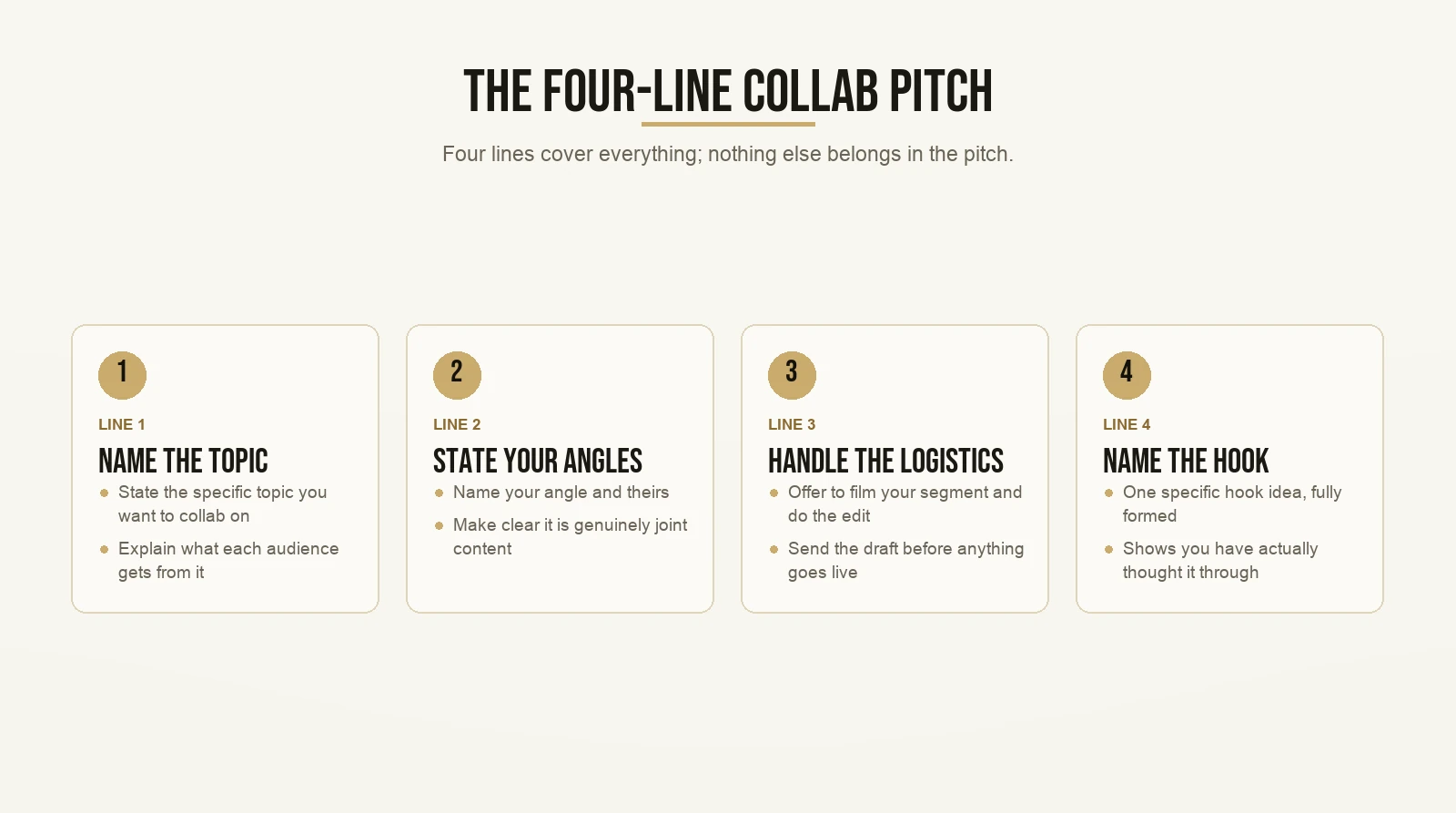
Keep it to four lines. No longer.
Most collab pitches are too long. They read like a cover letter. Nobody wants a cover letter. They want to know in under 60 seconds of reading whether working with you is worth their time. I have seen coaches pitch in three sentences and book a shoot that same week. I have also seen coaches write six paragraphs and never hear back. The length of your pitch is inversely related to its effectiveness.
Here is the structure.
Line one: Name the specific topic and explain why it serves both audiences. “I would love to do a Collab Reel on [topic]. Your audience wants X and mine wants Y, and this bridges both.”
Line two: Say what each of you brings. Name your angle and theirs. Make it clear this is genuinely joint content, not you asking them to appear in your video.
Line three: Offer to handle the logistics. You will film your segment, do the edit, and share the draft before it goes live. Take the friction off their plate.
Line four: Name the specific hook idea you have in mind. One sentence, so they can see you have actually thought about it and it is not vague.
That is the complete pitch. No pitch deck. No brand kit. No follower count.
Hold up. Should I mention my following to show I am worth their time?
No. That frame puts the focus on you. The pitch should be about the value to their audience. If your four lines make it clear their audience gets something genuinely useful, your follower count is irrelevant. A weak pitch is not saved by a big number.
One more thing: make it specific to them. Reference a Reel they posted recently or a topic they return to often. Show them you actually follow their content, not just their follower count.
Should You Run a Trial Reel Before Pitching?
Yes. Run a Trial Reel on your topic first, every time.
Instagram’s Trial Reels feature shows your Reel to non-followers for roughly 24 hours before a full publish. Meta’s own data found that 40% of creators who used Trial Reels started posting more often, and 80% of those saw an increase in reach from non-followers. It is a low-risk test run with a cold audience before you commit to anything.
Run the topic solo as a Trial Reel. If it performs in your top quartile, meaning the average watch time and sends per reach beat most of your other content, you have validated that cold audiences respond to this topic. Now you have evidence.
Include it in the pitch. “I ran a trial on this exact topic and it outperformed my top 25% of content. I think a collab version of this lands well on both grids.”
That respects the other creator’s time. You are not asking them to bet on an untested idea. You are arriving with a data point.
How Do You Structure the Collab Reel?
Two co-authors is the right number for most coaching collabs. Instagram allows up to five co-authors on a Collab post or Reel, but three or more tends to feel like a panel, which is harder to structure in a short video and harder for either audience to follow.
The format that works: a genuine back-and-forth where each person adds something the other cannot. A strong structure uses three beats: you state the problem, they add their angle, you bring it together with the practical takeaway. Each beat is one clear idea. No rambling.
Keep the video to 30-45 seconds if you can. Shorter videos are easier to watch all the way through. The longer a video, the better it needs to be to earn full watch time. A sharp 30-second collab beats a three-minute one that meanders. Pretty straightforward in principle, but most people push too long.
Write the hook together. The first line determines whether either audience watches past the two-second mark. Spend more time on that one line than on anything else in the entire video. Boom – that is where the reel wins or loses.
What Happens After the Reel Goes Live?
Watch the sends, not just the likes.
Likes are a positive signal. But sends per reach tells you whether the content is spreading into new networks. If your sends per reach on the Collab Reel beats your account average, the mechanic is working. If it falls short, the topic or execution missed somewhere and you adjust.
Reply to every comment on the Reel, on both your grid and your partner’s grid. New followers from the collab are watching to see how you show up. Responding converts a passive viewer into someone who remembers your name next time they see your content.
If the reel performs well, pitch a second one with the same partner. One collab does not build a relationship. Three collabs over three months with the same creator builds an audience that starts to associate you with each other. That compounding effect is something solo content cannot replicate on its own.
Extend the momentum through your Stories in the next 48 hours. Reference the reel and point viewers toward a next step – your story-to-call sequence or your DM follow-up process can turn new followers into active conversations before they forget why they followed.
The collab opens the door. Your follow-up content keeps people walking through it.
How to Use Instagram Collaborations to Reach Coaching Clients Every Quarter
One collab is a tactic. A quarterly habit is a growth system.
Map four qualified accounts per quarter. One per month to pitch, one in reserve in case timing does not work. Qualify all four against the four-filter check before you reach out. Test each topic with a Trial Reel. Send the pitch. Produce the reel. Watch the sends.
Four well-chosen collabs per quarter means four warm audience introductions. Each one grows your following with people who were already primed to trust you before they hit follow.
Anywho – that is the compounding version of how to use Instagram collaborations to reach coaching clients consistently. Not a one-off experiment, but a repeatable system built into your content calendar.
If you are still building the content foundation that makes a collab pitch worth sending, the Instagram launch content plan for coaches and the guide on building a personal brand on Instagram will give you the scaffolding to get there.
Want the templates behind content that actually gets watched? Grab the templates here and start with the first one today.