
Key Takeaways
- Instagram ended native in-app checkout in September 2025. The bio link, Stories link sticker, and DM automation are the three viable paths for delivering a digital product to buyers today.
- Templates outsell almost every other digital format as a first product on Instagram because the value is visible before the buyer purchases. No explanation required.
- The CIA framework is a 5-frame story arc that replaces a landing page for low-ticket offers. Each frame does one job. The sequence closes the sale inside Stories.
- Your first digital product is the foot in the door, not the destination. Build something small, deliver more than expected, and earn the trust to sell something larger to the same buyer later.
- The credibility bank must be filled before you launch. Teaching content is a deposit. Selling content is a withdrawal. Make enough deposits first.
What actually is a digital product you can sell on Instagram?
A digital product is anything you create once and deliver instantly: a template, a checklist, a script pack, a short course, or a swipe file. No shipping, no inventory, no delivery window. The buyer pays and receives access immediately. That is the whole transaction.
There are many formats in this category. Not all of them are equally easy to sell on Instagram.
A course requires you to convince someone the content is valuable before they can verify it. An ebook asks the buyer to trust your description without seeing the material. A template shows them exactly what they are getting the second they see the preview image.
On Instagram, a viewer decides whether to keep watching in under three seconds. Visible formats beat described ones every time. The buyer either understands the value immediately or they scroll past.
This is not about which format is objectively best. It is about which format requires the least selling. On Instagram, that is the template.
The format is only half of the equation, though. The other half is knowing how to position it without a separate sales page, an email funnel, or a full external checkout setup. Most guides skip that half entirely. This one does not.
Why does the format matter so much for selling on Instagram?
The format determines how much selling you have to do before the buyer taps. A format with visible value requires almost no persuasion. A format with hidden value requires a lot. For Instagram specifically, visible beats described every time.
Think about what it takes for someone to buy something they cannot directly see. You have to describe the contents in detail. You have to establish those contents are worth the price. You have to overcome the suspicion that this is just another download they will forget about.
That is a heavy lift inside a story frame or a Reel caption.
Now think about a well-structured template. The buyer sees the format in the preview image. They think: “I could use that today.” The decision is mostly made before they read the caption. The caption just confirms it.
This is why a template is the right format to start with. Not because templates are best for every business. Because they compress the time between seeing and buying to almost nothing.
Once you have made your first sale and understand how the system works, you can build formats that take more explaining. The format you choose also changes what post type you need to promote it – and that decision is worth making deliberately.
What is actually dead advice about selling digital products on Instagram?
Product tags for digital goods have never worked. Meta’s Commerce Policy bans digital downloads, ebooks, subscriptions, and templates from Shopping catalogs entirely. And native in-app checkout ended in September 2025. Every shop now redirects to an external website. Any guide that tells you to enable checkout on Instagram for a digital product is stale.
Here is the breakdown of what is dead and what works now.
Dead:
- In-app payment flows. Ended September 2025. All Instagram shops now redirect externally.
- Product tagging digital goods. Never worked. Meta’s Commerce Policy has always prohibited it.
- IGTV. Shut down in 2022.
- The 10,000-follower requirement for Stories link stickers. Removed in October 2021. Any account can use one today.
Works now:
- Bio link pointing directly to your checkout or product page.
- Stories link sticker. Drop the checkout link inside a story frame. The viewer taps once and lands at your checkout. No “link in bio” detour.
- DM automation. Ask viewers to comment a keyword on a Reel. They automatically receive the link in a DM. This is the most common low-friction path right now.
The Stories link sticker is the one most people underuse. The buyer is already watching your story when they tap it. They do not have to leave the app, find a bio, and navigate from there. Tap once, done.
Combined with the right story sequence, that link sticker turns your Stories into the entire sales mechanism. You do not need an external sales page for a low-ticket offer. You need five well-structured frames and a checkout page that loads fast.
What is the CIA framework and how does it sell your product in five frames?
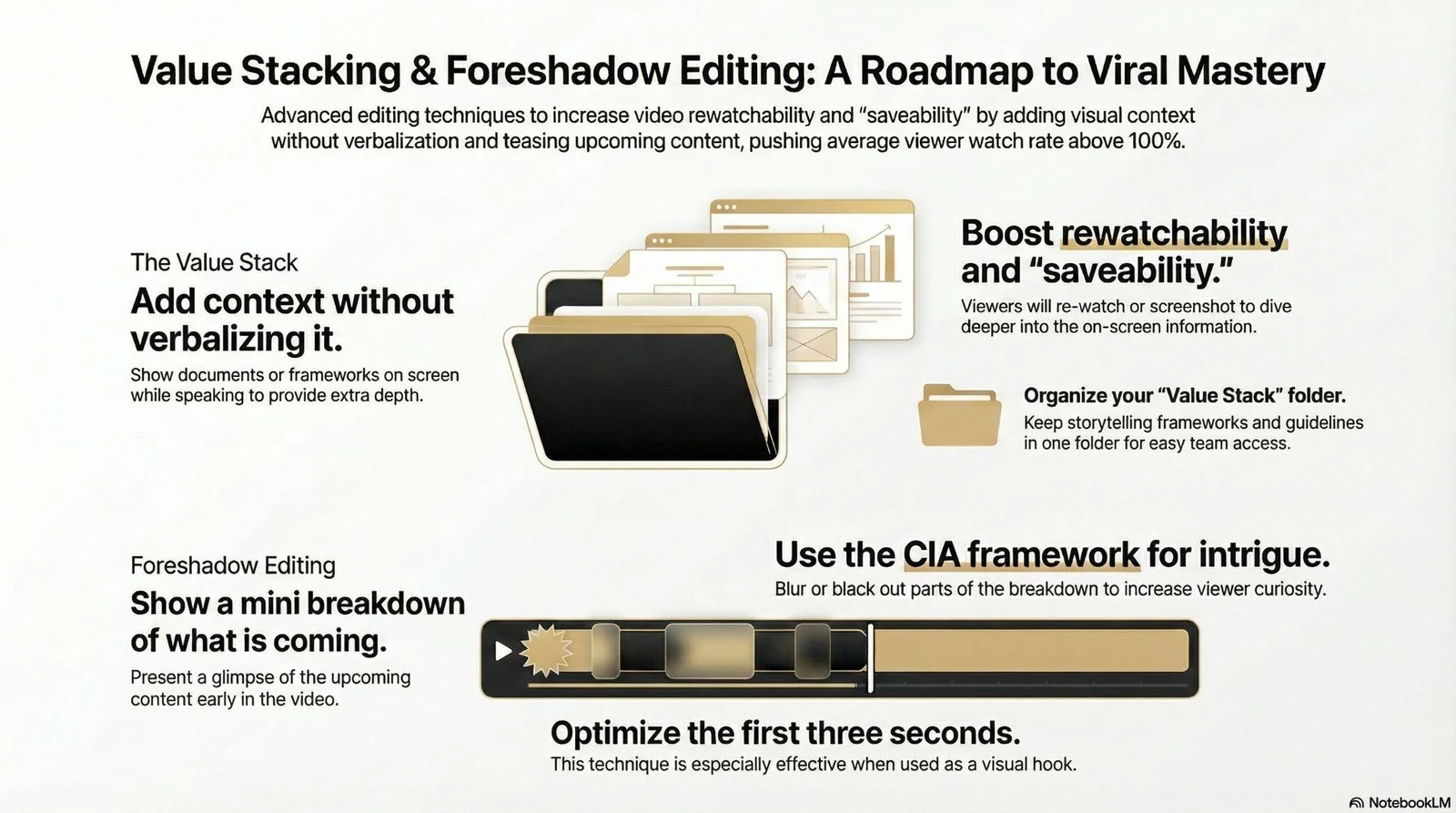
The CIA framework is an Instagram Stories sequence where each frame does exactly one job. Run the five frames in order and the viewer moves from recognizing the problem to tapping the link sticker. No landing page, no email sequence, no external funnel needed for a low-ticket offer.
Here is how each frame works.
Frame 1: The problem. Name the specific problem your buyer has right now, in their own words. Not marketing language. The exact phrase that shows up in comments and DMs. “You keep posting and nothing happens” lands. “Building brand awareness is challenging” does not. Use their words.
Frame 2: Why the usual fixes do not work. This frame separates your offer from every guide the viewer has already downloaded and ignored. The reason their current approach fails is not lack of effort. It is a missing piece. You name that piece specifically.
Frame 3: The mechanism. Introduce your product as the answer to frame 2. Do not describe what it contains. Describe what it does. “This template gives you the exact caption structure that gets saves” is a mechanism. “This is a comprehensive caption writing guide” is a description. Mechanisms sell. Descriptions do not.
Frame 4: Proof. One specific outcome, described as a behavior change or a measurable result. Not a revenue figure. Before: writing a caption took 45 minutes and nothing got saved. After: ten minutes and three consecutive posts each got saved over 200 times. That is proof the buyer can picture applying themselves.
Frame 5: The offer. State the price, drop the link sticker, tell them what to do. One sentence. Done.
Pretty straightforward when you look at the structure. Here is a worked example. Say your product is a Reels script template for coaches.
- Frame 1: “You spend two hours filming a Reel and it gets 80 views and dies.”
- Frame 2: “The problem is not the filming. It is the structure. Most coaches open with context instead of a hook that holds the first three seconds.”
- Frame 3: “This script template gives you the exact opening line framework that keeps watch time past the three-second mark.”
- Frame 4: “I used this on three consecutive Reels. All three reached viewers who had never seen my account. The three before them barely made it out of my existing followers.”
- Frame 5: “Tap the link. Instant download.”
Five frames. Each does one job. The viewer who reads all five does not need a sales page. They already have everything they need to decide.
This is what none of the other guides on how to create a digital product to sell on Instagram actually teach. They tell you to build a landing page, set up a Gumroad storefront, run traffic to an external funnel. The CIA framework cuts all of that out for a low-ticket offer because the story arc does the work the sales page was doing.
What is the credibility bank and why do you need to fill it before you launch?

The credibility bank is your track record of demonstrated expertise, built through teaching content before you ever need to sell anything. Not screenshots of income. Specific, observable proof that you know what you are talking about: processes you have walked through, outcomes described in concrete terms, a client’s words about what changed.
Here is why this matters for digital products specifically.
Nobody buys from someone they just met. Not even for a low-ticket template. The buyer has to believe you know what you are doing before they tap the link sticker. If your account is three weeks old and every post is “buy my template,” the credibility bank is empty. The CIA sequence cannot close a sale when the bank is overdrawn.
If you have spent eight to twelve weeks consistently teaching the problem your product solves, the buyer arrives at your story arc already persuaded. They have watched your teaching. They trust the mechanism. The CIA sequence confirms a decision they were already making.
The bank works on deposits and withdrawals. Every teaching post is a deposit. Every proof post is a deposit. Every selling post is a withdrawal. Make enough deposits before you start making withdrawals. You get the gist.
Hold up. Max, what counts as a deposit if I cannot use revenue numbers?
Fair question. Here is what fills the bank:
- A specific process, taught step by step with the outcome described in behavioral terms
- A mistake you made, what caused it, and what you changed afterward
- A before-and-after of a skill measured in time, saves, watch time, or responses – not dollars
- A result described from the inside: what it looked like before, what changed, what it looks like now
- A client’s exact words in a screenshot about the specific thing that shifted
None of those need a dollar figure. All of them build trust. And trust is the only thing that converts a viewer into a buyer. More on building your credibility bank in practice here.
For a fuller picture of how Max applies this teaching across different niches and audience types, his approach and background are covered here.
Reels bring the audience. Stories close the sale. How do you connect them?
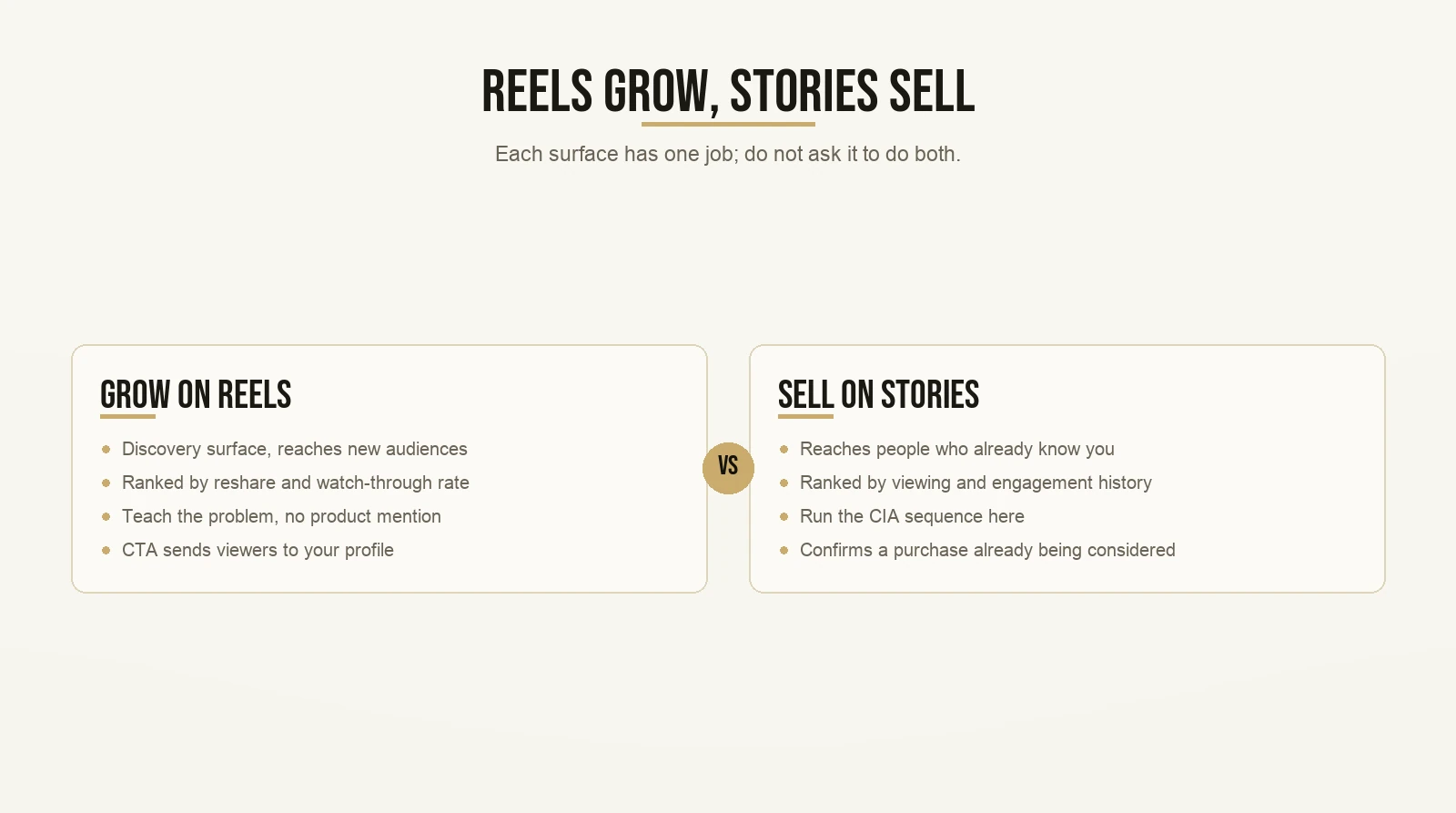
Post a Reel that teaches the problem your product solves. Do not mention the product in the Reel. End with a CTA telling viewers to follow for the solution. Then run the CIA sequence in Stories. The Reel feeds the audience. The story arc closes the sale. Neither surface works well when you ask it to do both jobs.
Instagram’s own ranking explanation makes the distinction clear. Reels are a discovery surface. The primary ranking signal is reshare rate, followed by watch-through rate. That means the algorithm shows your Reel to people who have never heard of you. Reels are an acquisition tool.
Stories work differently. They surface based on viewing history, engagement history, and closeness to the account. Stories reach the people who already know you. They are a conversion tool.
Most creators get this completely backwards. They sell on Reels and try to grow on Stories. The result is a Reel that sounds like an ad, which kills the reshare rate and tanks the reach. And Stories nobody sees because the account has no audience yet.
Flip it. Grow on Reels. Sell on Stories.
Reels can now run up to 3 minutes. That is more than enough time to teach one idea thoroughly, build genuine trust, and close with a CTA that sends the viewer to your profile. By the time they reach your story arc, they have already watched your teaching. The CIA sequence confirms a purchase they were already considering.
If you already have a service business, this setup runs in parallel with what you are doing now. The Reel attracts new people. The story arc sells the template. The relationship that follows sells whatever comes next.
What should your first digital product actually be?
The right first product is the answer to the question you get asked most. Not the product you want to build. The one your audience is already asking for. Comments, DMs, and replies are the market giving you a product brief in real time. Build exactly what it describes.
If three people messaged you this month asking how you structure your captions, the product is a caption template. If they ask how you plan your week of content, it is a content planning template. If they ask what tools you use, it is a resource guide.
The question was already doing your product research for you.
Here is the freaking important part. Your first digital product is not the destination. It is the foot in the door. Read that again.
The goal of a low-ticket offer is not to build a business on it. The goal is to convert a stranger into a buyer. A buyer who paid for something small and got more than they expected will seriously consider paying for something larger. That is how the relationship builds.
This reframes the question of what to build first. If you think the first product has to carry your whole business, you will overbuild it, overprice it, or both. Build something specific. One problem, one solution, one format. Price it low enough that the decision feels easy. Deliver more than the buyer was expecting. Now you have a customer, not just a transaction.
The higher-ticket offer, the coaching, the deeper course – those come later, to the same buyer who already trusts you. The first product earns you the right to have that conversation.
How do you know if your product is actually worth selling?
Three tests. Would you buy it? Can you describe what it helps the buyer do in one sentence? Is the format obvious from a single image? Pass all three and you have something worth launching. Fail any one and simplify until it passes.
But Max, I keep second-guessing whether what I built is good enough. What do I actually check?
Fair. Run the three tests.
Test one: would you buy it yourself? Not “is it complete enough.” If someone else made this exact product, would you pay for it? Honest answer only. If no, simplify until the answer is yes.
Test two: can you describe what it helps the buyer do in one sentence? Not what it contains. What it helps them do. “This template helps you write a caption in ten minutes that gets saves” is a product. “This is a comprehensive guide to Instagram content strategy” is a topic. Products have a specific outcome. Topics do not.
Test three: is the format immediately obvious from a single image? On Instagram, the product has to communicate what it is without explanation. A Canva template does this. A checklist does this. A 45-page ebook does not. If someone has to ask what type of thing it is, the sale is already lost.
Fail any one of these three tests and simplify. Not add. Remove until what remains is undeniably useful and does exactly one thing well.
Does your following size actually matter?
Less than most people assume. A small, engaged audience that trusts you converts far better than a large, passive one. The account with 1,200 followers teaching consistently will outsell the account with 15,000 followers posting randomly.
Instagram’s global advertising audience reached 1.99 billion in 2026. That number means nothing for your individual sales. Your audience is the specific group of people who have watched your teaching and trust your point of view.
Engagement rate tells you more than follower count. If people are replying, saving, and sharing, they are reading your content. That is the audience that buys.
You can make your first sale with fewer than 500 followers if those followers have watched your content consistently, your credibility bank has real deposits in it, and your CIA story arc is clean. The sequence does the work. You do not need scale to start.
How do you run this without burning out?
Create once, repurpose four times. The Reel teaches the problem. The carousel restates the Reel as slides. The caption rewrites the carousel as prose. The CIA sequence adapts the teaching for a story arc. One idea, four formats, four weeks of content from one session of work, and so on and so forth.
Building a content bank means you are never starting from scratch. You have a reserve. The system draws from it and you refill it in batches.
A properly structured system means the Reel keeps getting discovered. The story arc keeps running the CIA sequence. The link sticker keeps sitting there. The product does not expire. The system does not stop working unless you stop feeding it new teaching.
The move most people never make
Most people who want to learn how to create a digital product to sell on Instagram spend three months deciding what to build. They research formats, overthink the niche, and wait until they have more followers.
Here is what actually works. Pick the question you get asked most. Build the answer as a template. Set up the CIA story arc. Drop the link sticker. Post a Reel that teaches the problem. Point the CTA at your Stories.
That is the whole system. It is not complicated to understand. It is just hard to start.
Creators who understand what it actually takes to launch an offer on Instagram and then spend eight weeks filling the credibility bank before their first launch are the ones who make sales on day one. Not luck. Right order.
You already know what product to build. The question was never the format. It was whether you were going to start.
Want the templates behind content that actually gets watched? Grab the templates here and start with the first one today.