
Key Takeaways
- A named coaching framework is a marketing move as much as a teaching tool. It makes you structurally impossible to price-compare against a generic coach.
- Naming your process gives clients language to refer you. “She uses the [Your Framework]” is a referral that travels. “She’s a great coach” is not.
- The CCN framework tells you who your named system is actually for – and most coaches target the wrong audience with it.
- The CIA framework shows you exactly how to hook your content around your method so new viewers stop scrolling and pay attention.
- You do not need to invent new ideas. You need to name the ideas you already use.
What is a coaching framework, and why does it matter?
A coaching framework is the named, repeatable system you use to get clients a specific result. It is not a philosophy. It is not a set of values. It is not a list of principles. It is a process with a name, and the name is the part that does the marketing work.
Most coaches already have one. They just have not named it yet.
They follow the same steps every time. They ask the same sequence of questions. They move clients through the same progression from problem to result. But because they never gave it a name, it lives only inside their head. And inside their head, it cannot do anything for their business.
The moment you name it, everything changes.
Your framework becomes something a client can tell a friend about. It becomes the anchor for your content. It becomes the thing that separates you from every other coach who promises “a proven process” without ever saying what that process is.
A name is not a nice-to-have. For a coach trying to grow on social media, it is the foundation.
Why most coaches skip this step
Most coaches think the framework is for delivery. They think: I know my process, I use it every session, I do not need to write it down or give it a name. That is for coaches who need checklists.
That thinking costs them clients.
The framework is not just for delivery. It is for marketing. And a framework without a name cannot market anything.
Think about the names you already recognize. GROW. FUEL. OSKAR. These are coaching frameworks. You have probably heard of at least one of them. You have not heard of the thousands of unnamed processes that coaches use every day. The named ones get mentioned. The unnamed ones compete on price.
That is the whole argument, right there.
Why does a name make you impossible to compare on price?
Because price comparison requires comparison. And you cannot compare what you cannot describe. A potential client shopping around can line up “three coaching calls per month” against “three coaching calls per month” and let price decide. A client who found your named system cannot do that same comparison. The question shifts from “why is yours more expensive?” to “is this the right system for me?”
That is a different conversation. It is one you can actually win.
A potential client who is shopping around can easily line up “three coaching calls per month” against “three coaching calls per month.” Same surface structure. Price becomes the only differentiator. The cheaper option wins.
But a client who found your specific named system cannot do that comparison. There is nothing to line up against it. The price question shifts from “why is yours more expensive than hers?” to “is this the right system for me?” That is a completely different conversation. It is one you can win without discounting.
The CCN framework: who is your named system actually for?

This is where most coaches make the first mistake. They name their framework and then market it to everyone. That is how you get ignored by everyone.
The CCN framework fixes this. CCN stands for core audience, casual audience, and new audience.
Your core audience already knows you. They watch everything you post. They are ready to buy. A post about your framework does not have to convince them of much. They just need to see the steps clearly laid out and know what to do next.
Your casual audience has seen a few of your videos. They like what you do but are not committed yet. For them, your named framework is an introduction. It gives them something specific to follow and something specific to remember about you.
Your new audience has never heard of you. They are scrolling. Something stopped them. For them, your framework has to do all the work. It has to make them think: I have never heard it explained that way before. That person might actually know what they are talking about.
Here is the mistake most coaches make. When they create content about their framework, they write it for their core audience. They use inside language. They assume context that a new viewer does not have. And the new audience scrolls right past because nothing in that video tells them it was made for them.
Your framework content has to work for a new audience first. If it lands there, it lands everywhere. If it only works for people who already know you, it is not growing your business. It is just content for people who were already going to buy.
Understanding this is the foundation of how to position yourself as an expert on Instagram without burning out your existing audience in the process.
How do you actually create a coaching framework?
Start with the result you deliver. What is the one specific thing your client can do, have, or feel at the end of working with you that they could not before? Write that down. Be specific. Not “more confidence” but “gets on camera without freezing up.” Not “more clients” but “books discovery calls from Instagram content without running ads.”
Now work backwards. What are the three to five things you consistently help them do to get there? Write those steps in the order they actually happen. These are your framework steps.
Look at the first letter of each step. Can you make an acronym that sounds like a real word? You do not have to force it. But when the letters make a word, the framework becomes ten times more memorable. The word carries intrigue. It makes people want to know what the letters stand for.
If you cannot make a clean acronym, give the whole system a short memorable name instead. A name plus a number works well. “The three-step positioning method.” “The [Name] process.” Something short that tells the client what they are learning and what it will do for them.
That is your framework. It does not have to be complicated. It has to be named.
Hold on. I already teach steps in my content. How is a framework different?
Steps are what you do. A framework is what you call what you do.
Most coaches have steps. Almost none of them have a name for those steps. The name is the part that turns a lesson plan into a marketing asset.
When you give your steps a name, you give your clients something to hold onto. They remember the name before they remember the individual steps. And when they tell a friend about you, they lead with the name.
“You should talk to her. She uses this thing called [Your Framework] and it changed how I approach everything.” That sentence travels. It gives the friend something specific to ask about, something specific to search for.
“You should talk to her. She is a really good coach.” That is a kind thing to say. But it does not travel the same way. The person on the other end has nothing to latch onto, nothing to search for, nothing to ask about.
A name gives a referral traction. That is the whole difference.
Use the CIA framework to hook your method in your content

Here is where it gets interesting. You are not naming your framework just for your clients. You are naming it so you can build content around it. And the CIA framework is how you make that content hook.
CIA stands for clarity, intrigue, and attention grab.
Clarity means the hook tells the viewer exactly what the content is about and who it is for. If you coach first-time managers, a hook that says “Here is the framework I use with every first-time manager I work with” is clear. It names the topic. It names the audience. First-time managers know immediately whether this video is for them.
Intrigue means the hook makes people want to watch the whole thing. A named framework does this almost automatically. “Here is the CIA framework for making your content hook” creates more intrigue than “Here are three tips for better hooks.” The acronym signals that there is a system behind this. Systems are more compelling than tips because they promise a complete answer, not just one piece.
Hold on. Does every content hook need to be a framework acronym?
No. Intrigue can also come from a contrarian take, a personal story, or a surprising statement. But a named framework is one of the most reliable ways to create it, because the acronym forces the viewer to stay for the definition. They cannot know what CIA stands for unless they keep watching.
Attention grab is mostly visual. Does the video look different enough when it pops up in someone’s feed? This is the thing you can control: your background, your framing, whether you are moving, whether there is anything in the shot other than a talking head in a blank room.
Put the three together. When you create content about your coaching framework, lead with what it is and who it is for. Use the name of the framework and hint at what it unlocks. Make the video look like it is worth stopping for. That combination works for a new audience, which is the only kind of content that actually grows your following.
The same logic is behind the Reel hooks that stop the scroll – clarity and intrigue, packaged in something that looks worth watching.
How many videos should I make about my framework?
Far more than one. One video introduces the framework. A second video for each step gives you three to five videos right there. Then one for the most common objection, one for what happens when someone skips a step, and one that compares your approach to the old way of doing things. That is six to eight videos before you have repeated yourself at all, and you have not started on the questions your audience asks in the comments.
One video is not enough because your framework is not a single post. It is a content spine. Every question a client asks in a comment can become a new video that links back to the framework. Every step has nuances worth a dedicated video. You are not just collecting views. You are building a body of work.
A body of work is a much harder thing to walk away from than a single video.
What about GROW, FUEL, OSKAR, and all those established frameworks?
You can teach them. But you cannot own them. And neither can your clients.
When a client completes your version of GROW, they associate the framework with its creators, not with you. If they tell a friend about it, they recommend GROW. You do not show up in that referral.
When a client completes your named system, the association stays with you. Full stop.
The top competitors for this keyword right now – LinkedIn Advice, Carepatron, BetterUp – all recommend existing frameworks. They show you GROW and FUEL and OSKAR and say: choose one and use it. Nobody in that content ever tells you to build your own. That is the gap this post is filling. The mechanism is yours to design. The name is yours to own. The referrals stay with you.
You are not a GROW coach. You are a [Your Framework] coach.
What if my framework is not finished or proven yet?
Publish it anyway. The framework sharpens faster in public than in private. Comments reveal the gaps. Client questions show you where a step needs more detail. Two months of teaching it publicly and responding to what people get stuck on will teach you more than six more months of private refinement.
A framework you keep to yourself until it is perfect never helps anyone. One you publish now and sharpen as you go does two things at once. It builds your audience. And it actually gets better.
Teach the mechanism, not the results. Explain how and why each step works. That specificity is more credible than a testimonial you do not have yet. Coaches who teach that way tend to build trust faster than ones who lead with outcomes they cannot fully substantiate. You can see the pattern in how clients describe what shifted for them – the mechanism is usually what they mention first.
How does a named framework change your content strategy?
It connects everything. Without a named framework, each post stands alone. With one, your content builds on itself. Viewers who find step two go looking for step one. Viewers who finish step four are already looking for step five. You can build a series that gives people a clear reason to follow through to the end instead of watching one video and moving on.
Without a named framework, your content stands alone. Each post is its own thing. A tip here. A story there. A tutorial. None of it connects. Viewers who find video seven have no reason to go back to videos one through six.
With a named framework, your content builds on itself. You can create a series and tell people upfront: watch all five videos and you will know exactly how to get [specific result]. That series is stickier than five disconnected posts. And it is far easier to pitch in a hook. “This is part two of my [Framework Name] series” is a complete sentence that tells a viewer exactly what they are getting.
How to create a content series goes deeper on structuring that kind of content so each video stands alone and builds on the last one at the same time.
Does naming my framework work on every platform?
The principle works everywhere. The execution adapts to each platform.
On Instagram Reels and TikTok, the hook is fast. The name of the framework goes in the first two seconds. Viewers need to know immediately: there is a system here, here is what it is called, here is what I get if I keep watching.
On YouTube, you have more room. You can show the problem you were solving when you built this system. You can explain what you tried before and why it did not work. That context makes the framework more compelling because it shows the problem it solves, not just the solution.
On Instagram Stories, you can run the framework as a multi-slide series. One step per slide. More depth, less pressure to hook in the first frame. The platform adapts. The framework stays the same.
The platform is noisier than ever. Does that make this more or less important?
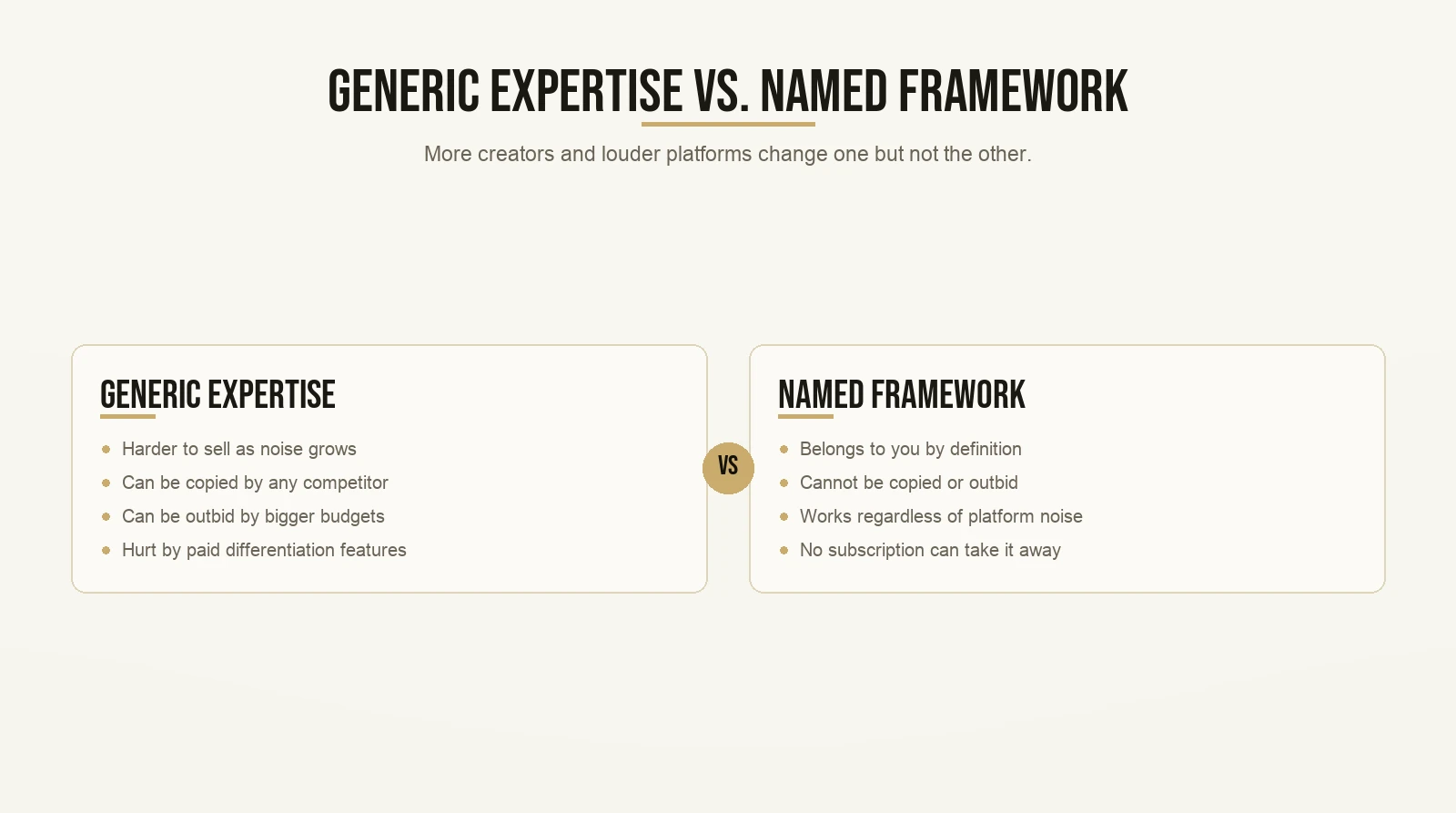
More important. The pool of creators competing in every niche keeps growing. When everyone is posting and offering coaching, generic expertise is the hardest thing to sell. A named framework is the one thing about your positioning that more creators and louder platforms cannot copy or outbid. It belongs to you by definition.
DataReportal’s 2026 report shows 5.66 billion social media user identities globally, up 259 million in one year. That is 259 million new accounts added in one year, many of them competing for the same niches. More noise means generic expertise is harder to sell.
Pew Research found in late 2025 that 50% of U.S. adults use Instagram. For adults 18 to 29, that number hits 80%. The audience is real and it is on the platform. So is every other coach targeting that same audience.
In September 2026, Meta launched Meta One, a paid subscription for creators and businesses. The explicit pitch is to help creators “establish your presence and turn attention into action.” Meta is now formally pricing the business-building layer of Instagram and Facebook. Differentiation is becoming a paid feature.
A named framework is how you get that differentiation without paying for it. You build something that no one else has. No subscription changes that.
One thing most coaches get wrong when they name their system
The name has to be clear, not clever.
Coaches sometimes name their frameworks after themselves, after metaphors that only make sense if you already know the system, or after references that feel meaningful inside the business but mean nothing to a new viewer. Those names serve the coach’s sense of identity. They do not help a new viewer understand what they are about to learn.
The best framework names do two things. They tell you what the system does. And they create curiosity about how it does it.
“The three-step audience clarity method” tells you what it does. “The CCN framework” creates curiosity about what CCN stands for. Both work. The acronym works because it forces the viewer to stay for the definition. They cannot know what the letters mean unless they keep watching. That is the intrigue built directly into the name.
Run your framework name through the CIA framework before you publish it. Clarity: does the name tell a new viewer what this system is about and who it is for? Intrigue: does it make them want to know more? Attention grab: does your video look like something worth stopping for?
If it passes all three, it is ready.
What to do this week
Here is the short version. Write down the result you deliver. Write down the steps. Name the system. Record one video introducing it. Post it.
That is the whole first move.
You can refine it later. You can change the name if it is not landing. You can add a step when clients keep getting stuck in the same place. But you cannot refine something that does not exist yet.
If you are already creating content without building around a named system, you are leaving your most powerful positioning tool unused. The platform is noisy. It is only getting noisier. The coaches who stand out are not the ones with the most posts or the largest followings. They are the ones you cannot compare to anyone else.
A named framework is how you become that coach. Build it, name it, and put it in front of people. Everything else follows from there.
Want the templates behind content that actually gets watched? Grab the templates here and start with the first one today.