
Key Takeaways
- The content you post does most of the qualifying work before you type a single DM. Wrong content strategy means wrong leads in your inbox, no matter how good the script is.
- The CCN framework (Core, Casual, New) determines how warm or cold the leads in your DMs will be. New audience topics pull in people who feel the pain but have never heard of you. Core audience topics bring in superfans only.
- One of the 7 building blocks is the CTA. When you build it right, the CTA inside your content triggers the DM and pre-qualifies the lead before the conversation starts.
- Sends per reach is one of Instagram’s top three ranking signals. Every DM share of your content is also a distribution boost for the next post.
- Voice notes outperform text in high-ticket DM conversations. They signal a human on the other end, not a bot.
Most guides to the instagram dm script to book discovery calls hand you a copy-paste sequence and send you on your way. Scripts break the moment someone says something unexpected. A framework does not. This post teaches you the full system: the content strategy that pre-qualifies your leads before you type a word, and the five-move conversation that takes them from first reply to booked call.
What does an instagram dm script to book discovery calls actually need to do?

A good DM script to book discovery calls has one job: move a warm lead from “I’m interested” to “let’s find out if there is a fit.” It is not a pitch. It is a short conversation that surfaces the real problem, bridges it to what you do, and books a specific time. Four to six messages, not forty.
Most coaches start with the script and skip the setup. That is the problem. The script is the last piece. Let me show you the piece that comes first.
The setup happens in your content, not your DMs
More photos and videos are now shared privately in DMs than are posted publicly to feed and stories combined, according to Instagram’s own data. That is not just a platform stat. That is the entire architecture of how trust gets built before a conversation starts.
Every post you publish is a filter. The people who watch to the end, save it, and respond to your CTA have already raised their hand. They told you they care about this problem. By the time you send the first DM, most of the qualifying work is done.
This is why you cannot script your way out of a bad content strategy. If your content is pulling in the wrong audience, no DM framework in the world fixes it.
Let me show you the framework that controls who ends up in your inbox in the first place.
What is the CCN framework and how does it control the quality of your DM leads?

CCN stands for Core, Casual, and New audience. These are three layers of people your content can reach. Core audience content only resonates with people who already know you well. New audience content resonates with people who have never heard of you but feel the same frustration. Who you target with your content determines who shows up in your DMs asking about working together.
Here is how it plays out in the social growth niche. A core audience topic might be something like “how I warm up DM leads using a three-step voice note framework.” Only your most loyal followers care about that one. A new audience topic is “why you’re posting every day and still not growing.” That lands for millions of people who have never seen your account before.
Hold on, Max. Doesn’t that mean I should only make new audience content?
Not quite. You need all three layers. But if you want to fill your DMs with fresh discovery call candidates consistently, you want content that sits in the casual to new audience range. Wide enough to pull in people who do not know you yet. Specific enough that the pain they recognize maps directly to what you sell.
When someone DMs you after a new audience video, they have already identified themselves. They feel the pain. They want the fix. You have not even said hello and the qualifying is mostly done. That is freaking powerful.
Every piece I see from agencies and scheduling tools teaching this topic skips this entirely. They treat every DM conversation as an equally cold outreach problem. The CCN framework completely flips that assumption. Your content is pre-qualifying leads before you ever open the inbox.
How the CTA inside your content pre-qualifies the conversation
This is where the 7 building blocks come in. The 7 building blocks are the core elements that make up a video built to go viral and drive action. The one that matters most for booking calls is the CTA. And the way most coaches use it, they are leaving the best part on the table.
The CTA is not just a call to action tacked onto the end of your video. It is the mechanism that filters who enters the DM conversation in the first place. This is super duper key.
Instead of posting a link in the description (which nobody types in manually), you ask people to comment with a specific keyword. They comment. That triggers an automated or manual DM with whatever you promised.
Three CTA modes depending on your goal:
- Build a following: “Follow for more [your topic].”
- Build trust and book calls: “Comment [keyword] and I’ll send you [the resource].”
- Sell direct: “Comment [keyword] for the link.”
For coaches trying to book discovery calls, the second one is the right tool. The lead has to take a specific action to get into your DMs. That action filters out passive scrollers. Only people who actually want what you have will bother to comment.
By the time you get the notification, this person has watched enough of your video to care, seen a CTA describing something they want, and typed a word in the comments. That is a self-qualified lead. Most people building instagram dm scripts to book discovery calls completely skip this step.
Instagram’s 2025 DM update added scheduled messages as a native feature, so you can time follow-up messages inside a sequence without a third-party tool. And Meta launched its own Business Agent for Instagram in June 2026, which handles automated keyword-triggered replies at the platform level. You do not need an outside tool to run this anymore.
Why sends per reach changes how you should think about DMs
Adam Mosseri named sends per reach as one of Instagram’s top three ranking signals in January 2025, alongside watch time and likes per reach.
Sends per reach measures how many people DM’d a piece of content to someone else, divided by how many people saw it. When someone shares your video to a friend, the algorithm reads that as a strong quality signal. The content gets pushed further. More people in your new audience layer see it. More people enter the DM conversation you built.
Here is what most coaches miss entirely: the DM system and the growth engine are the same machine. When you build content that triggers DMs, you are not just filling your inbox. You are also sending a distribution signal back to the algorithm that amplifies the next post.
A post with a high volume of DM shares will consistently outperform a post with a high volume of likes from a reach standpoint. That is not what most people expect. But that is how Instagram weights quality right now.
This is one more reason the CCN framework matters. New audience content gets DM’d more often because it taps into a universal frustration. “Why you’re posting every day and still not growing” gets sent to a friend dealing with the same thing. Core audience content is too specific to pass along. Boom. Two reasons to use CCN, not just one.
The 5-move instagram dm script to book discovery calls
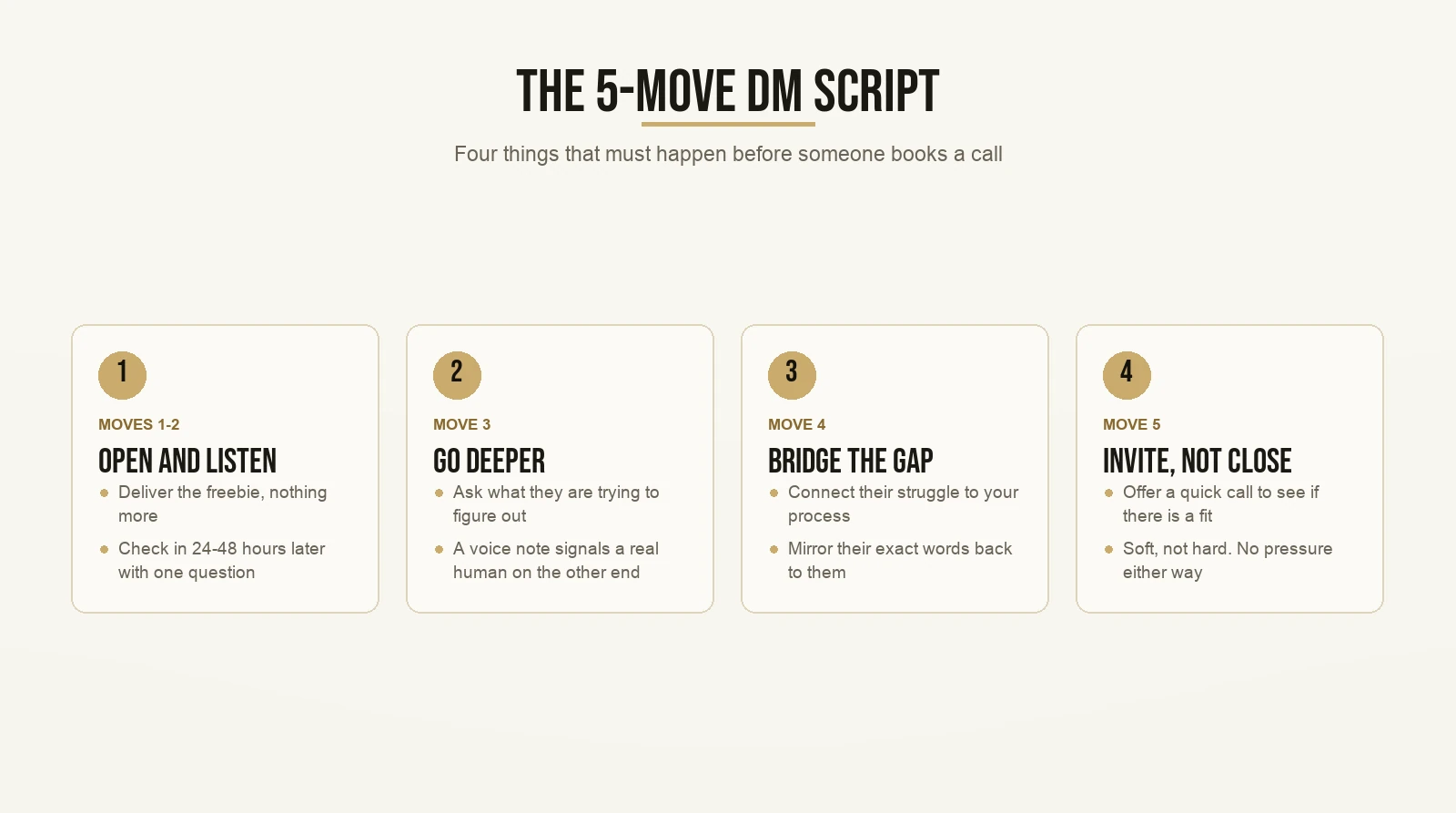
Here are the five moves. These are not five rigid messages to send in a fixed order. The conversation will go in different directions and you need to follow it. But these five things need to happen before someone books.
Move 1: Deliver what you promised.
This can be automated or manual. The lead commented your keyword. Send the freebie, resource, or link you offered. Do exactly that and nothing more.
Brief and human: “Here’s the [resource] you asked for – [link]. Let me know if anything comes up as you go through it.”
No pitch. No long intro. You promised something. You delivered it.
Move 2: The check-in.
Most coaches either skip this move or turn it into a pitch. Both are wrong. Send a genuine check-in 24 to 48 hours after they receive the resource.
“Hey, did you get a chance to look through that? Curious what stood out for you.”
One question. No selling. You are listening.
Move 3: The pain question.
They replied. Now go one level deeper. The goal is to get them talking about the gap between where they are and where they want to be.
“That makes total sense. What is the main thing you are trying to figure out right now with [the topic]?”
This is the best place for a voice note. A 30-second voice note here feels like a real conversation. It is harder to respond to with a single word. And in 2026, with Meta’s AI rolling out automated DMs to every business on the platform, a genuine voice note signals a real human on the other end. That is a competitive advantage now, not just a nice touch.
Hold on. What if they ghost me after I deliver the resource?
It happens. Send one follow-up 24 to 48 hours later. Keep it light: “Just checking you got through it okay.” If they do not reply to that, let it go. Chasing does not convert. It annoys. Move on.
Move 4: The positioning bridge.
Connect what they described to what you do. This is not a pitch. It is a reflection.
“Got it. That is actually the exact problem my process is built to fix. Most [your audience type] I work with are dealing with the same thing – [their words, not yours].”
Mirror the language they used to describe their own struggle. This is very very key. When you repeat their exact words back, it reads as empathy, not as a sales move.
Move 5: The invitation.
Soft, not hard. You are offering a conversation to find out if there is a fit, not closing a sale.
“Would it make sense to hop on a quick call to see if I can actually help? No pressure either way. I just find it’s a lot easier to figure that out in 20 minutes than going back and forth over messages.”
That is the full framework. Five moves. You can reason through any reply with it, not just the ones you prepared for. Scripts break when someone goes off-script. This does not.
What do you do when someone asks about price in the DMs?
It happens, and it happens early. People have learned that DM conversations often lead somewhere, so they screen before committing to a call. When someone asks “how much does it cost,” they are not necessarily ready to buy. They are finding out if you are worth their time. Do not answer with a number. Answer with curiosity.
“Totally fair to ask. It depends on what we would be working on together, and that’s part of what the call is for. What made you reach out in the first place?”
This pulls them back to the problem. The problem is where the conversation should live until you are on the actual call. For a deeper breakdown of the specific replies that keep this from stalling, how to handle price objections in Instagram DMs covers the full objection sequence.
Should you use voice notes in your DM sequence?
Yes, especially for high-ticket conversations. Voice notes outperform text consistently. They are harder to ignore, harder to misread, and nearly impossible to automate convincingly.
The best two moments to use them: Move 3 (the pain question) and Move 4 (the positioning bridge). Both moments need warmth and specific detail. A voice note delivers those in a way a paragraph of text cannot match.
Keep them under 60 seconds. One clear point per note. Lead with context so they know what you are referencing before they hit play.
One thing you need to know about cold DMs on Instagram
If you message someone who does not follow you, the message arrives as a text-only request until they accept it. Voice notes, images, and links are all blocked until the request is accepted. This is a hard platform constraint, not a setting you can work around.
This matters if you are doing any outbound outreach alongside your inbound system. Cold DMs have a structural ceiling that warm inbound DMs do not have.
The five-move framework in this post is built for warm inbound conversations, where the lead already engaged with your content and entered the conversation by their own choice. That difference alone accounts for most of the gap between a low reply rate and a strong one.
Build the content engine first. Let CCN determine who comes to you. The conversation sequence then runs on people who actually want to hear from you.
How does the content you post change the quality of the calls you book?
If you are booking calls that are not converting, the problem is usually upstream. The content is attracting the wrong audience layer. Go back to CCN and check what percentage of your recent posts spoke to people who have never heard of you before.
Core audience content builds depth with existing followers. It does not consistently fill your inbox with fresh discovery call candidates week after week.
You need a steady stream of casual and new audience posts to keep the pipeline active. Then the five-move sequence does the converting. Content attracts, CTA triggers the DM, the conversation books the call. Each part depends on the one before it.
If you want to see how coaches and service providers across different niches have put this together, their results are worth reading. For a deeper look at the content side of the equation, how to make Instagram Reels that convert to sales walks through what makes content actually drive action. And if you are using stories as part of your warm-up sequence, how to write Instagram story scripts for coaches covers how to build the trust that makes the first DM feel like a natural next step.
What does 2026 change about this framework?
Two things.
First, Meta’s AI Business Agent is now rolling out on Instagram DMs, free to every business at the platform level. Automated replies are going mainstream. Recipients will increasingly expect that a DM might be automated, which raises the bar for everything that follows the initial trigger message.
The counter is not better bot copy. The counter is being more human in ways automation cannot fake. Voice notes. References to the exact thing they said in their comment. Questions that prove you read their reply. These are the moves that separate a real conversation from a well-programmed one.
Second, Instagram’s direction for 2026 is prioritizing raw, real human content. The DM conversation is an extension of that signal. A formulaic copy-paste sequence reads as fake. An adaptive conversation built on a real framework reads as genuine.
This is the irony of having a framework: it makes you more flexible, not less. You know the five moves. You can execute them in whatever order the conversation demands. You are not following lines on a page. You are running a play and adjusting in real time.
Scripts break. Frameworks hold.
The thing most coaches skip entirely
Almost every post teaching the instagram dm script to book discovery calls treats the DM as the starting line. The content strategy, the CCN framework, the CTA building block, the keyword trigger, the warm-up sequence: all invisible.
CCN and the CTA from the 7 building blocks are not extras you add later. They are the engine. Without them, you are sending messages to cold people and wondering why the reply rate is low.
Here is the system from start to finish. Publish content aimed at the new and casual audience layers using CCN. Build a CTA that uses the keyword comment mechanism, one of the 7 building blocks, to trigger the DM and filter for people who actually want what you have. Follow the five moves. Handle the price question with curiosity. Use voice notes at the moments that need warmth.
That is the repeatable process. That is the difference between having a script and having a system.
Want the templates behind content that actually gets watched? Grab the templates here and start with the first one today.