
Key Takeaways
- An instagram story template is a prompt sequence, not a visual design. It is the question you ask and the follow-up you run to move a passive viewer into your DMs.
- Adam Mosseri identified reply-with-a-message as one of the three top signals that determine Stories tray order. The template is what produces that signal.
- Stories live in the Casual tier of the CCN framework. Their job is to convert existing followers into DM conversations, not to attract new ones.
- The credibility bank is the running total of trust you build across your profile. Every well-structured story is a deposit into it.
- The poll sticker gives you two options. The creator sees who voted and what they chose. Results disappear after 24 hours along with the story.
- The questions sticker lets followers send a free-text reply you see privately. You can share responses in a follow-up story without showing who sent them.
- The simplest sequence that works: one problem poll, one teaching follow-up, one DM ask.
What is an Instagram story template, really?
An Instagram story template is a reusable prompt structure that triggers a specific response from your audience. It is not a Canva layout. It is not a font pack. It is the question you ask, the poll you run, and the sequence you use to move a viewer from silent tap to written reply.
That definition matters because every search result on this topic gets it wrong. Type “instagram story template” into any search engine and every result is a visual design platform selling you palettes and layouts. Not one of them answers the question a coach actually needs answered: what do I put in the story that makes someone write back?
This post is about the structure underneath the design. The prompt logic that starts conversations and builds the kind of relationship that turns a follower into a client.
Let’s crack into it.
Why does the Stories tray rank differently from your feed?
Stories are a relationship surface, not a discovery surface. Your feed Reels reach people who have never heard of you. Your Stories deepen the connection with people who already follow you.
More than 500 million people use Instagram Stories every day. But not all of your followers see your story equally. The tray is ranked. Followers you have real back-and-forth with see your story first. Followers who only tap through passively see it later, or miss it entirely.
Mosseri explained the three signals that shape Stories tray order: likelihood to tap in, likelihood to like it, and likelihood to reply with a message. The reply signal is the most powerful relationship indicator on the platform. It tells Instagram these two people are in an actual conversation.
Here is what that means for you in practice. When a follower DMs you after your story, Instagram logs a strong signal. Your next story shows up earlier in their tray. They are more likely to see it. If they reply again, the signal strengthens. You are building a direct line to that person, one story at a time, and the algorithm helps you do it.
Mosseri has also noted that creators who post to Stories consistently see lower unfollow rates than those who do not. That retention compounds. Your warm audience grows month over month, and you have more people to run story sequences with every time you post.
The template is the mechanism that starts the chain. Design the prompt well and the algorithm rewards you for it automatically.
What is the CCN framework and where do Stories fit?

CCN describes three audience tiers: Cold, Casual, and Niche.
Cold is someone who has never heard of you. They find your Reel through Explore or a reshare from someone else. You are a complete stranger. They do not know your name, your method, or your track record.
Casual is someone who follows you. They saw enough of your content to hit follow, but they scroll past most of your posts. They are not buyers yet. They are not actively ignoring you either. They are in the middle, somewhere between stranger and superfan.
Niche is your core audience. These people watch everything, respond to everything, and are either already clients or very close to becoming one.
Here is where most coaches run into trouble. They post Reels built for their Niche audience. Content that assumes the viewer already knows the terminology and the offer. Those Reels stall between 100 and 900 views because Instagram shows them to your warmest followers first, gets a flat engagement signal, and pulls distribution back. The content only resonated with people who already knew you.
But wait, Max. If Reels are supposed to reach Cold audiences, what are Stories even for?
That is exactly the right question, and most coaches never ask it. Stories are the conversion layer. They are not for reaching strangers. They are for taking the Casual follower who hit follow two weeks ago and moving them into your Niche tier.
When someone in your Casual tier taps your story, that is the moment you convert them from a passive follower into an active participant. A well-designed poll asks them to self-identify their problem. A Q&A arc gets them to type something back. A follow-up story responds to what they told you. By the end of the sequence, they have had a conversation with you, and you have not made a single explicit pitch.
That is how the CCN framework maps to Stories. Reels bring Cold audiences in. Stories move Casual followers up the ladder into the Niche tier where real conversations happen.
What does a poll instagram story template actually look like?
Here is the simplest version. Two stories, run back to back.
Story 1: a poll sticker with a problem-naming question.
“Which is the bigger challenge for you right now?”
Option A: I do not have enough leads coming in.
Option B: My leads are not converting to clients.
No graphic needed. No complex text overlay. Just the question and two options.
After 24 hours you see who voted and what they chose. That list of voters is your warm signal. Every one of them just told you exactly what problem they are living with right now.
Story 2, posted the same day or the next morning. Address the result directly.
“Most of you said [Option A or B]. Here is the one thing that shifted it for me: [one sentence mechanism, not a pitch]. If you are in this situation right now, DM me the word LEADS and I will walk you through it.”
Hold up. Isn’t this just a pitch dressed up as a conversation?
No. Because Story 2 contains a real teaching moment. One sentence of actual mechanism. The person who voted already told you they have that problem. You are responding to what they said. The DM ask lands in context, not out of nowhere. It does not feel like an ad. It feels like a follow-up from someone who was paying attention.
That two-story sequence is the most reliable instagram story template I know for producing DM conversations from warm followers without any hard selling.
For a deeper look at how to use poll responses to sort and qualify your leads, see the full guide on using Instagram story polls to qualify coaching leads.
How does the Q&A arc work as a three-story sequence?
The Q&A arc runs over two to three days and uses the questions sticker. A follower types a free-text reply, you see it privately, and you can share their question in your next story without revealing their username or photo.
Day 1: open the floor. “Ask me anything about [your specific topic]. Drop it below.” Questions sticker. Nothing else needed.
Day 2: answer the strongest one or two questions. Show the question bubble. Give a two-to-three-sentence answer. End with: “More questions? Send them through.”
Day 3: pick the question that sounds most like someone who is close to buying. Answer it across two or three story slides in real depth. End the last slide with: “If this is exactly your situation, DM me. Let’s work through it.”
Why does this outperform a single story with a DM ask?
First, the person who submitted a question is already watching your story to see if you answer theirs. That is built-in watch time from someone who is actively interested.
Second, everyone else watching sees you respond to real questions from real followers. Trust builds fast when people see you actually showing up.
Third, by Day 3 when you make the DM ask, there is already a conversation in motion. You are not cold-calling your own followers. You are finishing something that started two days ago.
The arc also feeds your highlights. Save Day 3 to a Q&A highlight and it keeps working indefinitely as a credibility signal for anyone who visits your profile cold for the first time.
See the full breakdown in our guide to turning Instagram story views into discovery calls.
What is the credibility bank and how do Stories feed it?

The credibility bank is the running total of trust a new follower builds up as they move through your content. It is not one post. It is a pattern across multiple touchpoints. By the time someone has consumed enough of it, they say: this person knows exactly what they are talking about. I want to work with them.
The credibility bank has three layers.
Layer 1 is your feed. Every post that teaches a specific mechanism deposits into the bank. Vague advice does nothing. “Post consistently” is not a deposit. “Reels built for a Cold audience stall when the first hundred viewers are all your existing superfans, because the flat engagement signals irrelevance to the algorithm” is a deposit. Specificity is the deposit. That precision is where your authority comes from.
Layer 2 is your highlights. This is the permanent record on your profile. A Cold follower lands on your profile after your Reel reaches them for the first time. Empty highlights or outdated promotional content makes the bank look empty. Three clear highlights, who you are, what your method is, and proof it works for real people, pays out immediately. Max covers his full approach to building profile-level credibility here.
Layer 3 is your stories. Every story either adds to the credibility bank or it does not. A poll that names a real problem your audience is living with right now: deposit. A Q&A answer that shows you understand the nuance of your subject: deposit. A reshared meme with no context: not a deposit.
The rule is simple. Every story either teaches something or starts a conversation. Those are the only two moves that build the credibility bank in real time.
What is the Add Yours sticker and when should coaches use it?
The Add Yours sticker is a public template sticker. You post a prompt and anyone on Instagram can tap it and add their own response in their own story, creating a visible chain that anyone can see and join.
Instagram designed it for broad, participation-friendly prompts where the goal is volume of response. Their own examples include “this or that” comparisons and maps of places you have visited.
For coaches, Add Yours works best as a visibility play. A prompt like “Tell me the one thing you wish you knew before starting your business” can reach audiences beyond your current followers because the chain is public and anyone can participate.
What it does not do: surface buyers. The responses are public and unfiltered. You cannot tell from an Add Yours reply whether someone is a warm lead or just a casual participant. You also cannot have a private follow-up conversation the way you can after a poll vote.
Use Add Yours for brand reach. Use poll and Q&A templates for lead conversations.
One freaking important technical note here. Instagram added four new sticker types in May 2024: Add Yours Music, Frames, Reveal, and Cutouts. None of these expanded the poll sticker. The poll still only supports two answer options. If you want up to four options, that is the quiz sticker, which is a separate tool with a different job.
How do you string together a full instagram story template sequence?
Here is a five-story sequence you can run over two to three days. It moves a Casual follower from first engagement to DM conversation without a forced pitch.
Story 1: Problem poll. Two options. Let them vote and self-identify.
Story 2: Teaching story. One concept across two or three short text slides. No offer. End with a teaser: “There is more to this tomorrow.”
Story 3: Q&A open. “Based on what I just covered, what is your biggest question? Drop it below.” Questions sticker. Nothing else.
Story 4: Answer the strongest question from Story 3. Show the question bubble. Give a real answer. End with: “One more thing I want to cover.”
Story 5: DM invitation. “If you are dealing with [specific problem from Story 1], DM me the word [keyword] and I will send you [specific deliverable, not a pitch].”
That is four touchpoints before the ask. By Story 5, a Casual follower who watched all five has engaged at least twice: they voted on the poll and they either sent a question or watched someone else’s get answered. The DM ask lands with full context behind it.
Boom. That is the sequence.
One practical note. Stories with polls, questions stickers, quizzes, and link stickers cannot be boosted or promoted as ads. Removing those stickers to run a promotion also removes the mechanism. Build this system for organic reach. It compounds over time.
For what happens once someone DMs you, the guide to following up in Instagram DMs without being pushy covers the conversation from that point forward.
Does the quiz sticker do a different job from the poll?
Yes, and the distinction is super duper key.
A poll gives you two options. The respondent does not see the vote breakdown until after they tap. You receive a voter list sorted by answer. It is a problem-sorting tool.
A quiz sticker gives you up to four options and reveals the correct answer immediately after the viewer taps. It is a teaching tool, not a sorting tool.
Use the quiz sticker to correct a misconception your audience holds.
Example: “What matters most when a Reel is shown to a Cold audience for the first time? A) posting time, B) hook quality, C) caption length, D) follower count.” Mark B as correct. Everyone who taps learns something in one second and walks away with a slightly higher opinion of your expertise.
That kind of story builds the credibility bank fast. You are demonstrating that you know your subject in a single tap. But it does not sort leads. It tells you who engaged, not who has the specific problem you solve.
Use polls for sorting. Use quizzes for teaching. They look similar but they do completely different jobs in your story sequence.
What should go in your story highlights?
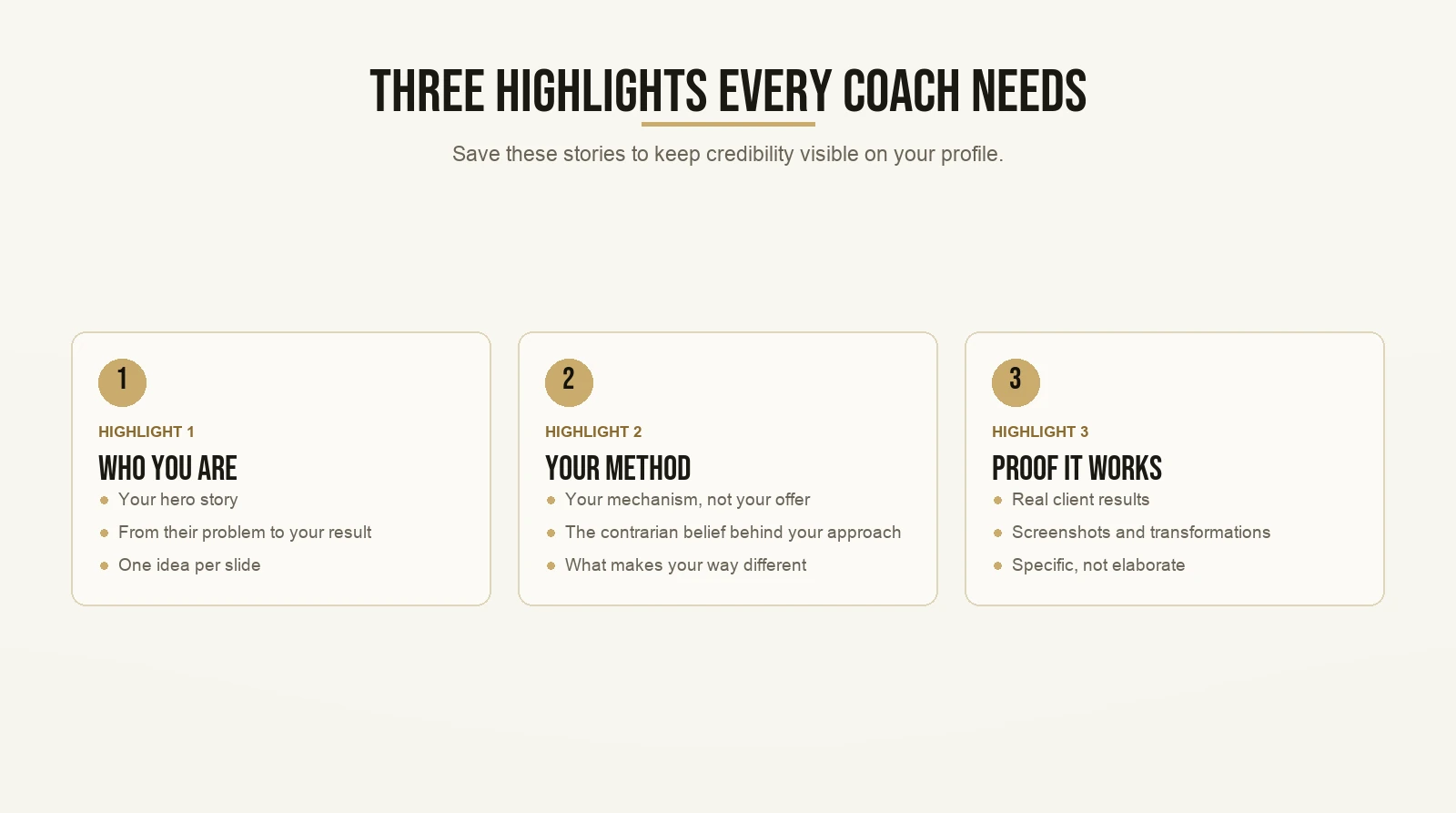
Your highlights are the permanent layer of the credibility bank. When a story’s 24 hours close, saving it to a highlight keeps it visible on your profile indefinitely.
Three highlights every coach should build first.
Who you are. Your hero story. How you went from having the problem your audience is living with right now to having the result they want. Keep every slide short. One idea per sentence.
What your method is. Not your offer. Your mechanism. The specific approach or contrarian belief that makes your way of solving the problem different from the generic advice your audience has already tried and found wanting. This is where you stand out from every other coach in your space.
Proof it works. Results from real clients. Screenshots, transformations, written feedback. The proof does not need to be elaborate. It needs to be real and specific.
When a Cold audience member finds your Reel, follows you, and visits your profile, those three highlights close the gap between “someone I follow” and “someone I am going to message.” That is the credibility bank paying out the moment they tap through them.
The whole system is a loop. Stories feed your highlights. Highlights warm up new Casual followers. Warm followers respond to your story prompts. Responses produce DMs. DMs become calls. You get the gist.
For how to attract those Casual followers in the first place, the full guide on how to find clients on Instagram walks through the entire funnel from content to booked call.
Want the templates behind content that actually gets watched? Grab the templates here and start with the first one today.